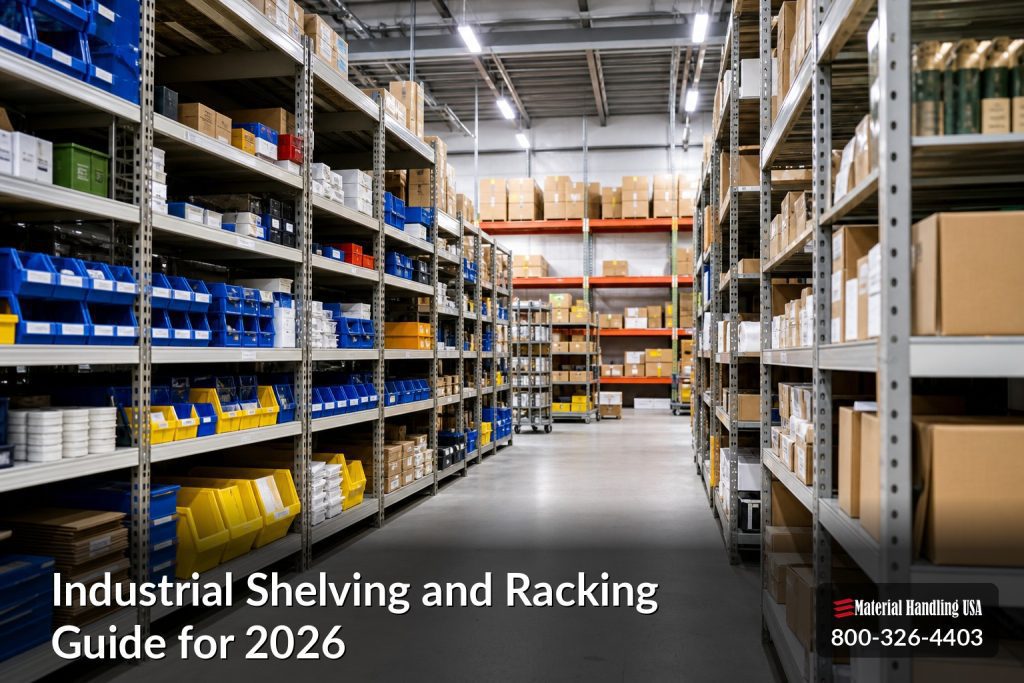
Industrial Shelving and Racking Guide for 2026
Choosing the right storage system is one of the most important decisions you'll make as a warehouse manager or buyer. This isn't just about being tidy; it’s about unlocking your operation's real potential for efficiency, safety, and profit. This guide will walk you through everything you need to know about industrial shelving and racking, from the absolute basics to advanced design strategy.
Your Guide to Warehouse Optimization
Think of your warehouse storage system as the backbone of your entire operation. A smart layout does more than just hold inventory—it smooths out workflows, cuts down on picking errors, and makes the most of every square foot you pay for. The right system turns your storage space from a simple cost center into a strategic asset that drives growth.
But with so many options out there, picking the perfect fit can feel like a monumental task. We designed this guide to cut through the noise. We'll explore how to match your specific inventory to the right system, optimize your floor plan for better flow, and keep your team safe in a compliant environment.
From Cost Center to Strategic Asset
Making a smart, informed decision about your shelving and racking right now saves you from costly planning mistakes down the road. Investing in the right system from the get-go means faster installation and helps you avoid the capacity bottlenecks that plague so many growing businesses. Simply put, companies that plan ahead are ready to handle more demand without dropping the ball.
An optimized warehouse isn't just about storing more products; it's about moving goods faster and safer. A well-designed racking system is your first step toward operational excellence and can have a massive impact on your bottom line by improving labor efficiency and reducing product damage.
Understanding the Market Growth
The demand for efficient storage has exploded, largely thanks to the non-stop growth of e-commerce. The global industrial racking market is expected to jump from US$19.2 billion in 2026 to a staggering US$34.5 billion by 2033. This shows just how focused companies are on maximizing every inch of space to keep their supply chains moving.
Planning for this growth is no longer optional. As you think about your facility's future, ask yourself if your current storage system is helping or hurting your goals. A deeper dive into overall warehouse optimization can give you a broader view of how to build a more efficient facility from the ground up.
Quick Guide to Industrial Storage Systems
To get started, this table gives you a high-level look at the most common storage systems. It's a great way to quickly start identifying which type might be the best match for your operation.
| System Type | Primary Use Case | Density | Accessibility |
|---|---|---|---|
| Selective Racking | General purpose, direct access to all pallets | Low | High |
| Drive-In/Drive-Thru | High-volume, uniform products (LIFO/FIFO) | High | Low |
| Pallet Flow Racking | Date-sensitive inventory, high-turnover (FIFO) | Very High | High |
| Push-Back Racking | Medium-turnover products (LIFO) | Medium-High | Medium |
| Cantilever Racking | Long, bulky, or awkward items (lumber, pipe) | Varies | High |
| Industrial Shelving | Hand-picked items, boxes, and parts | Varies | High |
By understanding these core differences, you can start to zero in on the systems that truly align with your inventory and workflow. When you're ready to start designing the ideal storage solution, Request a Quote from our experts for a free, no-obligation layout.
Finding the Right Pallet Racking System
Think of your pallet racking as the skeleton of your warehouse. Getting it right is just as critical as pouring a solid foundation for a new building—it’s the key to a safe, efficient, and profitable operation. This guide will walk you through the most common pallet racking systems, helping you match the right solution to your specific inventory, workflow, and facility.
Choosing the right industrial shelving and racking is a serious investment, and the market shows just how critical it is. Warehouse racking is a booming industry, with a projected growth of USD 2.3 billion between 2026 and 2031. It’s no surprise when you consider that 70% of warehouses worldwide already use racking to slash wasted space and speed up inventory access—a trend that the e-commerce explosion has put into overdrive.
This decision tree gives you a quick visual guide to see which storage system might be the best fit based on your inventory, space, and how often you need to grab your products.

As you can see, the perfect system is all about balancing how much you store, how fast you need it, and the physical space you're working with.
Selective Racking: The All-Rounder
Selective pallet racking is the most common setup for a good reason. It’s simple, affordable, and gives you 100% accessibility to every single pallet. Think of it like a library bookshelf for your warehouse; every item has its own dedicated slot and can be picked without touching anything else.
- Best For: Operations with a huge variety of SKUs, low pallet counts for each SKU, and the need for immediate, direct access to every product.
- Pros: Low upfront cost, simple installation, and total flexibility.
- Cons: It's the least dense option. You sacrifice floor space because every row of racking needs its own aisle.
If your inventory is diverse and you aren’t storing deep quantities of the same item, Selective Racking is almost always the best place to start.
High-Density Storage Solutions
When squeezing every last inch of storage out of your square footage is the goal, high-density systems are what you need. These systems trade a bit of direct access for a massive boost in storage capacity.
Drive-In Racking
This system lets your forklifts drive right into the rack structure to drop off or pick up pallets. It’s a Last-In, First-Out (LIFO) system, which works like stacking plates in a kitchen cabinet—you have to take the front one to get to the ones behind it.
Drive-In racking is a game-changer for storing huge quantities of the same product, especially if it isn't date-sensitive. It's a favorite in cold storage facilities and for bulk goods where space costs a premium.
Pallet Flow Racking
On the flip side, Pallet Flow is a First-In, First-Out (FIFO) system. Pallets are loaded from a rear aisle and glide forward on inclined rollers to a separate picking aisle. It’s like a vending machine for your pallets, automatically rotating your stock so the oldest products are always picked first. This is absolutely critical for food and beverage, pharmaceuticals, and any other perishable goods.
Push-Back Racking
Push-Back racking is a fantastic middle ground between density and selectivity. Pallets sit on nested carts that you push back along inclined rails when loading a new pallet. It works on a LIFO basis but still gives you access to a different SKU on each level of the rack, which is a big advantage over Drive-In.
For a deeper dive into these systems, check out our comprehensive guide to selecting pallet rack.
Cantilever Racking: For Awkward Loads
So, what do you do with items that won’t fit on a standard pallet? For long, bulky, or oddly-shaped materials like lumber, steel pipes, furniture, or rolls of carpet, Cantilever Racking is the only way to go. It has a heavy-duty central column with arms that stick out, creating an open-front shelf that can handle long loads of practically any size.
Picking the right system can feel overwhelming, but a smart decision now will save you from major headaches and costly fixes down the road. You don’t have to figure it out alone. Contact Us or call 800-326-4403 for a free, no-obligation layout and design from our team of experts.
Choosing the Best Industrial Shelving
While pallet racking is the heavyweight champion for handling full pallets, industrial shelving is the workhorse that organizes everything else. It’s the backbone for your parts bins, cardboard boxes, and all the non-palletized inventory that gets picked by hand. Making the right choice here is critical—it directly impacts your picking efficiency, inventory accuracy, and the overall safety of your facility.
The pressure to get this right has never been greater. With e-commerce continuing to boom, warehouses are scrambling to handle a flood of smaller, more frequent orders. Retail operations, from massive hypermarkets to local supermarkets, now lean heavily on effective industrial shelving and racking to keep their pick-and-pack lines moving. This isn’t just a trend; it's a fundamental shift in logistics, as detailed in recent industry growth insights.
Let's break down the world of industrial shelving to find the perfect fit for your hand-stack and bin storage operations.

Steel Shelving for General Purpose Use
When you picture classic, no-nonsense shelving, you're thinking of steel shelving. This is the go-to solution for warehouses, stockrooms, and maintenance departments across the country. It’s incredibly durable, reliable, and comes in two main flavors.
- Open Steel Shelving: Gives you visibility and access from all sides. Perfect for items you need to grab quickly without any obstruction.
- Closed Steel Shelving: Built with back and side panels, it’s ideal for containing smaller components and preventing products from falling off the back or sides.
Thanks to its impressive weight capacities, steel shelving is a rock-solid choice for storing heavy machine parts, tools, and archived business records. If you need a robust, all-around storage system that’s ready to work, our steel shelving options are in stock and ready to ship. You can Shop Now to find the exact size and configuration for your space.
Rivet Shelving: The User-Friendly Option
Rivet shelving, also known as boltless shelving, has become famous for two things: its surprising strength and its dead-simple assembly. Forget fumbling with nuts and bolts; the components cleverly lock together with just a rubber mallet. This makes initial setup and future adjustments incredibly fast.
Rivet shelving hits the sweet spot between affordability, strength, and ease of use. It’s an excellent choice for light to medium-duty applications where you might need to reconfigure your layout as your needs change.
Don’t let the simple design fool you. These units can easily hold hundreds of pounds per shelf, making them a fantastic fit for e-commerce fulfillment centers, busy retail stockrooms, and any general-purpose storage area where flexibility is a must.
Wire Shelving for Visibility and Airflow
In some environments, cleanliness and visibility are not just nice to have—they are required. That’s where wire shelving really shines. The open-wire design prevents dust buildup, promotes air circulation, and dramatically improves visibility for fast and accurate inventory counts.
This superior airflow makes wire shelving a staple in food service, healthcare, and electronics cleanrooms. More importantly, it allows water from overhead sprinkler systems to pass through to lower levels, a feature often required to comply with local fire codes. We stock a huge range of wire shelving units built for these specialized environments. Buy Online today for the fastest shipping in the industry.
Mobile Aisle Shelving for Maximum Density
What if you could double your storage capacity without a costly building expansion? That's the promise of mobile aisle shelving. This clever system puts standard shelving units on wheeled carriages that glide along floor tracks. The units compact together, eliminating every aisle but one that "floats" to wherever you need access.
This is the ultimate high-density solution for storing archived records, evidence, or slow-moving parts in places where every square foot counts. While the initial investment is higher, the ROI from reclaiming huge amounts of valuable floor space can be massive.
To find the ideal shelving solution for your unique operation, our team provides free, no-obligation layouts. Request a Quote or give us a call at 800-326-4403 to get started.
Designing Your System for Peak Performance
Anyone can buy racking. The real challenge—and where most operations either succeed or fail—is in the design. A well-designed system is far more than just steel bolted together; it's a high-performance logistics machine that powers your entire workflow. Getting this blueprint right from day one is what separates a smooth, efficient warehouse from one constantly battling bottlenecks and safety hazards.
Taking the time to plan your industrial shelving and racking upfront helps you avoid the costly mistake of investing in a system that doesn’t fit your space, your product, or your equipment. We’ve seen it happen: facilities that rush the design phase often hit an operational wall far sooner than they ever expected.

Demystifying Load Capacity
Understanding load capacity is one of the most critical parts of rack design, and it’s where we see the most dangerous misconceptions. It’s not just about what a single beam can hold. True capacity is a complex system of forces that runs from your concrete floor all the way to the top-most shelf.
A common mistake is to focus only on the stated capacity of the horizontal beams. But the vertical upright frames and, crucially, the spacing between beam levels are just as important.
An upright frame's capacity decreases as the vertical space between beam levels increases. Placing beams too far apart can dangerously compromise the entire system’s integrity, even if the individual beams themselves are not overloaded.
Our team provides free quotes and design consultations to ensure every single component works in harmony, guaranteeing a system that is both robust and, above all, safe.
Optimizing Your Warehouse Space
Maximizing your facility’s footprint is a puzzle with a few key pieces. The goal is not just to cram in as much product as possible; it is to strike the perfect balance between high-density storage and operational efficiency.
Here are the main factors you need to nail down:
- Aisle Width: This is dictated entirely by your forklifts. A standard counterbalance lift might require wide 12-foot aisles. Swap that for a narrow aisle or turret truck, and you can shrink those aisles down to just 6 feet, dramatically increasing your storage density.
- Vertical Height: Going vertical is the single most cost-effective way to add capacity. You will need to account for your building's clear ceiling height, local fire codes for sprinkler clearance, and the maximum lift height of your forklifts.
- Building Columns: Those immovable support columns can be a major headache. A smart layout works with the columns, not against them, minimizing wasted space and preventing awkward or unsafe travel paths for your team.
Getting these factors right means you’re not just storing inventory—you’re creating an efficient flow for every person and product that moves through your facility.
The Forklift and Racking Relationship
Think of your material handling equipment and your racking system as two sides of the same coin. You cannot choose one without thinking about the other. Designing a racking layout in a vacuum, without considering the forklifts that will service it, is a recipe for disaster.
For example, a high-density Drive-In racking system requires specific types of forklifts that can safely operate inside the rack structure itself. A Very Narrow Aisle (VNA) system, by definition, demands specialized turret trucks. Buying the wrong rack for your existing fleet—or the wrong forklift for your new layout—is an incredibly expensive and disruptive error to fix.
This is where expert guidance is priceless. We can design a system that works seamlessly with your current equipment or help you select the ideal combination of forklifts and racking to meet your operational goals. Do not leave this critical relationship to chance. Contact Us or call 800-326-4403 today for a free, no-obligation layout that ensures your system is designed for peak performance from day one.
Building a Culture of Warehouse Safety
In a busy warehouse, safety is not just a manual you hand out or a poster you hang on the wall. It’s a culture. That culture lives and dies by the integrity of your industrial shelving and racking. Getting your storage system right is not just about dodging fines—it is about protecting your people, your product, and your business's reputation.
A truly safe system starts long before the first pallet is loaded. It begins with a professional design and a by-the-book installation, the two fundamentals that prevent catastrophic failure. From there, it’s all about constant vigilance.
The Cornerstones of Racking Safety and Compliance
A safe racking environment really boils down to three things: proper installation, clear labeling, and consistent inspections. If you drop the ball on even one of these, you’re introducing a serious, often hidden, risk into your daily operations.
OSHA is clear on the importance of installing racking exactly to the manufacturer's specs. This is not just a recommendation; it is the only way to ensure the system performs as promised. A single bolt torqued incorrectly or an upright that is slightly out of plumb can compromise an entire bay, creating a time bomb that might only go off under a full load.
A racking system's stated load capacity is only valid when it is assembled and installed exactly as the manufacturer intended. Any shortcut or deviation, no matter how small it seems, voids that capacity and invites disaster.
A Practical Checklist for Daily Walk-Throughs
Regular inspections are your first line of defense against accidents. When you empower your team to spot potential problems, every employee becomes a safety watchdog. Here’s a simple checklist anyone can use for a quick visual inspection:
- Look for Damage: Scan for dents, twists, or scrapes on uprights, braces, and beams—the tell-tale signs of forklift impacts.
- Check Beam Connections: Are all safety clips in place? Beams must be fully seated and locked into the uprights.
- Spot Overloading: Visibly bowing or sagging beams are a major red flag. This is the most obvious sign that load capacity has been breached.
- Confirm Plumbness: Eyeball the rack uprights. They should be perfectly vertical, not leaning forward, backward, or to the side.
- Inspect Floor Anchors: Make sure all base plates are securely anchored to the concrete. The anchors should not be loose, damaged, or sheared.
Beyond the rack itself, clear visual cues on the floor are critical. Implementing effective warehouse floor marking guidelines dramatically improves traffic flow and reduces collisions.
Investing in simple safety accessories like column protectors and end-of-aisle guards can practically eliminate most forklift damage. These are an incredibly small price to pay to prevent costly repairs and dangerous collapses. If you spot damage or have any doubts about your system's integrity, do not guess. Call 800-326-4403 to talk to a safety expert immediately.
Conclusion: Turn Your Storage into a Strategic Asset
Choosing the right industrial shelving and racking is a strategic decision that directly impacts your warehouse's efficiency, safety, and profitability. By matching your storage system to your specific inventory and workflow—whether it's high-access selective racking, high-density drive-in systems, or versatile industrial shelving—you transform your storage space from a cost center into a powerful operational advantage.
Proper design, professional installation, and a culture of consistent safety inspections are the keys to unlocking the full potential of your investment. A well-planned system not only maximizes your storage capacity but also enhances labor productivity, reduces product damage, and ensures a safer environment for your team.
Facilities that plan their storage systems now are better prepared to handle future growth and avoid the operational delays that affect less prepared businesses. The lead time for design and installation means that a decision today prepares your warehouse for success months down the road.
Don’t leave this critical decision to chance. Our experts are ready to help you design a high-performance system tailored to your exact needs. Contact Us, call 800-326-4403, or Request a Quote for a free, no-obligation layout and discover how a smarter storage solution can benefit your bottom line.
Frequently Asked Questions
What is the difference between shelving and racking?
This is easily the most common question we get. The simplest way to think about it is this: racking is for pallets, and shelving is for parts.
Industrial racking is the heavy-hitter. It’s engineered from the ground up to hold fully loaded pallets, which are moved around with a forklift or other machinery. On the other hand, industrial shelving is designed for lighter-duty, non-palletized inventory. Think bins of small parts, cartons, or individual items that are picked by hand. Because of this, racking systems are built to handle dramatically higher weight loads than any shelving unit.
How do I calculate the load capacity I need?
Figuring out the right load capacity is a critical safety calculation, and it is about more than just the horizontal beams. First, you need to know the absolute maximum weight of your heaviest pallet. Multiply that number by how many pallets you plan on putting side-by-side on a single shelf level. That gives you the required beam capacity.
But that is only half the equation. The upright frames that support those beams have their own capacity limits, which change depending on how far apart you space your beams vertically. The more space between levels, the less weight the frame can safely support.
For an accurate and safe calculation, we always recommend consulting with a storage system expert. Mistakes in capacity planning can lead to catastrophic system failure.
How often should I inspect my racking?
For a safe warehouse, regular inspections are non-negotiable. Your forklift operators are on the front lines, so they should be doing a quick visual check every day to spot any obvious dents, dings, or misaligned components. Beyond that, a more formal, in-depth inspection should be done by a trained internal person on a weekly or monthly basis, depending on how much traffic your aisles see.
At the absolute minimum, OSHA guidelines point to a thorough annual inspection conducted by a qualified professional from outside your organization. Any damage found—no matter how small it seems—needs to be reported immediately, the area roped off, and repairs scheduled without delay.
Need Help With Your Project?
Our team provides free layout designs, competitive pricing, and professional installation across the United States.
Request a Free Quote → | Call (801) 328-8788
Who This Is For
Our industrial shelving and racking solutions are ideal for:
- Warehouse managers
- Facility planners
- Property managers
- Government coordinators
- Manufacturing managers
- Distribution operators