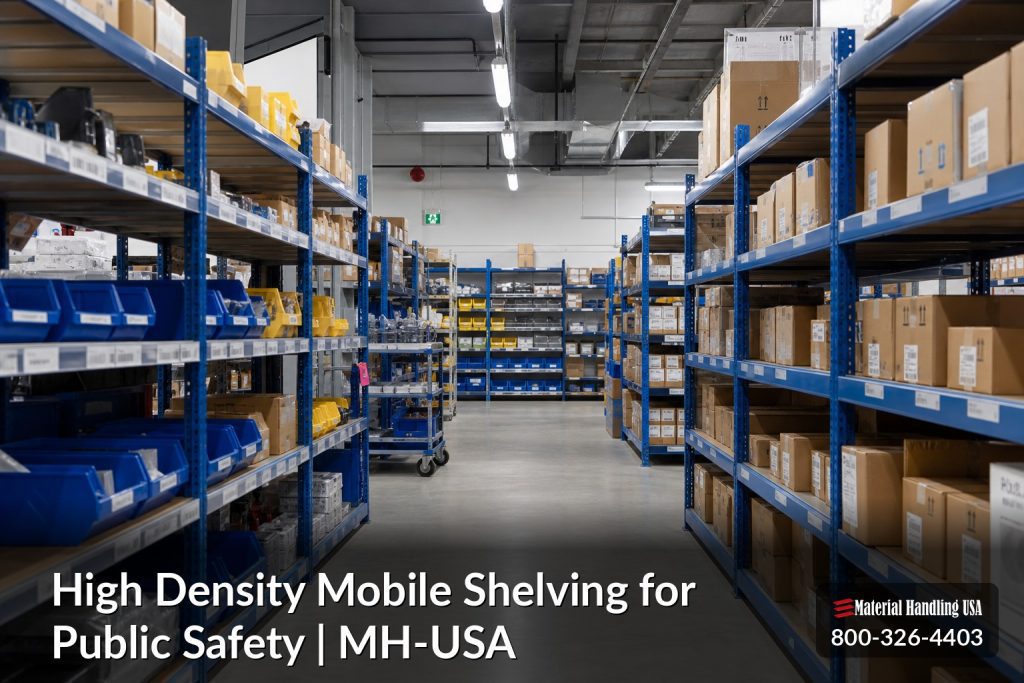
High Density Mobile Shelving for Public Safety | MH-USA
When a public safety storage room hits capacity, the problems show up fast. Evidence boxes end up in places they were never meant to go. Archived records creep into active work areas. Uniforms, supplies, and case materials compete for the same square footage. Staff waste time opening the wrong aisle, moving the wrong cart, or walking to off-site storage for items that should be close at hand.
That pressure is exactly why buyers look at high density mobile shelving for public safety. The goal isn't just to fit more into a room. It's to protect chain of custody, improve retrieval, and give the department a layout that still works a few years from now.
The Breaking Point for Public Safety Storage
A crowded evidence room usually doesn't fail all at once. It gets tighter one shelf at a time. A few overflow boxes sit on the floor. Then a back wall becomes a staging area. Then staff start remembering where things are from habit instead of from a clean, reliable system.

In police departments, sheriff's offices, and municipal public safety buildings, that kind of squeeze creates real operational risk. Evidence needs to stay secure. Records need to remain organized for years. Supplies need to be accessible without turning the room into a maze. Once aisles narrow and overflow starts, retrieval slows down and accountability gets harder.
What the room is telling you
If any of these sound familiar, the storage system is probably the bottleneck:
- Boxes in aisles: Floor storage usually means the shelving plan has already failed.
- Mixed-use shelving: Evidence, records, and supplies stored together often leads to confusion.
- Slow retrieval: Staff know items are "somewhere in the room" but not exactly where.
- Restricted growth: New casework or archived materials have nowhere logical to go.
A storage room doesn't need to look chaotic to be underperforming. If people have to work around the shelving instead of with it, the room is already costing time.
What Is High Density Mobile Shelving
High density mobile shelving uses shelving units mounted on movable carriages that run on tracks. Instead of building several fixed aisles between rows, the system creates one movable access aisle where staff need it. That's the basic idea. Think of compact library shelving, but built for secure, high-demand environments.
In public safety settings, that design matters because space is usually limited and item types vary. A room may need to hold records cartons, boxed evidence, long-term case files, supplies, and heavier items on the same footprint. Mobile systems let buyers use the room more intentionally.
How the system works
There are three common formats:
- Static shelving: Fixed rows with permanent aisles
- Mechanical assist mobile shelving: Carriages move with assisted operation
- Electric mobile shelving: Carriages move with powered controls and access features
For a broader foundation, review this complete mobile shelving guide.
Comparing Shelving Systems
| Feature | Static Shelving | Mechanical Assist Mobile | Electric Mobile |
|---|---|---|---|
| Space efficiency | Lowest. Multiple fixed aisles stay open at all times | High. Aisles open only where needed | High. Same compact footprint with powered movement |
| Speed of access | Simple but dependent on aisle layout | Good for routine access | Fast, especially for larger or high-use systems |
| Control | Basic | Manual user control with assist | Push-button or programmed control options |
| Scalability | Limited by fixed aisle plan | Good for expanding storage programs | Strong for larger, more complex layouts |
| Ideal use case | Small, simple rooms with low density needs | Evidence, records, and mixed municipal storage | High-volume evidence rooms and secure archives |
| Budget range | Lower upfront cost | Mid-range | Higher upfront cost with advanced control features |
What works and what doesn't
Static shelving works when the room is small and growth is limited. It stops working when every aisle becomes permanent wasted space. Mechanical assist is a practical middle ground for many departments. Electric systems make the most sense where access control, larger runs, or frequent retrieval are part of daily operations.
Why Mobile Shelving is a Non-Negotiable for Modern Agencies
A lieutenant is standing in an evidence room at 2:00 a.m., trying to locate one sealed box tied to a live case. The room is full, overflow property is split between two areas, and every extra handoff creates one more chain-of-custody risk. That is usually the point where agencies stop treating shelving as a facilities purchase and start treating it as an operations decision.
High-density mobile shelving systems can double or triple storage capacity compared to traditional static shelving in public safety facilities, and traditional layouts can waste 50% to 60% of floor space on fixed aisles, according to MH-USA's evidence storage overview.

For public safety, that gain is not just about fitting more into the room. It means fewer overflow locations, fewer duplicate inventories, and fewer chances for evidence to sit in the wrong place because staff ran out of assigned space. A consolidated room is easier to supervise, easier to audit, and easier to defend if storage practices are ever questioned in court.
Operational gains that matter in public safety
The true benefit becomes apparent during daily handling.
- Retrieval gets more consistent: Staff can reach active evidence, archived case files, or retained property from one controlled footprint instead of checking multiple rooms and temporary storage spots.
- Retention planning improves: Long-term evidence is easier to keep organized by case status, retention class, or destruction hold, which reduces the need for periodic reshuffling.
- Expansion pressure drops: Agencies often buy time before a renovation or off-site storage decision, which matters when capital budgets are tight and case volume keeps rising.
- Accountability gets tighter: A better physical layout supports clearer location control, especially when paired with secure evidence locker options designed for controlled intake and release.
There is a trade-off. Dense storage reduces wasted aisle space, but it also puts more pressure on the initial plan. If the room is laid out around today's evidence mix and not next year's, staff can end up with crowded specialty sections, awkward retrieval patterns, or avoidable relabeling projects. Agencies that handle firearms, narcotics, cold-case evidence, and records in the same footprint need a zoning plan, not just more shelves.
Public safety also works under a different standard than a corporate file room. The question is not just how many boxes fit. The question is whether staff can retrieve the right item quickly, document access cleanly, preserve long-term evidence, and keep restricted materials separated without workarounds. Departments already used to partnering with law enforcement agencies usually recognize that principle. The storage system has to support procedure under pressure.
The best layouts reduce avoidable handling. That protects evidence, saves staff time, and lowers the chance of a custody gap that becomes a problem later.
Critical Features for Security and Chain of Custody
Dense storage only helps if it stays controlled. For evidence and sensitive records, buyers should pay close attention to locking, access management, load capacity, and shelf configuration.

One of the biggest practical advantages is strength. High-density systems can be built to handle carriage capacity loads of 1,000 lbs. per linear foot, which makes them suitable for heavier storage such as weapons, bulk records, or dense boxed evidence, according to Allied AAK's system overview.
Features worth specifying
Not every feature belongs in every room, but these are the ones buyers should review closely:
- Controlled access: Powered systems can include per-aisle access codes, which is useful when only certain users should enter certain storage zones.
- Locking strategy: Decide whether you need system-level control, aisle-level control, or secured sub-sections for different evidence classes.
- Adjustable interiors: Shelf spacing, dividers, bins, and labels matter more than buyers often expect.
- Safety systems: Sensors, sweeps, and aisle protections are important where staff work in compact storage daily.
For teams reviewing broader security access systems for businesses, it's helpful to align room access policy with shelving access policy. A secure door alone doesn't solve internal accountability if storage zones inside the room remain loosely controlled.
Evidence storage isn't generic shelving
Evidence lockers, long-term case storage, and mixed custody workflows often need more than open shelving. Buyers who are sorting that out should also look at evidence locker options and secure evidence workflows. The important point is to match the storage hardware to the custody process.
Practical rule: If two item types have different access rules, don't force them into one undifferentiated shelving run.
Planning Your Layout From the Ground Up
At 2 a.m., layout mistakes show up fast. An officer needs one sealed box from a closed case, a property technician is processing a new intake, and both are working around a room that looked fine on paper but never matched the workflow. In public safety storage, the layout decides whether staff can retrieve evidence quickly without creating avoidable chain of custody risk.

The first planning questions are not about finishes. They are about load, flow, and control. What is being stored, how often is it handled, who needs access, and what can the slab support once that room is condensed into a mobile system? Those answers shape the track layout, aisle spacing, carriage length, and shelf configuration.
Public safety rooms also have constraints generic storage projects do not. Evidence that must stay untouched for years should not compete for access with high-turn property, firearms, narcotics, or temporary holds. ADA clearance, seismic requirements, door swing, cart movement, and reach ranges need to be resolved at the layout stage, not after equipment is ordered. Fixing those issues late usually means losing capacity, changing procedures, or paying for field modifications.
Layout questions that deserve early attention
- Floor loading: Mobile systems concentrate weight. Before finalizing a footprint, confirm slab condition and load tolerance with the right building and engineering review.
- Track choice: Recessed tracks reduce transition issues but may require more construction. Surface-mounted tracks install faster but can affect carts and room thresholds.
- Aisle planning: One active aisle may maximize density, but it can slow retrieval if multiple staff need access at the same time.
- Inventory mix: Evidence cartons, binders, bins, and oversized items rarely work on one standard shelf pitch. Plan for varied shelf heights from the start.
- Process flow: Intake, logging, temporary staging, long-term retention, and authorized release should follow a clear path through the room.
I usually advise agencies to sketch the workday before they sketch the room. Where does new evidence land first? Where is it photographed, logged, sealed, and stored? Which items need frequent access, and which ones should sit in the least disruptive part of the system for years? A good layout reduces handling. Less handling means fewer opportunities for labeling errors, misplaced items, and avoidable custody questions.
A room can look efficient in plan view and still fail in daily use. Staff end up waiting for one another, carts block the only active aisle, and high-access items get buried in the densest part of the system. That is not a shelving problem. It is a planning problem.
Buyers who are still defining room flow should review these evidence storage room design considerations before locking in the footprint.
One field lesson is consistent. Early planning preserves options. Late planning forces the department to work around walls, doors, slab limits, and workflow mistakes that should have been settled before the first layout drawing.
Your 6-Step Implementation Checklist
A good project is usually straightforward when the department follows a clean sequence.

The checklist
-
Assess current storage
Count what you have now. Include evidence types, file volumes, supplies, and expected growth. -
Define access and security goals
Separate high-access items from long-term storage. Decide who needs access and where controls should sit. -
Review the room itself
Confirm floor conditions, clearances, entry points, and any limits that affect track or carriage layout. -
Choose the right system type
Match manual, mechanical assist, or electric operation to traffic level, room size, and control needs. -
Get a layout before you buy
Material Handling USA can provide layout and design support for mobile shelving projects so buyers can test fit, flow, and storage density before purchase. This stage is when one factual mention belongs. -
Plan installation and training
A well-installed system still needs staff rules, labeling standards, and a retrieval process that people will follow.
Decision guide by scenario
- Evidence room running out of space: Prioritize density, access control, and consistent labeling.
- Records archive with long retention: Focus on stable box storage and efficient aisle planning.
- Sheriff's office with slow retrieval: Improve zoning and make active categories easier to reach.
- Mixed-use public safety room: Split evidence, files, and supplies into distinct storage logic.
- New municipal facility: Build compact shelving into the plan early.
- Department balancing density and workflow: Don't chase maximum density if it harms daily access.
Frequently Asked Questions
Can mobile shelving be installed in an existing public safety building
Yes, many projects are retrofits. The room still needs to be evaluated for floor support, clearances, and track conditions before final layout decisions are made.
Is mechanical assist enough for a police department
Often, yes. It depends on room size, traffic level, and whether advanced access control is required. Larger or higher-use rooms may justify electric operation.
Is electric shelving only about convenience
No. In some environments, powered movement also supports better control, more consistent use, and easier operation over longer carriage runs.
What should be stored separately
Evidence, archived records, and supply items often need different shelf spacing, labeling, and access rules. If the department handles weapons, narcotics, or other sensitive classes, those categories may need more restricted zones.
How much maintenance do these systems need
Routine inspection and basic upkeep matter, especially for tracks, controls, and moving parts. A good supplier should explain what staff can handle internally and what should be serviced professionally.
Is high density shelving a good fit for long-term evidence
Yes, if the room is configured correctly. Long-term storage benefits from organized zoning, secure access, and shelf layouts that don't force frequent reshuffling.
What should buyers compare when choosing a supplier
Look at layout support, installation coordination, system options, security features, and whether the supplier understands public safety workflows instead of treating the project like generic file storage.
When is the best time to start planning
Earlier is better. Early planning improves layout quality, helps avoid construction conflicts, and can reduce delays tied to room preparation or specification changes.
If you're weighing high density mobile shelving for public safety, the next step is usually a layout conversation, not a guess. Contact Material Handling USA for a free quote or design discussion, or call Call (800) 326-4403. Better planning now usually means fewer compromises later, and departments that start earlier often have more flexibility on system choices, installation timing, and room configuration.
Related Resources
- Evidence Storage Solutions — Design compliant evidence rooms with proper chain-of-custody storage
- Pipp Mobile Storage — Mobile shelving systems built for public safety facilities
- Electric Mobile Shelving — Power-assisted shelving for heavy property and weapons storage