Tire Storage Carousel for Dealerships: A Buyer’s Guide
Back rooms rarely fail all at once. They get crowded one tire stack at a time.
A dealership starts a seasonal storage program. A few rows of static racks seem fine. Then peak swap season hits, technicians wait on tire retrieval, parts staff squeeze around loose stacks, and service lanes lose time on work that should be routine. Tires end up in corners, against walls, and in any open space that looks usable for one more day.
That’s when a tire storage carousel for dealerships moves from nice idea to serious operational fix. If you’re trying to protect floor space, speed up seasonal tire changes, and reduce unsafe handling, vertical storage deserves a hard look.
A related read on optimizing automotive parts inventory is useful here because the same rule applies to tires. When storage gets disorganized, labor slows down first, then accuracy, then customer service.
The Seasonal Tire Tsunami Your Back Room Wasnt Built For
A busy service department can absorb a lot of stress, but tire season exposes weak storage fast. One day the room is manageable. A week later, it’s full of tagged customer sets, loose take-offs, special orders, and tires waiting for installation.

What the pressure looks like on the floor
Technicians lose time looking for the right set. Advisors feel the delay at the counter. Parts and service teams work around piles that were never meant to be a storage system.
Unstable floor stacks also create a basic safety problem. If staff need to bend, reach, drag, or unstack tires repeatedly, your process depends too much on individual effort and not enough on the system.
Tires don’t become hard to manage because of volume alone. They become hard to manage when storage and retrieval no longer match the pace of the shop.
For dealerships, this usually shows up in three places:
- Back room congestion that blocks clean movement between receiving, parts, and service
- Slow retrieval during seasonal surges when every lost minute backs up the schedule
- Inventory mix-ups when labels, locations, and storage order break down under pressure
What Is a Tire Storage Carousel
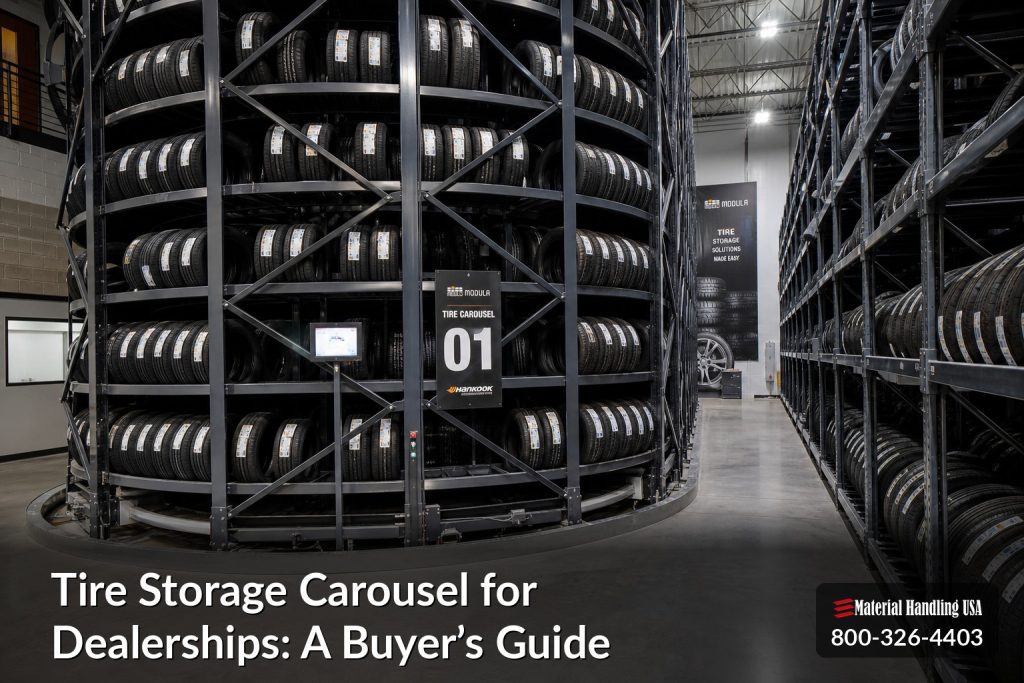
A dealership tire storage carousel is a motorized vertical storage system that keeps tires on rotating carriers and brings the selected tire set down to the operator at a comfortable working height. The easiest way to picture it is a dry-cleaning conveyor built for tire storage.

Goods to person instead of person to goods
That operating model matters. With floor stacks and static racks, your staff go to the tires. They walk, climb, reach, lift, and search. With a vertical tire storage system, the machine brings the tire to them.
That reduces wasted motion and makes storage more predictable. It also helps standardize the process, which is why dealerships looking at broader automation often review general E & I Sales automation insights before investing in storage equipment.
What a tire carousel actually does
A semi-automated vertical system like the Vidir Tire Carousel can store up to 352 tires in a 60 square foot footprint and recover up to 80% of floor space compared with traditional racking, according to The Driller coverage of the Vidir system.
The same source notes the ergonomic design can reduce musculoskeletal injury risks by 50% to 70% by presenting tires at waist height. That’s a practical operating advantage, not just a product feature.
Why Top Performing Dealerships Use Tire Carousels
Monday morning after the first cold snap, the service lane is full, the phone is ringing, and your back room is the bottleneck. The dealers that handle that rush well usually made the storage decision months earlier. They chose a system that cuts wasted motion, keeps inventory under control, and protects labor during the busiest weeks of the year.

Space becomes usable again
High-performing dealerships treat floor space like revenue-producing real estate. If tires are consuming receiving space, technician circulation, or staging area, storage is no longer a back-room issue. It is an operating cost.
A carousel shifts storage into vertical space and gives that floor area back to work that supports throughput. For many stores, that is the first reason to review an automated tire storage system for dealerships. The primary value is not just fitting more tires indoors. It is avoiding the cost of giving prime square footage to a low-efficiency storage method.
Retrieval stays consistent when volume spikes
Peak season exposes weak storage systems fast. A process that feels manageable at normal volume often breaks down when advisors are stacking work, porters are searching for sets, and technicians are waiting.
Top-performing dealerships use tire carousels because retrieval becomes more repeatable. Staff are not covering as much ground, climbing around stacked inventory, or relying on memory to find the right set. That consistency matters for labor planning and for customer promise times. It also matters for total cost of ownership, because labor waste every day can outweigh the purchase price difference between storage options over time.
Safety improves because the workflow is controlled
A safer tire room usually starts with a better process, not a safety poster. Carousels present inventory at a working height and reduce the ladder use, awkward reaches, and unstable floor stacks that create injuries and near misses.
The trade-off is straightforward. A powered system needs training, operating rules, and scheduled maintenance. In return, the dealership gets a cleaner and more controlled handling process that is easier to enforce across shifts.
Practical rule: If your current tire process depends on careful stacking, tribal knowledge, and staff remembering where things landed last week, the process is too fragile for seasonal demand.
Inventory control gets easier to manage
Top stores also use carousels because organization improves at the same time as storage density. Tire sets are easier to tag, place, retrieve, audit, and return in a consistent sequence.
That has downstream effects. Fewer misplacements mean fewer delays at write-up, fewer interruptions for parts and service staff, and fewer last-minute searches that burn payroll. Customers may never see the storage equipment, but they notice when check-in, retrieval, and vehicle delivery run on time.
The payoff is operational, not just physical
The strongest business case is rarely one benefit by itself. It is the combination of recovered floor space, more predictable retrieval, lower handling strain, and tighter inventory control.
That is why top-performing dealerships usually evaluate a tire carousel as a full operating decision. They look at labor hours, service throughput, safety exposure, space pressure, and future growth, then judge the system on total ownership cost after installation, not just the initial invoice.
Tire Storage Methods Compared
A dealership usually reaches this decision after the same trigger point. Seasonal tire volume grows past what the back room can absorb, retrieval starts stealing technician time, and every “low-cost” storage workaround begins showing its real price in labor, errors, and blocked floor space.
Most stores compare four options. A tire storage carousel, static tire racks, floor stacking, and mezzanine or raised storage. Each can work. The better question is what each method costs you over time, not just what it costs to buy.
As noted earlier, demand for carousel systems is growing because many dealerships are trying to store large seasonal tire volumes in limited space. That matters here because the right comparison is a total cost of ownership comparison. Purchase price is only one line item. Labor, search time, safety exposure, inventory accuracy, floor space pressure, and future expansion usually drive the bigger long-term cost.
For a broader look at tire storage systems for dealerships, compare the storage method to your actual seasonal workflow, not a generic warehouse setup.
Comparison of Dealership Tire Storage Methods
| Method | Space Efficiency | Retrieval Speed | Organization | Scalability | Labor Efficiency | Ideal Use Case | Budget Range |
|---|---|---|---|---|---|---|---|
| Tire storage carousel | High | High | High | Good within available height | High | High-volume dealerships with limited floor space | Higher upfront investment |
| Static tire racks | Moderate | Moderate | Moderate | Good if floor space is available | Moderate | Lower-volume or less space-constrained operations | Moderate |
| Floor stacking | Low | Low | Low | Poor | Low | Short-term overflow only | Lowest upfront cost |
| Mezzanine or elevated storage approach | Moderate to high | Moderate | Good if well planned | Good | Moderate | Facilities with clear height and broader parts storage goals | Project dependent |
What each method really means in practice
Carousel systems fit stores that need dense storage and fast retrieval in the same footprint. The trade-off is capital cost, power requirements, training, and planned service support. For dealerships running a serious seasonal tire program, that higher initial spend often buys back time, floor area, and handling control.
Static racks are a reasonable middle ground when volume is moderate and you still have open floor space. They are simpler to buy and maintain, but they do not remove as much walking, lifting, or searching. They also consume square footage that could be used for service operations, parts, or revenue-producing work.
Floor stacking has the lowest invoice and the highest hidden cost. It slows retrieval, makes counts less reliable, increases handling strain, and becomes harder to manage as soon as demand spikes. Use it for overflow, not as a standing system.
Mezzanines can make sense when the project is broader than tires and the building has the right height and structural conditions. They add usable area, but they also add travel time and handling steps unless the layout is carefully planned. For many dealerships, that means the storage problem moves upward instead of getting simpler.
A practical selection test helps. If your operation stores a modest number of sets and floor space is still available, racks may be enough. If you are already feeling pressure on retrieval time, storage density, and back-room safety at the same time, the lower-cost option can become the more expensive one within a few seasonal cycles.
Key Planning Factors for Your Carousel System
Good results come from sizing the system around your workflow, not just the number of tires you have today.

Capacity and growth
Start with actual tire counts. Look at your seasonal peaks, not average weeks. Then ask what your program should support two or three seasons from now. A carousel that fits today but boxes you in tomorrow isn’t a good buy.
Ceiling height and footprint
A high-density tire storage system depends on vertical space. Measure clear height carefully. Don’t guess. You also need to account for access zones, loading position, and safe movement around the machine.
Power, floor, and placement
A motorized system needs the right location. Plan for power, slab condition, and traffic flow. Avoid forcing the carousel into a space that creates bottlenecks at receiving or the service door.
A strong layout usually puts the carousel close to where tires are checked in and checked out, not wherever empty space happened to exist.
Service model and vendor support
A good supplier should help with layout, system sizing, installation coordination, and operating questions. Free layouts and designs with no obligation are valuable because they show whether the concept fits before you commit money to the wrong path.
A Practical Buying Checklist for Dealerships
A buyer usually gets better results by treating this as an operations project, not just an equipment purchase.

Six steps that keep the project on track
-
Audit your real tire volume
Count peak seasonal inventory, not rough estimates. -
Measure the room completely
Record ceiling height, footprint, door access, and obstructions. -
Decide what matters most
Some dealerships need maximum density. Others need faster retrieval during seasonal spikes. -
Review safety and access
Confirm how operators will load, unload, and work around the machine every day. -
Compare support, not just equipment
The Vidir tire carousel is one example of a vertical storage option, but your decision should also include layout help, installation coordination, lead time, and service access. -
Request a quote with full project scope
Ask what’s included, what isn’t, and what assumptions were made.
A few common planning mistakes
- Buying too small because the current season feels manageable
- Ignoring workflow and focusing only on storage density
- Comparing price only instead of total ownership cost and operating fit
Frequently Asked Questions
What should I include in total cost of ownership
Initial price is only one part of the decision. Dealerships often struggle to calculate TCO for tire carousels. ROI is often achieved in 18 to 24 months through labor savings, but you also need to include installation, energy use, and annual maintenance, which is typically 2% to 5% of initial cost, according to Southwest Solutions.
How much maintenance does a tire carousel require
Routine maintenance is part of ownership. The key question isn’t whether it needs service. It’s whether the supplier makes maintenance expectations clear and supports the system after install.
Is a carousel always better than static racks
No. If tire volume is low and floor space is available, static racks can still make sense. A tire carousel for dealerships becomes more compelling when space is tight and retrieval speed is affecting service flow.
Can the system support seasonal tire programs
Yes, that’s one of the most common fit cases. Seasonal storage creates repeated retrieval demand, which is where organized vertical access pays off.
What if our parts department is also crowded
That often strengthens the case for vertical storage. Recovered floor area can relieve pressure across adjacent functions, not just tire storage.
How should buyers compare suppliers
Look at layout support, quote detail, installation coordination, product fit, and availability. Fast shipping and delivery can matter, but only after the system is correctly sized.
Does a tire carousel replace every other storage method
Usually not. Many dealerships use a mixed approach, with carousel storage for active or seasonal tires and other rack systems for overflow or specialty inventory.
Reclaim Your Floor Space and Boost Efficiency
A tire storage carousel for dealerships works best when the problem is bigger than tire count alone. It fixes wasted vertical space, slow retrieval, and risky handling in one move. If you’re also reviewing room dimensions for a broader facility plan, this guide on how to determine ideal garage size is a useful planning reference.
The dealerships that move earlier usually get better planning timelines, cleaner installation scheduling, and fewer compromises around room layout. Request a free quote, ask for a no-obligation layout, or call for help comparing options before the next peak season tightens your space again.
If you’re evaluating a tire storage project, Material Handling USA can help you review storage volume, layout constraints, and system fit. To discuss options, Contact Us, Request a Quote, or call (800) 326-4403. You can also email Sales@MH-USA.com for pricing, availability, and planning support.