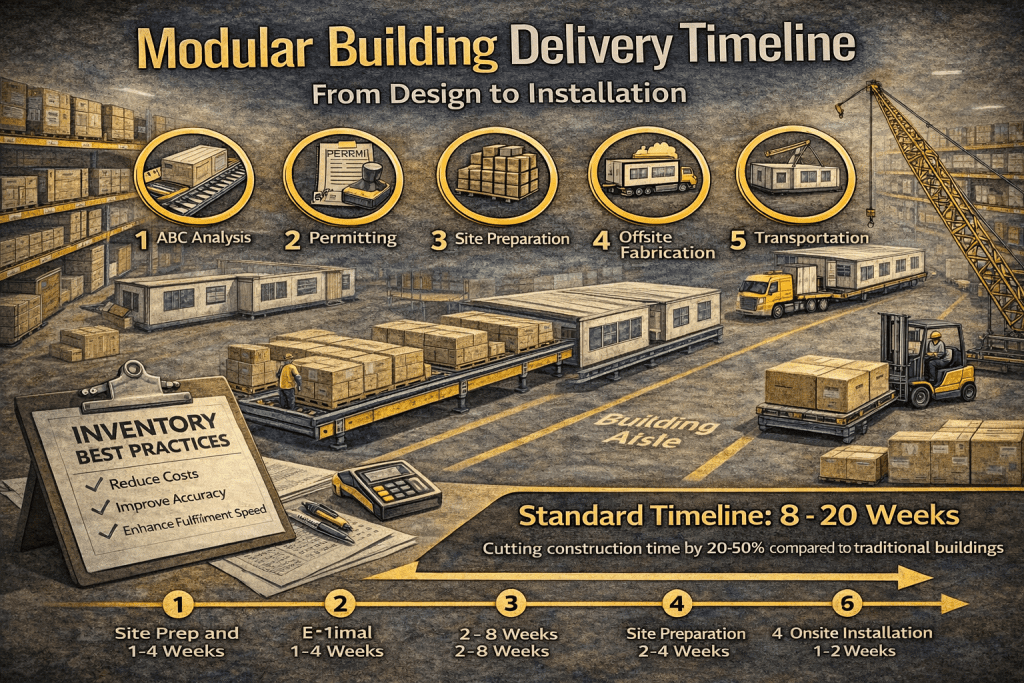
One of the biggest advantages of modular buildings is how drastically they can shorten a project schedule. We’re talking about compressing a timeline that normally stretches for months into a matter of weeks.
For any manager or buyer, this is a game changer. It means you get from the initial idea to a fully functional building faster than you thought possible. The entire journey—from design and engineering to the final installation—is typically completed in just 8 to 20 weeks. Compare that to the 6 to 12 months you would expect with conventional, stick-built construction.
Understanding the Modular Building Delivery Timeline
So, what is the secret? It is all about working in parallel.
With traditional construction, everything must happen in a rigid, step-by-step sequence. You cannot start framing until the foundation is poured, and you cannot install drywall until the roof is on. It is a linear process, vulnerable to weather delays and site issues at every stage.
Modular construction flips that model on its head. While your team is on-site clearing land, pouring the foundation, and running utilities, your building modules are being constructed simultaneously in a climate controlled factory. This overlap is what makes the timeline so much faster and more predictable.
This accelerated approach has been shown to reduce overall project timelines by 20-50%. A huge part of making this happen is having solid, effective supply chain management to keep materials flowing without a problem.
The proof is in the numbers. One recent survey found that a staggering 78% of firms using prefab and modular systems reported significant schedule improvements, letting them get their doors open and operations running far sooner.
A High-Level Project Roadmap
To get a feel for how it all comes together, it helps to look at the process in distinct phases. Each stage has its own timeline and set of tasks that methodically moves your project from a concept on paper to a finished, installed building.
Let’s break down the typical stages you can expect. This at a glance guide shows you what happens when, and for how long.
Standard Modular Building Project Phases
| Phase | Typical Duration | Key Activities |
|---|---|---|
| 1. Design & Engineering | 1 – 4 Weeks | Needs assessment, layout finalization, structural engineering, blueprint creation. |
| 2. Permitting | 2 – 8 Weeks | Submitting engineered plans to local authorities for approval. |
| 3. Site Preparation | 2 – 4 Weeks | Foundation work, utility hookups, ensuring site access for delivery. |
| 4. Offsite Fabrication | 4 – 8 Weeks | Module construction, interior/exterior finishing in a factory environment. |
| 5. Transportation | 1 – 5 Days | Shipping completed modules from the factory to the project site. |
| 6. Onsite Installation | 1 – 2 Weeks | Crating modules into place, seaming, final utility connections, and finish work. |
As you can see, the real magic happens when Phase 3 (Site Prep) and Phase 4 (Fabrication) run at the same time. This is the core reason modular beats traditional construction on speed, every time. It cuts out the bottlenecks that plague conventional projects and gets your new facility delivered and operational in record time.
Knowing these phases helps you stay ahead of the game and work with our team to keep things moving smoothly. Businesses that plan for these stages in advance are the ones that truly capitalize on the incredible speed of modular.
Ready to see what a timeline for your project could look like? Let’s map it out together.
Laying the Groundwork with Planning and Design
Every successful project starts with a solid plan. Think of this initial phase as the foundation—it is where your vision gets translated into a detailed blueprint. A predictable and fast modular building delivery timeline is only possible when you nail this crucial groundwork, making sure every detail is locked in before a single piece of steel is cut.
We dig deep into the intended purpose of your new facility. Are you building one of our bustling modular shipping receiving offices, or do you need a secure modular office with a storage roof? We need to know how you will use the space to ensure the design perfectly matches your operational goals. This collaborative process is key to preventing expensive changes and frustrating delays down the line.
At Material Handling USA, we provide complimentary layouts and designs, letting you visualize and tweak your space without any upfront commitment. In our experience, businesses that invest a little extra time in this discovery stage always have a smoother project and a faster completion.
Needs Assessment and Initial Consultation
The first step is always a deep dive into your specific requirements. We do not just ask what you want to build; we ask what problem you need to solve. This conversation is the cornerstone of an efficient timeline.
Here is what we will cover:
- Purpose and Function: Will it be a cleanroom, an in-plant office, or a security guardhouse? The function dictates everything, from the materials we use to the MEP (Mechanical, Electrical, Plumbing) systems.
- Space and Layout: How many people will use the space? What kind of equipment will it house? Our team helps optimize the floor plan for a natural workflow and maximum productivity.
- Site Location: Where is this building going to be installed? We look at site access, foundation requirements, and utility hookups right from the start.
- Budget and Timeline: Knowing your financial and time constraints from day one allows us to recommend the most practical and effective solutions for you.
This initial planning phase might seem meticulous, but it is your single greatest tool for speeding up the timeline. A well defined scope shuts down the possibility of mid-project changes—which are the number one cause of budget overruns and schedule delays in any construction project.
From Concept to Concrete Design
Once we have a handle on your needs, our design team gets to work creating a free, no obligation layout. This is not just a rough sketch. It is a detailed plan that brings your vision to life, showing you the proposed floor plan, door and window placements, and even electrical outlet locations. To see the level of detail we get into, you can review our modular building specifications.
This visual tool lets you make adjustments and give feedback before a single dollar is spent. The modular building delivery timeline really begins here, long before manufacturing. At the same time, mastering the key steps in land preparation for building ensures your site is ready the moment your new building arrives.
Finalizing the design promptly is essential. With an approved plan, we can move straight into the engineering and permitting stages, keeping your project on the fast track. Our experienced team will help you lock in a design that meets all your operational needs and is optimized for quick fabrication and installation.
Ready to start planning your new space? Contact our design experts today to get a free layout and quote. Call (800) 326-4403 to begin.
Navigating Engineering and Permitting
Once you have signed off on the initial design, the project shifts from concepts to concrete, engineered blueprints. This is a make or break stage. These technical drawings are not only what the factory needs to start fabrication, but they are also what local officials need to see before they hand over a building permit.
And here is where a huge advantage of the modular building delivery timeline really shines.
While all this critical engineering and permitting work is happening, your team can get started on site prep. This parallel workflow—digging foundations and running utilities while the building is being designed and approved—is the secret sauce that makes modular so much faster than traditional construction.
Navigating the maze of local building codes can easily bog down a project, but our deep experience in this area keeps things moving. We will walk you through gathering every piece of required documentation, from site and foundation plans to the complex MEP (Mechanical, Electrical, and Plumbing) drawings that permit offices scrutinize.
From Blueprints to Building Permits
The engineering phase is where we translate your approved layout into a set of construction ready documents. Our engineers dive into the details, ensuring every component meets structural integrity standards and complies with all relevant building codes for your specific location. This covers everything from load calculations and wind ratings to electrical system specs.
These state stamped engineered drawings are the heart of your permit application. Getting this package right the first time is absolutely essential for avoiding delays. An incomplete or sloppy submission can send you right to the back of the line, easily adding weeks or even months to your project. Our team meticulously prepares these documents to ensure a smooth review process. To see more on our commitment to compliance, check out our resources on delivering fast, code-compliant commercial modular buildings.
The Permitting Preparation Checklist
To keep your project on the fast track, having all your documentation in order is non-negotiable. Delays at this stage are almost always preventable with a little foresight. Being proactive here ensures your project moves forward without hitting unnecessary speed bumps.
Here is a checklist of the key documents and information typically needed to sail through the permitting process:
- Finalized Site Plan: A detailed bird’s eye view of your property showing exactly where the new building will sit, along with access roads and utility hookups.
- Foundation Plan: Engineered drawings that specify the type and dimensions of the foundation needed to support the modular structure.
- Detailed Floor Plans: Schematics showing the full interior layout—room dimensions, door and window locations, and where fixtures will go.
- Building Elevations: The exterior views of all four sides of the building, detailing finishes, roof pitch, and overall height.
- MEP Drawings: The nitty gritty plans for all Mechanical, Electrical, and Plumbing systems, including HVAC, power distribution, and water lines.
- Structural Calculations: The engineering data that proves the building can handle local environmental challenges like snow and high winds.
Having a partner who understands these local requirements is one of the most significant factors in maintaining a predictable modular building delivery timeline. It is not just about creating the plans; it is about creating plans that officials can approve quickly.
Around the globe, getting approvals right has a massive impact on project speed. In the Asia-Pacific region, for instance, government mandates for prefab systems are compressing project schedules by a whopping 20-40%. Cities there are showing how policy can accelerate timelines by requiring modular construction for public projects.
Partnering with an expert who knows how to navigate these regulatory waters is the key to preventing delays. Let our team handle the complexities of engineering and permitting so you can focus on getting your site ready for a fast, seamless installation.
Accelerating Progress with Parallel Construction
This is where the magic of modular construction really shines. While a traditional construction site sits quiet, waiting for foundations to cure, a modular project is buzzing with activity on two fronts at the same time. This parallel workflow is the engine that drives a seriously compressed modular building delivery timeline.
Think about the old way of building—everything happens one step at a time. You cannot put up walls until the foundation is poured and set. You cannot touch the interior until the roof is on. Each phase depends entirely on the one before it, creating a long chain reaction where one small problem can push the entire project back for weeks.
Modular construction breaks that chain. While your site is being prepped—foundations poured, utilities run, and access cleared—your actual building modules are already taking shape in our factory.
This off-site fabrication changes everything. It completely takes weather out of the equation, meaning rain, snow, or brutal heat will not ever slow down your build. It also gives us an incredible level of quality control, allowing us to stick to a tight, predictable production schedule.
The Power of Working in Parallel
The core advantage is simple: two huge project phases happen at once instead of one after the other. This simultaneous progress is what dramatically cuts down the time from breaking ground to moving in.
To see the impact, let’s look at the two methods side by side. The table below shows just how this parallel approach turns a long, delay prone process into an efficient one.
Timeline Comparison: Traditional vs. Modular Construction
By tackling the longest project phases simultaneously, modular construction offers a clear path to faster occupancy. The traditional, sequential method is vulnerable to compounding delays, whereas the parallel modular approach builds in efficiency from day one.
| Project Stage | Traditional Construction (Sequential) | Modular Construction (Parallel) |
|---|---|---|
| Site Prep & Foundation | Weeks 1-6: Site work begins and foundation is poured. No other work can start. | Weeks 1-6: Site work and foundation are completed simultaneously with factory fabrication. |
| Building Fabrication | Weeks 7-16: Framing, roofing, and exterior work begin after foundation cures. Vulnerable to weather. | Weeks 1-8: Building modules are constructed off-site in a controlled factory setting. No weather delays. |
| Interior Finishing | Weeks 17-24: MEP, drywall, and interior finishes are done sequentially on an open site. | Interior finishing is completed within the modules at the factory during the fabrication phase. |
| Total Time to Installation | 24+ Weeks | 8-10 Weeks |
The numbers do not lie. By overlapping these crucial stages, modular can slash the pre-installation schedule by more than half. For managers who need a new facility up and running now, this compressed timeline is a massive competitive edge.
Eliminating Common Project Bottlenecks
Traditional construction is famous for its bottlenecks. One trade gets delayed, and it creates a domino effect, pushing back every other team scheduled to come in. Off-site fabrication sidesteps many of these headaches.
- Weather Delays: Our factory does not care if it is raining or snowing. Production keeps moving on schedule.
- Labor Shortages: We have a dedicated, skilled workforce in one place, avoiding the site specific labor crunches that can stop a conventional project in its tracks.
- Material Staging: All materials are delivered straight to the factory floor, which means no on-site theft, weather damage, or logistical nightmares.
This highly organized approach means your project stays on schedule and on budget, making the modular building delivery timeline something you can actually count on.
By moving up to 80% of the construction activity off-site, we turn the unpredictable nature of a field operation into a precise, manufacturing process. This shift gives businesses a level of confidence in their expansion plans that is just not possible with stick-built methods.
The graphic below shows how the initial planning stages—design, engineering, and permitting—are the foundation for a successful parallel construction timeline.
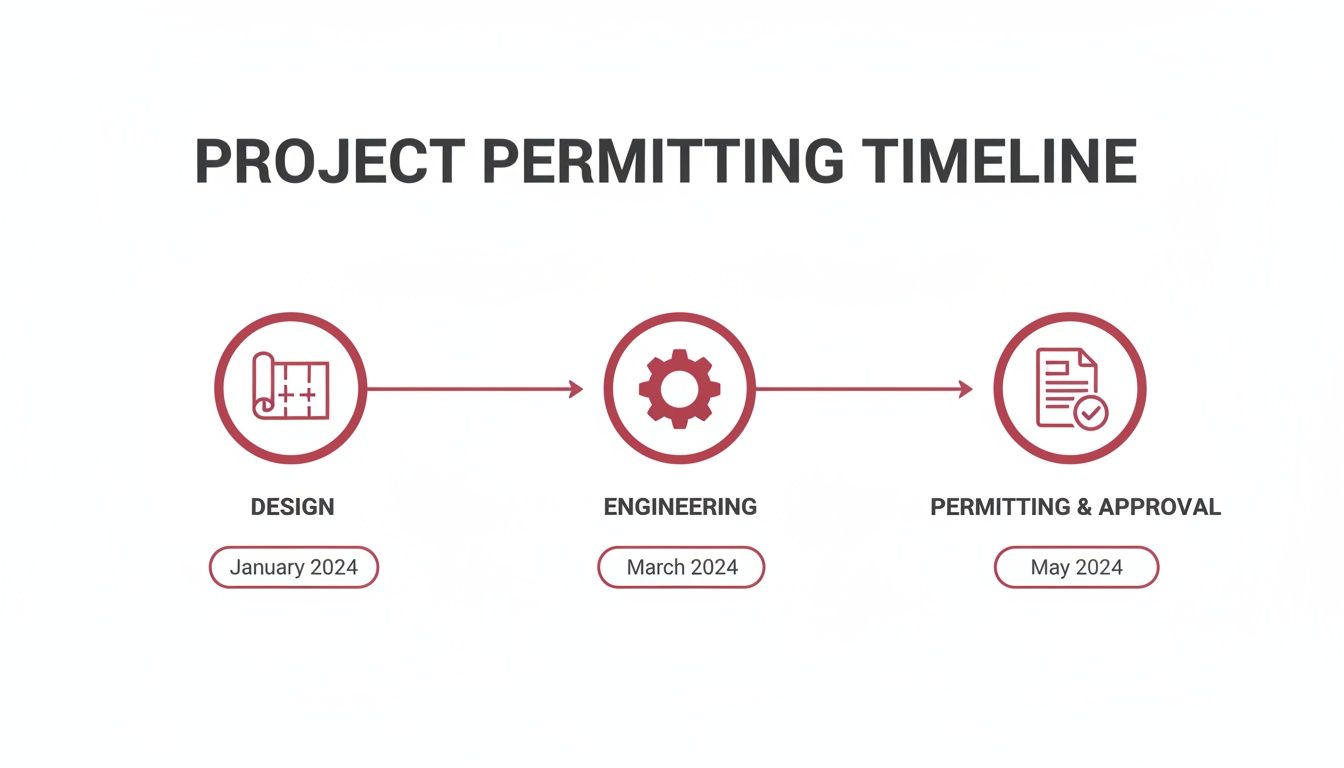
Getting these early phases right is what unlocks the incredible speed and efficiency of building your structure at the same time your site is being prepared.
Executing a Seamless Onsite Installation
This is the moment the magic happens—where the accelerated modular building delivery timeline really shines. For weeks, progress has been happening on two fronts: your site was being prepped while we were busy fabricating your building in our factory. Now, the completed modules arrive on trucks, ready to become your new facility. Our expert crews get to work, turning a prepared foundation into a functional building with incredible speed.
Of course, a smooth installation depends on teamwork. We coordinate closely with your people to make sure the site is 100% ready for delivery day. That means confirming clear, safe access for large trucks and the cranes needed to lift each module into place. Nailing down this part of the plan is what allows for a fast, efficient assembly that barely disrupts your day to day operations.
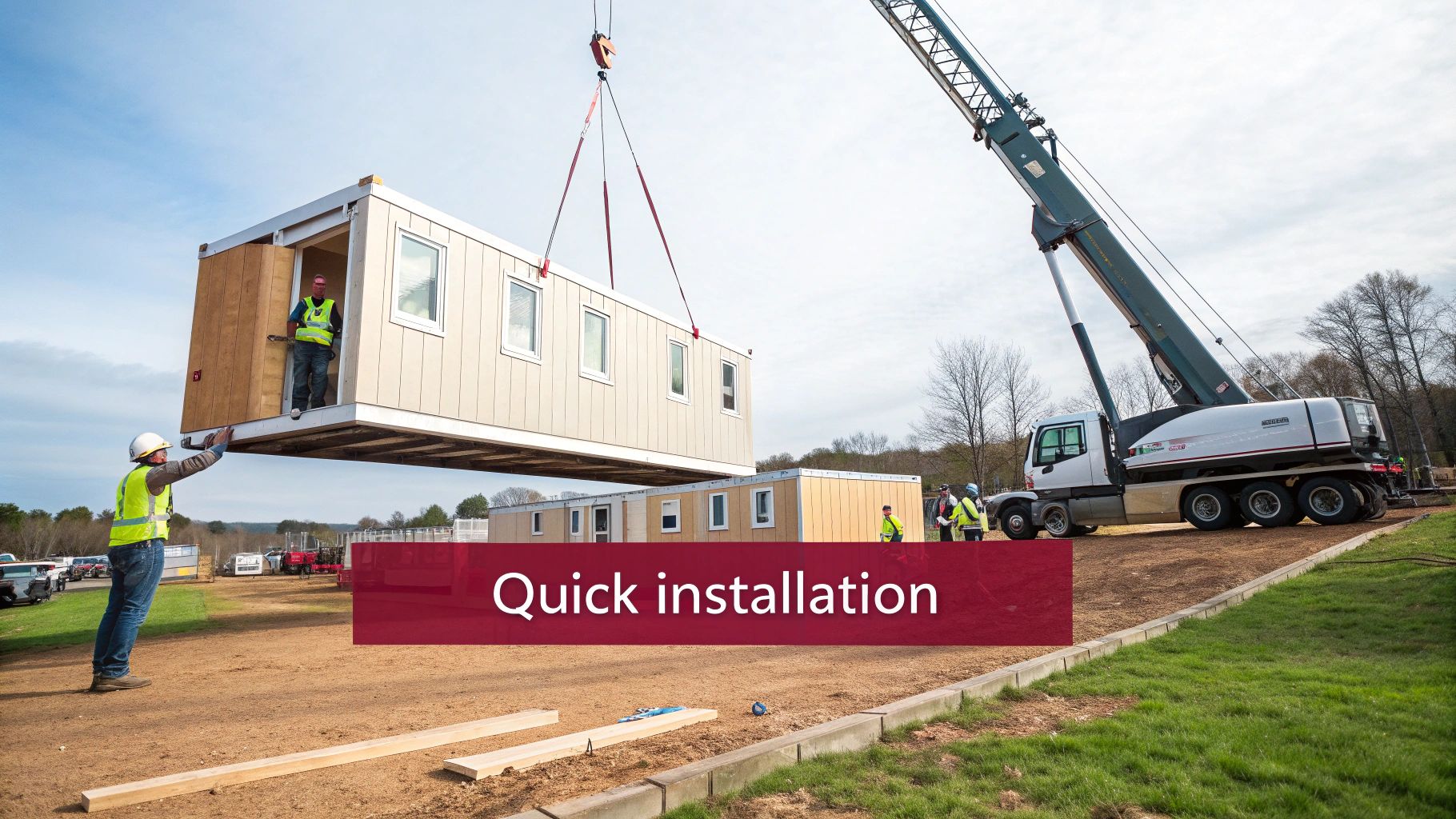
From Delivery Truck to Finished Structure
The installation itself is like a carefully choreographed dance. One by one, modules are precisely craned onto the foundation—a process that often takes just a few hours. Once every piece is set, our crews begin “seaming” them together, connecting the structural, mechanical, electrical, and plumbing systems between each module.
This assembly phase is typically wrapped up in just a few days. It is a massive difference compared to the weeks or even months you would spend on framing, roofing, and finishing a traditional stick-built project. For businesses that have their site prep done on time, it can feel like their new building pops up overnight.
The real advantage here is not just speed; it is certainty. Because up to 80% of the construction is finished in the factory, the onsite phase is focused on assembly, not building from scratch. This practically eliminates the risk of weather delays, labor shortages, and other common job site headaches that plague traditional projects.
Final Connections and Finishes
With the main structure assembled, the last steps are to connect the building to site utilities like power, water, and data lines. Our team then handles any final interior and exterior touches, such as smoothing drywall seams, installing flooring transitions between modules, and adding exterior skirting or trim.
This final stage is quick and methodical, leaving you with a high-quality, durable building that is ready for immediate use. This rapid turnaround means you can get a new space—like a modular shipping and receiving office—up and running far sooner, helping you see a return on your investment that much faster.
Onsite Installation Checklist
To make sure delivery and installation day goes off without a hitch, the site has to be completely ready. A lack of preparedness at this stage is one of the few things that can throw a wrench in an otherwise lightning fast timeline. Use this checklist to get your site ready.
- Foundation Ready: The foundation must be fully cured, inspected, and approved before the scheduled delivery date.
- Clear Site Access: We need a clear, unobstructed path for large trucks and cranes from the street to the installation spot. Double check for any low hanging power lines or tree branches.
- Stable Ground Conditions: The area where the crane will be set up has to be level and solid enough to support its massive weight.
- Utility Stub-Ups: All necessary utilities (water, sewer, electrical, data) should be stubbed up to the foundation, ready for our crew to make the final connections.
- Staging Area: A designated area should be available nearby for staging modules as they are unloaded before being lifted into place.
Checking these boxes ahead of time is absolutely critical. It allows our installation crew to work safely and efficiently, keeping the final phase of your modular building delivery timeline short and predictable. The clients who benefit most from the speed of modular are always the ones who nail their site prep.
Ready to see how a modular office with a storage roof can be installed on your site in a fraction of the time? Request a Quote and let us show you what a fast track timeline really looks like.
How We Get Your Project Done Faster
Picking the right partner is the single most important decision you will make to get the most out of modular construction. A predictable, hassle free modular building delivery timeline is no accident. It is the direct result of a finely tuned process designed to reduce friction and push your project forward at every single stage.
Our entire business is built on that principle. We wrestle with the complex details so you can stay focused on your operations, knowing you will get a top quality building on an aggressive schedule. This all starts the minute you first reach out to us.
Free Design and Expert Consultation
It all begins with free, no obligation layouts and designs. This initial collaboration is the foundation for a quick timeline. By helping you lock in the perfect floor plan for a modular office or a more complex modular building with a storage roof, we eliminate the expensive mid-project changes that completely derail traditional construction.
Our team’s experience ensures your design is not just functional—it is optimized for lightning fast factory fabrication. Nailing this down upfront means we can jump into engineering and permitting with total confidence and speed.
Cutting Through the Red Tape of Permitting
Permitting is, without a doubt, the biggest wildcard in any construction project. Our decades of experience navigating the maze of local building codes across countless municipalities gives you a serious edge. We help you assemble a complete and accurate permit application package, which drastically cuts down the risk of rejections or those painfully long review cycles.
We know what inspectors are looking for. We make sure your engineered drawings for structures like modular shipping and receiving offices check every box, the first time. This proactive approach keeps your project on the move while others are stuck in bureaucratic limbo.
For managers and buyers, this process is not just about speed. It is about minimizing risk, slashing costly operational downtime, and seeing a much faster return on your investment. Getting your facility up and running weeks or even months sooner is a real competitive advantage that hits your bottom line.
Quality and Speed, Straight from the Factory
Our obsession with high quality materials and efficient factory fabrication means you get a superior product built on a compressed schedule. The controlled factory environment wipes out weather delays and allows for obsessive quality control at every step. This parallel construction—building your structure while your site is being prepped—is the very core of an accelerated modular building delivery timeline.
Clients who bring us in early are consistently amazed at how quickly their new space becomes a reality. When you lean on our expertise, you set your project up for success and sidestep the common traps that blow up timelines and budgets.
Let our team show you how our streamlined process can make your next project a resounding success.
Conclusion
Ultimately, a shorter modular building delivery timeline boils down to three things: smart planning, expert guidance, and efficient execution. Our process is engineered to deliver on all three. From providing free layouts to wrestling with permits and ensuring rapid fabrication, we act as your dedicated partner to get your building installed faster. By getting you operational sooner, you cut downtime and gain a critical edge.
Ready to put your project on the fast track? Our team is standing by with free layouts and designs to get you started.
Contact Us today for a free, no obligation quote and see just how fast we can deliver your new modular building. Call (800) 326-4403 or Request a Quote online.
Got Questions About Modular Building Timelines? We’ve Got Answers.
When you are planning a new facility, you need straight answers. The speed of modular construction is a huge advantage, but it is only natural to have questions about how it all comes together. Let’s tackle some of the most common questions we hear from managers and buyers, so you can plan your project with total confidence.
Our whole approach is built on transparency. We want you to understand every single step, from the first sketch to the day we hand over the keys. Clear communication is what makes a project go smoothly.
How Long Does a Typical Project Take?
While every job has its own unique details, a standard modular building is typically designed, built, and installed in 8 to 20 weeks. It is a massive time saver compared to traditional construction, which can easily drag on for 6 to 12 months, if not longer. The final timeline really hinges on a few things: how complex your design is, how fast your local permitting office moves, and how quickly your site is prepped and ready for delivery.
What’s the Biggest Thing That Can Delay Delivery?
From our experience, the single most common holdup is the permitting process. Getting the green light from local building authorities can be a real wild card. Timelines vary dramatically from one town to the next, and it can create a bottleneck if you are not prepared for it.
This is exactly why working with a seasoned pro makes all the difference. We know what permit offices are looking for, so we help you put together a complete and accurate application package from day one. Getting it right the first time is the key to minimizing review cycles and dodging setbacks that could push back your project.
Can I Customize My Building, and How Does That Affect the Timeline?
Absolutely! Customization is one of the best parts of going modular. You get to call the shots on layouts, finishes, electrical plans, and anything else you need to make the space work for your operation.
Now, it is true that highly complex or one of a kind features can add a little time to the design and fabrication stages, but our process is built to handle it efficiently. We provide free layouts and designs right at the start to help you lock in all your requirements upfront. This way, any tweaks happen before production starts, which keeps the overall modular building delivery timeline as tight as possible.
What Do I Need to Do to Prepare My Site?
Site preparation is your side of the project, and it happens while we are busy fabricating the building in our factory. The main to do list includes making sure the site is level, accessible for large trucks and a crane, and that you have a proper foundation poured and fully cured.
You will also need to have all the utility hookups—power, water, data—stubbed up and ready for our crew to connect when they arrive. We will give you a detailed site prep checklist to walk you through it. A well prepped site is the final piece of the puzzle for a fast, seamless installation day.
Ready to start your project with a team that gets things done quickly and keeps you in the loop? Material Handling USA has the expertise to guide you through every stage. For a free, no obligation layout and quote, check out our modular buildings or give our experts a call today.