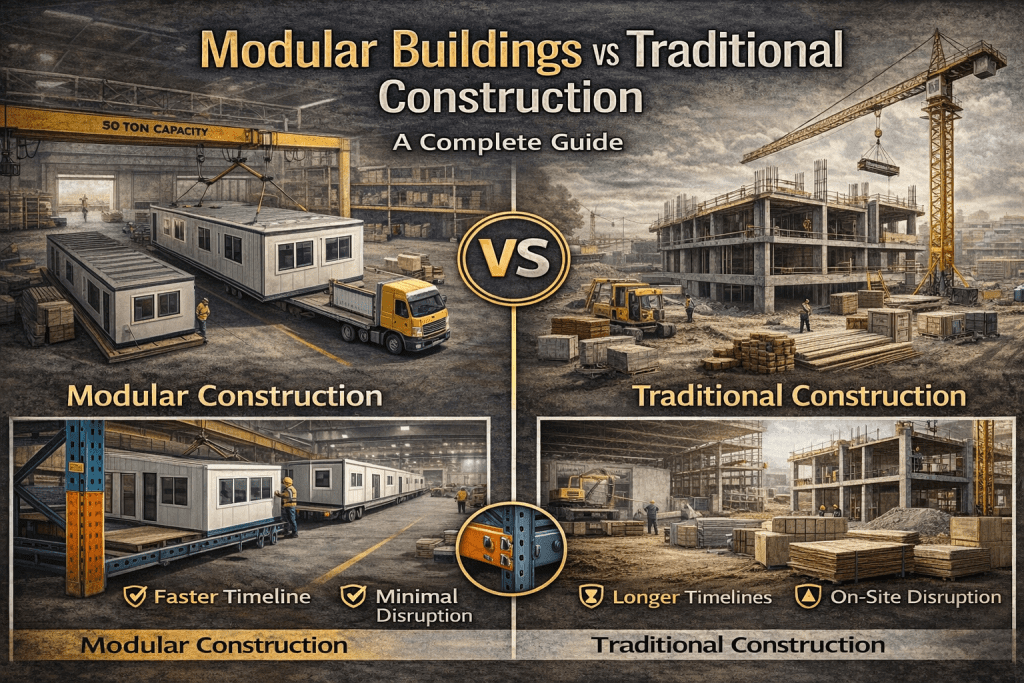
Deciding between modular buildings and traditional construction is a major strategic decision for any manager. The core difference lies in the workflow. Traditional construction is a linear process, built step-by-step on-site. Modular construction, in contrast, operates on parallel tracks: building modules are fabricated in a factory while site work is completed simultaneously. This approach can slash project times by 30% to 50%.
This single distinction creates a ripple effect, influencing everything from budget predictability to the level of disruption your daily operations will face.
Choosing Your Construction Method: An Executive Summary
When you’re researching your next facility expansion, you need to look beyond the final structure and consider the operational impact of the construction method itself. Your choice between a site-built project and a modern modular solution will directly influence your budget, timeline, and long-term flexibility.
We are all familiar with traditional, or “stick-built,” construction. It’s a well-known process, but it is sequential and completely exposed to on-site issues like weather delays, subcontractor scheduling conflicts, and material storage challenges. This uncertainty often leads to unexpected costs and extended timelines, creating a significant disruption in a facility that’s trying to remain operational.
In contrast, modern modular buildings use a parallel workflow that changes the entire dynamic. While your foundation is being poured and the site is prepped, the actual building components are fabricated off-site in a controlled factory setting. This concurrent process is what gives modular its incredible speed advantage. It also means quality control is precise, since everything is built to exacting standards, safe from the elements.
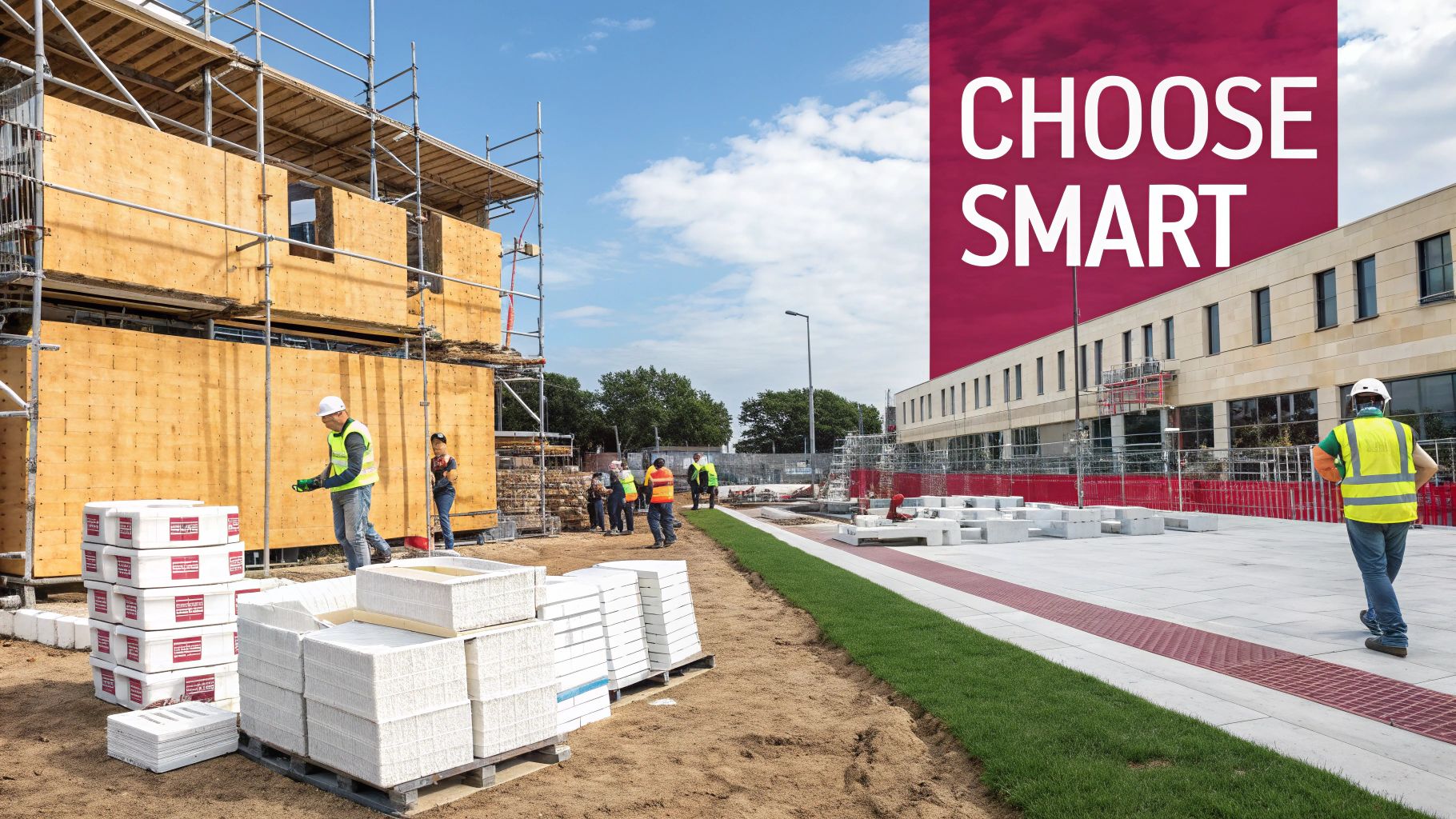
Key Differentiators at a Glance
To fully understand the choice you are making, it helps to see a direct, side-by-side comparison. This table breaks down the most critical factors facility managers need to weigh.
At a Glance: Modular vs. Traditional Construction
The table below offers a high-level overview. As you review it, think about what truly matters for your project. Is it speed to occupancy? Budget certainty? The ability to adapt down the road? Clarifying your priorities now will ensure you select the path that supports your business goals.
| Evaluation Factor | Modular Construction | Traditional Construction |
|---|---|---|
| Project Timeline | Significantly faster due to parallel workflows and factory fabrication. | Slower, sequential process dependent on site conditions and weather. |
| Cost Certainty | High predictability with fixed costs determined upfront. | Prone to budget overruns from unforeseen delays and on-site issues. |
| Site Disruption | Minimal on-site activity, reducing noise, traffic, and safety risks. | Extensive and prolonged site disruption, impacting daily operations. |
| Quality Control | Superior consistency and quality from a controlled factory environment. | Quality can vary based on subcontractor skill and on-site conditions. |
| Future Scalability | Easily expanded, reconfigured, or relocated to adapt to new needs. | Permanent structure; expansion is complex, costly, and disruptive. |
| Material Waste | Up to 90% less waste due to precise factory manufacturing. | Generates significant on-site waste, increasing disposal costs. |
Ultimately, the right decision comes down to your operational priorities. If minimizing downtime and achieving a faster return on your investment are at the top of your list, the advantages of modular construction are tough to ignore.
Planning your next expansion with a modular solution can help you avoid the common delays and budget surprises that plague traditional projects, positioning your company for more agile growth.
Ready to explore a faster, more predictable construction solution? Request a Quote or call our experts at (800) 326-4403 for a free consultation and layout design.
Comparing Project Timelines and Speed to Occupancy
When every day of downtime impacts your bottom line, the project timeline becomes more than a schedule—it’s a critical business metric. The debate over modular buildings vs traditional construction often comes down to one key factor: speed. In that race, modular construction is consistently faster to the finish line, thanks to a fundamentally different workflow.
Traditional construction follows a strictly linear path. One step must be completed before the next can begin. You cannot start framing until the site is fully prepped and the foundation is poured. This step-by-step process creates natural bottlenecks. Any delay—a permit issue, a week of bad weather, or a subcontractor delay—pushes the entire project timeline back, leaving you with an unpredictable completion date and extended disruption to your operations.
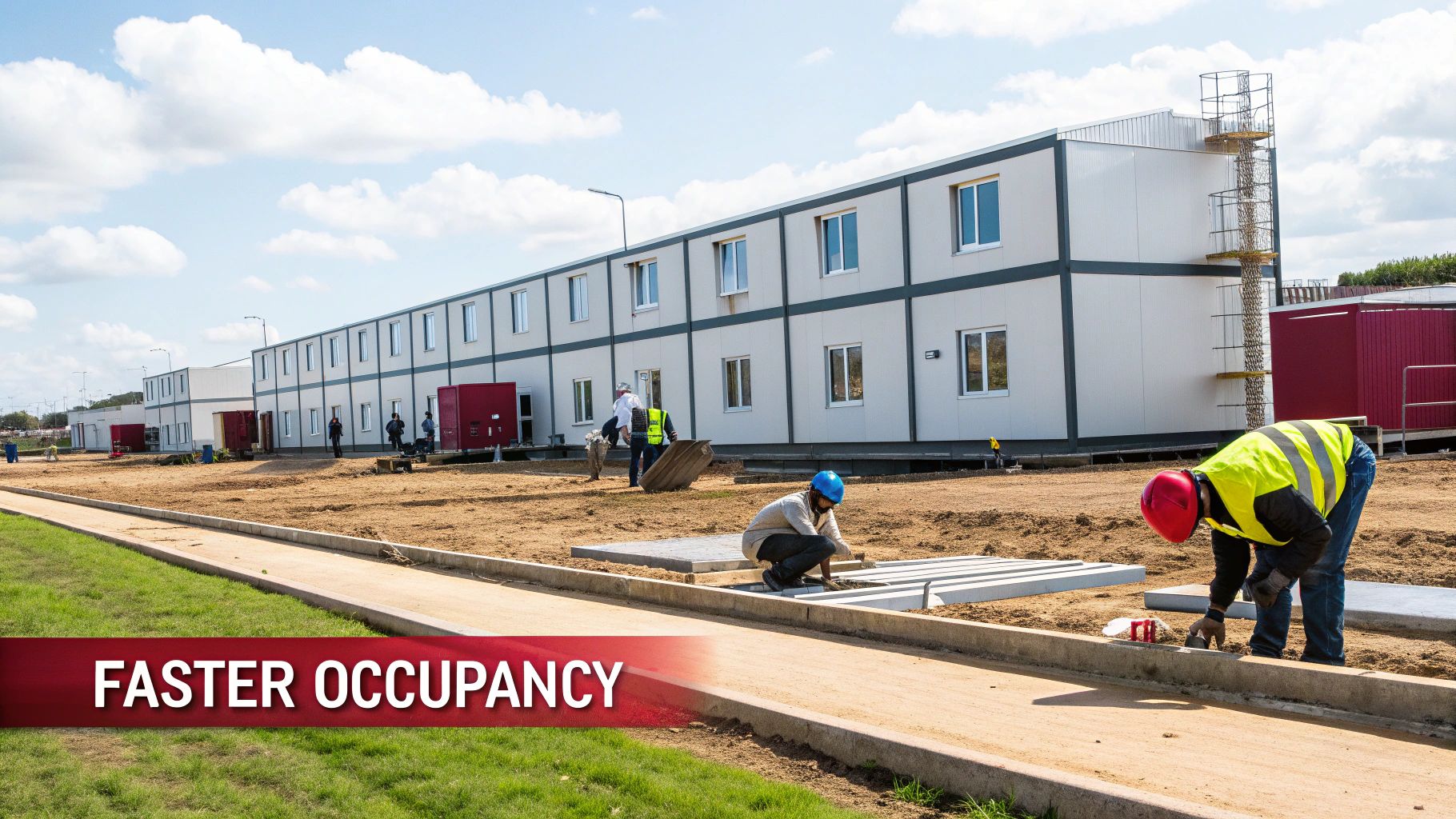
The Power of Parallel Workflows
This is where modular breaks the mold. It shatters the linear timeline by running two major processes at the same time. As soon as the project is approved, work begins on two fronts:
- On-Site Preparation: Your site is graded, utilities are installed, and the foundation is poured. All the necessary groundwork happens just as it would in a traditional build.
- Off-Site Fabrication: Simultaneously, in a climate-controlled factory, the modules that will become your building are constructed with precision. This includes not just framing but also electrical, plumbing, and even interior finishes.
By the time your site is prepped and ready, the nearly finished modules arrive on trucks for assembly. What would have taken months of on-site construction is now condensed into a matter of weeks, or sometimes even just days.
The core advantage of modular is simple: you’re building and preparing at the same time. This eliminates the lengthy sequential dependencies that plague traditional projects, getting your new space operational and generating value much sooner.
Minimizing Disruptions in Active Facilities
Imagine you need a new shipping and receiving office inside a warehouse that operates 24/7. A traditional build would mean months of dealing with dust, constant noise, and large sections of your floor cordoned off. It’s a logistical challenge that can hinder productivity and introduce new safety risks.
Now, consider the modular approach. The components are built miles away. When they arrive, the final assembly is clean, quiet, and incredibly fast. Your primary operations can continue with minimal interference. For a facility manager, that means protecting output and hitting targets without the headache of a prolonged construction project. The ability to deliver fast, code-compliant construction is what keeps your operational momentum going.
The Impact on the Bottom Line
A faster timeline is more than just convenient; it has a direct and measurable financial impact. Modular construction can complete builds 30% to 50% faster than conventional methods. That speed comes directly from those parallel processes, which also eliminate weather delays and streamline inspections within the controlled factory environment.
The quicker you occupy the space, the quicker you start seeing a return on your investment—whether from launching a new product line, expanding your team, or simply making your workflow more efficient months ahead of schedule.
Ready to see how a modular solution can accelerate your next project? Request a Quote today for a free, no-obligation design and layout.
Analyzing the True Cost and Financial Impact
When you compare modular buildings vs. traditional construction, looking at the initial price tag is just the beginning. A savvy manager digs deeper into the total cost of ownership, and that is where modular construction truly demonstrates its financial strength, especially through cost certainty and long-term savings.
The factory-based process of modular building offers a level of budget predictability that on-site construction simply cannot match. With a modular project, your pricing is locked in early. This insulates you from the budget challenges that often plague stick-built projects, like unforeseen site issues, labor shortages, or sudden spikes in material costs.
Upfront Savings Through Factory Efficiency
The immediate, upfront savings from modular methods are easy to see and quantify. It all comes down to the efficiencies of a controlled manufacturing environment.
- Optimized Labor: Our factory teams are specialized and consistent. This leads directly to higher productivity and lower hourly costs compared to coordinating various trades on a job site.
- Bulk Material Purchasing: We buy materials in large volumes straight from suppliers, which means we get better pricing—savings we pass directly on to you.
- Reduced Material Waste: Precision manufacturing in a factory setting slashes material waste by up to 90%. Scrap is minimized and often recycled, which cuts out the hefty disposal costs that come with on-site construction.
These advantages add up to a more cost-effective initial investment. In fact, modular construction often delivers significant savings over traditional methods right out of the gate. You can find more insights on modular construction’s cost efficiency and how it helps sidestep supply chain headaches.
Calculating Long-Term Financial Benefits
The financial upside of modular construction does not stop once the building is installed. Experienced buyers know that the total cost of ownership is what truly impacts the bottom line over the asset’s life.
A significant long-term benefit is lower maintenance. Because modular components are built with precision engineering in a controlled setting, they have tighter seals and more durable connections. This means fewer repair bills and less frequent upkeep compared to structures that were exposed to the weather during construction.
A significant hidden advantage of modular construction is its impact on your operational costs. A faster build time means your new space is generating revenue or improving efficiency months sooner, accelerating your return on investment.
Energy efficiency is another major factor. The precise construction of modular buildings leads to better insulation and less air leakage. The result? Lower heating and cooling costs, year after year, providing a continuous return on your investment. For facilities with specialized needs like cleanrooms or climate-controlled storage, those energy savings can be substantial.
The built-in flexibility of modular offices also provides a financial safety net. If your needs change down the road, the building can be reconfigured, expanded, or even moved for a fraction of what it would cost to renovate or tear down a traditional structure. This adaptability makes modular a smarter, more resilient asset for any growing business.
Thinking about a new modular office with a storage roof or a dedicated shipping and receiving office? Let us get you a clear picture of the financial benefits. Request a Quote or call our team at (800) 326-4403 for a free, no-obligation layout and cost analysis.
Evaluating Design Flexibility and Future Scalability
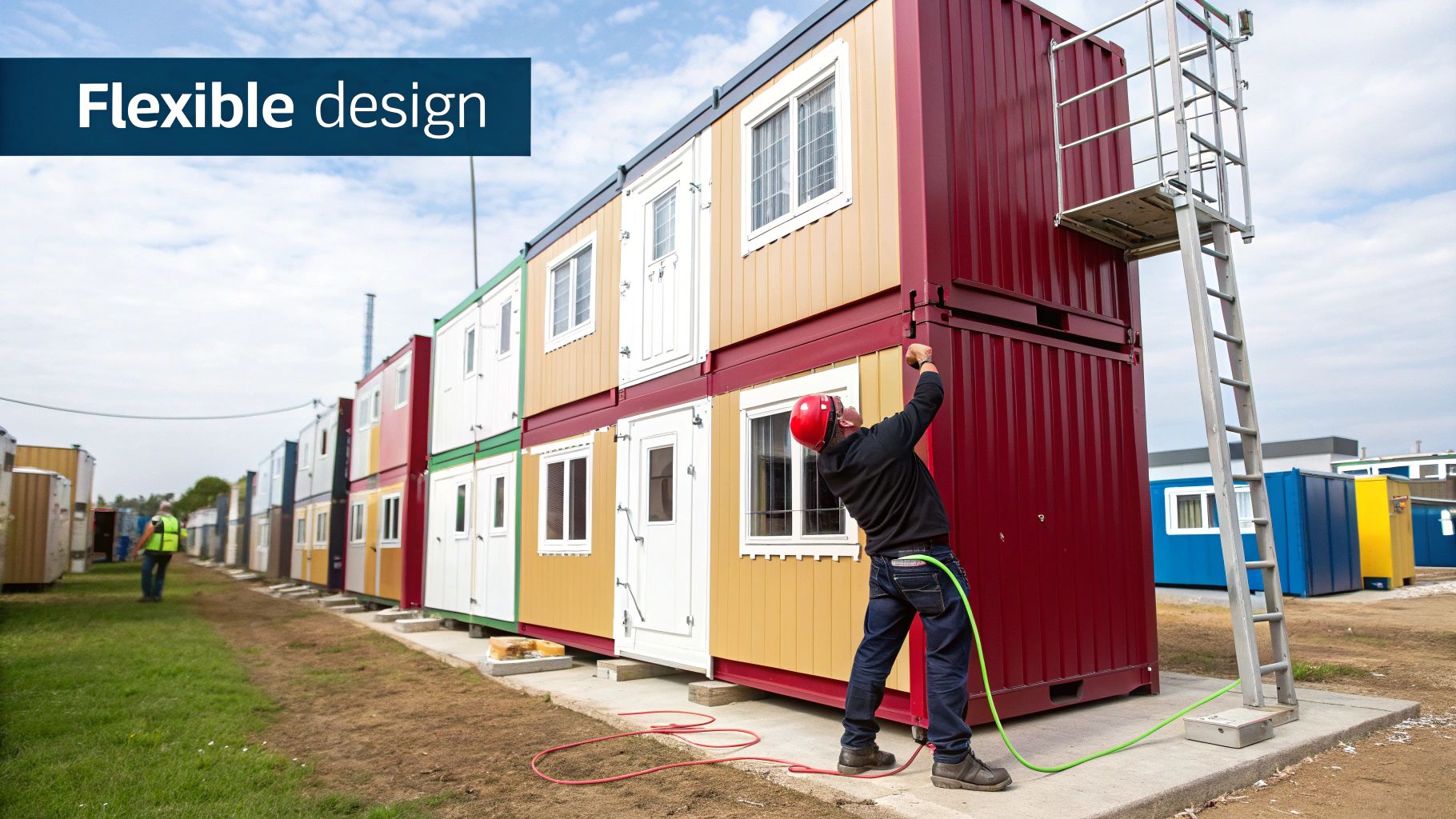
One of the biggest myths about modular buildings vs traditional construction is that modular means settling for a generic, one-size-fits-all box. The reality is quite different. Modern modular systems actually provide an incredible amount of design freedom, allowing you to create a space that is anything but standard.
More importantly, modular offers a level of future-proofing that traditional buildings cannot match. It’s less of a static structure and more of a strategic asset, built to adapt right alongside your business.
Customization From the Ground Up
With a modular approach, you are not stuck with standard templates. You have direct control over every critical detail of your facility’s design, ensuring it aligns perfectly with your operational needs.
This level of control includes:
- Custom Layouts and Dimensions: You define the exact footprint, ceiling height, and interior layout you need. It does not matter if it’s for a wide-open office, a series of secure storage rooms, or a complex cleanroom environment.
- Specialized Systems Integration: Specify your exact needs for HVAC, electrical, and data infrastructure from the start. This means your building arrives ready to support specialized equipment without the headache and high cost of retrofitting later.
- Tailored Finishes and Features: You get to choose from a huge range of wall finishes, flooring materials, and the placement of doors and windows to build an environment that is both professional and practical.
At Material Handling USA, we take this a step further by offering free design and layout services. Our experts work with you to map out and refine a solution, making sure the final product is exactly what you need, with no obligation.
Unmatched Scalability for Future Growth
Here’s where modular construction really shines in the long run: its built-in scalability. Business needs are never static; they are always changing. A traditional building is a permanent, fixed asset. Trying to expand or reconfigure it means a disruptive, expensive, and often impractical process of demolition and on-site construction.
Modular buildings are designed for change. They are not just structures; they are dynamic systems that can be easily expanded, reconfigured, or even completely relocated as your business evolves.
This adaptability is what protects your initial investment. For anyone exploring truly innovative approaches, looking at the concepts behind a unique shipping container modular home design can really highlight the sheer versatility of modular construction.
Adapting to New Demands
Imagine your warehouse needs to add a new quality control lab. With a traditional building, you’re looking at a major construction project right in the middle of your active facility. With a modular solution, new wall panels and components can be added cleanly and quickly—often over a weekend—with almost no disruption to your operations.
This ability to adapt is absolutely crucial. As your team grows or your operational focus shifts, your space can be modified without the downtime and steep costs tied to conventional renovations. The panels and components are engineered to be demountable and reusable, which makes the whole process efficient and sustainable. Given the high demand for adaptable spaces right now, planning for this kind of flexibility today can prevent major delays and operational bottlenecks down the road.
Ready to design a building that grows with you? Request a Quote or call us at (800) 326-4403 for a free consultation on a flexible modular solution.
Quality Control and Sustainability: The Factory Advantage
When comparing modular against traditional construction, the conversation usually focuses on speed and cost. While important, two other factors—quality control and environmental sustainability—are where the modular approach truly distinguishes itself, impacting everything from structural integrity to your company’s bottom line.
A traditional construction site is an exercise in managing variables. You are at the mercy of the weather, the varying skill levels of subcontracting crews, and the logistical challenges of protecting materials from the elements. Modular construction changes this by moving the entire build process into a controlled factory setting, which is a game-changer for quality.
Precision Engineering in a Controlled Environment
Every piece of a modular building is assembled using advanced machinery and a consistent, expert workforce. This factory-based process removes the variables that can compromise quality on a typical job site.
- Weather-Proof Production: Rain, snow, or extreme heat will not stop production or damage your materials. Work continues year-round, ensuring craftsmanship and material integrity are never sacrificed.
- Ironclad Standards: Before a module leaves the factory, it undergoes a series of multi-point quality inspections at every stage, guaranteeing it meets or exceeds all building codes.
- Pristine Materials: Materials are stored indoors, safe from moisture, sun damage, and job site wear. This means every stud, panel, and fixture is in perfect condition when it is installed.
This intense level of oversight delivers a final product with tighter seams, superior structural strength, and solid durability. In fact, many modular buildings are deliberately over-engineered to be even more robust than their site-built counterparts, specifically to handle the stresses of transport and final assembly.
Driving Sustainability and Corporate Responsibility
Structural quality is one aspect, but sustainability is now a core performance metric for any modern business. This is another area where modular construction provides significant, measurable environmental benefits that are nearly impossible to achieve with traditional methods.
The biggest advantage is a massive reduction in waste. Factory production is all about optimization, cutting down on scrap material and making recycling programs incredibly efficient. This can slash on-site waste by as much as 90%, lowering disposal costs and shrinking your project’s environmental footprint.
The sustainability of modular construction is not just an environmental talking point; it is a financial strategy. Less waste, lower energy use, and minimal site disruption all translate directly to a healthier bottom line and a stronger corporate image.
A Greener, Smarter Building Process
The environmental edge extends far beyond waste management. Because the bulk of the work happens off-site, the impact on your property is minimal. That means less soil erosion, less noise and air pollution, and fewer emissions from trucks and worker commutes. The precision engineering also creates a much tighter building envelope, which is why we have focused on guides for energy-efficient modular buildings that are sustainable and cost-effective. These structures simply require less energy to heat and cool over their entire lifespan, delivering operational savings year after year.
As companies face more pressure to adopt sustainable solutions, choosing a modular path does more than just check a box for corporate responsibility—it positions your facility as a forward-thinking, efficient operation. For a building solution that guarantees quality and supports your sustainability goals, modular is the clear choice.
Making the Right Strategic Choice for Your Business
We have covered a lot of ground comparing modular buildings to traditional construction, from speed and cost to quality and long-term adaptability. Now it is time to bring it all together. This is not just about picking a building; it is about choosing a construction path that supports your company’s growth and keeps operations running smoothly.
The decision you make now directly impacts your project’s timeline, budget, and future flexibility. A careful look at your priorities today can help you avoid common issues and set your company up for more agile growth down the road.
This decision tree lays out the two paths, highlighting what you can expect from each.
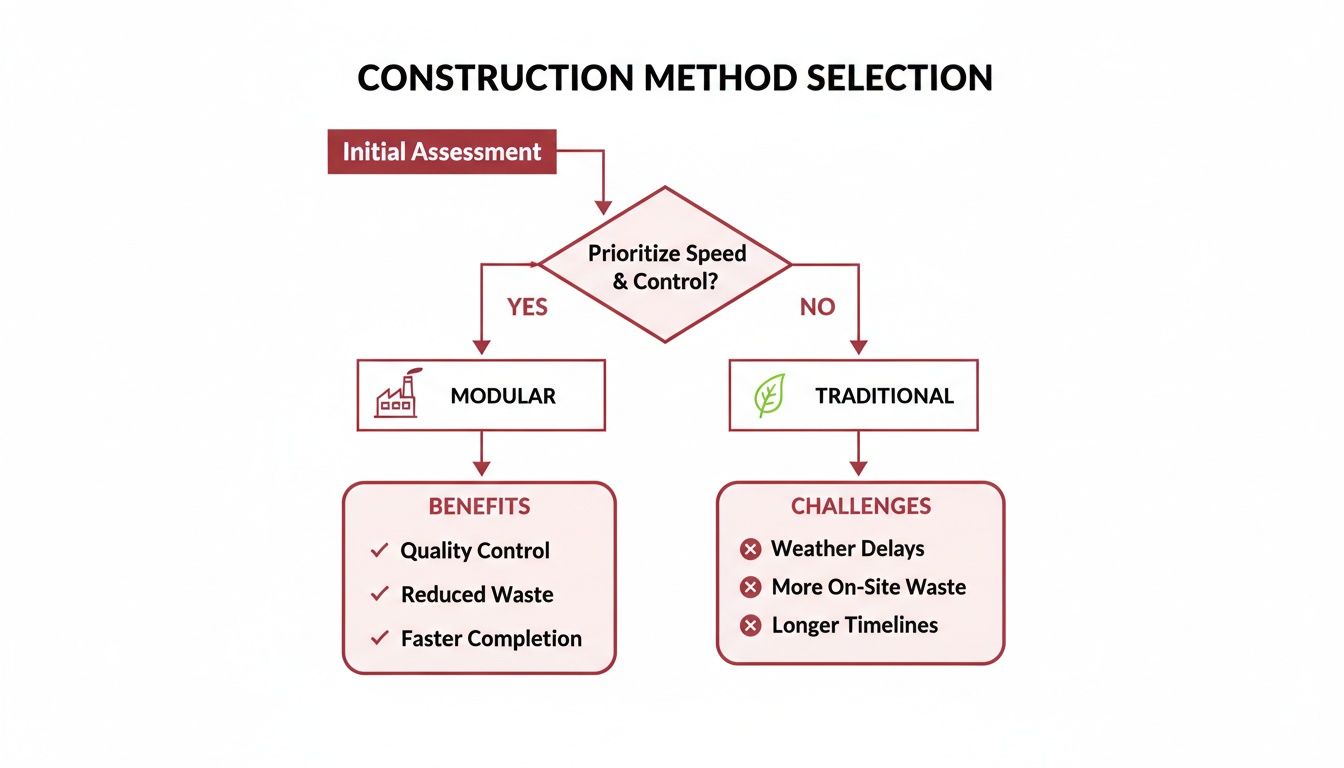
As you can see, the implications are significant. The controlled factory environment of modular construction consistently produces higher quality and more sustainable results. On the other hand, traditional methods are often unpredictable, presenting unforeseen challenges that can easily derail a project.
Your Project Priorities Checklist
To help you sort through it all, use this quick checklist. It will help you weigh what truly matters for your next project.
- Need for Speed: Do you need this space operational as soon as possible to hit production targets or minimize downtime? If time is your top priority, modular’s parallel workflow gives you a significant advantage.
- Budget Certainty: Is a fixed, predictable cost a primary concern? Traditional construction is known for budget creep, whereas modular provides firm pricing much earlier in the process.
- Future Growth: Do you foresee needing to expand, reconfigure, or even relocate this structure in the future? Modular provides an adaptable asset that can evolve with your business.
- Site Disruption: Is keeping your current operations running without interruption a major concern? With modular, up to 80% of the construction happens off-site, protecting your workflow from the usual disruption.
For specialized infrastructure, many businesses are turning to solutions like pre-fabricated modular electrical buildings, which perfectly illustrate the benefits of building off-site.
The choice between modular and traditional is a strategic one. It is about deciding between predictable speed and flexibility versus the familiar, but often uncertain, path of site-built construction.
Ultimately, planning ahead with a modular solution is your best bet to sidestep the project delays and budget overruns that plague traditional builds. In today’s market, where demand for fast, efficient construction is high, getting your project in the design and fabrication queue early is key to a smooth and predictable timeline. This proactive approach secures your spot and positions your company to seize growth opportunities without delay.
Ready to see how these benefits can work for your specific situation? Let’s take the next step. Our experts can provide a no-obligation design consultation to help you plan your project with complete confidence.
Contact Us for a free layout and design, or call (800) 326-4403 to speak with a specialist today.
Frequently Asked Questions
When you’re weighing modular buildings vs. traditional construction, a few key questions always come up. Managers and buyers need straight answers on durability, flexibility, and the details of the process. Let’s clarify these so you can make a confident decision for your next project.
Are modular buildings as durable as traditional buildings?
Absolutely. Modern modular buildings are engineered for the long term, built with high-quality materials like commercial-grade steel and heavy-duty wall systems.
The real advantage comes from the factory setting. Every component is built in a climate-controlled environment, subject to rigorous quality inspections at every step—something you do not get with on-site construction exposed to the elements. The final structure is designed to meet, and often exceed, the exact same local, state, and national building codes as a site-built facility.
How much customization is possible with a modular building?
A surprising amount. Modular does not mean one-size-fits-all. You have total control over the critical details that make a space work for your operation. You define the exact dimensions, the interior layout, and precisely where every door and window goes to optimize workflow.
Beyond the floor plan, you can specify all the MEP (mechanical, electrical, plumbing) systems needed to support specialized equipment. This makes them perfect for creating highly functional spaces like in-plant offices, cleanrooms, or secure guardhouses. At Material Handling USA, we even offer free design services to help you map out a solution that fits your operational needs perfectly.
What does the permitting process look like?
The permitting process is quite similar to conventional construction—after all, modular structures still have to comply with all applicable building codes. The key difference is that it is often much more efficient.
Because the engineering plans are standardized and the individual modules are pre-inspected at the factory, it can significantly simplify and accelerate the on-site inspection phase. Our team handles the heavy lifting by providing all the necessary engineered drawings and documentation your local authority needs for the permit application, smoothing out the whole process for you.
Can modular buildings be expanded or relocated later?
Yes, and this is arguably the biggest strategic advantage of going modular. The entire system is component-based, which makes future expansion as simple as adding more modules when your operational needs grow. There is no need to bring in a demolition crew.
Many of our structures are also designed to be non-permanent. They can be disassembled, moved, and reassembled at a new site with minimal waste or disruption. This adaptability transforms your building from a fixed asset into a flexible one that can evolve with your business—a stark contrast to a permanent, unmovable traditional building.
Conclusion
The choice between modular and traditional construction is a pivotal one for any business. Traditional methods offer a familiar path but come with inherent risks of timeline delays, budget overruns, and significant operational disruption. In contrast, modular construction provides a modern, strategic alternative that prioritizes speed, cost certainty, and long-term flexibility. By moving the majority of construction into a controlled factory setting, you gain a higher quality product, a more sustainable footprint, and a faster return on investment.
With current demand for efficient construction solutions on the rise, securing your project in the design queue sooner rather than later ensures a smoother, more predictable timeline. This proactive approach positions your business to adapt and grow without being hindered by construction delays.
At Material Handling USA, we provide free, no-obligation layouts and designs to help you visualize the perfect solution for your facility.
Contact Us or call (800) 326-4403 to get your free quote today.