Ecommerce warehouse racking has a harder job than racking in a typical stock warehouse. You may store thousands of SKUs, ship single items to homes all day, and see order volume jump during peak season. The racking and shelving you pick decide how fast people can find, pick, pack, and ship each order. For a real example with thousands of size and color variants, see our e-commerce apparel fulfillment racking case study.
This guide shows how to choose e-commerce storage racking step by step. It covers selective pallet rack, high density rack, carton flow, and shelving for ecommerce inventory, plus how to organize pallet orders when you ship at scale. When you are ready, you can lay out a system in our free pallet rack configurator or price one in the order pallet rack builder.
Quick answer
- Many SKUs with only a few pallets each: start with selective pallet rack.
- Small items picked one at a time: use boltless or bin shelving, or carton flow for fast movers.
- Many pallets of the same few SKUs: look at push back, pallet flow, or drive-in rack.
- Most growing ecommerce warehouses end up with a hybrid: reserve pallets up high, pick faces at the bottom.
What Makes Ecommerce Warehouse Racking Different
A traditional warehouse often moves full pallets or full cases to stores. An ecommerce warehouse moves “eaches,” meaning single items, to one customer at a time. That changes what matters most in your storage rack.
- More SKUs, less of each: You may carry many sizes and colors of one product, with only a case or two of each.
- More touches per order: Pickers walk to many locations to fill small orders, so travel time adds up fast.
- Peaks and returns: Holiday spikes and returned items need flexible space you can reset quickly.
- Two jobs in one building: You need dense reserve storage for pallets and easy hand-pick locations for single items.
That is why a good e-commerce racking plan is usually a mix of pallet rack and shelving, not one product. See the rack types we recommend on our ecommerce fulfillment pallet rack page. To see how storage fits into the full building flow, read our guide to e-commerce fulfillment center design built for speed and accuracy.
Key Factors in Your Racking Decision
Do not start with beams and uprights. Start with your products, how you fill orders, and how much you expect to grow. Get these three areas on paper first.
- Inventory profile: Your total SKU count, the size and weight of each pallet or carton, and how fast each item sells. A catalog of a few hundred SKUs needs a very different layout than one with several thousand.
- Order velocity and picking method: Do workers move full pallets, pull full cases, or pick single items for direct to consumer orders? This one answer shapes the whole layout.
- Growth plans: How much do you expect SKUs and daily orders to grow over the next three to five years? Planning for that now helps you avoid tearing out rack later.
Also note your building limits: clear height under sprinklers and lights, column spacing, dock door locations, floor slab condition, and the lift trucks you own or plan to buy. Your racking supplier will ask for all of these.
Selective Racking for Ecommerce: When Is It Enough?
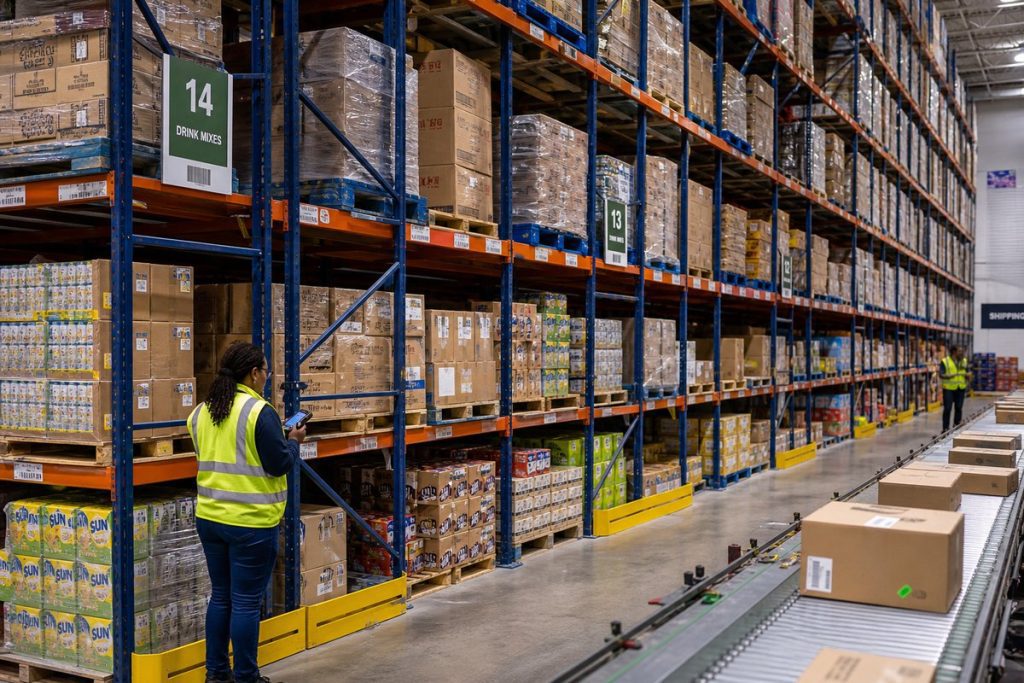
Selective pallet rack is the most common warehouse rack for a reason. Every pallet sits on its own beam level with an open face to the aisle, so you can reach any pallet without moving another one. For an ecommerce operation with a wide catalog and only a few pallets per SKU, that direct access matters more than packing in every last pallet.

The Power of 100% Accessibility
Because every pallet is reachable, selective rack works with first in, first out (FIFO) rotation. That is important for products with dates or short shelf lives. It is also usually the lowest cost way to add a pallet position, and you can move beam levels as your product sizes change. That flexibility helps a growing online store.
Is Selective Rack Right for You?
Selective rack is a strong fit if your operation looks like this:
- High SKU count: You manage hundreds or thousands of different products.
- Low volume per SKU: You only store a few pallets of each item.
- Unpredictable orders: Demand moves around your catalog from week to week.
- FIFO matters: You carry date sensitive goods.
- Budget is tight: You want the most pallet positions for the money.
Selective Racking for a Storeroom or Back Stock Room
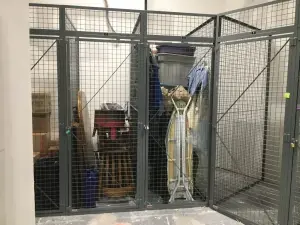
Selective racking is not only for big distribution centers. Many small ecommerce sellers start in a storeroom or the back room of a retail shop. In a tight room, a few short bays of selective rack with pallet rack shelving decks can hold pallets on the top level and hand-stacked cartons below. Plan for a pallet jack or forklift path, keep sprinkler and exit clearances open, and anchor every upright to the floor.
Some storerooms also use portable stacking frames or stack racks for overflow pallets. They can help with short term space, but they are a different product from anchored selective rack, so follow the maker’s stacking limits and do not mix the two in the same run. When the room is ready to grow, the pallet rack configurator is an easy way to test bay counts before you buy.
Key takeaway: Selective racking is the default starting point for most ecommerce warehouse racking. It gives the most flexibility for the cost and lets you reach any product at any time.
When to Consider Higher Density E-commerce Storage Racking
At some point, selective rack may not keep up. Aisles feel crowded, you are out of pallet spots, and leasing more space starts to look necessary. That is the signal to look at high density storage. These systems give up some direct access in exchange for more pallets in the same floor area. They work best when you hold many pallets of the same few SKUs.
Drive-in racking stores pallets several deep on rails, and a forklift drives into the bay to place and pull loads. It is last in, first out (LIFO), so it fits large batches of identical, non dated products.
Finding the Right Density Level
Push back racking is a middle ground. Each lane is usually two to several pallets deep, and each lane can hold a different SKU. It is also LIFO, but it keeps much more selectivity than drive-in.

Pallet flow racking uses sloped roller lanes. Pallets load at the back and roll forward to the pick aisle, which gives true FIFO rotation. It is common for food, beverage, and health and beauty products where rotation is required.
These systems cost more up front than selective rack. Compare the extra cost against what you save in floor space, rent, and labor before you decide. Our article on high density pallet rack storage capacity walks through that tradeoff.
Comparison of Common Pallet Rack Systems
The right choice always comes from your inventory and your goals. For load and size details, review our pallet rack specifications page.
| Rack Type | Storage Density | SKU Selectivity | Inventory Rotation | Ideal E-commerce Use Case |
|---|---|---|---|---|
| Selective | Standard | High (every pallet) | FIFO possible | High SKU count, low volume per SKU (apparel, electronics) |
| Drive-In | Very high | Low | LIFO | Bulk storage of identical, non dated goods |
| Push Back | High | Medium | LIFO | Medium SKU count with several pallets per SKU |
| Pallet Flow | Very high | Medium | FIFO | High volume, date sensitive products (food, cosmetics) |
| Carton Flow | High for cases | High at the pick face | FIFO | Fast moving each-pick and case-pick SKUs |
Ready to configure your pallet rack system?
Use our guided configurator to choose the right configuration, review your parts and submit it for checkout or a formal quote.
Shelving for Ecommerce Inventory: When Shelving Beats Pallet Rack
Not every ecommerce SKU belongs on a pallet. Phone cases, cosmetics, apparel, and small parts are often picked one at a time by hand. For that kind of inventory, shelving is often faster and cheaper per pick location than pallet rack. Many ecommerce warehouses keep pallet rack for reserve stock and use shelving for ecommerce inventory that is picked daily.
Boltless Shelving for Single-Item Picking
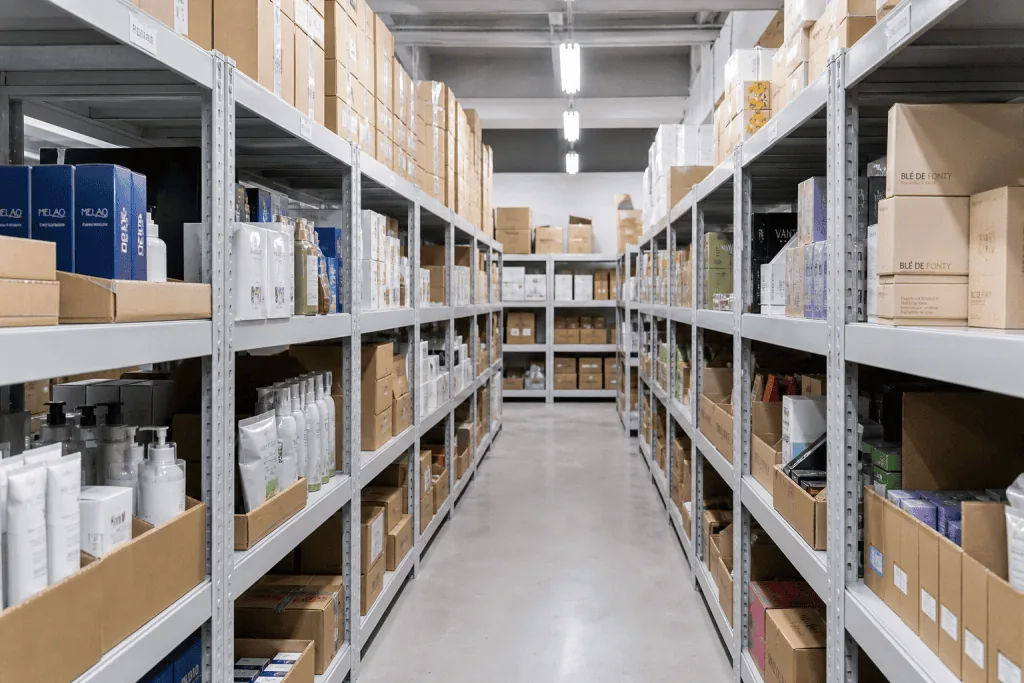
Boltless shelving sets up fast, adjusts without tools, and creates many hand-pick locations in a small footprint. It works well for light to medium items, open cartons, and returns processing. Plan shelf depth around your largest carton and keep the most popular items between knee and shoulder height.
Bin Shelving for Small Parts and Accessories
When SKUs are tiny, put them in bins on shelves. Bin shelving keeps small items separated and labeled, which cuts mis-picks. Our guide to shelving with bins explains how to size bins and lay out bin locations.
Pallet Rack Shelving for Bulky Cartons
Large or odd shaped items that are still picked by hand, such as oversized boxes or bagged goods, often fit best on wide span rack or pallet rack with wire or wood decking. This keeps heavy cartons off the floor without the cost of a full shelving system.
Shelving vs Pallet Rack for Ecommerce Storage
| Your Inventory Looks Like | Usually Best Fit | Why |
|---|---|---|
| Full pallets of each SKU, moved by forklift | Selective or high density pallet rack | Built for pallet loads and lift trucks |
| Small or light items picked one at a time | Boltless or bin shelving | Many pick faces at hand height, low cost per location |
| Fast moving cases picked all day | Carton flow at the base of the rack | Restocks from the back, picks from the front |
| Bulky cartons picked by hand | Wide span or pallet rack shelving | Holds heavy, odd sizes without pallets |
| A mix of all of the above | Hybrid layout | Each SKU goes where it picks fastest |
To compare the two in more depth, read boltless shelving vs pallet racking, or sketch a shelving layout in our shelving configurator.
How Picking Style Changes the Racking Conversation
A layout that looks great on paper still fails if it does not work for the people picking orders. Design the rack around your pickers. Are your operators moving full pallets with forklifts, or walking the aisles to pick cases and single items? The answer changes the whole design.
Designing for Your Picking Workflow
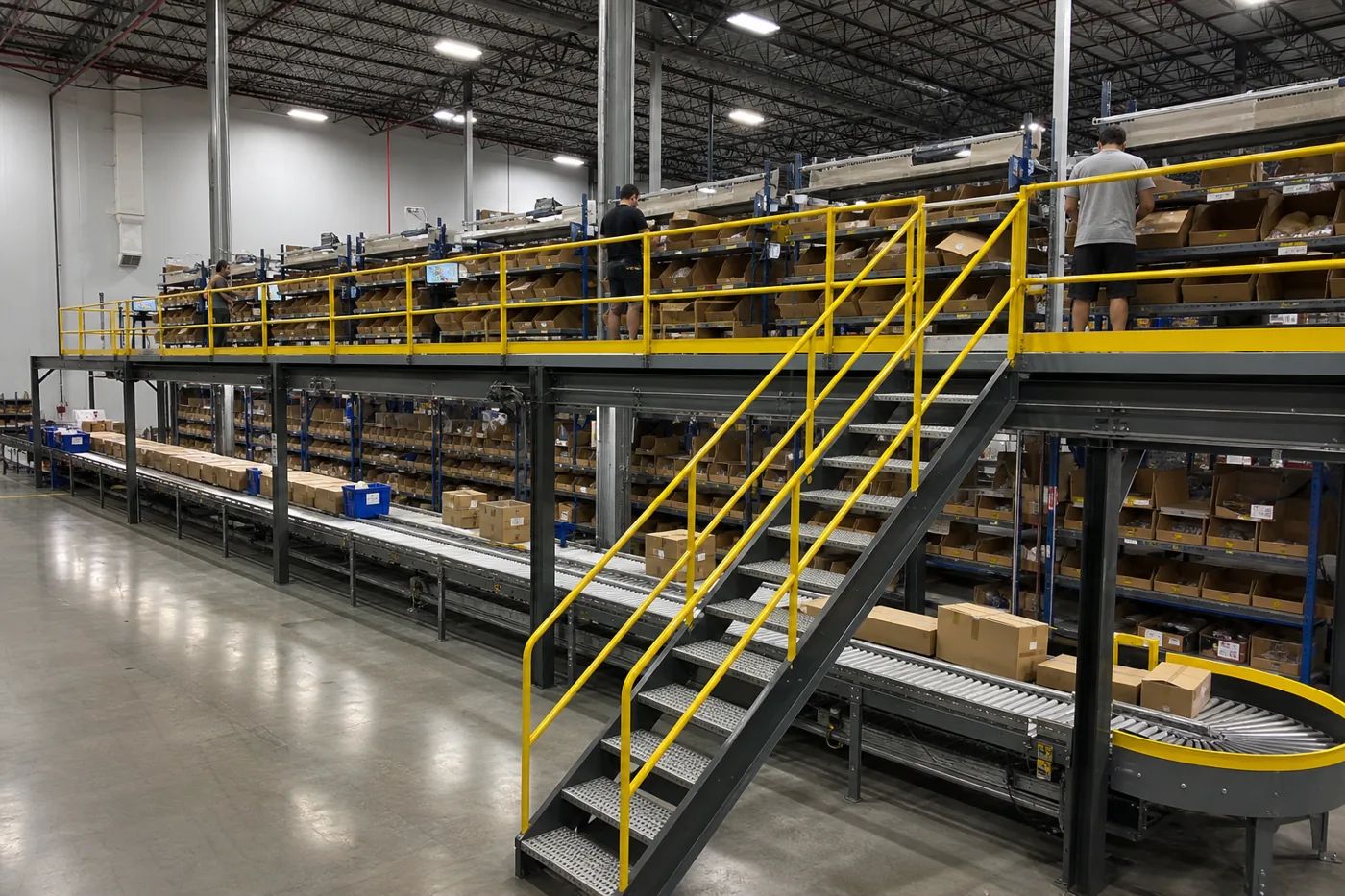
For full pallet moves, most standard racking works. The focus becomes aisle width and travel paths. When most work is case picking or each picking, ergonomics, quick access, and ground level speed become the top priorities.
Many ecommerce warehouses use a hybrid model. Upper rack levels hold reserve pallets, while the lower levels become the pick zone. The “golden zone,” roughly between a picker’s waist and shoulders, is where your fastest SKUs should live. Less bending and reaching means less strain and smoother picking. If pick times are already a problem, see our page on what to do when warehouse pick times are too slow.
Integrating Racking for Optimized Picking
- Selective racking: Upper levels hold reserve inventory at a low cost per position.
- Carton flow racks: At ground level, gravity lanes present cases at the pick face and restock from the back.
- Wide span shelving: For bulky items that are hand stacked, pallet rack shelving adds a durable shelf inside the rack bay.
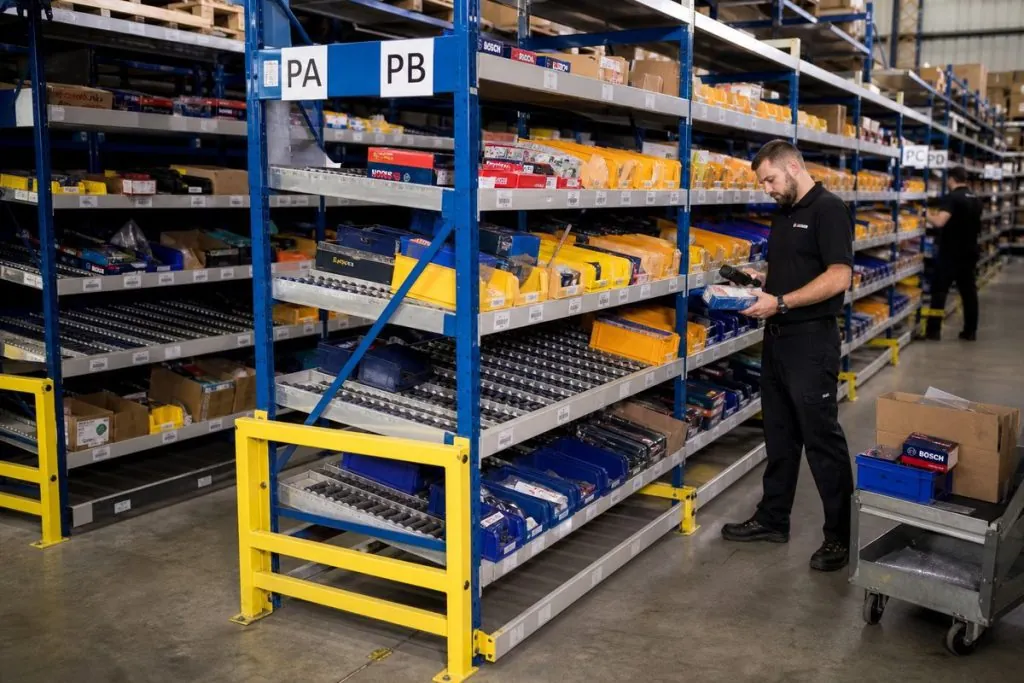
This layered approach stacks pallets high for density and saves the best real estate for order picking. For more on blending rack types, see the top 10 questions about pallet rack. When the building also handles packing, our picking and packing solutions page covers the stations at the end of the pick path.
Efficient Methods for Organizing Pallet Orders for Large-Scale Distribution
As volume grows, many ecommerce sellers also ship full pallets and mixed pallets to retailers, marketplaces, and their own satellite sites. Organizing those pallet orders well keeps outbound docks from turning into a traffic jam. These methods work together with your rack layout.
- Slot by velocity (ABC slotting): Rank SKUs by how often they ship. Put “A” items in the easiest locations closest to shipping, “B” items next, and slow “C” items in upper or back locations.
- Split reserve and forward pick: Keep full pallets in reserve rack and replenish a forward pick location. Pickers then build orders from one compact zone instead of the whole building.
- Use dedicated staging lanes: Mark floor lanes near the docks by carrier, route, or ship time. Finished pallets wait in their lane, which reduces mis-loads.
- Pick in waves, batches, or zones: Group orders by ship time or customer, or assign pickers to zones, so they make fewer long trips. The best method depends on your order mix and your software.
- Label every location: Clear, scannable labels on every beam level and bin make it possible to direct picks and count inventory accurately.
- Cross-dock where it fits: Full pallets that leave as they arrived can move from receiving to shipping without ever going into rack.
Our guides to distribution center storage layout and how to design a pallet rack layout go deeper on aisle and dock planning.
Signs Your Current Layout Is Hurting Throughput
Even good racking fails inside a poor layout. The warning signs are usually easy to see once you look for them.
The Red Flags of a Flawed Layout
- Constant gridlock: Your team waits for a clear path more than it moves product.
- Too much travel: Pick paths are long and winding for simple orders.
- Bad slotting: Your fastest SKUs are in the back, far from packing.
- Rising pick errors: A spike in mistakes often points to a confusing floor plan.
- More product damage: Crowded aisles lead to bumps, drops, and crushed cartons.
If this sounds familiar, rethink the layout. Aim for one way flow of goods, separate zones for equipment and people, and fast movers close to where orders ship.
The Critical Link Between Layout and Safety
A poor layout is not just slow. Crowded aisles raise the risk of forklift and pedestrian collisions, and loose stacks can fall. OSHA’s materials handling and storage standard (29 CFR 1910.176) requires safe clearances and stable storage. Rack design in the United States is commonly based on the ANSI MH16.1 specification from the Rack Manufacturers Institute. Clear traffic lanes, end-of-aisle protection, posted load capacities, and anchored uprights help keep your warehouse racking safe.
6-Step Checklist for Choosing E-commerce Racking
- Analyze your inventory profile: List SKU count, carton and pallet sizes, weights, and sales velocity (fast, medium, slow).
- Map your picking process: Note how much of your work is full pallet, case picking, or each picking, and where pickers spend the most time.
- Measure your building: Record clear height, column spacing, dock doors, sprinkler layout, and the lift trucks you use.
- Project future growth: Estimate SKU and order growth over the next three to five years and design for that, not just today.
- Match storage to each SKU group: Compare selective, push back, pallet flow, carton flow, and shelving using the tables in this guide.
- Lay it out and get a quote: Build a first draft in the pallet rack configurator, then request a free warehouse design review from our team.
Conclusion: Build Your Ecommerce Warehouse for Growth
The right ecommerce warehouse racking makes every order faster and more accurate, and it gives you room to grow. Start with your inventory data, your picking methods, and your growth plan. Then match each group of SKUs to the storage that fits it, whether that is selective rack, a high density system, carton flow, or shelving.
Explore our full line of pallet rack and pallet rack systems, configure a system in the pallet rack order builder, or request a free layout and design. Prefer to talk it through? Call (800) 326-4403.
Frequently Asked Questions About Ecommerce Warehouse Racking
What is the best racking for an ecommerce warehouse?
For most ecommerce warehouses with many SKUs and low volume per SKU, selective pallet rack is the best starting point because every pallet is reachable. Most operations then add shelving or carton flow at ground level for single-item picking.
What is the best shelving for ecommerce inventory?
For small and light items picked one at a time, boltless shelving and bin shelving are usually the best fit. They create many hand-pick locations at a low cost. Bulky cartons often fit better on wide span or pallet rack shelving.
How do I calculate the load capacity I need for my racking?
Find the weight of your heaviest fully loaded pallet, then multiply by the number of pallets per beam level. That is your minimum beam capacity. Your upright frames must also carry the total of all levels in the bay. Always confirm capacities with the rack maker’s load charts and post the ratings on the rack.
What is the difference between roll formed and structural pallet rack?
Roll formed rack is made from cold formed steel. It is lighter, usually costs less, and is easy to adjust, so it suits most ecommerce and retail use. Structural rack uses hot rolled steel channels. It is heavier and stands up better to forklift impact, so it is common in freezers and very high traffic areas.
How wide should aisles be in an ecommerce warehouse?
Aisle width depends on the lift truck you use. Check the right angle stacking requirement on your truck’s spec sheet and add working clearance. Narrow aisle and very narrow aisle trucks need less space than counterbalance forklifts, so they fit more rack in the same building, but they cost more and may need guidance or special floors.
Can I mix different types of racking in my warehouse?
Yes. A hybrid layout is common. For example, use pallet flow for your fastest SKUs, push back for medium movers, selective rack for slow movers, and shelving for small each-pick items. A professional layout makes sure all of the systems work together.
When should I upgrade from selective racking to a high density system?
Consider it when you are running out of pallet positions, aisles are so crowded that picking slows down, or a large share of your inventory is a few high volume SKUs. Push back, pallet flow, or drive-in can add storage in the same footprint.
Do you offer installation for ecommerce warehouse racking?
Yes. Material Handling USA provides layout design, delivery, and professional installation, including anchoring to local building code and seismic requirements. Call (800) 326-4403 or contact us to start.
Need Help With Your Ecommerce Warehouse Racking?
Our team provides free layout designs, competitive pricing, and professional installation across the United States.
Request a Free Quote | Call (800) 326-4403 | Email sales@mh-usa.com
Related Resources
- Pallet Racking
- Pallet Rack Configurator
- Ecommerce Fulfillment Racking in Ogden, Utah
- Security Cages
- Mezzanines
- Pallet Racking Systems: Complete Buyer’s Guide (Modern Materials Handling)
Online Store
Shop at MaterialHandling-USA.com
Need rack components or warehouse supplies? Shop online for fast delivery:
Warehouse Equipment & Supplies
Pallets
Stretch Wrap & Shrink Film
Shipping Labels & Tags
Shop pallet rack & accessories →