
Warehouse Pick Times Too Slow? Rack Layouts That Speed Up Picking
Slow pick rates are usually a layout problem, not a labor problem. Carton flow, pallet flow, golden-zone slotting and rack-supported pick modules cut travel and search time out of every order line.
Talk with a pallet rack specialist. Call (800) 326-4403 or Email Sales@MH-USA.com

Where Your Pick Time Actually Goes
When a warehouse manager says picking is too slow, the instinct is to look at people. The data almost never supports that. Order picking absorbs roughly half of warehouse operating cost, and travel absorbs roughly half of the time inside picking itself.
That is good news, because travel, search and reach are all functions of how the rack is laid out and how SKUs are assigned to it. A picker cannot walk less by trying harder. They walk less when the fast movers are close to the pack line, when a few feet of aisle presents twenty SKU faces instead of two, and when the pick face sits at waist height instead of on the floor or the third beam level.
| Time Component | Typical Share of Pick Time | What Fixes It |
|---|---|---|
| Travel between locations | About 50% | Velocity-based slotting, zone picking, compressing pick faces per aisle-foot, pick modules with takeaway conveyor |
| Search and identification | 10–20% | One SKU per pick face, clear location labeling, flow lanes that always present the front case |
| Reach, bend and lift | 10–20% | Golden-zone slotting, carton flow at 20–60 in., pallet positions reserved for full-pallet moves |
| Waiting and congestion | 5–15% | Wider aisle module where traffic warrants, separated replenishment path, split pick and reserve zones |
| Actual grasp and place | 15–25% | Case flow, bin fronts, unit-of-measure match — the only part a picker directly controls |
The first question we ask
Before recommending any rack change, MH-USA asks for order-line history by SKU and the current pick location of each one. Two to four weeks is enough. Roughly 20 percent of SKUs usually generate 80 percent of picks, and if those SKUs are not sitting in the best real estate in the building, the layout has a known 10 to 30 percent of travel time available before anyone spends money on steel.
Fix Slotting Before You Buy Anything
Slotting is the assignment of each SKU to a specific location based on how it behaves — pick frequency, cube, weight, replenishment rate and which items appear together on orders. It is the highest-leverage change in any picking operation because it costs labor to execute and nothing to buy.
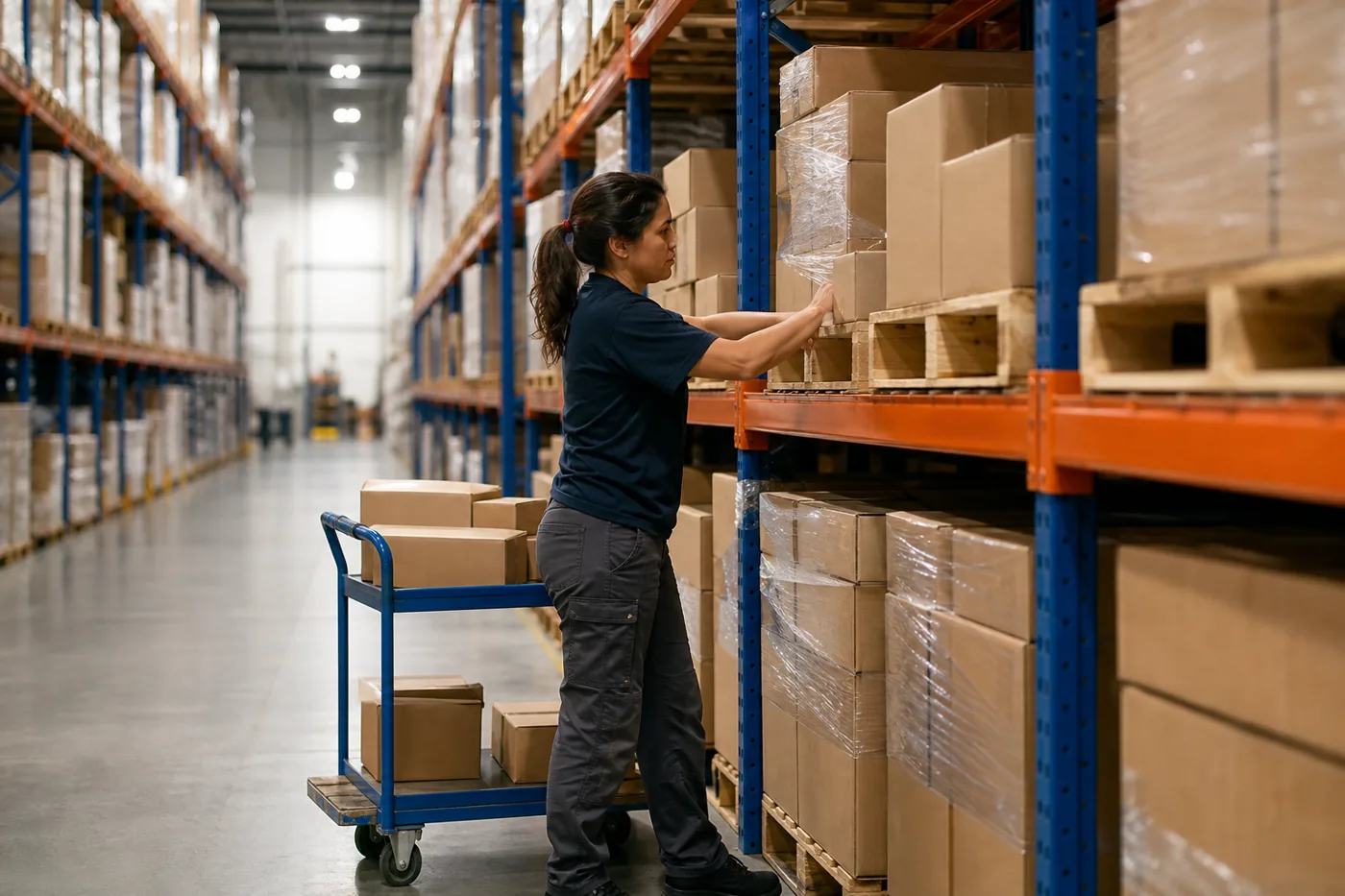
Velocity zones
Split the building into fast, medium and slow zones and place them by distance from shipping, not by SKU number or by whatever aisle had space. Fast movers belong closest to the pack and dispatch area, in the most accessible rack. Medium movers fill the next band. Slow movers, seasonal stock and overstock go to the far aisles and the high beam levels, where a longer trip happens rarely.
The golden zone
Within a bay, height matters as much as distance. The golden zone — roughly 20 to 60 inches from the floor, between knee and shoulder — is where a case can be taken without bending or reaching overhead. The fastest 20 percent of SKUs should never sit outside it; floor-level and top-level positions are for slow movers, reserve pallets and bulk.
Pick-face sizing and replenishment
A pick face that holds less than a day of demand generates a replenishment move that interrupts the aisle. A pick face that holds three weeks of a slow mover wastes prime real estate. Size each face to demand and replenishment cycle, then choose the rack that presents that quantity at the right height.
Our warehouse slotting optimization guide covers the analysis in detail, and the SKU upload analyzer will profile your item file and show the velocity split before an engineer gets involved.
Carton Flow: More SKU Faces Per Foot of Aisle
Static pallet positions are efficient for storing product and inefficient for picking cases from it. A pallet in a rack bay presents one SKU across 48 inches of aisle. Replace that bay with inclined carton flow lanes and the same 48 inches can present six, eight or more SKU faces, all inside the golden zone, all self-facing as cases slide forward under gravity.

The mechanism is simple: cases or totes ride a wheel bed or roller track pitched a few degrees toward the aisle. A picker takes the front case and the next one arrives at the pick position without anyone facing the shelf. Loading happens from the back, off a reserve aisle, so replenishment never blocks the pick path — one of the largest hidden causes of congestion in a static-rack pick line.
Independent research on high-density flow-rack storage found measurably shorter order-picking times than full-pallet storage, and found that the advantage strengthened at higher pick levels, where reaching into a static pallet is slowest.
| Carton Flow Component | Function | Selection Notes |
|---|---|---|
| Wheel bed track | Full-width bed of skate wheels; cases can be any footprint | Best for mixed case sizes and frequent SKU changes; wheel bed track drops into standard rack beams |
| Roller lane | Full-width rollers between lane guides | Best for consistent, heavier cases and totes with a firm, flat bottom |
| Lane dividers and guides | Keep one SKU per lane and stop side drift | Set lane width to case width plus clearance; too wide and cases skew and jam |
| Lane pitch | Controls travel speed | Typically a few degrees; pitched to the lightest case that still must flow, not the heaviest |
| Front stops and shelves | Hold the pick position and support the take | Choose stop height for case face height so the picker does not lift over a lip |
| Rear-load reserve access | Separates replenishment from picking | Requires a back aisle or a module level above; this is the throughput benefit, not an option |
Pallet Flow and Reserve: Feeding the Pick Line
A fast pick line starves if replenishment cannot keep up with it. That is why the reserve zone behind or above the pick face matters as much as the pick face itself.
Pallet flow rack stores full pallets on gravity conveyor lanes five to twenty pallets deep, loaded at one face and picked at the other, giving true FIFO rotation. For food, beverage and any date-coded product it solves rotation and replenishment in the same structure: a lane empties toward the pick face automatically, so replenishment is a short move rather than a hunt.
Push-back rack stores two to six pallets deep on nested carts and keeps every lane at the aisle face, which makes it a strong reserve system where SKU count is moderate and LIFO rotation is acceptable. Selective rack remains the right choice for the pick line itself when full-pallet or layer picking dominates, because nothing beats direct access to every position.

| Zone | Job | Usual System | Pick-Rate Effect |
|---|---|---|---|
| Case pick line | Present many SKU faces in the golden zone | Carton flow in rack, shelving, bin fronts | Largest — cuts travel and search per line |
| Full-pallet pick | Move whole pallets to staging | Selective or very narrow aisle | Neutral; keeps 100% selectivity for pallet moves |
| Replenishment reserve | Feed the pick face without blocking it | Pallet flow, push-back, double-deep, upper beam levels | Indirect but decisive — prevents pick-face stockouts |
| Bulk and slow movers | Hold low-frequency stock cheaply | Drive-in, deep reserve, floor stack | Positive by removal — keeps slow SKUs out of the fast aisle |
Cost per pallet position and cost per pick face are different metrics, and a good layout optimizes both separately. Component and installed pricing for each system is on the pallet rack cost and pricing page.
Pick Modules: Stacking the Pick Face Vertically
When one level of pick face is not enough, the answer is to build up. A rack-supported pick module is a multi-level structure — rack uprights carry both the storage and the walkable levels — with case flow or shelving on each level, stairs, handrail, and takeaway conveyor that carries completed cases or totes down to pack and ship.
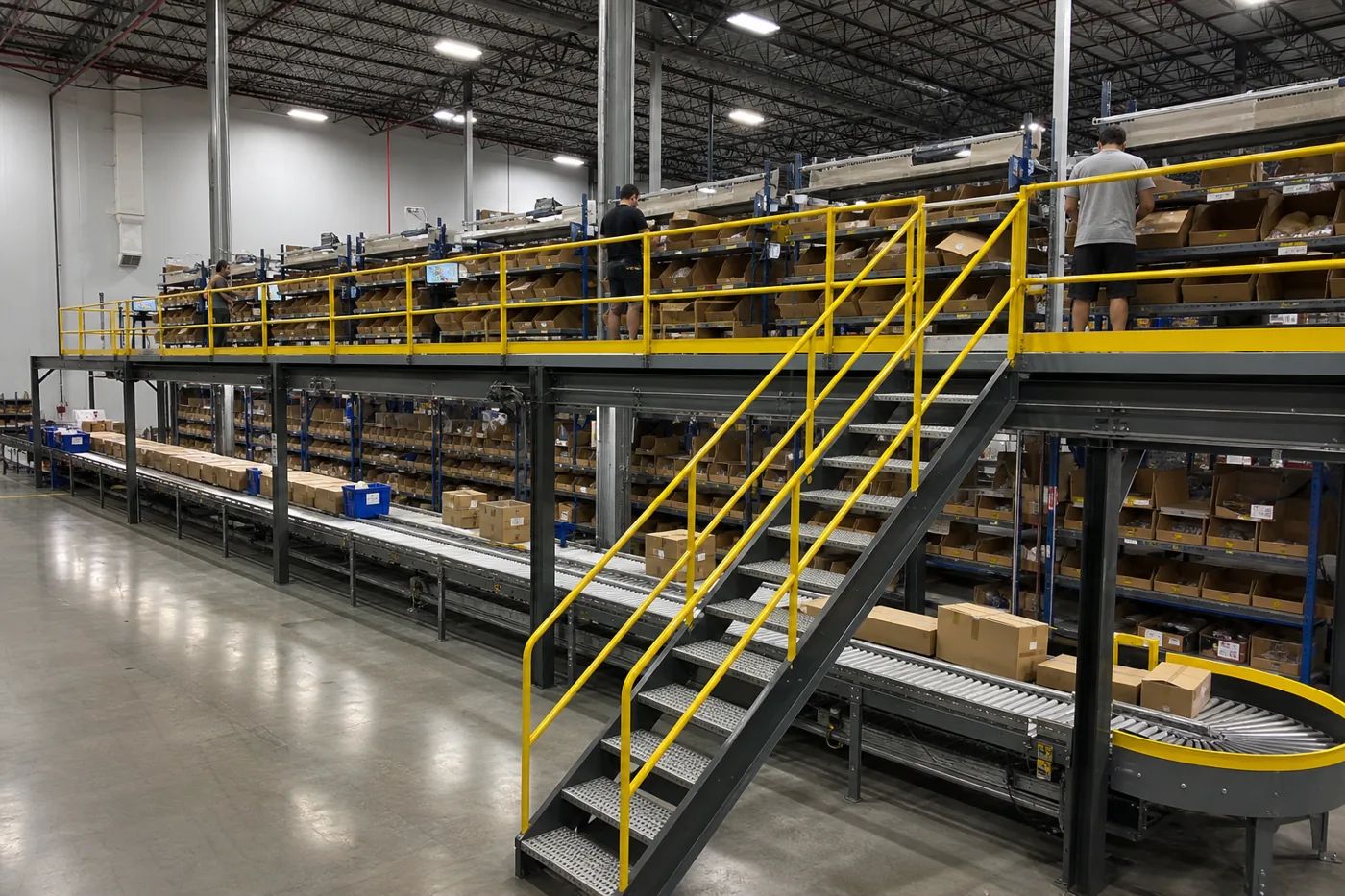
Two things drive the pick-rate gain. First, vertical stacking multiplies pick faces without adding building footprint or walking distance, so a picker covers a zone measured in feet rather than aisles. Second, takeaway conveyor removes cart travel completely: the picker never leaves the zone, and the pace of the conveyor sets a consistent flow to packing instead of a queue of carts arriving at random.
Modules are engineered projects, not catalog purchases. Deck selection, egress and stair placement, guardrail, conveyor cutouts, in-rack sprinkler requirements and the local building code all interact, and the structure is designed to the same ANSI MH16.1 rack standard plus the applicable live-load requirements for the walking levels. Where the pick face needs a full working floor rather than rack levels, a structural mezzanine may be the better structure. MH-USA engineers, supplies and installs both.
When a module is justified
Look for three signals: pick faces required exceed what one level of aisle can hold; cart or tote travel is a measurable share of picker time; and the building has unused clear height above the current pick line. If all three are true, a module usually returns more lines per hour than any amount of reslotting.
A Diagnosis Path for Slow Picking
Work the cheap levers first. Each step below either fixes the problem or produces the data the next step needs.
Measure the baseline
Capture lines per picker hour, travel time per line, replenishments per shift, pick-face stockouts and error rate. Without a baseline no change can be defended or repeated.
Profile the SKUs
Rank items by pick frequency, then by cube and weight. Identify the top 20 percent of SKUs by lines and the unit of measure each is actually picked in.
Reslot to velocity and golden zone
Move fast movers close to dispatch and into the 20–60 inch band. Push slow movers up and out. Re-measure; this alone commonly moves pick time 10 to 30 percent.
Match the rack to the unit of measure
Case and each picking on static pallet positions is the single most common mismatch. Convert those bays to carton flow, shelving or bin fronts and keep pallet positions for pallet moves.
Separate replenishment from picking
Give the reserve a rear-load path — pallet flow, push-back or an upper level — so restocking never occupies the pick aisle.
Compress travel with a module
If pick faces or travel remain the constraint, stack the pick line and add takeaway conveyor. Engineer to code with stamped drawings.
Re-measure and hold the gain
Slotting decays as demand shifts. Re-run the velocity analysis quarterly and keep the pick face sized to current demand.
Speed That Survives Contact With the Warehouse
A faster pick line is a busier pick line. More touches per hour in a compressed area means more forklift and pallet-jack traffic near people, so the engineering has to keep pace with the throughput. Column protection at lane entries and aisle ends, end-of-row guards where pick and replenishment paths cross, and clear separation of pedestrian and lift-truck routes are specified as part of the layout, not added later.

Rack for picking is designed and load-rated the same way as any other configuration: capacity calculated per ANSI MH16.1, anchoring and base plates engineered for the site’s seismic design category, and load-capacity plaques provided so operators know the rating of each configuration. Guidance on rack safety and inspection practice is published by OSHA and the rack industry; MH-USA follows the manufacturer’s design and the applicable standard rather than a generic capacity chart. Beam levels are set from the lowest obstruction — sprinkler heads, lighting, building steel — and flue spacing follows the fire-protection design for the commodity being stored.
Once a pick line is running, a routine rack inspection and repair program protects the gain. Damaged uprights in a high-traffic pick aisle are both a safety issue and a throughput issue, because a blocked or derated bay pushes product back into the wrong location.
Get a free quote
Tell us what you are storing, the room size and your timeline. A project specialist will follow up with layout options and pricing. Prefer to talk? Call (800) 326-4403.
Slow Picking FAQ
In almost every manual operation the answer is travel and search, not picker effort. Studies of order picking consistently put travel at roughly half of total pick time, and picking itself at about half of warehouse operating cost. When pick times drift upward the usual causes are fast-moving SKUs spread across the building, too many pick faces per aisle-foot, pallets stored where cases should be picked, congestion in a shared aisle, and pick locations above or below comfortable reach so every line costs an extra reach, bend or lift-truck move.
Reslotting alone commonly cuts travel-driven pick time by 10 to 30 percent because it shortens the walk without changing a single beam. Converting full-pallet reserve positions to case flow lanes at the pick face typically adds another step change: published research on flow-rack storage measured shorter pick times than full-pallet picking, and the gain grows as more SKU faces are compressed into the same aisle length. Pick modules deliver the largest gains, 2x or better lines per hour, because they stack pick faces vertically and take walking out of the process entirely with takeaway conveyor.
The golden zone is the band roughly between the picker’s knees and shoulders, about 20 to 60 inches from the floor, where an item can be grasped without bending or reaching overhead. Picks inside that band are faster and safer. The design rule is simple: the fastest-moving SKUs occupy golden-zone positions, medium movers sit just above or below, and slow movers go to high beam levels or reserve. Carton flow lanes exist largely to put many SKU faces inside that band at once.
Carton flow (case flow) is for case and each picking: inclined wheel bed or roller lanes inside a rack bay feed cases forward to the pick face, so a picker faces many SKUs in a few feet of aisle. Pallet flow is for full-pallet throughput: gravity lanes five to twenty pallets deep with FIFO rotation, loaded at one face and picked at the other. Many operations use both, pallet flow for reserve and replenishment, carton flow for the pick line above or beside it.
Start with slotting, because it is the cheapest lever and it tells you what the rack has to do. If pick rates are still limited after reslotting, and the constraint is aisle length or picker travel rather than SKU placement, a rack-supported pick module is the next step. A module is justified when a single level cannot hold enough pick faces, when takeaway conveyor would remove cart travel, or when the building has clear height that the pick line is not using.
Use lines per picker hour, travel time per line, replenishments per shift, pick-face fill rate and error rate. Capture two to four weeks of order history before changing anything: line counts by SKU, order profiles, unit-of-measure mix, and the physical location of every pick. That data set is what MH-USA’s engineers use to size the pick face, choose between carton flow, selective, push-back or a module, and forecast the pick-rate change before the first upright is ordered.
Some, and usually it is worth it. Case flow and pick-module levels trade pallet positions for pick faces, so density in that zone falls while throughput rises. The normal answer is to split the building: a dense reserve area (pallet flow, push-back, drive-in or double-deep) behind or above a fast, selective pick line. Reserve carries the cube, the pick line carries the labor.
Get an Engineered Pick-Line Layout
Send us your building dimensions and a few weeks of order-line history. We’ll return a slotting plan and rack layout with the projected pick-rate change and installed pricing.