When you hear “warehouse space optimization,” you might picture a weekend tidying project. But it is so much more than that. It is about strategically rethinking every square foot of your facility—inventory, storage systems, and workflows—to squeeze the absolute most out of the space you already have.
The real goal is to turn underused areas, especially that empty air above your head, into active, productive storage zones. A successful project moves beyond just cleaning up; it fundamentally redesigns how products, people, and equipment move and interact.
Why Inefficient Warehouse Space Is Costing You Money
That unused vertical space and those congested aisles? They are not just an eyesore; they are actively draining your profit margins. A poorly laid-out warehouse directly inflates labor costs, creates frustrating bottlenecks, and slows down every single order that goes out the door.
Viewing space optimization as a core business strategy—not a one-off cleanup job—is the first step. It is how you transform your facility from a cost center into a genuine competitive advantage.
An inefficient layout forces your team to walk further for every single pick, which directly drives up labor hours per shipment. In fact, studies show that picker travel can account for more than 50% of the time spent picking orders. That is a massive, hidden cost that chips away at your bottom line every day. When aisles are cluttered or poorly planned, all that wasted movement gets even worse.
The Hidden Costs of Poor Layouts
Beyond the obvious labor expenses, a disorganized warehouse creates a waterfall of other problems. Misplaced inventory leads directly to lost sales and hours of wasted time just searching for items. When your storage is not dense enough, you are paying rent on square footage that is not making you a dime.
With U.S. warehouse costs climbing higher every year, you cannot afford to ignore this. Maximizing every square foot of your existing facility has to be the priority before you even think about a costly expansion or move.
A smarter layout has an immediate and direct impact on your bottom line by:
- Slashing Labor Expenses: Shorter, more direct picking paths mean fewer wasted steps and lower payroll costs.
- Boosting Order Throughput: When products are easy to find and access, your team can get more orders out the door, faster.
- Improving Inventory Accuracy: A logical, organized system dramatically reduces the risk of lost items, ensuring your data is actually reliable.
- Enhancing Safety: Clear, well-organized aisles prevent accidents and create a much safer work environment for your people.
Key Pillars of Warehouse Space Optimization
Here is a quick overview of the primary strategies and their impact on your day-to-day operations. Think of this as your high-level game plan.
| Strategy | Primary Goal | Key Solutions (Products/Services) |
|---|---|---|
| Space Audit & Analysis | Identify inefficiencies and data-driven opportunities. | Free Layouts & Designs, On-site Measurement |
| Vertical Maximization | Increase storage capacity within the existing footprint. | Pallet Racking, Mezzanines, High-Density Shelving |
| Workflow Optimization | Reduce travel time and eliminate operational bottlenecks. | Slotting Analysis, U-Shaped or I-Shaped Flow Design |
| Safety & Compliance | Ensure a safe, OSHA-compliant working environment. | Guard Rails, Rack Capacity Signage, Egress Planning |
By focusing on these core areas, you are not just putting out fires. You are building a plan that solves today’s space crunch while setting you up for scalable, sustainable growth for years to come.
How to Conduct a Warehouse Space Audit
Before you can fix your space, you have to truly understand it. A thorough warehouse space audit is the only way to move from guesswork to a strategy backed by real data. This is not just about walking the floor; it is a deep dive into your current layout, workflows, and inventory to find those hidden drains on efficiency.
The goal here is to get hard numbers, not just a gut feeling that things are crowded. A good audit gives you the clear, actionable insights you need to design a facility that is more productive and less costly. It is the foundation for everything that comes next.
Measuring Cube Utilization and Finding Dead Zones
Your warehouse is not just square footage; it is a three-dimensional asset. The single most important metric most facilities overlook is cube utilization. This simply measures how much of your total available volume—floor to ceiling—is actually being used for storage. It is shocking how many warehouses leave vast “dead zones” of empty air above their racking or in forgotten corners.
Start by getting out the tape measure:
- Total Cubic Space: Calculate the total volume of your storage areas (Length x Width x Height).
- Occupied Space: Figure out the volume currently taken up by your inventory and racking.
- Calculate Utilization: Divide the occupied space by the total available space. That is your percentage.
If that number is low, it is a huge red flag—and a massive opportunity. Identifying these dead zones is your first step toward reclaiming that wasted potential with solutions like taller racking or mezzanines, often increasing capacity without expanding your footprint by an inch.
Mapping Product and People Flow
How do your products and your team actually move through the building? Taking the time to map this flow from the receiving dock to the shipping door will shine a bright light on workflow bottlenecks and inefficient travel paths that are quietly bleeding your labor budget dry.
These small inefficiencies add up, creating a domino effect of congestion, wasted labor, and ultimately, lost profit.
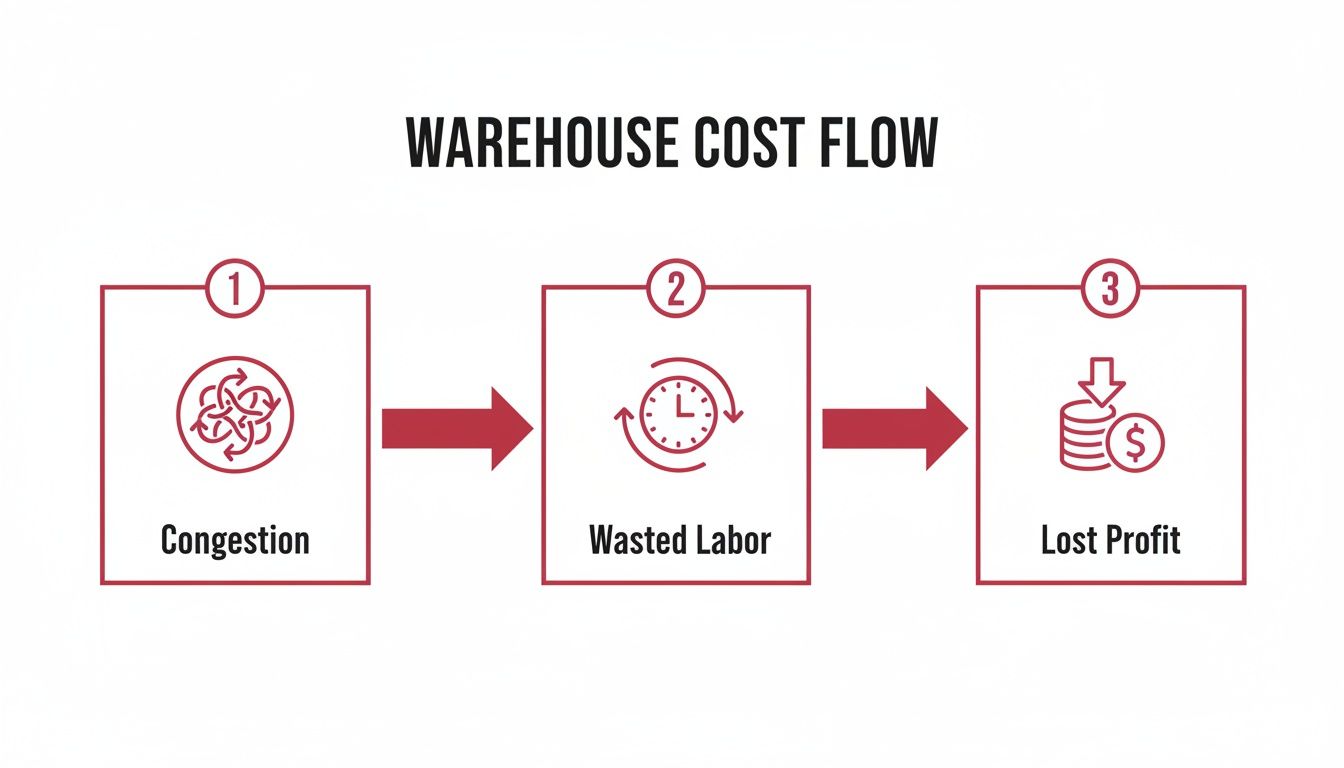
As you can see, storage problems and workflow problems are two sides of the same coin. You cannot really fix one without addressing the other.
Pro Tip: Grab a floor plan and physically trace the routes of your top 20% most popular SKUs. We guarantee you will find that a handful of items are responsible for a huge chunk of your team’s daily travel time. This is pure gold when it comes to designing a more logical layout.
Gathering the Right Data for a Smarter Layout
A proper audit goes way beyond physical measurements. You need to collect operational data to build a complete picture that informs your redesign. As you assess your space, you will also inevitably identify outdated or obsolete equipment. A quick win is often to recycle old computers to reclaim valuable office space and other unused tech.
Here is a checklist of the data points we always look for:
| Data Category | Specific Metrics to Track | Why It Matters |
|---|---|---|
| Inventory Data | SKU velocity (A, B, C items), product dimensions, seasonality. | Informs your slotting strategy to put fast-movers right where you need them. |
| Operational Data | Pick rates per hour, average travel time per pick, order accuracy. | Benchmarks your current performance and helps quantify the ROI of any changes. |
| Equipment Data | Forklift turning radius, aisle width requirements, equipment condition. | Ensures the new layout actually works with your existing material handling fleet. |
| Facility Data | Column spacing, door locations, clear height under sprinklers. | Defines the physical “rules” and constraints that your new design must follow. |
Pulling all this information together can feel like a lot, but it is absolutely essential. The better your data, the more effective your final design will be. Demand for warehouse redesigns is high, so starting this data collection process now can help you secure a spot in our design queue and avoid planning delays down the road.
Our team specializes in turning this raw data into a professional, actionable plan. Contact us for a free, no-obligation layout and design consultation to see how your audit findings can translate into a more efficient warehouse.
Maximizing Vertical Space with Smart Storage
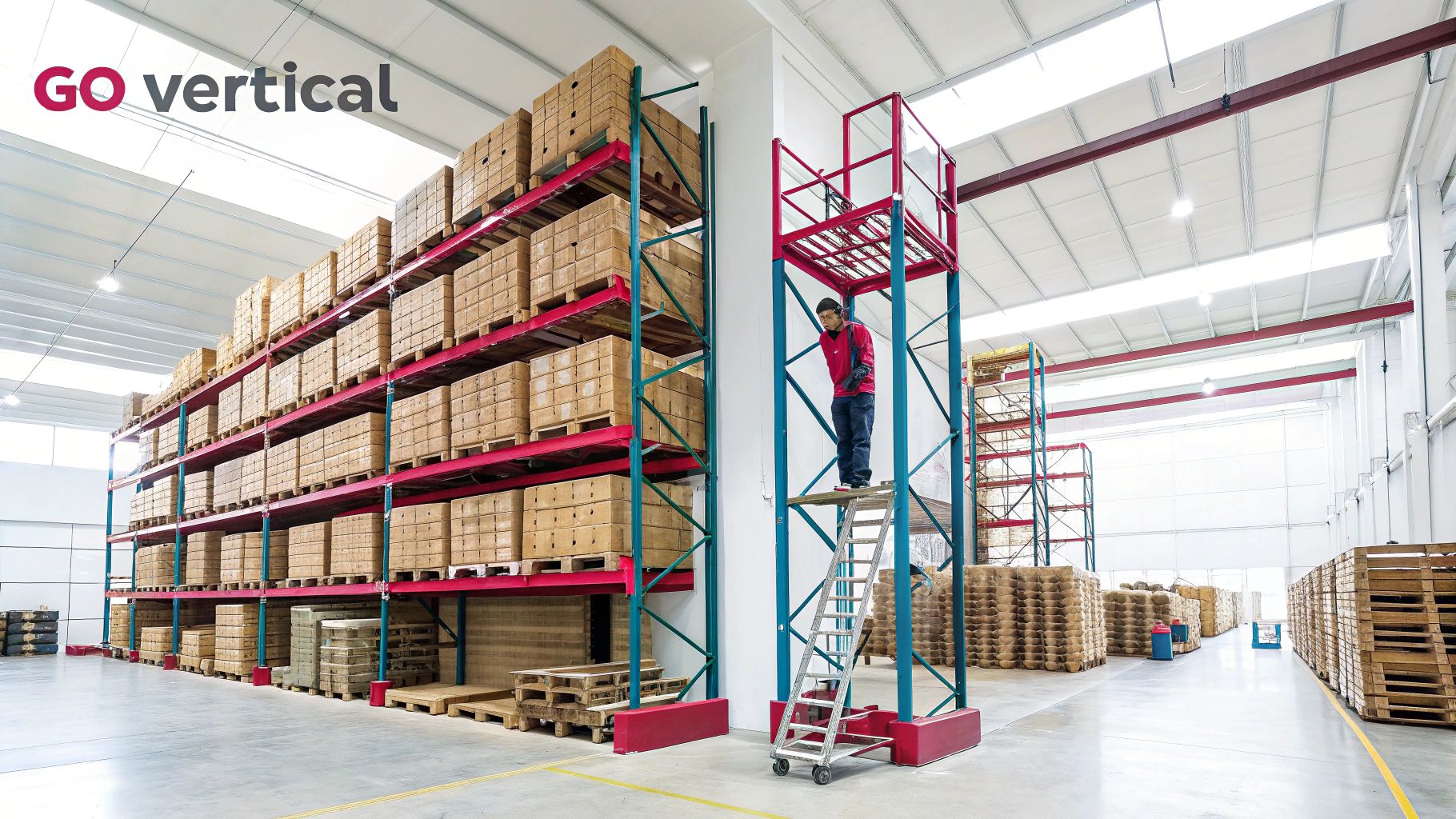
When managers need to optimize their warehouse space, the first instinct is often to expand the floor plan. But the biggest and most cost-effective opportunity is usually right above their heads. Going vertical and capitalizing on your building’s full cube is the fastest way to boost capacity without the massive cost and disruption of new construction.
Smart vertical storage solutions turn that empty air into productive, revenue-generating space. Instead of spreading out, you build up, transforming your existing footprint into a high-density powerhouse. This is not just about adding more shelves; it is a strategic shift in how you see your facility’s potential.
Pallet Racking: The Backbone of Bulk Storage
For any facility handling palletized goods, a well-designed pallet racking system is non-negotiable. It is the skeleton that lets you safely and efficiently store heavy, bulky items. Getting the system right is critical, and it all comes down to your specific inventory and how you move it.
- Selective Racking: This is the go-to for most operations. It offers direct, unimpeded access to every single pallet, making it perfect for facilities with a high number of SKUs and lower volume per SKU. Accessibility is the name of the game here.
- Drive-In Racking: If you are dealing with high volumes of just a few SKUs, this system is a density king. Forklifts drive directly into the racking bays to place or retrieve pallets, but it operates on a last-in, first-out (LIFO) basis, so it is best for uniform inventory.
- Push-Back Racking: Another LIFO system, this setup uses nested carts on inclined rails. When you load a new pallet, it pushes the one behind it back. It gives you much higher density than selective racking but still lets you access different SKUs in each lane.
Choosing the wrong system can cause more headaches than it solves. Our experts can analyze your inventory and provide a free quote to determine the perfect fit for your operation.
Mezzanines: Creating New Floor Space from Thin Air
What if you could double your usable floor space without pulling a single building permit for an expansion? That is exactly what a structural mezzanine delivers. These elevated platforms create an entirely new level inside your facility—perfect for more storage, office space, or light assembly work.
A mezzanine is often the single most impactful investment a facility can make for optimizing warehouse space. It unlocks a massive amount of new, usable area for a fraction of the cost and time required for traditional construction.
Because mezzanines are classified as equipment, not permanent building additions, they often come with significant tax advantages and a much simpler installation process. We can create free, no-obligation designs to show you exactly how a mezzanine could transform your layout.
Specialized Shelving for High-Density Needs
Not everything comes on a pallet. For all the smaller, high-density items like parts, electronics, or secured evidence, specialized shelving is what brings order and space savings. Systems like industrial steel shelving or mobile aisle shelving are engineered to pack a huge number of small SKUs into a minimal footprint.
The key is to match the shelving to the product. With U.S. warehouse rents continuing to climb, investing in smart vertical storage is no longer just an option for growth—it is essential for survival.
The high demand for these space-saving solutions means planning ahead is crucial. Engaging our design team early helps you lock in a faster installation timeline and avoid the operational drag from delaying necessary upgrades.
To see how these systems could work for you, Request a Quote or give us a call at 800-326-4403 today.
Designing a Layout for Optimal Workflow
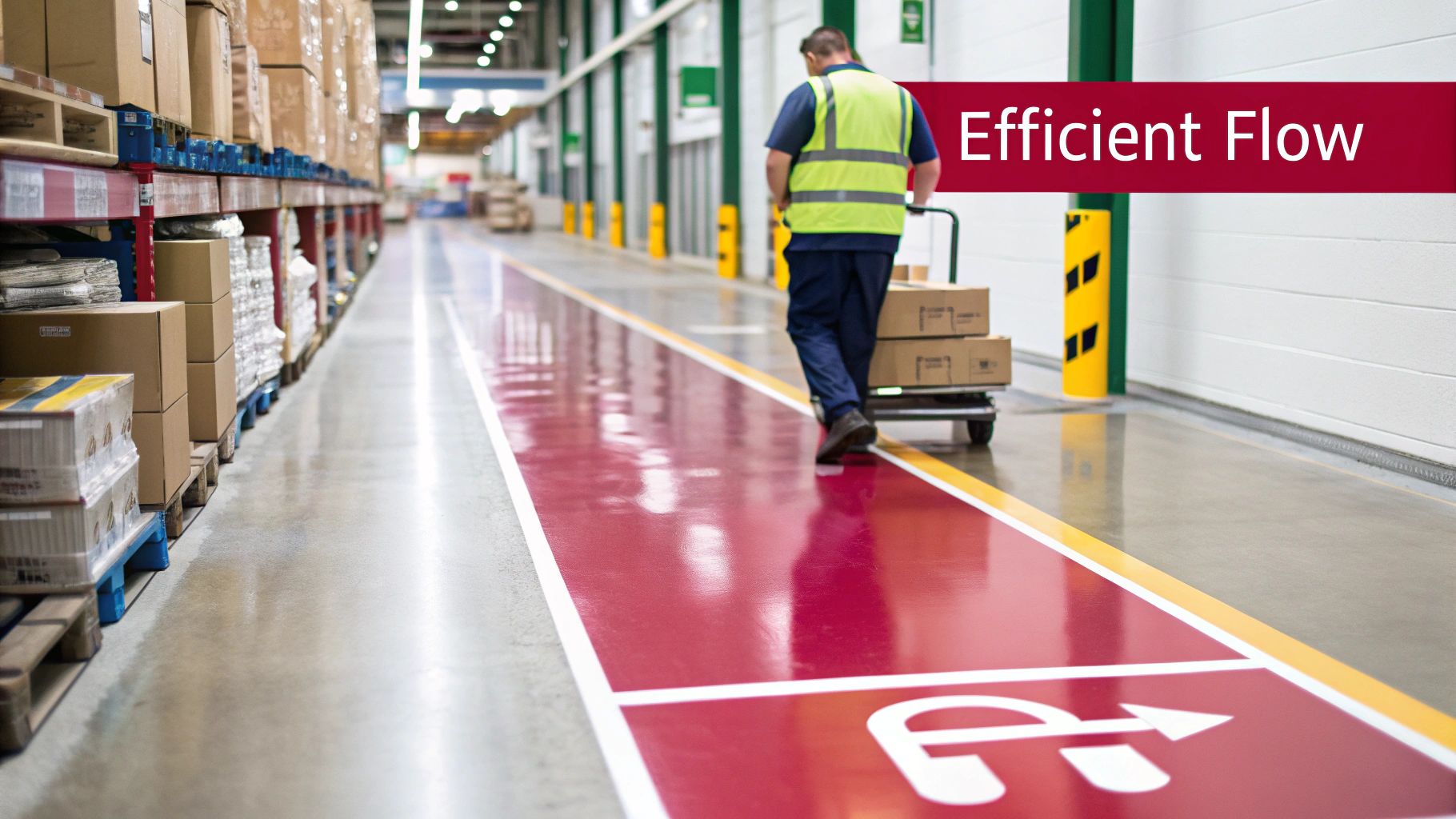
Great storage is only half the battle. If your team cannot move efficiently, you are leaving money on the table. A truly smart layout is all about the flow—the dynamic movement of goods, equipment, and people. The goal is to engineer a path of least resistance from the moment a shipment arrives until an order goes out the door.
This is where you slash travel time, reduce picker fatigue, and get rid of the bottlenecks that quietly kill productivity. It requires thinking beyond just where to put things and getting critical about how they are accessed. This is where a good storage plan becomes a great operational advantage.
Slotting Optimization: The Secret to Faster Picking
At the heart of any high-performance layout is slotting optimization. This is not just about finding an empty spot on a shelf; it is the strategic assignment of storage locations based on hard data. The main driver here is SKU velocity—knowing which items fly off the shelves and which ones tend to sit for a while.
By placing your fastest-moving items in the most accessible, ergonomic locations (think waist-high and close to packing stations), you can make a massive dent in travel time. It is a simple change that reduces physical strain on your team and sends pick rates soaring.
Choosing the Right Flow Strategy
How products physically move through your facility is what ultimately defines its efficiency. Your operational needs will dictate the best strategy, but the two most common approaches are U-shaped and I-shaped flows.
- U-Shaped Flow: In this setup, your receiving and shipping docks are on the same side of the building. Goods come in, move through storage and picking in a “U” pattern, and exit near where they started. This layout is great for consolidating dock operations, which can boost security and simplify staffing for smaller teams.
- I-Shaped (Through) Flow: Here, receiving is at one end and shipping is at the other. Products move in a straight line right through the facility. This is the go-to for high-volume operations because it completely separates inbound and outbound traffic, preventing any congestion at the docks.
The right choice depends on your building’s physical constraints, order volume, and the type of inventory you handle. A well-chosen flow is the foundation to eliminate bottlenecks with a lean warehouse layout design.
Key Takeaway: An optimized workflow is not just about speed. It is about creating a predictable, repeatable process. When your team can move efficiently without crossing paths or hunting for items, accuracy improves, and operational stress goes down.
The Power of Dedicated Functional Zones
You have to create clearly defined zones for different activities if you want to prevent chaos. By dedicating specific areas for receiving, quality control, storage, picking, packing, and shipping, you eliminate crossover traffic and make sure every task is done in a space designed for it. When designing your layout, think about the path goods will take and the equipment needed, ensuring you have properly trained forklift certified personnel.
Proper zoning crushes congestion. By setting up zones based on product type or pick frequency—and putting high-demand items near the docks—travel time plummets.
Our team provides free designs to help you map out these critical zones and engineer a lean, efficient workflow that fits your unique business. Because we specialize in creating these custom layouts, we can help you visualize a more productive facility and put you ahead of the curve.
To see how a professional layout can transform your workflow, Contact Us or call 800-326-4403 for a no-obligation consultation.
Putting Your Optimization Plan Into Action
A perfectly designed warehouse layout is a powerful blueprint, but its true value comes when you bring it to life. This is where planning meets the pavement—or, in this case, the concrete floor. A smooth implementation bridges the gap between your current bottlenecks and future productivity, turning strategic designs into real, tangible gains for your operation.
The focus now shifts from what to do to how to get it done right. Moving forward is all about a coordinated effort between your team, a smart schedule, and an unwavering commitment to safety. With the right approach, you can manage the transition with minimal disruption and start seeing the benefits of your investment almost immediately.
Communicating the Vision to Your Team
Your team is the most critical piece of this puzzle. A new layout directly impacts their daily routines, travel paths, and workflows. Getting everyone on board from the start is not just nice—it is essential. Before a single rack is moved, gather your team and explain the “why” behind the changes.
Show them the new layout and walk them through how it makes their jobs better:
- Less Wasted Motion: Explain how the new slotting strategy means less walking and faster, more efficient picking.
- A Safer Workplace: Point out the wider main aisles, clearer emergency exits, and better overall organization.
- Smarter Workflows: Demonstrate how dedicated zones for receiving and packing will cut down on congestion and frustration.
When your team understands the redesign is meant to make their work easier and safer, you build trust and buy-in. Early, transparent communication turns potential resistance into a collaborative spirit.
Scheduling Installation to Minimize Downtime
We get it—your operation cannot just shut down for a week. That is why a phased implementation plan is the only way to go. We will work directly with you to create a schedule that keeps your core operations running while we transform your facility, section by section.
This often means working during off-peak hours or on weekends to further reduce the impact on your daily throughput. A key advantage we bring to the table is the fastest shipping and delivery in the industry. This ensures that all materials—from racking to mezzanines—arrive exactly when they are needed, preventing the project delays that can derail even the best-laid plans.
A well-managed installation is not just about speed; it is about precision. By securing your project plan with us, you can lock in installation timelines and avoid the operational drag that comes from putting off necessary upgrades. This proactive approach ensures you start reaping the rewards of an optimized layout without pointless interruptions.
Conducting Essential Safety Training
A new layout means new traffic patterns, different equipment placements, and updated storage configurations. Because of this, comprehensive safety training is not just a good idea—it is non-negotiable. It is what empowers your team to operate confidently and securely in the redesigned space. For a deeper dive, you can explore our resources on full warehouse design solutions.
This training absolutely must cover:
- New Traffic Flow: Clearly define designated pedestrian walkways versus equipment-only aisles. No ambiguity.
- Rack Load Capacities: Make sure every single team member understands the weight limits for the new racking systems.
- Emergency Egress Routes: Run drills. Familiarize everyone with the updated evacuation paths until it is second nature.
Investing in thorough training protects your most valuable asset—your people—and ensures your new layout is not only efficient but also fully compliant with safety standards. Acting now means you get these crucial safety upgrades in place sooner rather than later.
To start putting your plan into action, Request a Quote or call us at 800-326-4403 to discuss a phased implementation strategy that works for you.
Your Top Warehouse Optimization Questions, Answered
Deciding to overhaul your warehouse is a big move. It is totally normal to have questions about the process, the cost, and what the real-world payoff looks like. Here are the straight-up, practical answers to the questions we hear most often from managers ready to get serious about their space.
These are not textbook answers. They come from years of being in the trenches, helping facilities just like yours become more efficient and profitable.
How do I know if I need to optimize or move?
This is the big one, and the answer is usually screaming at you from your warehouse floor. Are you constantly fighting for storage room, even when you look up and see nothing but empty air? If your aisles are clogged, pick times are creeping up, and your team is wasting time hunting for inventory, it is almost always a sign to optimize first.
Before you even think about the massive cost and headache of moving, a professional space audit can uncover a surprising amount of hidden potential. It is not uncommon for facilities to boost their storage capacity by 50% or more right where they stand. High-impact solutions like taller pallet racking or a structural mezzanine are the keys to unlocking that potential.
Our free layout consultation is designed to give you a clear answer to this exact question. We will help you calculate the potential gains and map out the smartest path forward, so you can see a direct, dollars-and-cents comparison between optimizing and relocating.
What is the typical ROI on a racking or mezzanine project?
While every project is different, most businesses see a full return on their investment within 12 to 24 months. The payback does not just come from one place; it is a combination of several key improvements all hitting at once.
- Slash Labor Costs: Smarter picking paths and better organization can cut labor expenses by up to 30% by eliminating wasted steps.
- Boost Order Throughput: When everything is easier to find and access, your team can simply get more orders out the door, every single day.
- Avoid Expansion Costs: Honestly, the biggest return is often the money you do not have to spend on leasing or building a bigger facility. That is a huge win.
By truly maximizing your cubic footage, you drive down your storage cost per square foot. We can help you pencil out a specific ROI for your operation during a free quote and design consultation. Just Request a Quote to get that conversation started.
How much disruption should I expect during installation?
We know that shutting down operations is not an option. Our project specialists are experts at creating phased implementation plans designed from day one to keep your business running.
This usually means we work in contained sections of your facility or schedule the install during your off-peak hours, nights, or weekends. A huge part of making this work is our commitment to having the fastest shipping and delivery in the industry. When materials show up on time, projects do not get stuck in limbo, and your operations do not get stalled.
Proactive planning is the single best way to guarantee a smooth installation. It starts with our free layout design service and lets you start reaping the benefits of your new layout that much faster.
Are there safety and compliance standards I need to consider?
Absolutely, and this is non-negotiable. Safety is the foundation of any good warehouse redesign. Any new layout has to be 100% compliant with all OSHA standards and local fire codes. We are talking about everything from minimum aisle widths and clear emergency exits to displaying the correct rack load capacities and ensuring your fire suppression systems are not blocked.
This is not something you should have to become an expert in overnight. Our in-house design and permitting specialists live and breathe these regulations. When you work with us on a free layout design, we make sure your new plan is not only hyper-efficient but also fully compliant. It is about protecting your team, your inventory, and your business.
Conclusion: Transform Your Space, Transform Your Business
Optimizing your warehouse space is not just about making things look neater. It is a fundamental business strategy that directly boosts your capacity, slashes operating costs, and improves safety. By conducting a thorough space audit, maximizing your vertical cube with smart storage like pallet racking and mezzanines, and engineering a workflow for peak efficiency, you turn your existing facility into a competitive advantage. The gains in productivity and the savings from avoiding a costly move deliver a powerful ROI.
At Material Handling USA, we provide more than just quality products and competitive pricing; we offer the end-to-end partnership you need to nail your warehouse optimization project, from the first sketch to the final bolt. With high demand for storage solutions, planning ahead has never been more critical. Starting the conversation now helps you lock in faster installation times and avoid the operational drag that comes from putting off essential upgrades.
Ready to find the right solution for your facility? Contact Us today at Sales@MH-USA.com or call 800-326-4403 to talk with one of our design specialists.