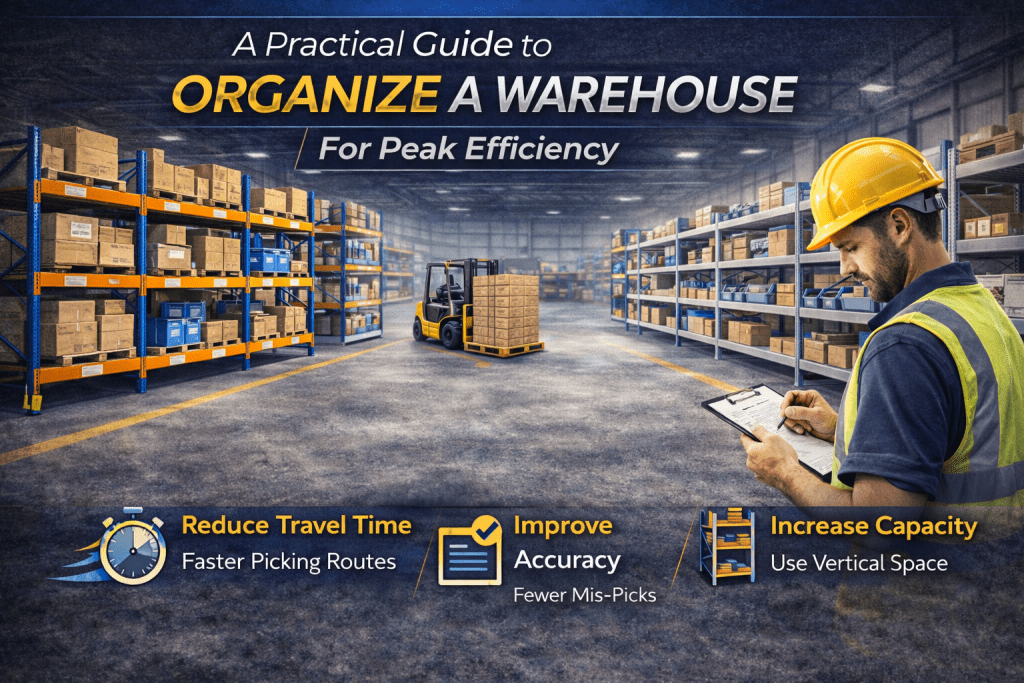
To really get a handle on warehouse organization, you have to create a system where products move logically from receiving to shipping with as little wasted motion as possible. This is not just about tidying up; it is a mix of strategic space planning, efficient inventory management, and having the right storage equipment.
Get this right, and you will have more than a clean facility. You’ll have a high performance operation that slashes costs and gets orders out the door faster.
Why a Well-Organized Warehouse Is Your Greatest Asset
Think of your warehouse as the engine of your entire business. Getting it organized is far more than a cleanup project; it is a critical competitive advantage that hits your bottom line directly. When you decide to organize a warehouse, you are making a direct investment in your company’s operational health and its future.

The benefits ripple through every part of your operation. A clear, logical system cuts down on labor costs by minimizing the time employees spend hunting for items. This naturally speeds up order fulfillment, letting you get products to customers faster, a huge differentiator in today’s market.
The Core Principles of an Efficient Warehouse
There are three core principles that drive the success of any warehouse organization project. Nailing them translates directly into tangible results, like better profitability and higher inventory accuracy.
- Logical Product Flow: Your inventory should move in one direction, from receiving straight through to shipping. This eliminates backtracking and kills bottlenecks before they start. It is the foundation of a smooth workflow.
- Easy Accessibility: This one’s simple but powerful: your most frequently picked items need to be the easiest to get to. This simple change can drastically cut down on travel time for your team.
- Smart Space Utilization: Every square foot in your facility is a valuable asset. Using vertical space with the right racking and shelving maximizes your storage capacity without a costly expansion.
This guide will walk you through the essential phases of a successful reorganization. We will cover everything from auditing your current space to implementing smart inventory systems, making sure you have a complete resource to solve your most pressing operational challenges. For an even deeper dive into process optimization, check out this practical guide to improving warehouse efficiency.
Translating Organization into Business Success
A disorganized space creates hidden costs that quietly eat away at your profits. Lost or misplaced inventory, slow picking times, and even workplace accidents are all symptoms of a poor layout. A well-organized facility, on the other hand, directly boosts performance.
A structured layout and clear processes can turn a cost center into a competitive advantage. It moves your operation from reactive problem solving to proactive, efficient execution.
Implementing a thoughtful organization plan is one of the most impactful projects a manager can take on. It is the key to unlocking higher productivity and building a more resilient supply chain. As you continue reading, you will find actionable steps and expert insights to guide you. For a deeper dive, you can also explore our resources on comprehensive warehouse optimization.
Auditing Your Space and Setting Clear Goals
Before you even think about moving a pallet rack or taping a new aisle, the first real step in organizing a warehouse is a top to bottom audit of your current operations. This is not about pointing fingers or finding fault. It’s about getting cold, hard data to see what’s really happening on your floor, uncovering those hidden bottlenecks, and setting a firm baseline for every improvement you make. This way, every decision is backed by facts, not just a hunch.
Start by walking the floor and mapping out the entire life of your products. Trace the path an item takes from the second it hits the receiving dock, through put away, into storage, during picking, and all the way to packing and shipping. It sounds simple, but you would be amazed at what this little exercise reveals, unexpected detours, frustrating backtracking, and all the little things that eat up your team’s valuable time.
Conducting a Data-Backed Analysis
A walkthrough gives you the feel of the place, but the numbers tell the true story. One of the most powerful tools for this is an ABC analysis. It is a classic inventory method for a reason; it works. You are essentially sorting your products based on how much value they move.
- ‘A’ Items: These are your rock stars. They are the fastest moving products that make up about 20% of your inventory but generate a massive 80% of your revenue.
- ‘B’ Items: Your steady, middle of the road products. They move moderately and contribute a fair amount to sales.
- ‘C’ Items: These are the slow movers. They make up the bulk of your inventory items but bring in the least amount of revenue.
Knowing this breakdown is everything. Your ‘A’ items need to be the easiest to get to, located right near your shipping zones to slash travel time for your pickers. One of the most common, and expensive, mistakes we see is burying these high velocity products in the back of the warehouse.
This kind of analysis is what lets you plan an intelligent layout. Since 2000, manufacturing warehouse space has shot up by 86.2%. That puts immense pressure on operations managers to handle more and more inventory without breaking the bank on real estate. This is exactly why smart layouts and flexible solutions are no longer a “nice to have”; they are critical for growing without chaos. Discover more insights on the growing warehousing market and its challenges.
Your Comprehensive Warehouse Audit Checklist
Beyond how your products flow, you need to get a handle on the physical space itself, its limitations and its hidden potential. Use this checklist to make sure you do not miss anything important.
| Area of Assessment | Key Questions to Ask |
|---|---|
| Space Utilization | How much dead air is above our racks? Are our aisles wider than the equipment requires? |
| Storage Systems | Is our current racking actually right for our product mix? Any damaged or overloaded shelves? |
| Material Handling | Do we have the right equipment (forklifts, pallet jacks)? Are there maintenance backlogs? |
| Facility Condition | What’s the state of the floor? Is the lighting good enough in every corner? Are all dock doors working properly? |
| Safety & Compliance | Are fire lanes and emergency exits completely clear? Are safety signs visible and correct? |
Running through these questions gives you a 360 degree view of your warehouse’s health. It is not just about finding problems. It is about arming yourself with the intelligence you need to make improvements that actually stick.
Setting Specific and Measurable Goals
Once you have your audit data, you can finally move from vague ideas like “we need to be more efficient” to concrete targets. Clear goals are the bedrock of any successful re-organization. They give you a destination and a way to know when you have arrived.
The goal of an audit is not to find problems; it is to define opportunities. It transforms your project from a reaction to a strategic initiative with a clear return on investment.
Instead of fuzzy goals, you can set sharp, well defined objectives like these:
- Reduce picker travel time by 20% by moving all ‘A’ items to the front.
- Increase storage capacity by 25% by installing taller pallet racking.
- Decrease order mis-picks by 15% by rolling out a new barcode labeling system.
These are the kinds of targets that should guide your layout design and equipment choices. They ensure every dollar you spend and every hour you invest is focused on a real business outcome. With these goals locked in, you’re ready to start designing a warehouse that truly works for you.
Do not hesitate to Contact Us for a free, no obligation layout and design to see how your goals can become a reality.
Designing a Strategic Warehouse Layout for Better Workflow
You have done the audit and set your goals. Now it is time to turn that data into a physical blueprint for efficiency. Designing a strategic warehouse layout is not just about cramming in as many racks as possible; it is about creating a deliberate, efficient path for your products and your people.
The mission is simple: cut down on wasted movement. Every unnecessary step a team member takes is a drain on your productivity and your bottom line. A smart layout is your best defense against the hidden costs of bottlenecks and disorganized flow.
The Essential Zones of an Effective Warehouse
Every well run warehouse, no matter what it stores, is built around a few core zones. How you connect these areas will make or break your workflow.
- Receiving: This is ground zero for all incoming inventory. You need ample space here for unloading trucks, inspecting goods for damage, and checking shipments against purchase orders. Do not skimp on this area; a bottleneck here backs up the entire operation.
- Put-Away and Storage: Once products are checked in, they move to their home. This zone is often split into bulk storage for full pallets and forward picking areas, where smaller, ready to ship quantities are staged for easy access.
- Picking: This is the heart of your warehouse and where your biggest labor costs live. Pickers can spend over half their time just walking the floor. The design of this zone directly impacts how many orders you can get out the door each day.
- Packing and Shipping: After an order is picked, it lands here for final packaging, labeling, and staging before being loaded onto outbound trucks.
The diagram below shows how the initial steps of mapping your flow and analyzing your products feed directly into how you should design these zones.

This process is about making sure your layout is based on hard data, not just guesswork.
Choosing the Right Product Flow Strategy
How inventory moves from one zone to the next defines your entire workflow. The shape of your building and the location of your dock doors will be the biggest factors, but most warehouses fall into one of two primary patterns.
- U-Shaped Flow: This is one of the most common layouts for a reason. Receiving and shipping docks sit side by side on the same wall. Inventory flows in a “U” pattern, in through receiving, back into storage, and then forward to shipping. It is fantastic for cross docking and makes managing dock traffic much simpler.
- I-Shaped Flow (or Through-Flow): You will see this in facilities with docks on opposite ends of the building. Inventory moves in a straight line from receiving on one side to shipping on the other. It is a clean, direct path often favored by large scale distribution centers.
Remember that ABC analysis you did? This is where it pays off. Your fastest moving ‘A’ items must be stored on the most direct route between receiving and shipping, as close as possible to the packing stations. And if you have multiple levels, do not forget that vertical movement is just as important. Knowing the specifics of freight elevator dimensions and codes can make a huge difference in your multi-story workflow.
A layout designed around your fastest moving products is a layout designed for profitability. It directly attacks your single biggest labor cost: travel time.
Planning for Future Growth and Flexibility
The perfect layout for today might be a straitjacket tomorrow. Product lines change, order volumes spike, and operations evolve. A rigid design will quickly become your biggest operational headache.
This is why building in flexibility is a strategic move. Think modular. Think vertical. Incorporating systems that can adapt saves you from a complete, and costly, overhaul down the road.
Solutions like industrial mezzanines can literally double your usable floor space by building up instead of out. You can create new zones for storage, light assembly, or even office space without the expense of new construction. The key is to eliminate bottlenecks with a lean warehouse layout design by planning for that future flexibility right from the start.
Choosing the Right Storage and Handling Equipment
Your strategic layout is the blueprint for a more efficient operation, but it is the physical equipment that truly brings that vision to life. This is where the rubber meets the road; selecting the right storage systems and material handling tools is a critical step to organize a warehouse. This is not just about filling space; it is about making a calculated investment in systems that perfectly match your inventory profile and workflow.
The real goal here is to strike that perfect balance between storage density, product accessibility, and your budget. The choices you make will directly impact everything from picking speeds to how well you can utilize every single square foot of your facility.
Matching Storage Systems to Your Inventory
The foundation of any organized warehouse is its storage system. Pallet racking and industrial shelving are definitely not one size fits all solutions. The best choice depends entirely on what you store, how often it moves, and how much of it you have.
Here is a look at some of the most common systems we see in the field and what they are best for:
-
Selective Pallet Racking: This is the most popular type of racking for a reason. It gives you 100% accessibility to every single pallet, making it perfect for operations with a high number of different SKUs and low pallet quantities per SKU. If you run a First-In, First-Out (FIFO) inventory system, selective racking is your go to.
-
Drive-In/Drive-Thru Racking: When you need to maximize every inch of space, drive in racking is a powerhouse. It is built for high volume, low SKU inventory and is ideal for Last-In, First-Out (LIFO) systems. Think of it as the perfect solution for storing huge quantities of identical products.
-
Industrial Shelving: For all your hand stacked items, loose parts, or smaller cartons, versatile shelving is essential. From heavy duty steel shelving for bulkier items to mobile aisle systems that reclaim floor space, the right setup keeps all your non palletized inventory organized and easy to grab. Explore our complete guide to warehouse shelving and racks to see the full range of options.
Deciding between these requires a hard look at your product data. That ABC analysis you performed earlier? That’s your roadmap to making the smartest equipment investment.
A Practical Comparison of Storage Solutions
To help you weigh the pros and cons, we have put together a table that breaks down the key characteristics of common storage systems. Use it to line up your operational needs with the right equipment.
Warehouse Storage System Comparison
| Storage System | Best For | Storage Density | Inventory Access (Selectivity) | Relative Cost |
|---|---|---|---|---|
| Selective Racking | High SKU diversity, FIFO operations | Moderate | High (100% access) | Low |
| Drive-In Racking | High-volume, low-SKU products, LIFO | High | Low (last pallet in is first out) | Moderate |
| Push Back Racking | High-density LIFO, moderate SKUs | High | Moderate | High |
| Pallet Flow Racking | High-density FIFO, perishable goods | Very High | High (first pallet in is first out) | Very High |
| Industrial Shelving | Hand-stacked items, parts, cartons | Varies | High | Low-Moderate |
Choosing the right system has never been more important. The relentless growth of e-commerce has seen warehouse utilization increase by a staggering 611.68% since the pandemic began, driving the need for smarter storage. The entire warehousing market is projected to hit USD 5,077.15 billion by 2034, highlighting just how critical organized facilities are for modern fulfillment. Read the full report on the warehousing market to understand these industry wide shifts.
Selecting the Right Material Handling Equipment
Once your products are stored, you need an efficient way to move them. Your material handling equipment is essentially the circulatory system of your warehouse. The right tools ensure inventory flows smoothly from receiving to shipping, cutting down on manual labor and speeding up your processes.
Your choice here depends on practical factors like your facility size, average pallet weights, and the distances your team has to travel.
Choosing handling equipment is a direct investment in your team’s productivity. The right tool not only speeds up the work but also improves safety and reduces physical strain on your employees.
A simple manual pallet jack is perfect for moving pallets short distances on the ground floor. But for facilities that need to lift pallets onto racks, a walkie stacker or a forklift becomes necessary. In larger operations with predictable, high volume workflows, installing a conveyor system can dramatically slash travel time and create a highly efficient, automated flow for moving goods from picking zones to packing stations.
Our team can help you navigate these choices. With our free layout design service, we can model your workflow and recommend the perfect combination of storage and handling equipment to meet your goals. Many managers find that just talking through their layout with an expert solidifies their purchasing decisions and prevents costly mistakes down the line.
Ready to see how the right equipment can transform your space? Request a Quote or give us a call at (800) 326-4403 for a no obligation consultation.
Implementing Smart Inventory Management and Processes
A great warehouse layout is just the skeleton; disciplined processes are the muscles that make it move. Without the right operational systems in place, even the most strategic design will fall apart under the daily grind. This is where you connect your physical space to your digital tools, creating a system that keeps things running smoothly and accurately for the long haul.
It all starts with a smart inventory placement strategy, often called slotting. The goal here is simple: store items in the most efficient location based on how often they’re picked. This is a direct application of the ABC analysis you did earlier, making sure your layout works just as hard as your team does.

Mastering Inventory Slotting Strategies
There are two main ways to approach slotting, and the best fit really depends on your product mix and how fast things move.
-
Fixed Bin Location: In this classic system, every single SKU gets its own permanent, designated home. This makes it incredibly easy for new staff to learn where products are, which can seriously speed up both put away and picking, especially for teams without advanced tech. It’s a solid choice for businesses with a stable and predictable product line.
-
Random/Chaotic Location: The name sounds messy, but it’s actually a hyper efficient, data driven strategy that requires a good Warehouse Management System (WMS). Items are simply placed in any available open slot, and the system keeps track of every single location. This approach is fantastic for maximizing your storage space since you are not leaving “reserved” spots empty for items that are out of stock.
For most modern warehouses, a hybrid approach is the sweet spot. You could use fixed locations for your fastest moving ‘A’ items to guarantee quick and consistent access, while using a random location strategy for your slower ‘B’ and ‘C’ items to get the most out of your available shelf space.
Choosing an Efficient Order Picking Method
Order picking is almost always the most labor intensive, and expensive, part of warehouse operations. Picking the right method for your facility can slash travel time for your team and dramatically boost the number of orders you can get out the door each day.
| Picking Method | How It Works | Best For |
|---|---|---|
| Batch Picking | A picker grabs all the items for multiple orders at once, completing the entire “batch” in a single trip. | Operations with lots of small orders and a low number of SKUs per order. |
| Zone Picking | Pickers are assigned to specific zones and only pick items within their area. Orders are passed from one zone to the next. | Larger warehouses with high order volumes and a wide variety of SKUs. |
| Wave Picking | Orders are released to the floor in coordinated groups, or “waves,” to prevent bottlenecks in packing and shipping. | Complex operations that need to carefully balance the workload across all departments. |
Getting this right minimizes footsteps and maximizes productivity. It’s how you turn a major cost center into a powerful fulfillment engine.
The Foundation of Accuracy: Labeling and WMS
None of these strategies work without a rock solid foundation of data accuracy. This is where a consistent labeling system and a powerful Warehouse Management System (WMS) become absolutely essential. Every bin, rack, and aisle needs a clear barcode or QR code. This is the bedrock of real inventory control.
A good WMS gives you a real time, bird’s eye view of your entire operation. It turns guesswork into certainty and lets you manage inventory with precision instead of just reacting to problems as they pop up.
This level of digital oversight is critical for growth. In fact, 36% of companies are planning to invest in predictive analytics in the next five years, and that kind of technology is completely dependent on the clean, reliable data a WMS provides. As warehouse automation becomes more common, the role of these systems only grows more important.
You can discover more about current warehousing trends to see how technology is reshaping the industry. Implementing these smart processes is the final piece of the puzzle; it is what creates a warehouse that is not only efficient today but ready for whatever comes next.
If you are ready to connect your physical layout with the smart processes that make it shine, we can help. Request a Quote or call us at (800) 326-4403 to discuss how the right systems can support your goals.
Ready to Build a Better Warehouse?
Turning your warehouse from a necessary cost into a competitive advantage is a big undertaking, but the payoff, both operationally and financially, is huge. This guide has walked you through the nuts and bolts of organizing your space for peak performance. You now have a clear roadmap for auditing what you have, designing a smarter layout, picking the right gear, and implementing systems that actually work.
But remember, a great warehouse reorganization is not a one and done project. It’s a commitment to getting a little more efficient, a little more accurate, every single day.
We know a better warehouse is well within your reach, and our team is ready to help you make it happen. A well planned project started today means a faster install and less time lost to operational headaches down the road.
With our competitive pricing, industry leading shipping speeds, and free, no obligation layout design services, you’ve got a partner dedicated to your success. Our in house experts can help you visualize a more productive space and select the exact equipment to hit your goals.
The opportunity to create a more efficient, profitable operation is right in front of you. Let’s get started on building a warehouse that works as hard as you do.
Contact Us today or call (800) 326-4403 for your free consultation and quote.
Your Top Warehouse Organization Questions, Answered
When you are staring down the barrel of a full warehouse reorganization, a lot of questions pop up. It’s a big project, and you want to get it right. We hear these questions all the time from operations managers and buyers, so let us clear them up and get you moving forward with confidence.
How Long Does It Take to Organize a Warehouse?
This is the classic “it depends” question, but I can give you some real world context. A simple re-slotting project in a small stockroom might be a couple of long weekends. But if you are talking a full scale overhaul of a distribution center, think new racking, conveyor systems, and software integration, you should plan for several months from the first drawing to the final sign off.
The timeline really hinges on a few key factors:
- Size and Complexity: A 10,000 sq ft facility is a different beast than a 200,000 sq ft one.
- Equipment Lead Times: Custom pallet racking or a structural mezzanine is not an off the shelf purchase. Lead times can be significant.
- Operational Disruption: How much downtime can you afford? A phased approach takes longer but keeps orders moving.
The best way to keep a project on track is solid planning. The sooner you start the design process, the more buffer you have for securing equipment and booking installation crews, who are always in high demand.
What Is the First Step to Organize a Warehouse?
Before you move a single box or even think about buying new shelving, the absolute first step is to conduct a thorough audit of your current space and workflow. You need a data backed picture of what’s working and what’s costing you time and money.
This is not just a quick walkthrough. It means mapping your product flow from receiving to shipping, running an ABC analysis to pinpoint your fastest moving items, and getting real numbers on your current space utilization.
I cannot stress this enough: without a proper audit, you are just guessing. You might end up investing in a solution that does not solve your actual problem. Starting with data ensures every decision you make is strategic and gets you closer to your efficiency goals.
How Can I Maximize My Existing Warehouse Space?
When you run out of floor space, the best place to look is up. Think vertically. Most warehouses have a surprising amount of unused vertical real estate. Installing taller pallet racking systems or adding a structural mezzanine can literally double your storage capacity without the massive expense and headache of a building expansion.
Another pro tip is to look at your aisle widths. Are they wider than your forklifts or other equipment actually need? Shaving even a foot off each aisle adds up to a huge amount of recoverable space across an entire facility. For the right type of inventory, high density storage like drive in or push back racking can also be a game changer, dramatically increasing your storage density.
Ready to see what’s possible in your footprint? Request a Quote and we will provide a free layout design that shows you how to get the most out of every square foot.
At Material Handling USA, we bring the expertise and equipment you need to build a more productive and efficient warehouse. From free, no obligation designs to some of the fastest delivery speeds in the industry, we are here to be your partner in success. Contact Us or call our team directly at (800) 326-4403 to get started.