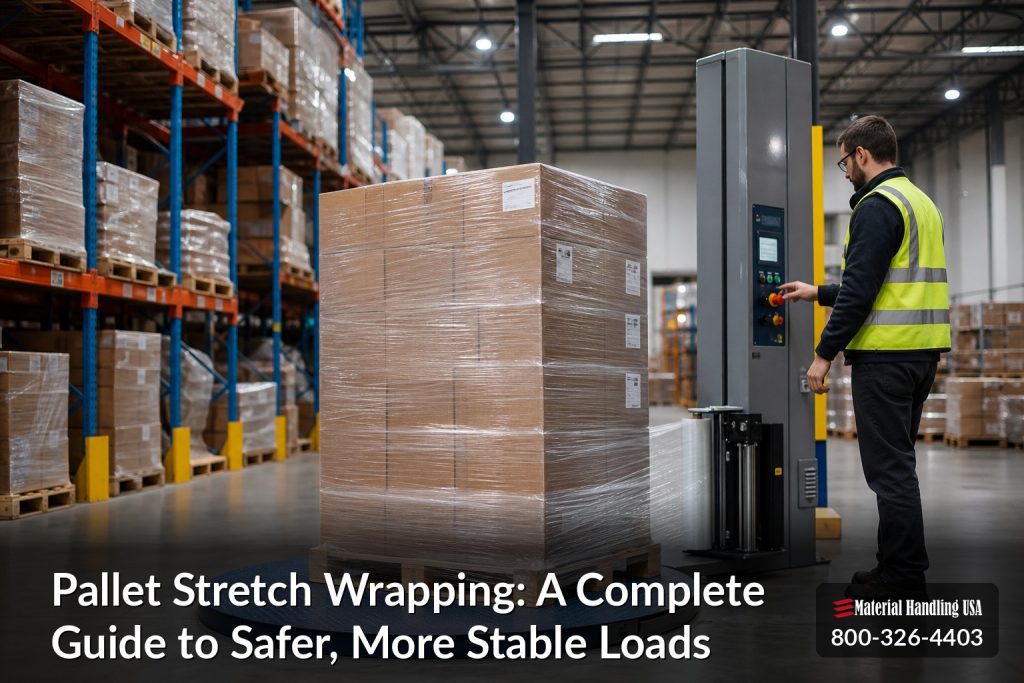
Pallet stretch wrapping is the process of tightly wrapping a palletized load in layers of stretchable plastic film. It's a simple concept, but getting it right is your first line of defense against product damage, load shifting, and serious safety hazards all the way down the supply chain. When done correctly, it guarantees your goods show up at their destination in the exact same condition they left your warehouse.
Why Pallet Stretch Wrapping Is Your First Line of Defense
Thinking of pallet stretch wrapping as just the last step in packing is a huge mistake. It's a critical business strategy that directly impacts your bottom line. A solid wrapping process isn't just an operational task; it's the backbone of your supply chain's integrity and a key driver of both profitability and safety. Nail this, and you stop the costly domino effect that always starts with a single, wobbly pallet.
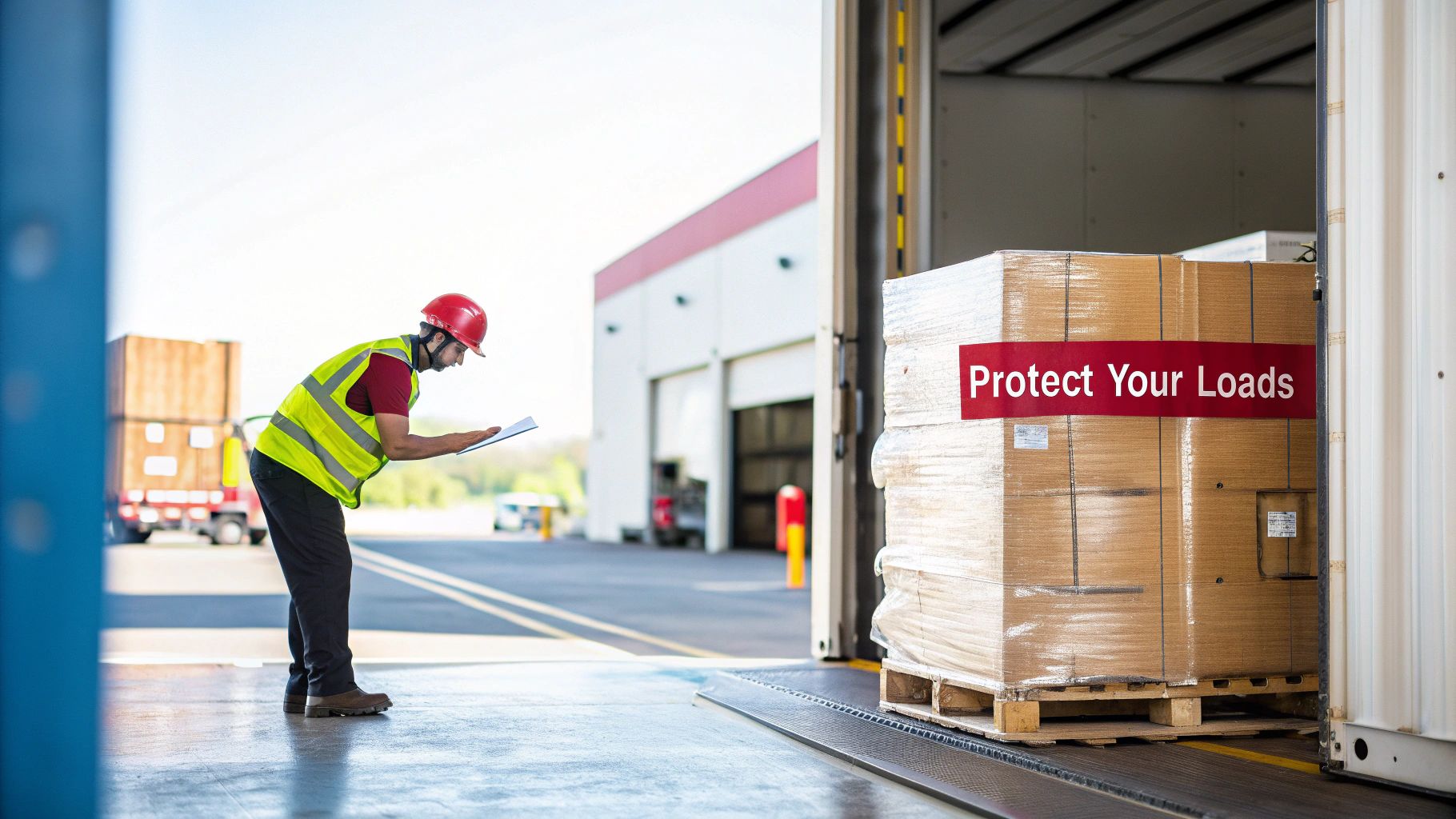
A poorly wrapped pallet is a ticking time bomb. It’s not a matter of if it will fail, but when. The consequences can be anything from minor scuffs on a product to a full-blown catastrophic collapse that damages equipment, injures your crew, and grinds operations to a halt.
The Strategic Impact of Effective Pallet Wrapping
A dialed in pallet wrapping strategy delivers clear, measurable benefits across your entire operation. This isn't just about wrapping boxes; it's about safeguarding your inventory, protecting your people, and seeing an immediate, obvious return on investment.
Here's a quick look at how a refined pallet wrapping process pays off in real, tangible ways for your business.
| Benefit | Impact on Your Operations |
|---|---|
| Product Protection | Slashes damage from shifting, moisture, dust, and tampering. This means fewer returns and less money wasted on replacements. |
| Cost Reduction | Directly lowers costs tied to damaged goods, inefficient labor, and using way too much film. |
| Improved Safety | Keeps unstable loads from toppling over, protecting employees from serious injury and minimizing your liability. |
| Enhanced Efficiency | Makes loading and unloading a breeze, leading to faster truck turnaround times and higher daily throughput. |
| Load Unification | Locks individual items into one solid, stable unit, making the whole pallet much easier and safer to handle and transport. |
This process is about more than just securing the load on the pallet. It’s also about fulfilling your part in understanding supply chain responsibility, a framework that ensures everyone is accountable for safe transport practices. Getting your wrapping right confirms you're aligned with broader industry safety standards, which is non-negotiable.
The industry knows how crucial this is, and the numbers back it up. The global stretch wrapper market is expected to grow significantly, underscoring just how essential this equipment has become in modern logistics.
By making a robust wrapping strategy a priority, you’re not just protecting products; you’re fortifying your entire operational framework from the ground up.
Choosing Your Pallet Stretch Wrapping Equipment
Picking the right stretch wrapping equipment can be the difference between a smooth running warehouse and a constant bottleneck. Your choice directly impacts everything from labor costs and material use to how many pallets you can get out the door. The three main routes, manual, semi-automatic, and automatic, are each built for a different scale of operation.
Making the right investment isn't just about the price tag. You have to think about the total cost of ownership and the returns you'll get from better safety, consistent wraps, and serious film savings.
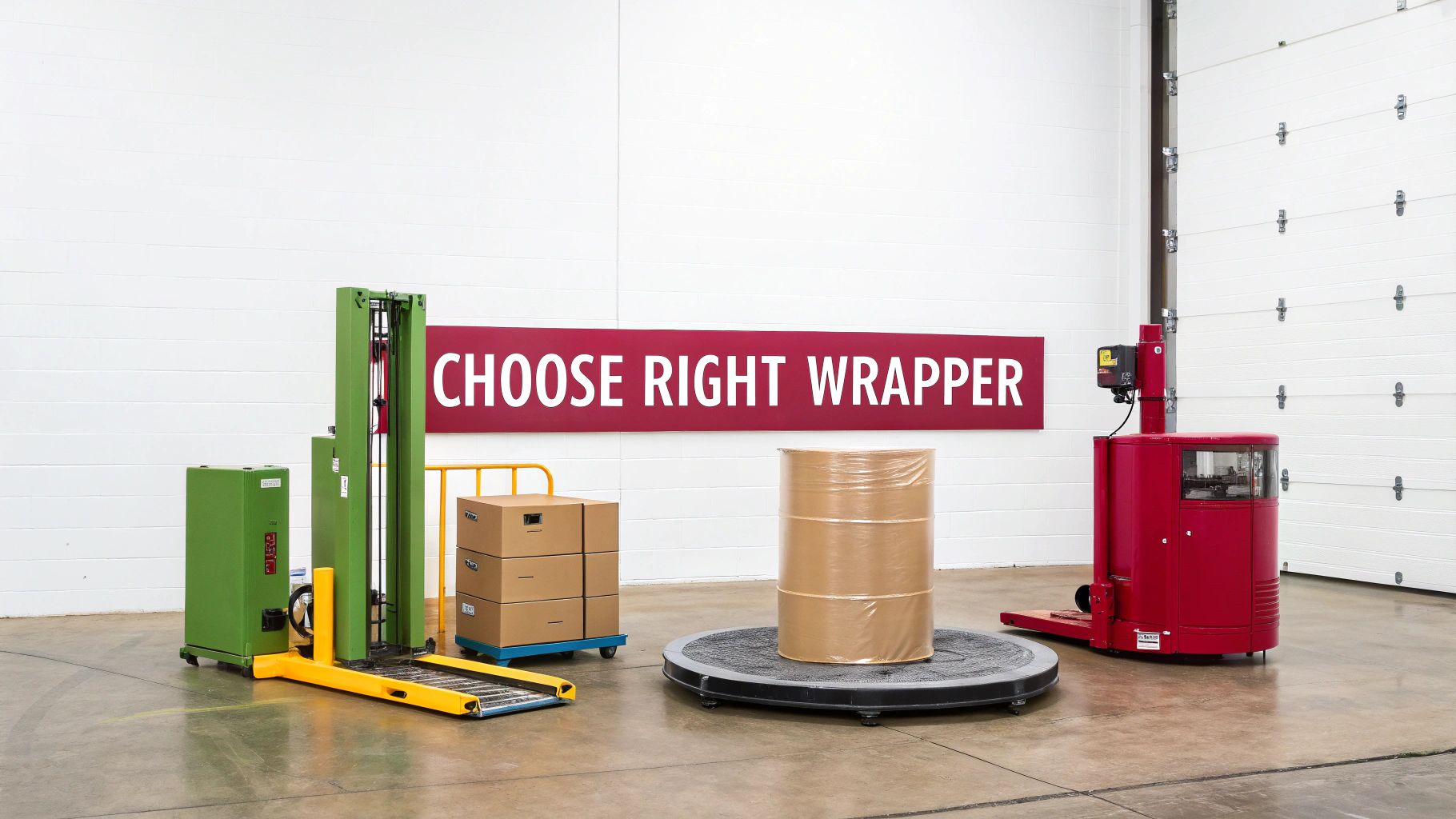
Manual Hand Wrapping
Let's start with the basics: manual wrapping. This is where an operator literally walks circles around the pallet with a hand held dispenser. It’s a common starting point for low volume operations, and it makes sense if you’re shipping fewer than 10-15 pallets per day.
The initial cost is next to nothing, but that's where the good news ends. Consistency is a huge problem. The tension and overlap will vary from person to person, and even from the top to the bottom of the same pallet. To make up for this, operators often use way more film than needed, which drives up your material costs. Plus, it's a physically demanding job that can lead to worker fatigue and injuries.
Semi Automatic Stretch Wrappers
This is where things get serious. Semi-automatic machines are a massive leap forward in both efficiency and consistency. The operator places the pallet on a turntable, attaches the film, and hits a button. The machine takes over from there, delivering a perfect wrap every single time.
These wrappers are the workhorses for most mid-sized facilities, particularly those shipping between 15 and 100 pallets per day. Yes, the upfront investment is higher than a hand wrapper, but the ROI usually comes fast. You'll see it in labor savings, less film waste, and loads that are far more secure.
Key Takeaway: Upgrading to a semi-automatic wrapper often pays for itself surprisingly quickly. By precisely controlling film tension and pre-stretch, these machines can slash film usage by 50% to 75% compared to doing it by hand. Those are real, ongoing savings.
The numbers back it up. Semi-automatic machines are popular for good reason; they hit that sweet spot of affordability and performance. This segment of the market continues to grow as warehouses and distribution centers prioritize efficiency.
Fully Automatic Stretch Wrappers
For the high volume players, big distribution centers and manufacturing plants shipping more than 100 pallets per day, fully automatic systems are the only way to go. These machines are integrated right into a conveyor line, meaning there's zero operator intervention needed for the wrapping process.
Pallets move automatically into the wrap zone, get wrapped to exact specifications, and then continue down the line to the staging area. It's a completely hands off approach that maximizes throughput, eliminates wrapping related labor costs, and produces perfectly identical loads every time. If you want to see the full spectrum of options, our guide on stretch wrap machines for pallets is a great resource.
Equipment Comparison at a Glance
Use this direct comparison to quickly evaluate which stretch wrapping equipment aligns with your operational needs, budget, and volume.
| Feature | Manual Wrapping | Semi-Automatic Wrapper | Automatic Wrapper |
|---|---|---|---|
| Pallets Per Day | Under 15 | 15 – 100 | 100+ |
| Upfront Cost | Very Low | Moderate | High |
| Labor Requirement | High (1 Operator Full Time) | Low (Operator for loading/starting) | Very Low (No Operator Needed) |
| Wrap Consistency | Low / Inconsistent | High / Very Consistent | Highest / Perfectly Consistent |
| Film Efficiency | Very Low (No Pre-stretch) | High (Powered Pre-stretch) | Highest (Advanced Pre-stretch) |
| Best For | Startups, very low volume | Small to mid-sized warehouses | High-volume distribution centers |
Ultimately, choosing the right machine is a strategic decision that affects your entire operation. Take a hard look at your daily pallet volume, labor situation, and budget to find the system that will deliver the best long term value.
How to Select the Right Stretch Film
Picking the right stretch film for your pallets is just as critical as the wrapping equipment itself. The film is what does the real work of securing your load, and a bad choice can quickly lead to damaged products, wasted material, and ballooning costs.
Let's cut through the jargon and get into the practical side of film selection. Making a smart choice here is one of the easiest ways to protect your shipments and your bottom line.
The two main players you'll hear about are cast stretch film and blown stretch film. They're made differently, and those differences give them unique characteristics. Knowing when to use which is the first step to mastering your wrapping operation.
Cast vs. Blown Stretch Film: A Head to Head Comparison
Cast film is what most people are familiar with. It's made by pouring a thermoplastic material onto a chilled roller, which cools it rapidly. This process gives the film fantastic clarity (perfect for scanning barcodes), a quiet unwind, and a very consistent thickness. It's an excellent all rounder, especially for uniform loads where a clean, professional look matters.
Blown film, on the other hand, is made by extruding the material through a circular die and blowing it up like a bubble. This creates a much tougher, more resilient film with incredible puncture and tear resistance. The trade-offs? It’s usually hazy, much louder coming off the roll, and costs a bit more.
To make it simple, here’s a quick breakdown:
| Feature | Cast Stretch Film | Blown Stretch Film |
|---|---|---|
| Clarity | High (Excellent for scanning barcodes) | Low (Often hazy or cloudy) |
| Puncture Resistance | Good | Excellent (Best for sharp corners) |
| Cling | Two Sided (Can cause pallets to stick) | One Sided (Pallets won't stick together) |
| Unwind Noise | Quiet | Loud |
| Cost | Lower | Higher |
| Best For | Uniform, lightweight loads; retail displays | Heavy, irregular loads; sharp edges |
For most modern warehouses handling standard pallet loads, cast film is the workhorse. It's cost effective and performs beautifully. But if you’re wrapping things like heavy machine parts or pallets with sharp, unforgiving corners, the extra toughness of blown film is a smart investment to prevent load failures in transit.
Matching Film Gauge to Your Load Type
Film gauge, or thickness, is a balancing act. Go too thin, and you risk a load failure. Go too thick, and you're literally wrapping your profits in plastic and throwing money away on every pallet.
Here’s a real world guide for matching gauge to your loads:
- Light & Uniform Loads (up to 1,200 lbs): Think simple, stable loads like boxes of paper goods. A 60-70 gauge high performance film is usually more than enough.
- Medium & Irregular Loads (1,200 to 2,200 lbs): For mixed goods or items that could shift around a bit, stepping up to an 80 gauge film gives you the holding force you need.
- Heavy or Unstable Loads (2,200 to 3,000 lbs): If you're wrapping heavy items like cases of beverages or wobbly, unstable loads, a 90-120 gauge film is your safest bet for maximum containment.
Expert Tip: Don't just equate thickness with strength. Modern high performance films are engineered to deliver superior strength at a lower gauge. This allows you to "down-gauge," saving a significant amount of money without compromising the integrity of your load.
Maximizing Yield with High Performance Film
If you're running a semi-automatic or automatic stretch wrapper, you absolutely need to be using high performance machine film. This isn't your standard hand wrap; it's engineered with multiple layers designed to stretch much, much further, a concept called pre-stretch.
A machine with a powered pre-stretch system can stretch this film by 200% to 300% before it even touches the pallet. This means a single 5,000 foot roll of film effectively becomes 15,000 to 20,000 feet of usable film. The impact on your cost per pallet is massive. Want to dig deeper into optimizing all your materials? Check out our comprehensive wholesale shipping supplies buying guide.
Ultimately, choosing the right film comes down to knowing your load types, your equipment, and your budget. By getting the fundamentals right, film type, gauge, and performance, you can ensure every pallet that leaves your dock is secure, stable, and wrapped at the lowest possible cost.
When you’re ready to dial in the perfect film for your operation, our team is here to help. Request a Quote or Call (800) 326-4403 for expert guidance.
Perfecting Your Pallet Wrapping Technique
You can have the best stretch film and the most expensive machine on the market, but if your wrapping technique is off, you're going to have failures. It's that simple. Mastering the application isn't just about going through the motions; it's about understanding the physics of load containment. A proper technique is what turns a stack of boxes into a single, stable unit that’s ready for the chaos of transit.
From the moment you anchor the film to the final cut, every move you make contributes to the load's integrity. Little mistakes, a weak anchor, a poor overlap, can compromise the entire wrap. That leads to shifted products, damaged goods, and serious safety hazards. Let's break down the essential techniques your team needs to nail a perfect wrap, every single time.
Preparing the Pallet and Anchoring the Film
Before a single inch of film comes off the roll, your foundation has to be solid. Start with a clean, sturdy pallet. That’s non-negotiable. Give it a quick once over for protruding nails, splinters, or sharp corners that could rip the film wide open. Stack your load to be as square and centered as possible, and whatever you do, avoid overhang. Overhang is just asking to get snagged and torn during transport.
Now for the most critical part: the first wrap. Your film needs a rock solid anchor point to build the tension required for a secure load. A common shortcut is just tucking the film under the corner of a box. Don't do it. It’s unreliable and often leads to the wrap unraveling.
Instead, take about two feet of film and twist it into a tight, rope like tail. Thread this "rope" through an opening in the pallet base and tie a secure knot. This creates a powerful anchor that won't slip when the tension kicks in.
This visual guide breaks down the key decisions in optimizing your entire pallet stretch wrapping process, from load characteristics to the right equipment settings.
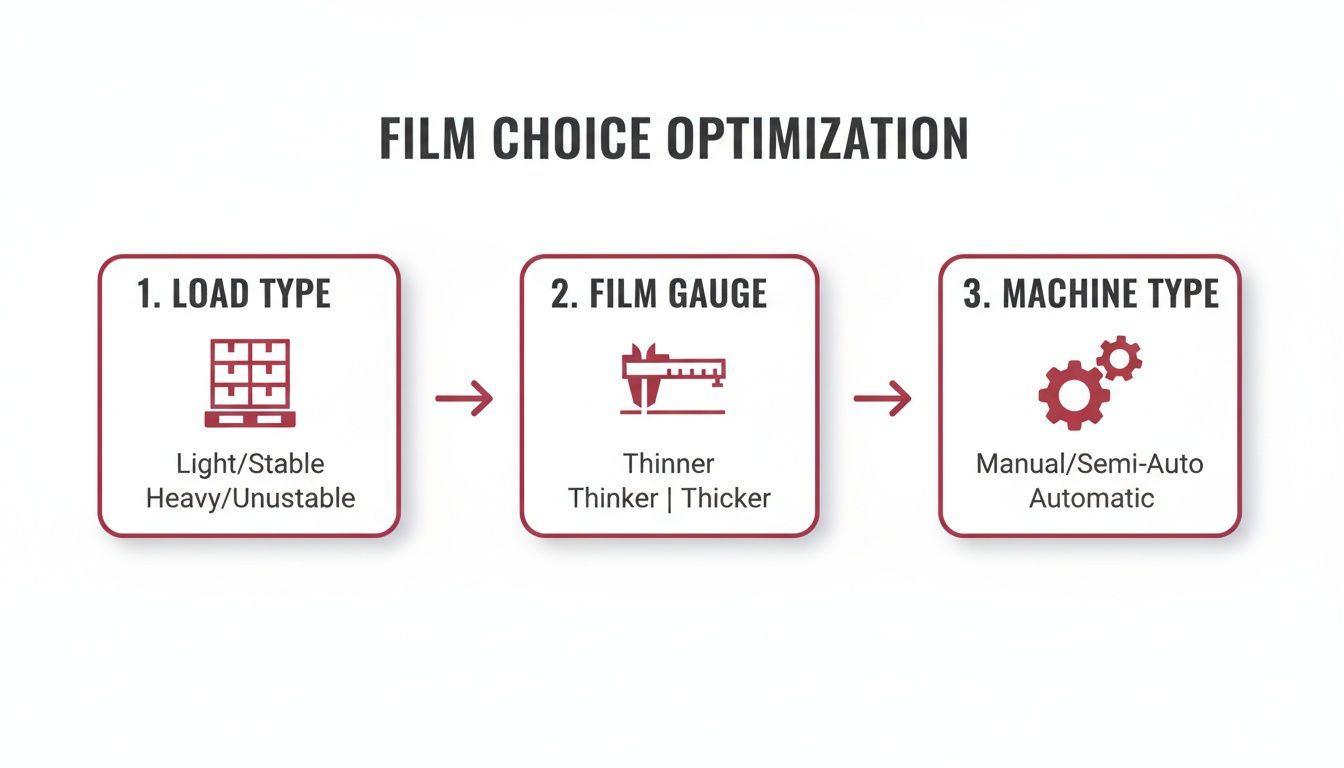
As the flowchart shows, choosing the right film gauge and machine is directly tied to your load's characteristics. Getting the first step right makes the entire process smoother.
Mastering the Base and Overlap
The bottom of the pallet is where failure usually begins. It’s the point of maximum force and shifting potential. To fight this, the first three to five wraps should be dedicated to locking the load to the pallet itself. This means wrapping the bottom layer of boxes and the top of the pallet deck together, creating one unified block. This locking technique is hands down the most effective way to stop products from sliding off during a sudden stop or sharp turn.
As you start moving up the pallet, the overlap between film layers is everything. The industry standard is a 50% overlap. This guarantees that every part of the load is covered by at least two layers of film, distributing the containment force evenly and eliminating weak spots. Skimping on the overlap creates gaps and dramatically reduces the wrap's strength, making it vulnerable to failure. A consistent, even overlap is the sign of a professional job.
Pro Tip: If you're running a semi-automatic machine, you can fine tune this by adjusting the speed of the film carriage's vertical movement. A slower ascent increases the overlap, adding more holding force for heavier or unstable loads. A faster ascent reduces overlap, which can save film on lighter, more uniform pallets.
Securing the Top with Cross Wrapping
The top layers of a pallet are notorious for shifting and toppling over. The best way to prevent this is a technique called cross-wrapping, sometimes known as an "X-pattern." Once you reach the top of the load, don't just stop. Continue wrapping, but guide the film diagonally across the top corners of the load, forming an "X." A couple of passes will do the trick.
This simple pattern locks the top layers of boxes together, preventing them from being jostled loose from above. After you've made your "X," finish the job with two or three standard horizontal wraps around the very top of the load to tie everything together.
Using the right equipment for these techniques is crucial, as it directly impacts both efficiency and safety. Pallet stretch wrapping machines are the workhorses for securing loads, with the market valued at USD 1.2 billion in 2024 and projected to hit USD 2.5 billion by 2033. This growth shows just how much businesses rely on automation to reduce labor costs and ensure pallets can survive tough transport, cutting down on the expensive damage claims that plague the shipping industry. To see where things are headed, you can explore the full pallet stretch wrapping machine market report.
Terminating the Wrap Securely
How you finish is just as important as how you start. A long, dangling film tail is a major hazard. It can get snagged by forklifts, caught in conveyor systems, or even trip an employee, which could unravel the entire pallet.
Cut the film close to the pallet, leaving just a few inches of tail. Then, smooth that tail flat against the side of the pallet. The film’s natural cling is more than enough to hold it securely without any tape or adhesives. This leaves you with a clean, professional, and safe finish.
By focusing on these core techniques, a solid anchor, a locked base, 50% overlap, a cross-wrapped top, and a clean finish, you can ensure your pallet stretch wrapping process is effective, efficient, and safe. This isn't just wrapping; it's strategic load containment.
Ready to put these techniques into practice with the right supplies? Contact Us for a free consultation on optimizing your entire wrapping operation.
Spotting and Fixing Common Pallet Wrapping Problems
Even the smoothest warehouse operations hit snags. When it comes to stretch wrapping, a snapped film, a crushed box corner, or a load that looks like it's leaning after a short trip are all red flags. These aren't just one off annoyances; they're signs that your wrapping process needs a quick tune up.
Fixing these issues on the fly is about more than just salvaging a single pallet. It's about preventing product damage, cutting down on wasted film, and keeping your entire line moving. Let’s dive into the most common wrapping headaches we see in the field and the straightforward ways your team can solve them for good.
Film Breaks and Tears: What's Really Going On?
Nothing grinds an operation to a halt faster than a roll of film that keeps snapping. It's a massive waste of time and material, forcing your operator to stop, re-thread, and start over. In our experience, it almost always comes down to one of two culprits.
First, take a hard look at your load. Are there sharp corners on the boxes, the products themselves, or even the pallet? A splinter of wood or a protruding nail from a pallet is all it takes to puncture the film as it's stretched taut.
- The Fix: Get some cardboard or plastic corner protectors on that load before you wrap. This simple step gives the film a smooth, rounded surface to glide over, and you'll see your film breaks drop dramatically.
Second, you might be getting a little too aggressive with your machine's tension settings. Cranking the tension too high stretches the film past its limits, and it will inevitably snap, especially as it navigates a corner.
- The Fix: Dial back the tension or post-stretch settings on your wrapper. Your goal is to apply just enough force to secure the load, not to strangle it. Make small adjustments and test until you find the right balance.
Why Your Products Are Getting Crushed
If you're unwrapping a pallet only to find crushed boxes, your containment force is way too high. This is a classic mistake when moving from a heavy, rigid product to something lighter and more fragile. The force needed for a pallet of concrete blocks will absolutely destroy a pallet of potato chip boxes.
A great wrap is about containment, not compression. You're trying to unitize the load so it moves as a single, solid block, not squeeze everything into a smaller cube.
Thankfully, the solution is simple: ease up on your machine's tension settings. Start low and do a test wrap. Give the load a push. If it feels wobbly, bump the tension up in small increments and try again. Keep going until you find that sweet spot where the load is secure but the product is still in perfect shape.
Solving the Mystery of the Shifting Load
A load that slides off its pallet during transit is probably the most dangerous, and expensive, wrapping failure. It happens when the film isn't properly bonded to the pallet itself. The products might be wrapped tightly together, but if the whole unit isn't locked to its base, it's just waiting to slide off during a hard brake or a sharp turn.
The key is creating a rock solid bond between the bottom layer of your product and the pallet.
- Start Strong: Don't just tuck the film under a box. Twist the first few feet of film into a tight "rope," thread it through a corner of the pallet, and tie it off securely.
- Lock the Load: Make sure the first 3 to 5 revolutions of the wrap cover both the bottom layer of boxes and the top few inches of the pallet. This creates an anchor, effectively locking the load to its foundation and stopping any side to side movement.
If these problems keep popping up, it might be a signal that it's time for an equipment check up or a fresh look at your overall process. Our team lives and breathes this stuff. Request a Quote for new equipment or Contact Us for a free layout consultation to get your wrapping operation running perfectly.
Your Partner in Optimized Packaging Solutions
You now have a solid playbook for mastering pallet stretch wrapping, from picking the right equipment and film to locking down the best techniques. It all boils down to some pretty clear wins: lower costs, safer loads, and a more efficient warehouse floor. The next step is putting it all into practice and seeing those results firsthand.
Here at MH-USA, we don't just sell products; we deliver complete, end to end solutions. We get that effective wrapping is just one piece of your operational puzzle. A real partner helps you see the bigger picture, sometimes even connecting the dots to specialized services like supply chain management outsourcing services to get your entire operation humming.
Elevate Your Entire Workflow
With our competitive pricing and the fastest shipping in the industry, our team of experts is ready to be your go-to source for every material handling need. We believe in showing our value from the get go, which is why we always offer free layouts and designs with no obligation.
Take the next step toward a safer, more cost effective warehouse. Let our specialists show you how the right equipment and supplies can transform your packaging process from a cost center into a competitive advantage.
Don't let wrapping inefficiencies or product damage eat into your bottom line. Contact Us today to talk with a specialist, or Request a Quote for a detailed estimate built around your exact needs.
You can also call us directly at (800) 326-4403.
A Few Questions We Hear All the Time
When you're dealing with stretch wrapping day in and day out, a few questions always seem to pop up. Here are some quick answers from our experience to help you sort out common challenges on the warehouse floor.
How Much Stretch Film Should I Actually Use on a Pallet?
There’s no magic number here; it really boils down to your specific load. The weight, how stable (or unstable) it is, and what kind of wrapper you're running all play a huge role.
But if you need a solid rule of thumb, here's what we tell people: Make sure you get at least two to three solid wraps around the very top and very bottom of the load. For the main body of the pallet, you want about a 50% overlap as you spiral up or down. This simple technique ensures you don't have any weak spots with just a single, vulnerable layer of film.
Keep in mind, if you're using a modern machine with pre-stretch capabilities and a high performance film, you'll see a dramatic drop in how much film you use while getting a much tighter, more secure wrap.
What's the Real Difference Between Pre-Stretch and Post-Stretch?
Getting these two terms straight is probably the single most important step to wrapping pallets effectively and saving money.
Pre-stretch is something that happens inside the machine before the film even makes contact with your pallet. The film is fed between two special rollers, with one spinning faster than the other. This action stretches the film, often by 200% or more, unlocking its full strength and potential. It’s the key to getting the most out of every roll.
Post-stretch, which most operators just call tension, is the force applied as the film comes off the machine and is wrapped onto the load. This is what actually squeezes your products together, creating the containment force that keeps everything from shifting.
How Often Should I Get My Stretch Wrapper Serviced?
Don't wait for it to break. Proactive maintenance is your best defense against unexpected downtime right in the middle of a big shipping day.
We always recommend a good preventative maintenance check up every three to six months. The right frequency for you will depend on how hard you run the machine and the environment it's in; a dusty warehouse will need more frequent attention than a clean one.
Pay close attention to the rollers, the film grippers, and the entire film carriage assembly. A little bit of consistent cleaning and lubrication goes a long way in preventing the most common (and annoying) equipment failures.
Can I Just Swap Out Different Types of Stretch Film on My Machine?
You can, but it's not a simple plug and play situation. Just throwing a new roll on without tweaking your machine settings is asking for trouble.
To get the performance you're paying for, you absolutely have to calibrate the machine's settings, especially tension and pre-stretch levels, to match the specific film you're loading. If you try to run a high performance film on a machine that isn't set up for it, you'll likely just end up with constant film breaks, a pile of wasted plastic, and dangerously unstable pallets.
Ready to implement these best practices with the right equipment and supplies? The experts at Material Handling USA offer free, no-obligation layout designs to optimize your entire packaging workflow. Contact Us today to learn more or Request a Quote for your specific needs.
Who This Is For
Our pallet stretch wrapping solutions are ideal for:
- Warehouse managers
- Facility planners
- Property managers
- Government coordinators
- Manufacturing managers
- Distribution operators
Frequently Asked Questions About Pallet Stretch Wrapping
What are the benefits of pallet stretch wrapping?
Proper pallet stretch wrapping reduces product damage during shipping, improves load stability, and lowers freight costs. It also speeds up the loading process and protects against moisture and dust.
How do I choose the right shipping supplies?
Consider your product weight, dimensions, fragility, and shipping method. Match box sizes closely to product dimensions to reduce void fill and DIM weight charges. Use quality tape and stretch wrap for load security.
Do you offer bulk pricing?
Yes, we offer volume discounts on shipping supplies and packaging materials. Contact us for bulk pricing on boxes, tape, stretch wrap, labels, and other supplies.
Related Resources
Need Help? Get a Free Quote
Material Handling USA can help you find the right solution. Call (800) 573-3252 or email sales@mh-usa.com to speak with a product specialist. We provide free quotes, layout assistance, and expert recommendations.