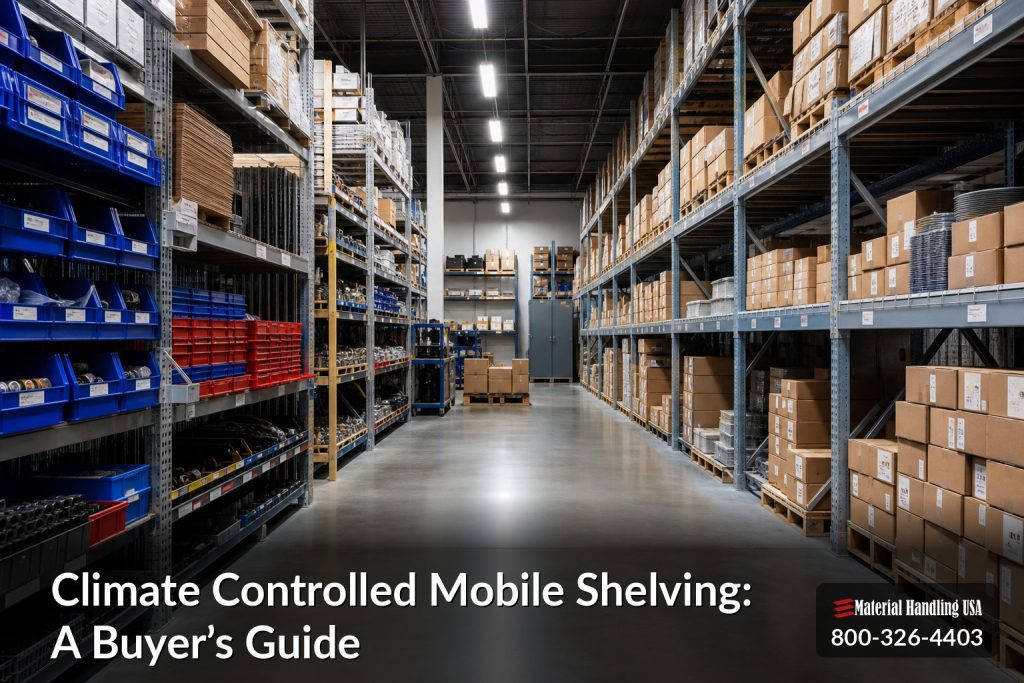
Space runs out faster than most facilities expect. A lab adds new sample types, an evidence room keeps older cases longer, or a cold storage area takes on more SKUs without getting any larger. The problem usually isn't just capacity. It's capacity plus protection, access, and accountability.
Static shelving makes that problem worse over time. Fixed aisles lock in wasted square footage, airflow can be uneven, and every added row creates another trade-off between storage density and retrieval speed. For facilities managers and buyers, climate controlled mobile shelving is worth looking at because it addresses all three pressures at once: space, environmental stability, and operational control.
The Growing Need for Smarter Storage Solutions
Most buyers start this search when they're boxed in by their building. Expanding a footprint is expensive, disruptive, and often slower than operations can tolerate. That's especially true in labs, pharmaceutical storage, secure archives, and evidence rooms where the contents themselves require tight environmental conditions.
Climate controlled mobile shelving changes the math inside the room you already have. Instead of building around multiple permanent aisles, the shelving moves on a carriage system so staff open access only where they need it. That high-density approach is one reason these systems can deliver space savings of up to three times compared to traditional static shelving by eliminating fixed aisles, according to the Self Storage Association climate control data spotlight.

That same source notes the broader shelving market is projected to grow at a 5.90% CAGR from 2023 to 2030, which tracks with what many buyers are already seeing on the ground. More facilities are trying to recover space inside conditioned environments rather than add new conditioned environments.
Where static shelving falls short
A standard shelving row works fine when floor area is cheap and environmental precision isn't critical. In a cold room, evidence vault, or research storage area, those assumptions usually don't hold.
Common failure points include:
- Locked-in aisle loss: Permanent aisles consume valuable square footage whether anyone is using them or not.
- Inconsistent storage planning: Teams keep adding standalone units, which creates awkward corners and poor traffic flow.
- Harder environmental control: More conditioned air volume and poor airflow paths can make stable storage harder to maintain.
Practical rule: If your inventory is sensitive and your room is expensive to condition, every unused aisle becomes an operating cost.
Why buyers are treating this as an investment
The strongest projects aren't framed as “we need better shelves.” They're framed as “we need to protect sensitive inventory in a fixed footprint without compromising workflow.” That's a different purchasing conversation. It shifts attention from shelf count to storage density, airflow, compliance readiness, and long-term operating efficiency.
What Is Climate Controlled Mobile Shelving
Climate controlled mobile shelving is a high-density shelving system installed on movable carriages, typically running on floor-mounted rails, inside an environment where temperature control matters. Think of compact library shelving, but built for cold rooms, controlled labs, secure evidence storage, and other spaces where environmental performance matters as much as storage capacity.
The moving base is what makes the system mobile. The climate controlled part comes from the shelving design, room integration, and airflow behavior that support consistent storage conditions for sensitive materials.

The main components
Most systems are built around a few core elements:
- Carriages: The mobile base that supports the shelving and moves along rails.
- Rail system: Guides travel and keeps rows aligned.
- Shelving uprights and shelves: Often open-wire or other airflow-friendly configurations suited to temperature-controlled rooms.
- Controls: Manual assist, mechanical drive, or powered controls depending on the application.
- Safety features: Motion sensors, anti-tip protections, emergency stops, and access control where needed.
For buyers comparing options, a broader guide to mobile shelving systems helps separate basic compact storage from systems meant for controlled environments.
What makes it different from standard mobile shelving
Not every mobile shelving system belongs in a climate-sensitive room. Standard compact shelving may increase density, but it won't automatically support the airflow, materials, finishes, and operating tolerances needed in refrigerated or tightly monitored spaces.
That's where many specs go wrong. Buyers focus on movement and capacity first, then realize later that the shelving material, airflow pattern, or carriage design doesn't fit the environment.
| System type | Best use | Main limitation |
|---|---|---|
| Static shelving | General storage with fixed access | Wastes aisle space in expensive rooms |
| Standard mobile shelving | High-density storage in general interiors | May not be optimized for airflow or thermal conditions |
| Climate controlled mobile shelving | Sensitive inventory in conditioned or monitored rooms | Requires tighter design coordination |
A good compact shelving system saves space. A good climate controlled mobile shelving system saves space without working against your environmental requirements.
Primary Benefits and Key Applications
The value of climate controlled mobile shelving shows up in three places that matter to buyers: space optimization, asset protection, and operational efficiency. If one of those is missing, the project usually underperforms.

Space optimization in high-value rooms
In controlled storage, floor space is never just floor space. It's conditioned, monitored, and often hard to expand. Mobile systems solve that by consolidating access aisles into a single active aisle while keeping inventory densely stored.
For labs and pharmaceutical stockrooms, that means more storage inside the same room envelope. For secure facilities, it can mean preserving chain-of-custody workflows without pushing overflow inventory into secondary spaces.
A useful example is mobile shelving for pharmaceutical supplies, where dense storage and reliable access have to coexist.
Asset protection through airflow and temperature consistency
Climate controlled mobile shelving proves its value in these specialized environments. According to Labs USA's climate-controlled mobile shelves overview, mounting adjustable open-wire shelves on motorized carriages creates a compact, high-density configuration that can reduce the energy required for heating and cooling by up to 50% compared to static shelving, while the open-wire design supports 99% airflow penetration for more uniform temperature distribution.
That matters in applications like:
- Laboratories: Biological samples, reagents, and test materials need consistent conditions and organized access.
- Evidence rooms: Sensitive materials can't be exposed to uncontrolled hot or cold spots.
- Electronics and technical storage: Components often perform better when stored in stable, monitored environments.
Operational efficiency for daily retrieval
The best systems don't just store more. They help people retrieve inventory with less wasted movement and fewer handling errors. In practice, that means staff can open the aisle they need, reach the right shelf faster, and keep high-value materials organized by category, case, lot, or workflow.
That improvement is especially visible in spaces where contents are frequently accessed but still need protection:
| Application | What the system helps solve |
|---|---|
| Research labs | Organized sample access in conditioned rooms |
| Pharma storage | Dense inventory storage with better airflow |
| Evidence storage | Secure access and environmental consistency |
| Cold storage rooms | Reduced conditioned air volume and better use of footprint |
A system like this works best when layout, access patterns, and environmental goals are designed together. Density alone doesn't fix poor organization.
A Buyer's Checklist for System Design
Most specification problems happen before the first rail is installed. Buyers know they need more storage, but they haven't translated that need into load, climate, safety, and access requirements. A disciplined checklist prevents expensive redesigns.

Start with load and structure
The shelving has to match what you're storing, not just how much of it you have. Dense systems concentrate weight differently than static layouts, so carriage design and floor evaluation matter early.
The most important structural baseline from a buyer's standpoint is this: for fluctuating temperatures, systems should use riveted-bonding construction with minimum 2.7 mm thick C-profile steel carriages, delivering a load capacity of 1385 kg per linear meter and maintaining durability across -30°C to +40°C, according to the government master specification reference. That same reference ties the spec to moisture control by preventing conditions that can contribute to mold.
Confirm the environmental conditions
A buyer should be able to answer these questions before requesting a quote:
- Temperature range: What operating temperatures must the system tolerate?
- Humidity exposure: Is the room dry, refrigerated, humidified, or washdown-prone?
- Airflow expectations: Does the application benefit from open-wire storage or another configuration?
- Condensation risk: Are there conditions that could encourage corrosion or moisture accumulation?
Decide how people will access it
A slow or awkward system creates workarounds, and workarounds usually create safety issues.
Manual systems can make sense in some lower-volume applications. Powered systems are often the better fit when rows are long, inventory is heavy, or access needs to be frequent and controlled. Security-sensitive environments may also require controlled access methods and audit-friendly operation.
Buyer note: If multiple teams access the room, design for the busiest user and the heaviest load case, not the average day.
Review safety and reliability details
These details often get treated like add-ons. They shouldn't.
Use this short review list when comparing quotes:
- Anti-tip protection: Required for stable operation in high-density systems.
- Rail and carriage alignment: Poor alignment causes wear, access issues, and service calls.
- Emergency stop capability: Important in powered systems and secure environments.
- Sensor package: Motion and positioning features reduce operational risk.
- Finish selection: Match coatings and materials to moisture and corrosion exposure.
Ask about controls and monitoring readiness
Even if your project doesn't need software integration on day one, the system shouldn't block it later. Buyers are increasingly planning for monitored storage, especially in regulated environments. That means asking whether the controls, carriage design, and room layout can accommodate sensors, logging, and future environmental integration.
A practical comparison helps:
| Checklist item | What to confirm before purchase |
|---|---|
| Load capacity | Stored item weight, carriage rating, floor support |
| Climate specs | Temperature range, humidity, airflow needs |
| Access method | Manual or powered operation, user frequency |
| Safety package | Anti-tip, emergency stop, motion sensing |
| Monitoring readiness | Compatibility with logging and facility systems |
Integrating Environmental Controls and Monitoring
A climate controlled mobile shelving system shouldn't be treated as a stand-alone fixture. In a well-planned room, it operates as part of the larger environmental system, alongside HVAC, room controls, and monitoring protocols.
That integration matters because the shelving changes how air moves and how storage density affects the conditioned space. In practical terms, the shelves, controls, and room systems need to support the same environmental target instead of fighting each other.

Why monitoring now matters more
Monitoring is no longer just a nice feature for sensitive storage. The requirement is getting more specific. The Invicta Mobile Shelving article on lesser-known applications notes that emerging compliance updates such as FDA 21 CFR Part 11 and ISO 17025 are mandating verifiable temperature logging for mobile units, and that reports have identified a significant share of evidence rooms failing audits due to unmonitored temperature variances caused by shelving shifts.
That changes the buyer's question from “Can this room stay cold?” to “Can we verify what happened inside this room over time?”
What good integration looks like
A well-integrated system typically includes:
- Environmental sensors placed where conditions can shift
- Logging that matches your documentation requirements
- Coordination with HVAC or building management workflows
- Alerting when movement, access, or environmental readings fall outside accepted conditions
For facilities dealing with humidity management in adjacent spaces, even a residential-focused resource like this guide on reducing household humidity is a useful reminder of the basics: air movement, moisture sources, and monitoring all affect stability. In commercial settings, those same principles become more technical and more important.
Designing for compliance instead of retrofitting later
Retrofit monitoring is possible, but it's rarely the cleanest route. It's better to plan cable routing, sensor placement, control access, and data expectations while the room is being designed. For example, environmental chamber storage solutions are often evaluated with this same mindset because storage hardware and environmental verification have to support each other.
If your team may need audit trails later, design for them now. Retrofitting proof is usually harder than installing proof.
Installation Maintenance and Calculating ROI
Installation goes smoother when the room is surveyed properly up front. Rail placement, floor condition, clearance, door swing, and access routes all affect the final result. In climate-sensitive areas, installation sequencing also matters because buyers want to limit disruption to active storage environments.
Maintenance is usually straightforward if the system is specified correctly. Keep rails clean, inspect movement and alignment, confirm safety devices function as intended, and review any environmental sensor hardware on a regular schedule. Problems tend to come from neglect, impact damage, or using the system outside its intended load and environmental conditions.
Where the return comes from
The business case usually comes from a combination of savings and risk reduction rather than a single line item.
| ROI factor | Why it matters |
|---|---|
| Recovered floor space | Can delay expansion, renovation, or off-site overflow |
| Lower conditioned air volume | Supports more efficient heating and cooling |
| Better organization | Reduces search time and handling mistakes |
| Inventory protection | Lowers exposure to spoilage, damage, or compliance issues |
Some buyers focus too narrowly on initial system cost. That misses the bigger operational question. If your current layout forces overflow storage, slows retrieval, or makes environmental verification harder, the existing setup is already costing you.
A practical buying advantage also gets overlooked. Projects that move into planning sooner usually have more flexibility in layout, installation timing, and product selection. Waiting until storage is already failing often means tighter schedules and fewer options.
Partner with Material Handling USA for Your Solution
Climate controlled mobile shelving makes sense when space is tight, stored items are sensitive, and accountability matters. The right system improves storage density, supports environmental consistency, and gives your team a more controlled way to retrieve and manage inventory.
Material Handling USA helps buyers evaluate these projects with free layouts and designs, no-obligation quotes, competitive pricing, and fast shipping options. If you're comparing systems for a lab, warehouse, cold room, or secure storage area, Request a Quote, Contact Us, email Sales@MH-USA.com, or Call 800-326-4403 to discuss your layout before schedules tighten and installation windows become harder to secure.
Frequently Asked Questions
| Question | Answer |
|---|---|
| Can climate controlled mobile shelving be installed in an existing room? | Yes, in many cases it can. The key issues are floor condition, clearances, door access, and whether the room's environmental systems can support the new storage density. |
| Do motorized systems always require major utility work? | Not always. Power needs depend on the drive system and control package. This should be reviewed during design so electrical planning happens before installation. |
| Is open-wire shelving always the right choice? | It's often a strong fit in controlled environments because airflow matters, but the best configuration depends on what you store and how the room is conditioned. |
| What features help evidence storage projects? | Buyers usually prioritize secure access, reliable movement, anti-tip protection, and environmental logging that supports documentation requirements. |
| Can these systems support future monitoring upgrades? | Many can, if the project is designed with controls and sensor compatibility in mind from the start. |
| How do I know whether to choose manual or powered operation? | Base that choice on row length, load, access frequency, and the number of users. Heavy, frequently accessed systems usually justify powered operation more easily. |
If you're planning a climate controlled mobile shelving project, Material Handling USA can help you compare configurations, review your space, and build a practical layout with no obligation. For pricing, lead times, and design guidance, Request a Quote, Contact Us, or Call (800) 326-4403.
Related Resources
- Pipp Mobile Storage Systems — Industry-leading mobile shelving for climate-controlled environments
- Electric Mobile Shelving — Motorized mobile systems for temperature-sensitive storage