Home » Security Cages » Steel vs Aluminum
Steel vs Aluminum Security Cages: Material Comparison Guide
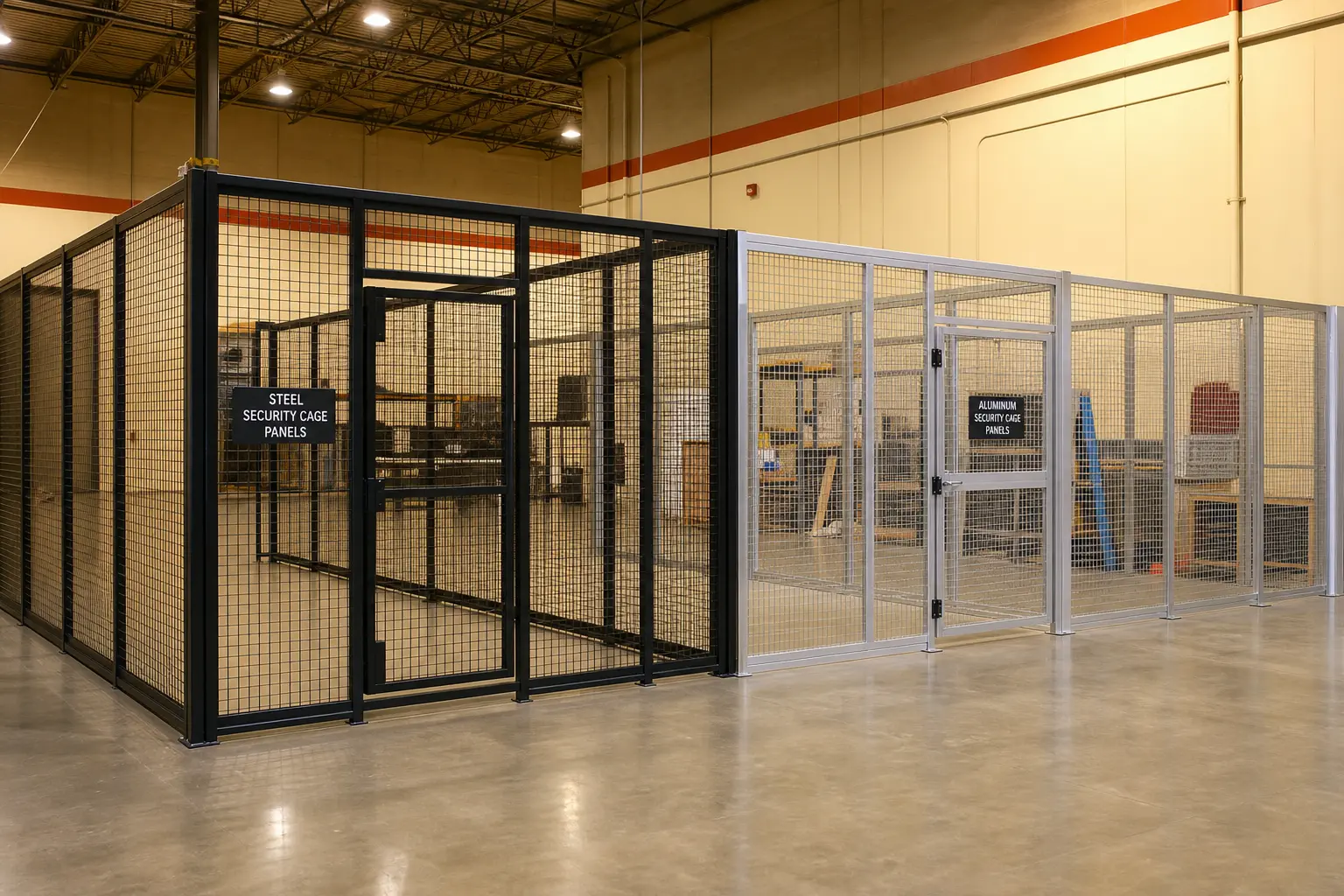
Choosing the right material impacts security, longevity, and total cost. Here’s how they compare.
Why Material Choice Matters
When specifying Security Cages, the material you choose affects everything: security strength, corrosion resistance, weight, cost, and longevity. While carbon steel dominates the industrial Wire Mesh Partitions market (roughly 90% of installations), aluminum and stainless steel have specific applications where they outperform.

This guide compares the three main material options so you can make an informed decision for your project.
Head-to-Head Comparison
| Property | Carbon Steel | Aluminum | Stainless Steel |
|---|---|---|---|
| Strength | ⭐⭐⭐⭐⭐ | ⭐⭐⭐ | ⭐⭐⭐⭐⭐ |
| Corrosion Resistance | ⭐⭐ (powder coated) | ⭐⭐⭐⭐ | ⭐⭐⭐⭐⭐ |
| Weight | Heavy (8 lbs/ft²) | Light (2.8 lbs/ft²) | Heavy (8.5 lbs/ft²) |
| Cost (per LF) | $25 – $50 | $40 – $80 | $80 – $150 |
| Cut Resistance | Excellent | Fair | Excellent |
| Lifespan | 20–30 years | 30+ years | 30+ years |
| DEA Compliant | ✅ Yes | ❌ Not typically | ✅ Yes |
Carbon Steel: The Industry Standard
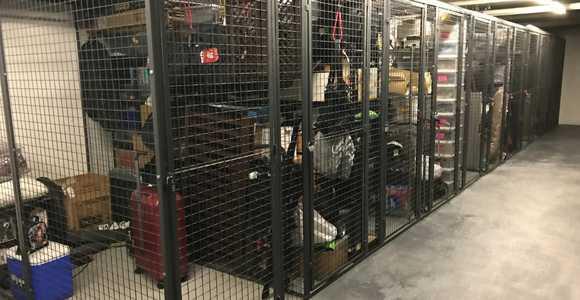
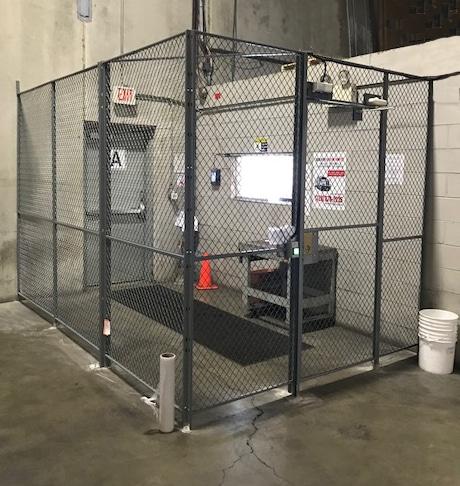
Carbon steel Wire Mesh Panel Options are the default choice for nearly every industrial security cage application. Here’s why:
- Superior strength-to-cost ratio: A 10-gauge carbon steel wire has a tensile strength of ~65,000 PSI — far exceeding what’s needed for forced entry resistance
- Cut resistance: Requires angle grinders or bolt cutters to breach — hand tools won’t get through
- Weldability: Easy to fabricate Custom Security Cages configurations, special brackets, and reinforcements
- Powder coat finish: Provides excellent corrosion protection in dry indoor environments (20+ year life)
- Compliance: Meets all DEA, OSHA, and building code requirements for security caging
Best Applications for Carbon Steel:
Warehouse Security Enclosures, Tool Cribs, DEA Drug Storage Cages, Law Enforcement Evidence Storage, Machine Guarding, Server & Data Center Cages, and Manufacturing Security Cages — basically everything indoors.
Limitations:
Carbon steel’s main weakness is corrosion in wet or humid environments. Powder coating helps, but scratches or chips expose bare steel to rust. For outdoor, washdown, or coastal applications, consider alternatives.

Aluminum: Lightweight and Corrosion-Resistant
Aluminum security panels weigh roughly one-third of equivalent steel panels. This makes them ideal for specific situations:
- Outdoor applications: Aluminum naturally forms a protective oxide layer — no painting needed. Perfect for Outdoor Security Cages setups.
- Rooftop equipment: Lightweight panels reduce structural load on roofs. Critical for HVAC and telecom equipment cages.
- Coastal/marine environments: Salt air destroys carbon steel. Aluminum resists salt corrosion without special coatings.
- Food processing: Aluminum won’t rust into food products. Easier to clean and maintain in washdown environments.
- Portable/relocatable cages: Light weight makes assembly, disassembly, and transport practical.
Limitations:
Aluminum is softer than steel — it can be cut with hand tools more easily. This makes it unsuitable for high-security applications like DEA drug storage, evidence rooms, or facilities where forced entry resistance is critical. Aluminum also costs 60–100% more per linear foot than carbon steel.
Stainless Steel: Maximum Corrosion Resistance
304 and 316 stainless steel provide the ultimate combination of strength and corrosion resistance. However, the premium cost (3–4x carbon steel) limits it to specialized applications:
- Pharmaceutical cleanrooms: 316L stainless won’t contaminate sterile environments. Withstands aggressive cleaning chemicals.
- Food and beverage: USDA/FDA-approved material for food contact zones. Weld-polished joints prevent bacterial harborage.
- Chemical storage: Resists most acids, alkalis, and solvents that would destroy carbon steel or aluminum.
- Extreme outdoor: Coastal, tropical, or industrial environments with severe corrosion potential.
How to Choose the Right Material
Decision Framework:
- Indoor, dry environment? → Carbon steel (best value)
- Outdoor or high humidity? → Aluminum or galvanized steel
- DEA or high-security? → Carbon steel or stainless (never aluminum)
- Food/pharma cleanroom? → Stainless steel 316L
- Rooftop or weight-limited? → Aluminum
- Coastal/marine? → Aluminum or 316 stainless
- Budget-constrained? → Carbon steel with powder coat
Galvanized Steel: The Middle Ground
Hot-dipped galvanized steel offers a compromise between carbon steel’s strength and aluminum’s corrosion resistance. The zinc coating provides 15–25 years of corrosion protection in outdoor environments at roughly 30–50% more than standard powder-coated carbon steel.

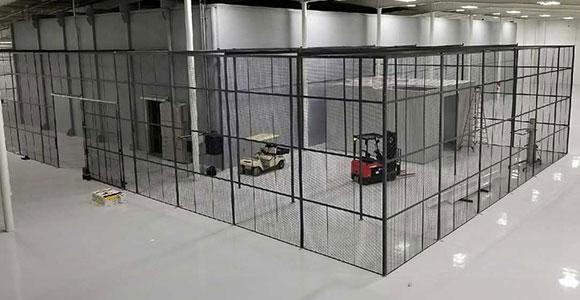
Galvanized is an excellent choice for Outdoor Security Cages installations, loading dock cages, and Driver Access Cages areas exposed to weather but requiring steel-level security.
Not Sure Which Material to Choose?
Tell us about your environment and application — we’ll recommend the most cost-effective material. Free consultations, no obligation.
Steel vs. Aluminum: In-Depth Material Analysis
Carbon Steel Properties & Performance
Carbon steel (ASTM A1008/A1011) is the dominant material for industrial security cages, accounting for over 90% of installations. Its advantages include highest strength-to-cost ratio of any cage material, excellent weldability for manufacturing, high stiffness (resists deformation under load), and compatibility with powder coating and galvanizing finishes.
Standard security cage wire uses low-carbon steel with 0.05–0.15% carbon content. This composition provides adequate hardness for cut resistance while maintaining ductility for the weaving/welding process. Tensile strength of 10-gauge low-carbon steel wire is approximately 50,000–65,000 PSI — sufficient to resist casual cutting with hand tools.
Aluminum Properties & Performance
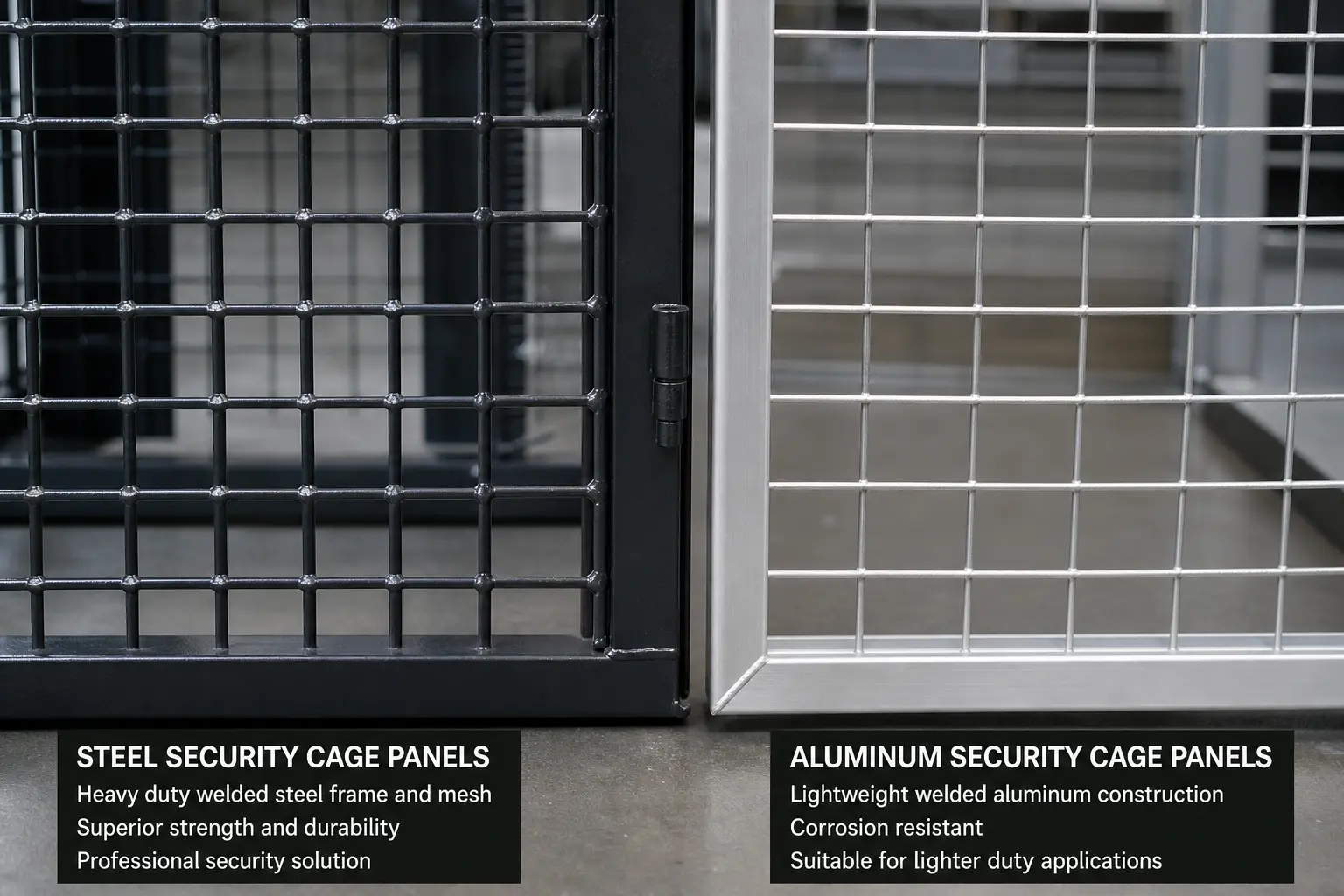
Aluminum alloy (typically 6061-T6 or 6063-T5) cages serve specialized applications where steel’s properties create problems. Aluminum’s natural corrosion resistance eliminates the need for coatings in outdoor, coastal, freezer, and wash-down environments. Its light weight (1/3 of steel) simplifies installation and reduces structural loading on mezzanines and raised floors. Non-magnetic properties make aluminum essential for MRI rooms and electronic testing environments.

However, aluminum’s lower strength means thicker gauges are needed to match steel’s security performance. An aluminum cage providing equivalent security to a 10-gauge steel cage requires approximately 8-gauge aluminum wire — increasing material cost. Aluminum also costs 2–3× more per pound than steel, making aluminum cages significantly more expensive for equivalent security levels.
Stainless Steel: The Premium Option
Stainless steel (304 or 316 grade) combines steel’s strength with superior corrosion resistance. 304 stainless handles most indoor and mild outdoor environments. 316 stainless (marine grade) resists chloride corrosion in coastal, chemical, and pool/spa environments. Stainless steel costs 4–6× more than carbon steel but provides decades of maintenance-free performance in environments that would destroy standard steel or aluminum.
Galvanized Steel: Best of Both Worlds
Hot-dipped galvanized steel provides carbon steel’s strength with long-term corrosion protection. The zinc coating sacrificially corrodes before the underlying steel, providing 20–30 years of protection. Galvanized panels cost 15–25% more than powder-coated steel but significantly less than aluminum or stainless steel. They’re the go-to choice for outdoor cages, outdoor equipment protection, and humid environments where corrosion is a concern.
Material Selection Decision Matrix
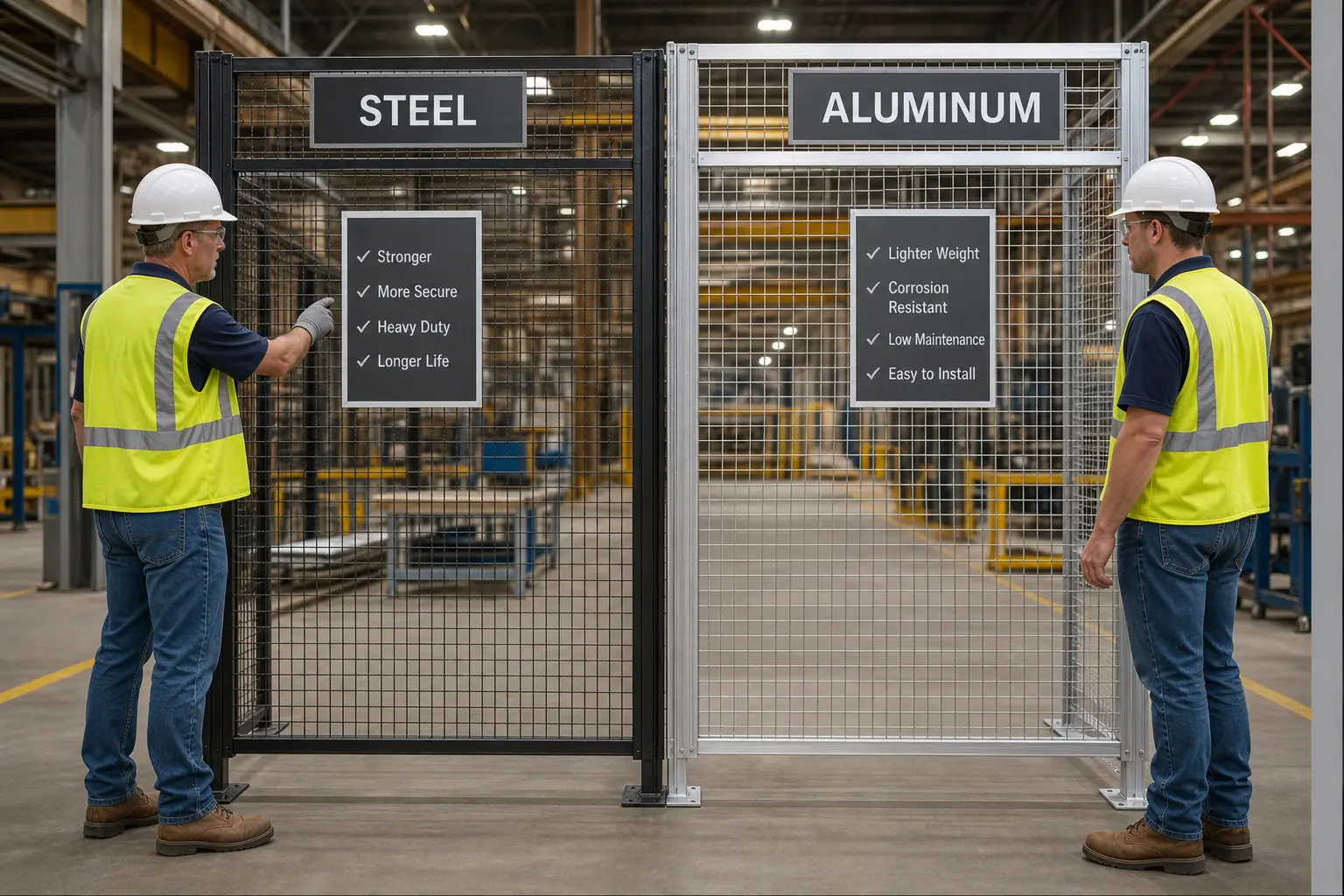
Choose carbon steel (powder-coated) for indoor warehouse, tool crib, data center, and general commercial applications. Choose galvanized steel for outdoor, humid, or corrosive environments where cost matters. Choose aluminum for weight-sensitive installations, freezer environments, and non-magnetic requirements. Choose stainless steel for chemical exposure, clean room, food processing, and coastal applications where long-term maintenance costs justify the premium. Our HVAC distribution branch case study shows how that choice plays out in a leased parts-and-supply warehouse.

Why Choose Material Handling USA for Steel Security Cages vs Aluminum: Material Comparison for Industrial Enclosures
{
}
Material Handling USA brings over 30 years of experience to every security cage project. Our team has designed and installed thousands of security enclosures across warehouses, distribution centers, manufacturing plants, healthcare facilities, law enforcement agencies, and data centers throughout the Intermountain West and nationwide.
Our Process
Every project begins with a thorough understanding of your requirements. We conduct on-site assessments (or virtual consultations for initial planning), capture detailed measurements, and discuss your security objectives, workflow needs, and budget parameters. Our engineering team creates custom CAD layouts showing exactly how your cage system will look and function — you review and approve the design before we proceed.
{
}
We source panels, doors, locks, and accessories from leading American manufacturers Products — the industry’s most trusted manufacturers. Both offer comprehensive product lines with rapid availability and proven quality. Our bulk purchasing relationships deliver competitive pricing that individual buyers can’t achieve on their own.
Professional Installation & Support
Our trained installation crews handle every aspect of cage assembly — from floor anchoring to door hanging to access control integration. We work around your schedule to minimize operational disruption. Every installation concludes with a formal inspection and documentation package. Post-installation, we remain available for adjustments, expansion, and ongoing maintenance support.
{
}
Serving the Intermountain West & Beyond
Headquartered in Salt Lake City, Utah, Material Handling USA provides direct service throughout Utah, Idaho, Colorado, Nevada, Arizona, Wyoming, and Montana. Nationwide projects are supported through our network of installation partners and direct-ship capabilities. Wherever your facility is located, we deliver the same quality, attention to detail, and customer service that has built our reputation over three decades.
{
}
Request Your Free Quote
Ready to secure your facility? Contact Material Handling USA for a free, no-obligation consultation and quote. Our team responds within one business day with a preliminary assessment and next steps.
- Phone: (800) 326-4403 or (801) 328-8788
- Email: sales@mh-usa.com
- Online: Request a Quote
We look forward to helping you design the right security cage solution for your facility.
Frequently Asked Questions
Can I mix materials in one cage system?
Yes, but carefully. Dissimilar metals in contact can cause galvanic corrosion (e.g., aluminum panels on steel posts). Use isolation bushings or coated fasteners at junction points. Our Custom Security Cages engineering team designs mixed-material systems when the application calls for it.
Does material affect fire ratings?
All three materials (steel, aluminum, stainless) are non-combustible and meet NFPA fire code requirements for security caging. However, aluminum loses structural strength at much lower temperatures (~600°F vs 1,100°F for steel), which may matter in some fire-rated applications.
What about wire gauge — is it the same across materials?
No. Because aluminum is softer, an aluminum cage typically needs to go two gauges heavier to match the security level of steel. A 10-gauge steel panel provides equivalent security to roughly 6-gauge aluminum. This narrows the weight savings and increases cost.
Which material has the best resale value?
Stainless steel has the highest scrap value. Carbon steel panels in good condition can be resold for 40–60% of new price. Aluminum also retains good resale value. All three are fully recyclable.
What is the installation timeline?
Most security cage projects follow a 2–3 week timeline from initial contact to completed installation. Week 1 covers site assessment and design. Week 2 handles order processing and material preparation. Week 3 is delivery and professional installation. Expedited timelines are available for urgent security needs — some projects can be completed in as little as 5 business days from initial contact.
Do you provide free site assessments?
Yes. Material Handling USA provides complimentary on-site measurements and CAD layout design for all security cage projects. Our assessment includes detailed measurements, obstacle identification, workflow analysis, and a complete proposal with pricing. For projects outside the Wasatch Front, we can conduct virtual assessments using photos and measurements you provide.
Can security cages be customized?
Absolutely. While standard panel sizes handle most configurations, our custom security cage capabilities include non-standard dimensions, angled walls, multiple door types, height transitions, and integration with existing structures. Custom powder coat colors, galvanized finishes, and specialized hardware are also available. Our engineering team designs custom solutions that meet your exact specifications.
What warranty do security cages carry?
All security cages from Material Handling USA include manufacturer warranties covering defects in materials and workmanship. our manufacturing partners both stand behind their products with comprehensive warranty programs. Our installation workmanship is warranted for one year, including a 90-day adjustment period where we return to tighten hardware and verify door alignment at no charge.
Do you serve locations outside Utah?
Yes. While headquartered in Salt Lake City, Material Handling USA serves the entire Intermountain West including Utah, Idaho, Colorado, Nevada, Arizona, Wyoming, and Montana with direct installation crews. Nationwide projects are supported through our installation partner network and direct-ship capabilities. Contact us to discuss your project location.
Explore More Security Cage Solutions
Online Store
Shop at MaterialHandling-USA.com
Need barriers, access control, or secure storage? Shop online:
Lockers
Warehouse Equipment & Supplies
Browse security & access control products →