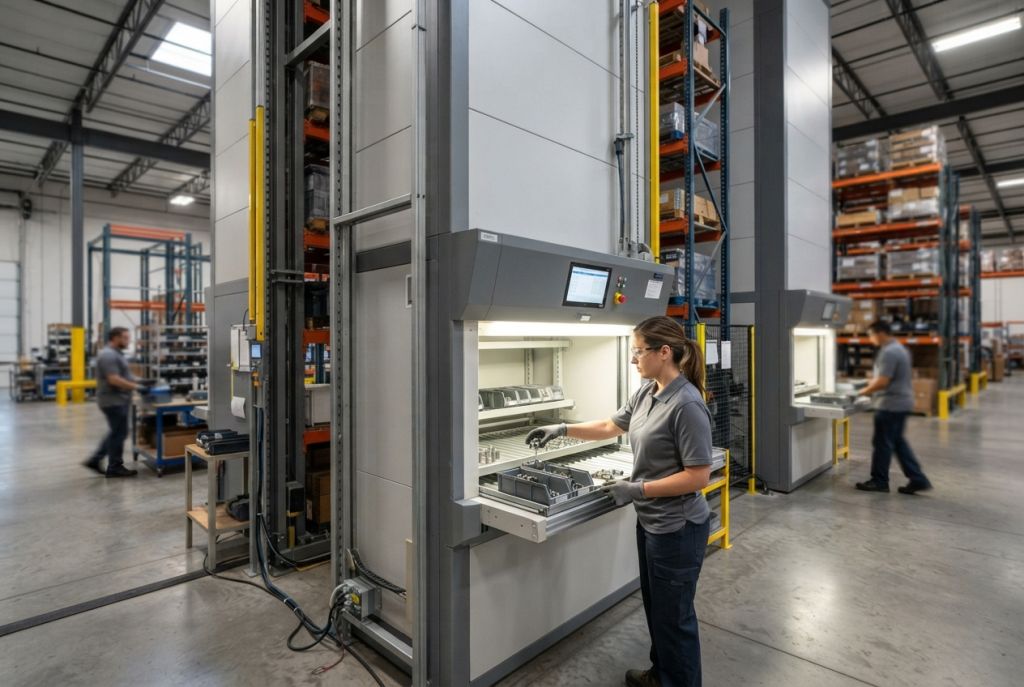
A vertical storage carousel can improve space utilization by up to 75% and reduce labor costs by up to 67% versus static shelving when the fit is right, but the key decision comes down to inventory profile, ceiling height, and whether the new layout shortens the work. For electrical distributors, the best results usually come when wire spools, cable reels, and small parts are matched totheright carrier setup and the carousel is placed where it supports picking instead of interrupting it.
If you're dealing with wire reels on the floor, cartons of fittings on open shelving, and too many small bins spread across a parts room, the problem usually isn't just storage. It's the mix of storage and motion. People walk too far, search too long, and use floor space for inventory that could be stored overhead.
A vertical storage carousel is often a strong answer for that exact situation. It can organize wire, support cable reel storage, and tighten up small-parts access in one compact footprint. The key is planning it like an operating system, not like a standalone machine.
Your Guide to Smarter Electrical Parts Storage
Electrical distribution spaces tend to become patchwork operations over time. A few shelves get added for breakers. A rack gets repurposed for wire. Loose hardware ends up in bins near the counter. Then picking slows down because the layout reflects growth, not flow.
That is where a vertical storage carousel earns attention. It gives you a way to move wire spools, cable reels, and parts into a controlled footprint that uses building height instead of more floor area. In practice, that can mean less clutter around staging zones, cleaner picking paths, and faster access to the items your team touches every day.
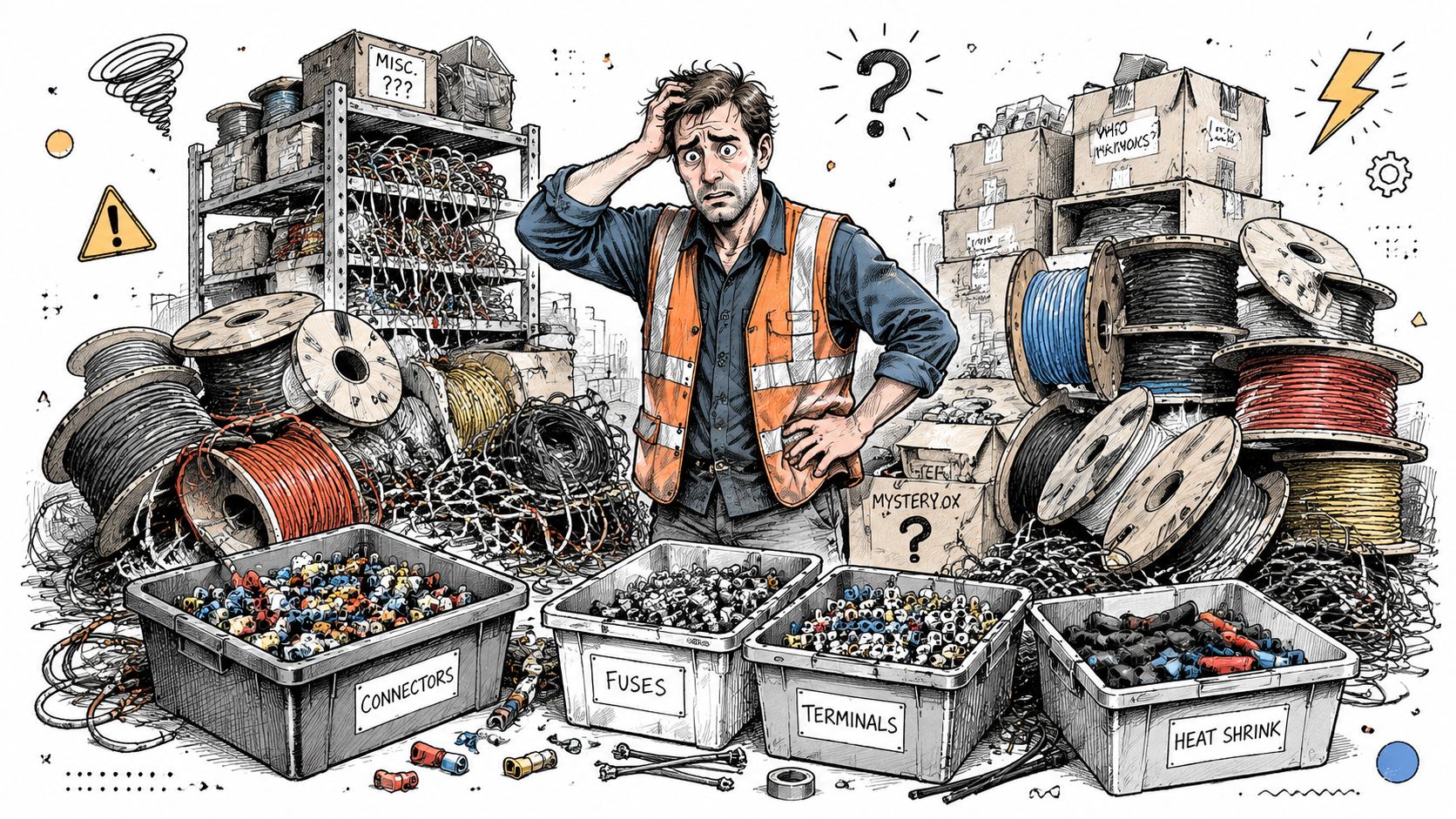
For buyers, the useful question isn't whether vertical carousel storage saves space in general. It usually does. The better question is whether it fits your inventory, your pick pattern, and your building without creating a new bottleneck near receiving, cutting, packing, or the will-call counter.
Practical rule: If a carousel saves floor space but makes operators queue up in the wrong part of the building, the project needs another layout pass.
What Is a Vertical Storage Carousel
A vertical storage carousel is an enclosed storage system with carriers that rotate in a vertical loop and bring items to a fixed access opening. Instead of a worker walking aisle to aisle, the machine presents the inventory at a pick window.
This is one of the earliest goods-to-person storage formats still used in warehouses. Vertical storage carousels have been in use since the 1950s, and they're widely described as a foundational ASRS technology that uses a rotating vertical loop to present items to an operator at a pick window, according to warehouse automation background on carousel systems.
How the system works in practice
The concept is simple. Carriers move on a loop, much like a Ferris wheel. The operator stays in one place while the requested shelf rotates into position.
That matters for electrical distributor storage because many SKUs are small, repetitive, and picked often. Connectors, fittings, terminals, switches, and service parts don't need pallet storage. They need dense, visible, repeatable storage close to the work.
Why the format has lasted
The core principle hasn't changed much because it still solves a common warehouse problem. It uses vertical height instead of floor sprawl, and it keeps the operator at a consistent access point.
If you're comparing systems, Vidir vertical storage solutions are one example of this category for buyers looking at vertical carousel applications and related high-density systems.
Why Electrical Distributors Use Vertical Carousel Storage
Electrical distributors usually carry a difficult mix. One area holds wire spool inventory. Another holds cable reels. Nearby shelves carry thousands of small parts that don't take much room individually but become hard to manage in volume.
A vertical carousel storage system fits that environment well because it handles density and organization together. It can help move inventory off the floor, reduce visual clutter, and keep frequently picked items in a more controlled access point.
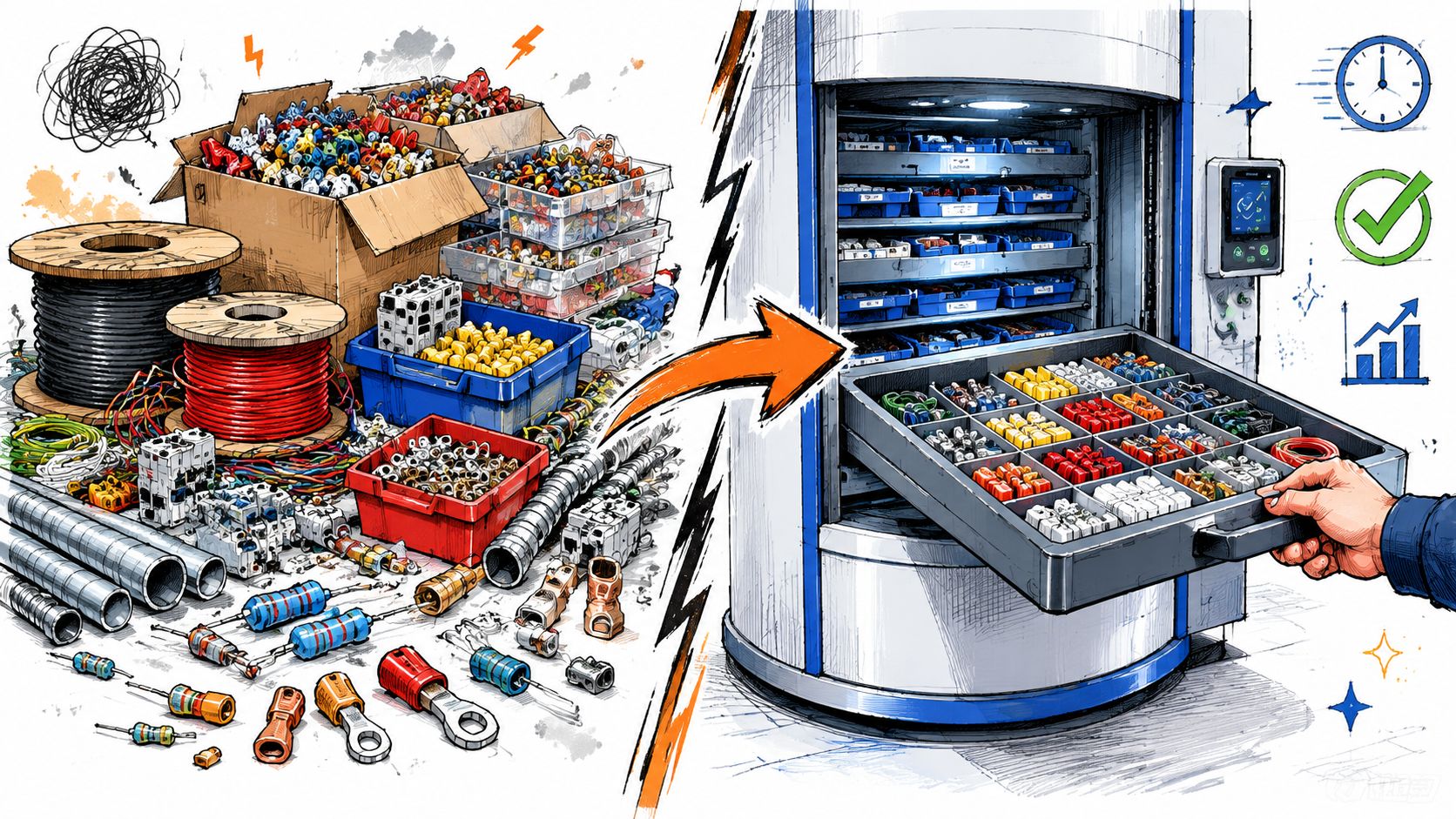
Common reasons the fit is good
- High SKU count: Electrical rooms often carry many small components that are easy to lose on open shelving.
- Mixed inventory behavior: Some items are fast movers, others are reserve stock, and they shouldn't all be stored the same way.
- Need for cleaner access: Enclosed storage can help protect parts from dust and reduce casual handling.
- Pressure on floor space: Wire and cable inventory can consume valuable square footage that operations teams need for staging or packing.
For many facilities, the attraction isn't automation for its own sake. It's the chance to make a crowded parts area behave like a controlled storage zone.
A wire spool carousel or industrial wire carousel can be especially useful when reels and smaller electrical supplies are currently split across too many locations. That kind of fragmentation slows picking and makes replenishment harder than it should be.
Key Applications for Electrical Supplies
Wire spool carousel applications
Wire is one of the clearest use cases. A wire spool carousel stores spools in a vertical format so operators can access them without dedicating broad floor sections to racks and loose reel positions.
That can work well in distribution branches, back-of-house supply rooms, and cut-and-serve stations where repeat access matters. In those settings, the value comes from tighter control and better organization as much as space savings.
For teams focused mainly on spool handling, motorized wire spool carousel systems are worth comparing against general-purpose parts carousel designs.
Cable reel storage applications
Cable reels are trickier because the right solution depends on reel size, handling method, and whether cutting happens at the storage point or somewhere else. Some facilities need access-first storage. Others need storage that supports dispensing and controlled handling.
A carousel can be a good fit when reels are within the size and weight profile of the system and the workflow benefits from fixed-point access. It is less attractive when reel dimensions change constantly or when the operation depends on broad simultaneous access by several workers.
Parts carousel applications
Small parts are where a parts carousel often delivers the most day-to-day value. Bins, dividers, and labeled compartments make it easier to store terminals, connectors, fittings, anchors, clips, and repair items in a compact footprint.
The most successful installations usually start with the SKUs people waste time looking for, not the SKUs that are merely inconvenient.
For electrical supplies, that means the carousel often becomes the home for high-touch, small-to-medium inventory that needs consistent locations and fast retrieval.
Performance Benefits You Can Expect
Better use of building space
A commonly cited benchmark is that vertical storage carousels can improve space utilization by up to 75% and reduce labor costs by up to 67% versus static shelving, according to industry ASRS guidance on vertical carousels. The same source states that vertical carousels can also double the storage capacity of traditional static racking units.
For electrical distributors, that matters because floor space is usually competing with receiving, order staging, counter service, and cutting operations. If inventory can move upward, those other functions get more room.
Faster retrieval and less walking
Goods-to-person storage doesn't eliminate all labor. It changes where the labor happens. Instead of walking and searching, the operator spends more time at the access point retrieving, confirming, and moving picked material to the next step.
That works best when pick activity is steady and repetitive. If the same families of wire accessories, fittings, and service parts are touched all day, a vertical carousel often supports a cleaner rhythm than scattered shelving.
Better inventory order and control
Carrier systems in this category are designed for dense small-parts storage. One manufacturer notes shelf ranges of 49 to 144 inches wide and 17 to 24 inches deep, which shows why these systems are usually better for small-to-medium items than pallet-scale inventory, as noted in the source above.
That geometry supports cleaner slotting. It also helps teams standardize where parts live, which can make training easier and reduce the amount of inventory knowledge trapped in one employee's head.
Vertical Carousel vs Common Alternatives
A vertical storage carousel isn't the answer to every storage problem. Standard shelving still has a place. Cantilever rack still makes sense for long or awkward stock. The right comparison depends on what you store and how often you touch it.
Storage option comparison for electrical distributors
| Storage Option | Best Use | Benefits | Planning Notes |
|---|---|---|---|
| Vertical storage carousel | Small-to-medium electrical parts, wire spools, repeat picks | Dense storage, goods-to-person access, cleaner organization | Best when SKU profile is fairly structured and pick activity is frequent |
| Standard shelving | General stock, low-cost storage, broad manual access | Simple, familiar, easy to expand in small increments | Uses more floor space and increases walking as inventory grows |
| Cantilever rack | Long conduit, pipe, or other long stock | Good access for long items and awkward lengths | Poor fit for dense small-parts storage and not ideal for mixed tiny SKUs |
| Drawer and carousel-based dense storage systems | Small parts requiring organized compartment storage | Strong organization and compact footprint | Compare carrier style, access method, and growth needs carefully |
If your evaluation includes denser small-parts systems beyond a classic vertical loop, drawer and carousel high-density storage options can help frame the difference.
Where each option tends to struggle
- Shelving struggles when SKU count grows faster than the footprint.
- Cantilever struggles when the inventory is mostly small parts or packaged accessories.
- Carousels struggle when item sizes change constantly or several operators need broad simultaneous access.
Planning Your Vertical Storage Carousel Project
A good fit comes down to three checks. Product fit, site readiness, and workflow fit. Miss one of those, and the carousel can still function but won't deliver the result you expected.
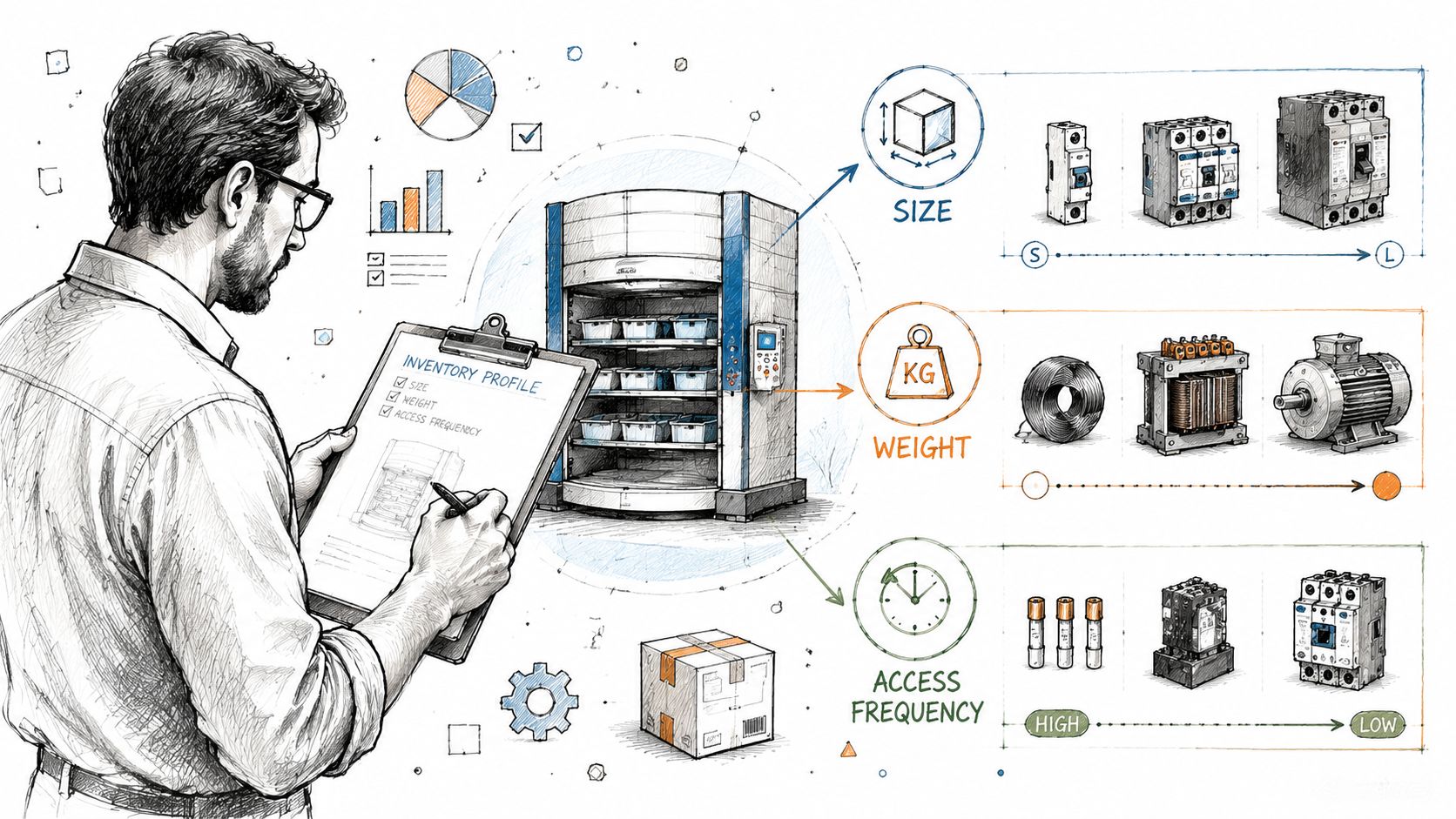
Inventory size, weight, and access frequency
Vertical carousel systems are typically compact ASRS units measuring about 6 to 14 feet wide, 4 to just over 5 feet deep, and 7 to 32 feet tall. Carrier dimensions commonly range from 49 to 144 inches wide and 17 to 24 inches deep, with reported load capacity up to 1,430 pounds per carrier and an overall machine maximum load of 27,558 pounds, according to Explore MH-USA vertical storage solutions.
Those numbers tell you two things. First, the system can handle meaningful small-partsand reel storage. Second, it still has boundaries. This isn't pallet racking, and it shouldn't be treated like it is.
Layout, installation, and fire protection
Placement matters more than many buyers expect. A carousel should support the actual path of work from receiving to storage to picking to packing or cutting. If you place it where operators cross traffic or block staging, the system creates friction instead of removing it.
Fire protection also changes once units get taller. Guidance states that carousels over 8 feet require intermediate sprinkler levels at 10 foot vertical intervals, and if the clearance from the top of stock to the ceiling exceeds 10 feet, more complex suppression layouts may be needed, according to carousel fire protection guidance.
Don't wait until equipment selection is finished to check sprinklers, ceiling clearance, power, and delivery access. Those issues shape the project early.
ROI depends on operating reality
The weak point in many vertical carousel discussions is ROI modeling. Public content often focuses on footprint savings and picking speed, but the more useful question is whether the system pays back under your actual order profile, labor market, maintenance tolerance, and training capacity.
A practical guide from the market notes that public content often underplays the tradeoff around order profile, labor rates, uptime, maintenance, and workflow variability, and also notes that vertical carousels are often better suited to routine, standardized operations than highly variable ones, as discussed in this guide to understanding vertical carousels.
For electrical distributors, that's an important filter. If the inventory and workflow are consistent, the economics are often easier to justify. If the operation changes week to week, flexibility may matter more than density.
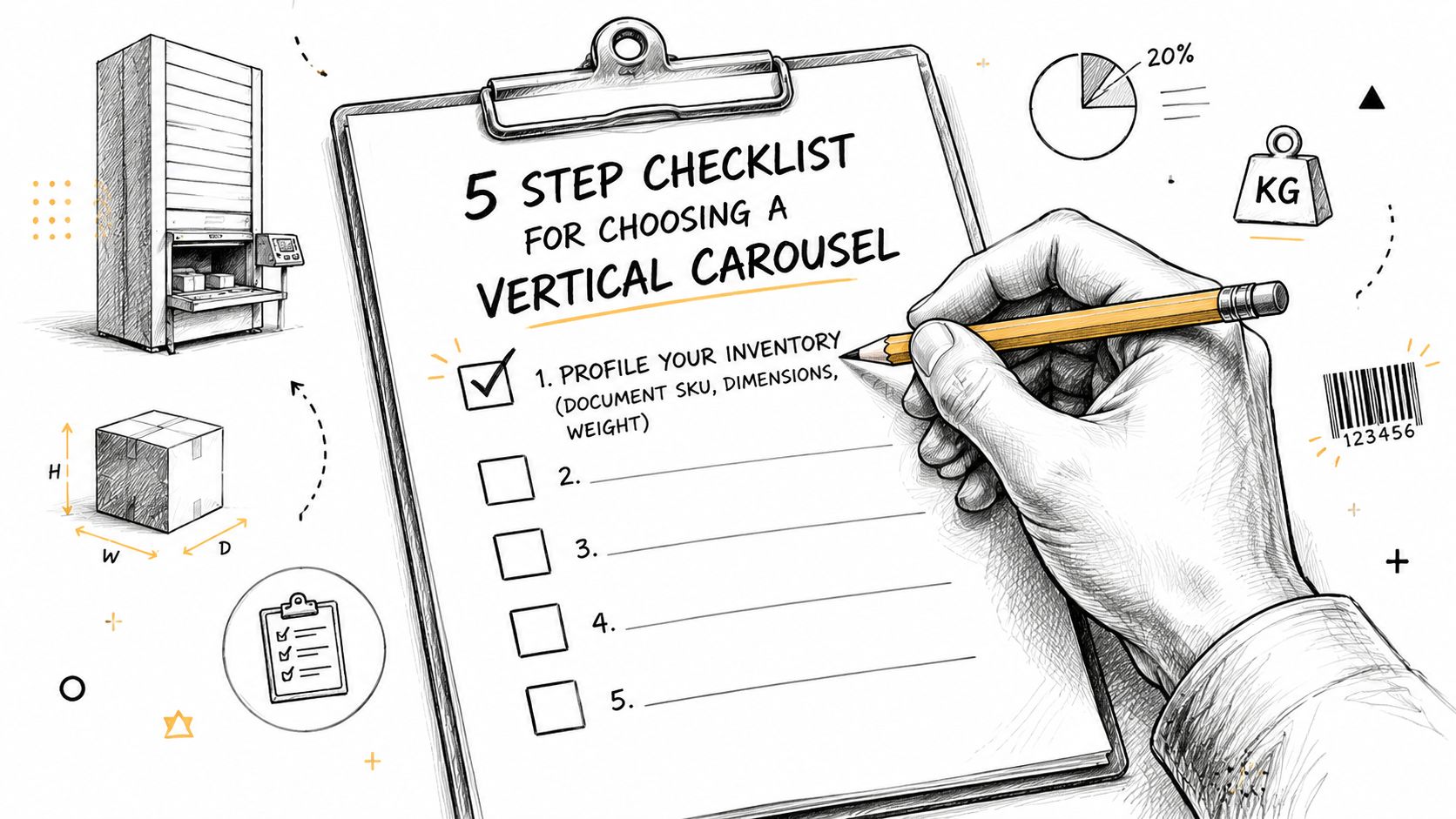
5 Step Checklist for Choosing a Vertical Carousel
A bad carousel decision usually starts the same way. The branch is short on space, counter staff are walking too far for small parts, wire handling is messy, and the team asks for a quote before anyone has defined what should go in the machine. That is how distributors end up with a system that fits the building but does not fit the work.
-
Profile the inventory
Start with the products, not the equipment. Separate small boxed parts, fittings, devices, reels, cut wire, and slow-moving reserve stock. Record dimensions, weight, package type, pick frequency, and whether items are usually picked eaches, inner packs, or full cartons. This step often decides whether one carousel makes sense or whether part of the inventory should stay on shelving, cantilever rack, or reel storage. -
Measure the actual site
Use field measurements, not old drawings. Check clear height, columns, lights, ductwork, sprinkler conflicts, floor condition, power location, and the path for delivery and installation. Also verify operator space at the access opening. A machine can fit on paper and still create congestion at the counter, in shipping, or in replenishment aisles. -
Map the workflow around it
Identify who will use the carousel and what happens before and after each touch. Counter picks, branch replenishment, order picking, wire cutting, packing, and staging have different demands. One access opening can work well for controlled parts storage, but it may become a bottleneck if the same machine has to support counter service and batch picking at the same time. -
Set the business case before you price equipment
Be clear about what the project needs to improve. The goal might be getting small electrical parts off open shelving, reducing travel for fast picks, tightening control of higher-value items, or creating a cleaner wire handling process. Rank those goals. If everything is a priority, equipment selection usually drifts toward the wrong compromise. -
Ask for a layout based on operating reality
A useful proposal should show carrier configuration, access point location, product mix assumptions, and how replenishment will work. It should also make clear what does not belong in the carousel. That matters for electrical distributors because wire, cable, and packaged parts rarely behave the same way in storage, and forcing them into one machine plan usually hurts efficiency instead of improving it.
Questions to Ask Before Requesting a Quote
A good quote request gives the vendor enough operating detail to rule out bad fits early. For electrical distributors, that matters because wire, cable, fast-moving parts, and branch replenishment do not create the same storage problem.
Start by defining the use case in plain terms. Is the carousel meant to support counter picks, batch order picking, controlled parts storage, reel handling, or a mix of those jobs? If the answer is "all of them," ask which function matters most when demand spikes. That one decision affects carrier design, access opening placement, and whether the machine improves labor or just shifts congestion to a new location.
Ask these before you talk to a vendor
- What inventory will live in the machine on day one? List the actual SKUs, not general categories. Include dimensions, weights, pick frequency, and any awkward packaging.
- Which products should stay out of the carousel? Some wire reels, long items, reserve stock, and low-activity parts are often better on other storage.
- How many operators need access during peak periods? One access opening can work well for controlled inventory. It can also slow down a busy counter or picking team.
- What happens before and after each pick? Ask where items go next: wire cutting, packing, staging, counter handoff, or branch shipment.
- Will replenishment happen during operating hours? If yes, define how stock will be added without blocking picks.
- What system will control inventory accuracy? Decide whether operators will work from ERP transactions, scanner input, paper picks, or a separate carousel interface.
- What site conditions could change the design or install cost? Include clear height, floor condition, sprinkler constraints, power, and access for delivery and assembly.
- What maintenance support will operations need? Ask about daily checks, service intervals, common wear points, and what happens if the machine is down during business hours.
Questions specific to wire and reel storage
- Are reel diameters, widths, and weights consistent enough for a standard carrier layout? Wide variation usually reduces density and makes replenishment harder.
- Will operators pull full reels, cut-to-length orders, or both? Each approach changes how material should be presented and where labor is spent.
- Does the process require measuring, cutting, labeling, and staging at the same point of use? If so, quote the full work area, not just the machine.
- How will partial reels be tracked and returned to storage? At this stage, many wire programs lose inventory accuracy.
- What is the plan for damaged reels, special-order cable, and slow movers? Keeping exceptions in the same machine often creates more complexity than value.
A vendor can only build a useful proposal from operating facts. Give them the inventory profile, the workflow, the constraints, and your primary performance goal. That usually leads to a better recommendation, and it reduces the chances of paying for a carousel that solves the wrong problem.
Frequently Asked Questions About Vertical Carousels
Are vertical storage carousels new technology
No. Vertical storage carousels have been used since the 1950s, so buyers are looking at a long-established goods-to-person format rather than an unproven concept.
What kinds of inventory fit best
They are usually best for small-to-medium parts, packaged components, and repetitive picks. Electrical supplies, service parts, wire accessories, and organized reel storage are common fits.
Can a vertical carousel store wire spools
Yes, in the right configuration. A wire spool carousel or industrial wire carousel can work well when spool sizes and handling needs fit the carrier design and the workflow benefits from fixed-point access.
Are vertical carousels better than standard shelving
For many electrical distributor storage applications, they are better at density and controlled access. Standard shelving is still useful for broad manual access, low-volume stock, and simple overflow storage.
When is cantilever rack the better option
Cantilever is usually the better choice for long items that don't belong in a parts carousel. If the inventory is mainly conduit, bar, or other long stock, cantilever often makes more sense.
How tall can these systems be
Published system dimensions commonly reach from about 7 feet up to 32 feet tall, but the practical limit depends on your building, fire protection, and installation conditions.
How much weight can a carrier hold
Published specs report load capacity up to 1,430 pounds per carrier, with overall machine maximum load reported at 27,558 pounds. Actual application fit still depends on item shape, distribution, and the selected machine.
What usually causes a poor result
The most common issue is mismatch. Either the inventory doesn't suit the machine, the site isn't ready, or the carousel is placed in a way that creates a workflow bottleneck.
Take Control of Your Warehouse Space
A crowded electrical warehouse usually shows the same warning signs. Wire reels end up in aisle ends, fast-moving parts get split across too many bin locations, and pickers lose time walking around storage that grew without a real plan. That is usually the point where a vertical storage carousel moves from a nice idea to a project worth pricing.
For electrical distributors, the right decision is not just about storing more in less space. It is about fitting the machine to the inventory profile, the pick routine, and the building you already have. Wire, cable, terminals, connectors, and boxed electrical parts all behave differently in storage. A good result depends on slotting the right items into the carousel, keeping replenishment simple, and placing the unit where it supports the actual workflow instead of creating a new bottleneck.
Early planning gives you more good options. If operations, maintenance, and safety review the project before floor space gets reassigned, it is easier to handle power requirements, clearances, fire protection, load conditions, and operator access without expensive changes later.
Material Handling USA can help evaluate vertical carousel storage for wire, cable, and electrical parts with free quotes and free layouts and designs with no obligation. To get a vertical carousel storage quote, Contact Us, Request a Quote, or call (800) 326-4403. If you prefer email, reach the team at Sales@MH-USA.com.
Related Solutions