Storage pressure usually shows up before anyone has time to plan for it. An evidence room starts using temporary bins in the aisle. A lab stockroom adds overflow cabinets that block access. A government records area runs out of shelf space, but the building footprint isn't changing. When that happens, staff lose time, retrieval slows down, and the room becomes harder to secure and maintain.
GSA mobile shelving systems solve that problem by changing the layout logic, not just adding more shelves. Instead of giving every row its own permanent aisle, the shelving moves so one active aisle serves multiple rows. If you've seen compact library stacks, the concept is familiar. The difference here is that the system is specified for government and regulated environments where procurement, safety, and compliance matter just as much as storage density.

Introduction
When buyers start looking at mobile shelving, they usually think the question is simple. How many shelves fit in the room? In practice, the better question is whether the system will satisfy your access pattern, your security requirements, and your purchasing rules without creating problems later.
That matters in GSA environments. A shelving layout that looks efficient on paper can still fail if the contract path is unclear, the rail installation isn't right, or the wrong drive type is selected for the daily workload. Procurement officers care about schedule compliance. Facility managers care about floor conditions, user safety, and long term serviceability. Both are right.
Practical rule: Buy the system for the way the room is used, not just for the way the room measures.
The strongest projects start with three realities:
- Space is expensive: If expansion isn't realistic, the storage system has to recover usable square footage inside the existing footprint.
- Access needs vary: Archives, evidence, medical supplies, and controlled inventory don't behave the same way.
- Compliance can't be an afterthought: In federal and regulated settings, contract verification and specification discipline prevent avoidable delays.
What Are GSA Mobile Shelving Systems
A GSA mobile shelving system is a high density storage system built on wheeled carriages that move along floor rails. The shelving units shift laterally so users open only the aisle they need. That eliminates fixed aisles between every row and makes far better use of the room.
The "GSA" part matters because buyers aren't just choosing a storage product. They're looking for equipment that fits federal purchasing channels and the expectations that come with them. In government settings, that often means the system has already been packaged for schedule-based procurement and evaluated for the type of use common in agencies, labs, records rooms, and secure storage areas.
How the system changes the room
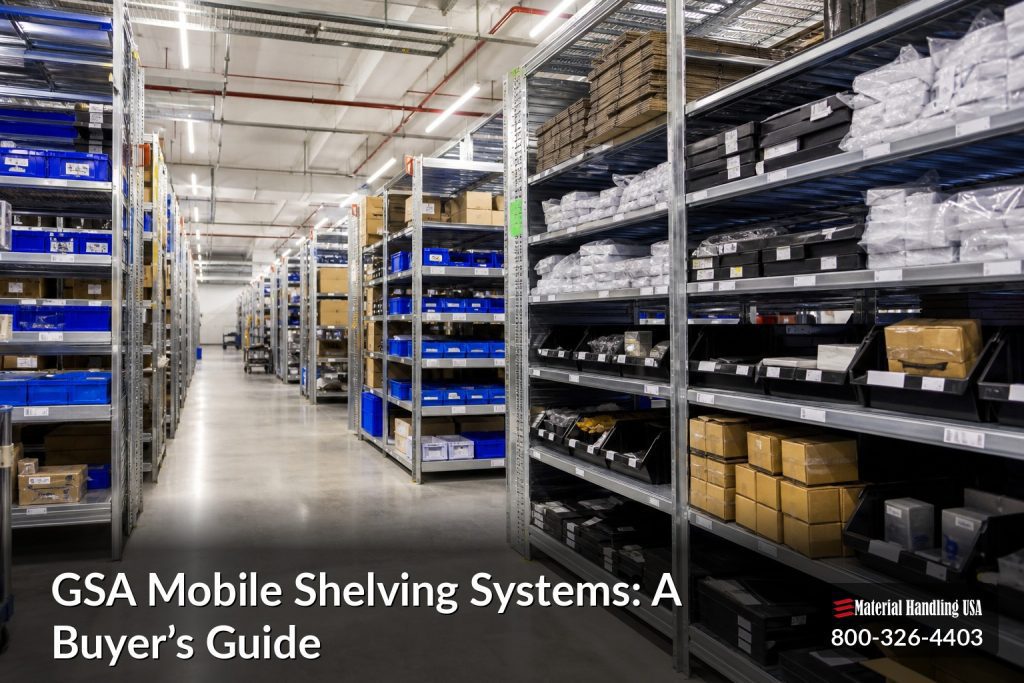
In an evidence room, mobile shelving can turn scattered, hard-to-track storage into a controlled layout with dedicated locations and fewer dead zones. In a laboratory stockroom, it can concentrate consumables and reference materials without forcing a larger footprint. In a warehouse support area, it can increase density where boxed inventory, tools, or parts need to stay accessible but organized.
Demand for these systems reflects that practical value. The global mobile shelving market is valued at USD 1.75 billion in 2025 and is projected to reach USD 3.78 billion by 2035, with demand driven by space-efficient systems that can double or triple storage capacity compared to static shelving. North America holds 30% of the market share due to demand in government buildings, labs, and secure evidence storage, according to mobile shelving market data from Business Research Insights.
Where buyers often go wrong
Many teams evaluate shelf dimensions before they evaluate use conditions. That's backwards. The first screen should be operational.
A practical starting point is to review examples of manual mobile shelving systems and then work outward from access frequency, security level, and user effort. That sequence usually leads to a better decision than shopping by appearance or nominal capacity alone.
If your room has mixed-use storage, don't assume one drive type fits every row. The access pattern should decide that.
The Transformative Benefits and Use Cases
The reason mobile shelving keeps showing up in government and regulated projects is simple. It improves capacity without asking for a building addition.
GSA-approved mobile shelving systems can increase storage capacity by 50 to 60% compared to static shelving because the rows ride on steel rails and share aisle space. Mechanical-assist models use gear reduction, such as 1:40, so an operator can move thousands of pounds with under 50 lbs of effort, based on GSA contract product details from Southwest Solutions.

Where those gains show up
For procurement officers, that storage gain isn't just a feature. It's a way to defer other facility changes, simplify room organization, and avoid the operational drag that comes with overflow storage.
For facility managers, the use cases are more concrete:
- Evidence rooms: Better aisle control, more predictable storage locations, and easier segregation of sensitive materials.
- Labs and healthcare support spaces: Higher density without turning the room into a maze of cabinets and dead-end aisles.
- Warehouse support and parts storage: More product in the same footprint, with less walking and less floor area lost to permanently open aisles.
What works and what doesn't
Mechanical-assist systems often hit the sweet spot when a room has steady use but doesn't justify powered movement. They keep effort low and reduce the rough handling that can happen when staff have to muscle heavy rows by hand.
What doesn't work is forcing manual movement into a room with frequent access and heavy daily traffic. That choice may look cheaper at purchase, but it usually shows up later as operator frustration, slower retrieval, and inconsistent use of the system.
The right shelving system should make staff follow the intended storage plan. If users avoid moving the carriages, the design is wrong.
A Practical Guide to GSA Procurement and Compliance
Many articles stop being useful at this stage. They explain the product, then skip the purchasing path. In GSA work, that gap creates delays.
A 2024 GAO report highlighted that 28% of federal storage procurements faced delays due to unverified contract compliance. Proper use of GSA Schedule contracts for mobile shelving can reduce audit risks by 40%, and federal storage needs are forecast to grow 15% year over year, as summarized by Nationwide Shelving's discussion of GSA mobile shelving compliance.
The checks that should happen before layout approval
Before you sign off on a shelving package, confirm the contract path and the product path match. That means checking the active GSA Schedule status, confirming the relevant SIN, and making sure the quoted configuration is the one covered under the schedule process you're using.
Use this checklist:
- Verify schedule status through the appropriate GSA contract lookup process.
- Match the product configuration to the quoted contract terms, not just the base product family.
- Review FAR alignment for the procurement method being used, especially if the purchase will be part of a larger facility package.
- Document security and safety options in the RFQ so access control, rail type, and locking method aren't treated as afterthoughts.
- Confirm installation scope because floor prep, anchoring, and field conditions can affect both compliance and final cost.
Comparing procurement options to system types
| Feature | Manual System | Mechanical-Assist System | Powered Electric System |
|---|---|---|---|
| Best fit | Low-access archives | Moderate daily access | High-frequency secure storage |
| Procurement complexity | Lower | Moderate | Higher due to controls and safety integration |
| User effort | Highest | Reduced through gearing | Lowest with push-button operation |
| Security integration | Basic locks and controlled access planning | Strong fit for controlled rooms | Strong fit for advanced access control |
| Common buying mistake | Selecting it for busy rooms | Under-specifying rail and layout details | Buying power where usage doesn't justify it |
A lot of procurement friction comes from treating shelving like commodity furniture. It isn't. It's a facility system with operational, safety, and contract implications.
If your team also works on broader public-sector projects, this overview of understanding government construction bids is useful background because shelving purchases often intersect with larger bid packages, site work, and compliance review.
Buyers who need a contract-specific starting point can review GSA shelving contracts before developing the final RFQ package.
Choosing Your System Specs and Security Features
Once the procurement path is clear, the next job is matching the system to how the room operates. At this point, practical decisions matter more than brochure language.
Electric mobile shelving systems use low-voltage motors for push-button access, reducing operator fatigue by 80% and boosting productivity by 40% in high-frequency environments. Integrated infrared safety features can reduce accidents by 95% by stopping motion when an obstruction is detected, according to electric compact mobile shelving specifications from GSA Filing Systems.
Mobile shelving system comparison
| Feature | Manual System | Mechanical-Assist System | Powered Electric System |
|---|---|---|---|
| Movement method | Push-pull or hand operated | Geared hand crank or assisted drive | Motorized push-button operation |
| Best environment | Low-traffic archives and records | General storage, evidence, mixed-use rooms | High-access evidence, healthcare, active stockrooms |
| Operator effort | Highest | Moderate to low | Lowest |
| Safety package | Basic mechanical safeguards | Good balance of control and ergonomics | Broadest safety and access feature set |
| Security options | Standard locks | Locking and controlled aisle planning | Strong fit for sensors, access control, and managed aisles |
| Budget profile | Lowest entry cost | Mid-range | Highest initial cost |
Security details worth specifying
In secure rooms, the carriage type is only part of the system. Buyers should also define how users gain access and how motion is controlled.
Focus on these options:
- Aisle locks: Good for rooms where only certain staff should open active aisles.
- Controlled access points: Useful when the shelving supports evidence, regulated supplies, or high-value inventory.
- Sweep sensors and obstruction detection: Especially important in powered systems where multiple users may be working nearby.
- Specialized interiors: Weapon racks, drawers, dividers, and compartmented shelving can matter as much as the carriage system itself.
- Seismic and anchoring requirements: Important where code conditions or site conditions require stronger restraint.
What usually makes the right choice
Manual systems usually make sense when access is infrequent and simplicity matters more than speed. Mechanical-assist works well when staff need repeated access but the room doesn't justify powered controls. Electric systems earn their keep when usage is frequent enough that ergonomics, consistency, and safety automation improve daily operations.
One option buyers often evaluate alongside other contract-ready storage packages is Material Handling USA's mobile high-density storage, which is used for compact rail-based shelving layouts in commercial and regulated spaces.
Space Planning and Total Cost of Ownership
A mobile shelving project succeeds or fails before installation day. If the floor isn't evaluated correctly, if the room circulation isn't mapped, or if the storage mix changes after layout approval, even a well-built system can become awkward to use.
That is why the planning phase should cover load conditions, active aisle placement, user circulation, and future expansion. The best layouts leave room for the way staff retrieve, stage, and return materials. They don't just maximize shelf count.

How to think about cost over time
Powered systems have 15 to 20% higher upfront costs, but a 2025 IFMA study found their total cost of ownership is 22% lower over 10 years in high-access facilities due to a 65% reduction in labor. Manual systems often reach ROI in under 18 months in low-traffic environments, based on healthcare mobile shelving lifecycle analysis from ASA Group.
That trade-off is straightforward in practice:
- Choose manual when the room is quiet, access is occasional, and low complexity matters most.
- Choose powered when staff open aisles constantly and labor efficiency affects operations every day.
- Choose mechanical-assist when you need a middle ground that balances ergonomics and capital cost.
Planning steps that save trouble later
A solid project review should include:
- Floor and installation review: Confirm the slab and rail interface are appropriate for the planned system.
- Access pattern mapping: Identify who uses the room, when they use it, and whether multiple users need concurrent access.
- Security layering: Decide early if the shelving must integrate locks, controlled access, or compartmented interiors.
- Lifecycle service planning: Maintenance access and parts support should be discussed before the room is built out.
- Layout validation: Free layouts and design support help catch aisle conflicts and clearance issues before field work starts.
Buy the layout before you buy the shelving. A good rendering can prevent a bad installation.
Conclusion
GSA mobile shelving systems make sense when a facility has to gain capacity, tighten organization, and protect secure inventory without expanding the building. Value isn't only in the shelving itself. It's in choosing the right drive type, specifying the right security features, and following a procurement path that won't create compliance headaches.
Teams that move earlier in the planning cycle usually get better layout options, cleaner installation schedules, and fewer purchasing delays. That matters when rooms are already full or when a project has to fit into a larger facility timeline. For buyers thinking beyond purchase price, this outside resource on how to minimize industrial door upkeep is a good reminder that facility equipment should always be evaluated on long-term ownership, not just installation cost.
If you're planning a government, lab, warehouse, or evidence storage project, Material Handling USA can help with free layouts and designs, free quotes, and practical guidance on compliant storage options. To discuss your project, Request a Quote, Contact Us, or Call (800) 326-4403. You can also reach the team by email at Sales@MH-USA.com.
Related Products & Resources
- security cages — Wire partition security cages for warehouse, server rooms, and evidence storage
- electric mobile shelving — Motorized high-density shelving systems for maximum storage capacity
- evidence storage solutions — Complete guide to law enforcement evidence room design and storage