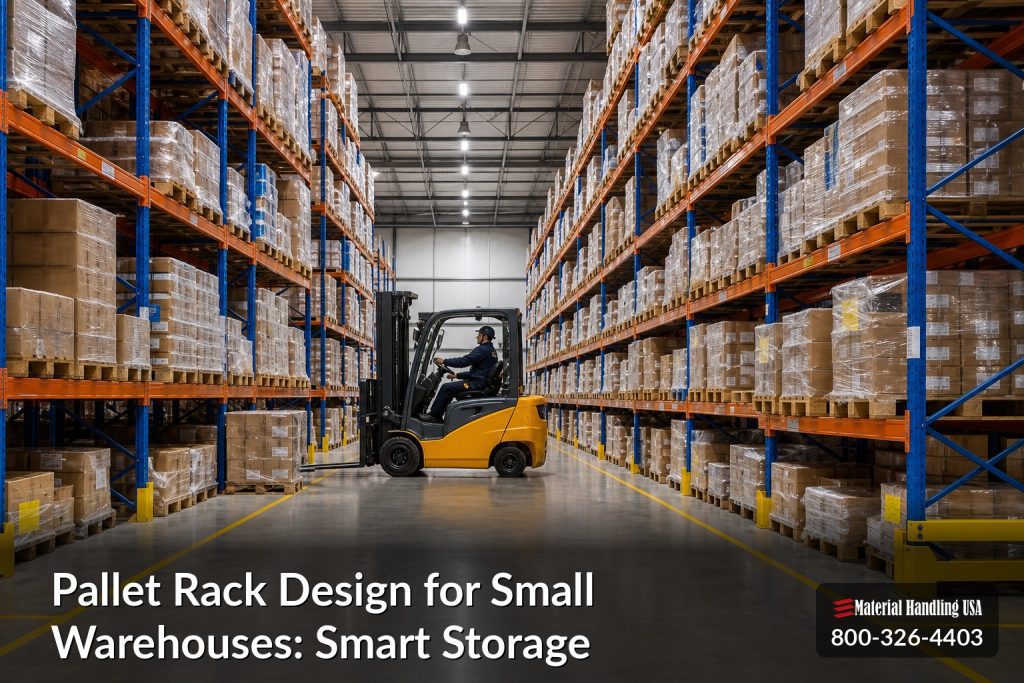
When a small warehouse starts to feel full, the problem usually isn't just lack of space. It's lost floor slots near the dock, pallets staged in the wrong areas, pick paths that zigzag, and racks that were added one row at a time without a real plan. The building feels maxed out, but the cube usually isn't.
That's why pallet rack design for small warehouses should be treated as an operational decision, not a simple equipment purchase. The right layout can recover capacity, shorten travel, and make receiving and shipping easier to manage. The wrong one locks you into daily workarounds that cost labor, slow turns, and force premature expansion.
From Crowded Aisles to Unlocked Capacity
In smaller facilities, the pain shows up fast. One late inbound load fills the staging area. A few oversized pallets spill into travel lanes. Pickers start walking around blocked corners instead of through clean aisles. Then the usual conclusion follows: we need more building.
Often, that's not the first fix.
A better layout changes how the building works. Longer rack runs can reduce interruptions. Cleaner aisle structure makes travel more predictable. Better use of height can pull inventory off the floor and restore dock space for the work that moves orders out the door.
Small warehouses usually don't fail because they lack square footage. They fail because the square footage is doing too many jobs at once.
That's why I start with flow before equipment. Where does product enter, pause, get stored, get picked, and leave? If those movements cross too often, no rack style will save the operation. If they're sequenced well, even a tight footprint can feel much larger.
A useful starting point is reviewing how your facility uses floor area today, especially around staging and travel lanes. The guidance in maximizing floor space in a warehouse is a good reality check before you commit to any rack layout.
Your Warehouse Needs Assessment
A small warehouse pays for design mistakes twice. First in rack steel and lift equipment. Then again in labor, blocked staging, and slow picking every day after the install. A needs assessment keeps the project tied to operating cost, not just storage capacity on paper.

Start with the pallet, not the rack
Pallet size drives more of the layout than many teams expect. If your operation can standardize, do it early. The 40” x 48” GMA pallet is the standard for 90% of U.S. systems, and designing around it can increase potential pallet positions by up to 40% compared to mixed or odd sizes, according to Mazzella's pallet racking design guidance.
Mixed pallet sizes create hidden cost. Beam levels get set for the worst case, which leaves air around smaller loads. Forklift operators slow down because one bay takes a different entry angle than the next. The result is less usable storage and more time spent handling around exceptions.
Standardization also affects ROI. In a small building, an extra row of rack only pays off if the operation can use it without adding confusion, damage, or extra touches.
Ask the questions that affect cost, access, and flow
A good assessment goes past pallet count. It should show what inventory behavior is costing you now and what the new layout needs to fix.
Checklist for the first review
- What moves fastest and needs the shortest travel path to picking or shipping
- Which SKUs sit longest and can be placed in less convenient locations
- How many pallets per SKU you typically hold at one time
- Whether FIFO or LIFO matters for shelf life, lot control, or customer requirements
- What your current forklift can safely lift and stack at the heights you want to use
- Where floor staging keeps returning because storage and workflow are out of sync
- How often you break pallets and shift from full-pallet storage to case picking
Those answers shape the financial trade-offs. If you carry many SKUs with only one or two pallets each, selective rack often delivers the best return because it preserves access and keeps labor predictable. If you hold deeper inventory in fewer SKUs, a denser layout may add more positions per square foot, but only if the savings in space outweigh the slower access and added handling.
I usually tell clients to price the labor effect, not just the steel. Saving one aisle can look smart in a quote. Losing pick speed every day is where small warehouses give that savings back.
Match the system to the work you can actually run
Small operations rarely have the luxury of separate equipment and dedicated zones for every task. One lift truck may handle receiving in the morning, replenishment at noon, and shipping in the afternoon. Rack design needs to fit that reality.
That means checking practical limits early. Can the truck turn in the proposed aisle width with your actual loads, not empty forks? Will the team need direct access to every SKU, or can some items sit in deeper lanes? Are you designing for your current order profile, or for the one you expect after growth?
If you are still sorting through access, clearance, and configuration questions, common pallet rack design questions facility managers ask can help narrow the options before you request a layout.
The best assessments are specific enough to guide a free design review. They give the rack supplier what they need to draw a layout that fits your inventory, your equipment, and your labor budget without forcing expensive changes after material is ordered.
Measuring for a Perfect Fit
A small warehouse can lose money before the first rack is installed. It happens when a layout looks efficient on paper, material gets ordered, and then a column guard, low-hanging pipe, or shallow dock approach forces field changes. Rework costs more in a small footprint because there is rarely spare space to absorb a bad assumption.

Good measurements do more than prevent fit problems. They protect return on investment. In a 10,000 to 30,000 square foot building, one bad aisle decision or one missed obstruction can wipe out positions you expected to gain, or force a narrower operating envelope that slows every pallet move afterward.
What to measure before anyone draws a layout
Start with the building shell, then document the constraints that change rack count, beam length, and aisle geometry.
- Clear height to the lowest real obstruction, including lights, sprinkler lines, conduit, and door tracks
- Column locations with width, depth, spacing, and any guards or bases that project into the aisle
- Dock doors and man doors including swing, approach area, and the space staging consumes
- Electrical panels, heaters, drains, fire risers, and walls that limit rack placement or required access
- Floor condition where anchors will be installed and loaded uprights will bear
- Travel paths for forklift turns, pallet jack movement, battery changes, and pedestrian routes
This part is simple, but it has to be exact.
Where small warehouses usually miss capacity
Vertical space is often the cheapest capacity a small warehouse can get, but only if the usable height works with the pallets you store. A 48-inch pallet load is not a 48-inch storage requirement. You also need beam depth, flue space, lift clearance, and room for safe placement and retrieval.
The Warehouse Education and Research Council notes that slotting and layout discipline have a direct effect on how efficiently facilities use available cube, especially in space-constrained operations in its warehouse space utilization guidance. In practice, I see the same problem repeatedly. Teams measure to the roof deck, not the lowest obstruction, then assume they can add another beam level. By the time the lift truck mast, pallet overhang, and fire protection clearances are checked, that extra level disappears.
Field note: Measure the building that exists. Old drawings miss tenant improvements, patched columns, replacement sprinklers, added conduit, and other changes that affect rack height and row spacing.
Accurate measurements also keep the rack spec aligned with the loads you plan to store. If you need a refresher on beam sizes, frame depths, and capacity basics, these pallet rack specifications help organize the information before a formal design review.
Choosing the Right Rack System for Your Space
A small warehouse can burn money two ways. One layout leaves pallet positions on the table. Another squeezes in more rack, then slows every putaway, pick, and replenishment move enough to erase the gain. The right system earns its floor space.
What usually works in smaller footprints
Selective rack is still the right answer for many small warehouses because it protects flexibility. If you carry a wide SKU mix, need direct access to each pallet, or expect inventory profiles to change, selective rack usually produces the best total operating result, even when it is not the densest option on paper. It also keeps operator decisions simple, which matters in facilities where one mistake can block an aisle or tie up the only lift truck.
Push-back and other higher-density systems fit a narrower operating profile. They work best when you have fewer SKUs, deeper pallet quantities, and enough consistency to group product by lane. The trade-off is reduced selectivity, more rules around replenishment, and a layout that is harder to rework if your mix changes six months from now.
Some small facilities should not put everything on pallet rack at all.
If part of the inventory is hand-picked, light, irregular, or fast-moving in broken-case quantities, a hybrid layout with rack plus shelving often outperforms an all-rack plan. That approach can lower forklift travel, improve picking speed, and avoid paying for heavy-duty storage where lighter storage will do the job.
Small Warehouse Pallet Rack Comparison
| System Type | Storage Density | SKU Selectivity | Cost per Pallet | Best For |
|---|---|---|---|---|
| Selective rack | Moderate | High | $50 to $80 per pallet position installed based on PHI's pallet rack cost overview | Many SKUs, direct access, flexible layouts |
| Push-back rack | Higher | Lower than selective | Higher than selective | Fewer SKUs with deeper pallet counts |
| Double-deep style layouts | Higher than single-deep selective | Moderate | Higher than selective | Operations willing to trade some accessibility for more storage |
| Hybrid rack plus shelving zones | Varies by mix | High for split inventory | Varies by application | Small warehouses storing both palletized and hand-picked items |
Choose for total cost of ownership
Purchase price is only the starting number. The more useful question is what each system does to labor, travel time, replenishment discipline, damage risk, and future changes.
I often see small warehouses chase density because the rack quote looks efficient. Then the operation pays for that decision every day. A denser system can reduce travel distance per pallet stored, but it can also increase touches, force more relocations, and make slot changes expensive. In a 20,000 square foot building, those frictions show up fast because there is no spare area to absorb them.
A practical test helps. If your pallet profile, SKU count, and order pattern are likely to change, buy flexibility first. If your product is stable, deep, and predictable, density may produce a real return. The best rack system is the one that lowers your storage cost without raising your handling cost enough to cancel the gain.
Aisle Width, Load Capacity, and Safety Codes
A small warehouse often feels fine until the first busy week exposes the layout. Forklifts wait on each other, pallets get staged in receiving because there is no clean travel path, and the extra rack row that looked smart on paper starts costing time every shift. Aisle width sits at the center of that trade-off. It changes how many pallet positions you can fit, what lift truck you need, how fast operators work, and how much damage risk you accept.

Aisle width is an ROI decision
Counterbalance trucks usually need wider aisles than reach trucks. Narrower aisles can create room for more storage in the same building, but the savings are never limited to rack geometry. Equipment cost, battery charging, operator training, floor condition, pallet quality, and throughput all change with the aisle plan.
In small warehouses, I usually frame the decision this way. If adding pallet positions delays a building expansion or cuts outside storage, narrower aisles may pay back fast. If the operation is simple, labor is tight, and product moves in and out with frequent touches, wider aisles can be cheaper over time because they keep handling faster and more forgiving.
Aisle width should be tested against total operating cost, not just capacity on a CAD drawing.
Capacity has to match the heaviest reality
Load capacity mistakes are expensive because they often start with a harmless assumption. Someone uses average pallet weight. Someone else adds an extra beam level later. The rack still looks the same, but the rating has changed.
Beam capacity and upright capacity depend on the full configuration, including beam length, level spacing, frame height, anchoring, and the actual load at each level. The safe number is based on the heaviest pallet the system may see in normal use, including inbound exceptions and seasonal product. If one pallet can exceed the design load, the rack needs to be rated for that condition.
That is the number to put on the drawing and on the load plaques.
Code compliance belongs in the layout, not after installation
A workable layout still fails if it ignores anchoring, flue space, rack protection, forklift clearances, and fire protection rules. Small warehouses run into this problem often because every inch feels valuable. Then the install crew arrives and part of the layout has to change to meet site conditions or code requirements.
Review the relevant OSHA warehouse guidance while the layout is still being developed. OSHA will not size your uprights or choose your beam length, but its guidance reinforces the need for clear aisles, safe truck operation, and properly maintained storage equipment. Pair that with local fire code review and the rack manufacturer's load data before material is ordered.
That step costs little. Fixing a noncompliant layout after purchase does not.
Get Your Free Design and Fast Installation
Good pallet rack design for small warehouses comes down to a few hard truths. You need the right pallet assumptions, accurate building measurements, a realistic view of how inventory moves, and a layout that respects both cost and daily operations. When one of those is wrong, the project gets expensive in a hurry.
That's why a professional layout review usually pays for itself before the first upright is installed. Material Handling USA provides free layouts and designs with no obligation, along with quoting support for rack systems, accessories, and related storage equipment. That gives you a way to compare options before committing to material, labor, or a forklift change.

Projects tend to move more smoothly when the planning starts early. Better layouts mean fewer field changes, faster installs, and less chance of losing time to redesigns once material is on the floor. With demand staying steady for storage upgrades, earlier planning usually gives buyers more flexibility on scheduling and product availability.
If your warehouse is running out of room, don't wait until overflow becomes the normal process. Material Handling USA can help you compare rack options, review your measurements, and build a layout that fits your inventory, equipment, and budget. For a free quote and no-obligation design, Contact Us, Request a Quote, email Sales@MH-USA.com, or Call (800) 326-4403. If you already know what you need, you can also Shop Now and Buy Online through our store for fast shipping, competitive pricing, and quality products built for working warehouses.