Warehouse layout design software is the modern tool for transforming a chaotic, inefficient floor plan into a high-performance operation. It allows you to build, test, and perfect the physical flow of goods in a digital environment, replacing guesswork with a precise plan before you invest in physical changes.
The Blueprint for a High-Performance Warehouse
Staring at a crowded, inefficient warehouse floor can feel overwhelming. Common issues like wasted travel time for pickers, bottlenecks at shipping docks, and underutilized space quietly drain your budget and slow down operations. A smart layout is the foundation of a productive facility, but designing one can seem like a monumental task.
This is where a digital-first approach using warehouse layout design software changes the game. It moves your planning from a static whiteboard to a dynamic, virtual environment where you can see your ideas in action.
Think of it less as a simple drawing tool and more as a powerful simulation engine. It allows you to visualize workflows, identify potential traffic jams, and test how different equipment will fit and function in your space. The goal isn't just to fit more pallet racks into a building; it's to engineer a safer, more efficient environment where every movement has a purpose.
Preventing Costly Real-World Mistakes
One of the biggest advantages of this software is catching design flaws before a single rack is installed. You can test if your aisle widths are adequate for a new forklift fleet or model how receiving and shipping docks will perform during peak season. This digital trial-and-error prevents the expensive rework and operational headaches that can sink budgets later on.
When laying the groundwork for a modern facility, it's also critical to understand the unique design considerations for automated warehouses.
By modeling your operations digitally, you gain the confidence that your physical layout will meet performance expectations from day one, minimizing trial and error on the warehouse floor.
This forward-thinking approach is becoming the new industry standard. The global warehouse management system (WMS) market, which is closely tied to layout design, was valued at over $3 billion and is projected to reach nearly $16 billion by 2033. This growth highlights how critical optimized warehouse operations have become. You can find the full research on WMS market trends on GrandViewResearch.com.
Ultimately, a perfected digital blueprint is the first step. The next is turning that vision into a high-functioning reality with the right equipment and expert guidance. By partnering with a team that understands both digital design and physical implementation, you ensure a smooth transition. Material Handling USA offers complimentary warehouse design and layout services to help you create and execute the perfect plan.
Decoding Key Software Features and Capabilities
Looking at a long list of software features can be confusing. To cut through the noise, focus on the core tools that deliver measurable results for your operation. These platforms are designed to take your planning from a flat, static blueprint to a dynamic, interactive model of your facility.
The most fundamental feature is 2D and 3D visualization. This allows you to create a detailed floor plan and then virtually walk through it. Think of it as a flight simulator for your warehouse; you can experience the space, check sightlines, and spot potential choke points long before ordering any pallet racking. Gaining that visual confirmation is a huge step in getting everyone on board and ensuring the plan is practical.
Beyond just visualizing the layout, the best software provides intuitive drag-and-drop interfaces. This makes it easy to place, move, and rearrange essential equipment like shelving, conveyor systems, and workstations. You can test different arrangements in minutes, experimenting with the layout to find the most efficient flow without needing a degree in computer-aided design.
The image below shows how this kind of software is key to turning operational chaos into a well-oiled machine.
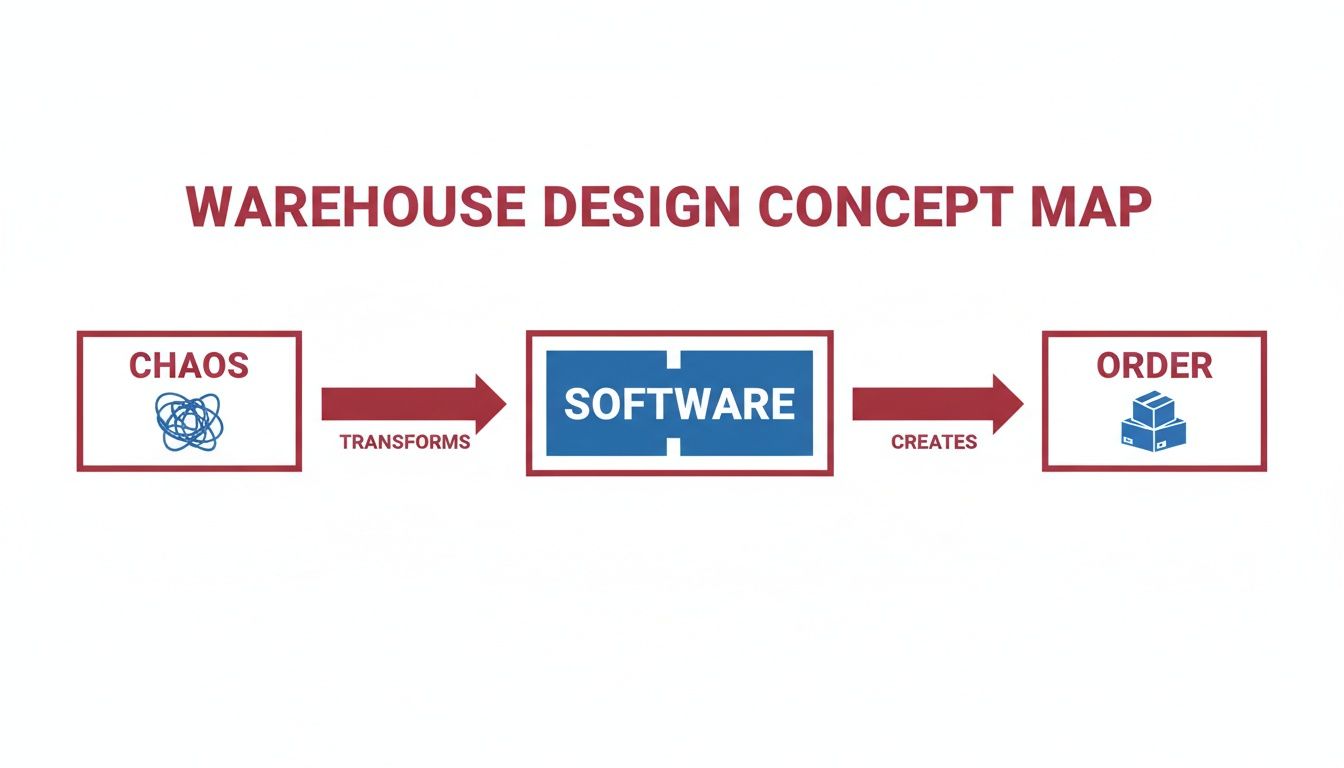
It’s all about creating a bridge from disorganized processes to a clear, efficient, and orderly warehouse operation.
Advanced Optimization Tools
Once you have the basic layout finalized, advanced features come into play to fine-tune performance. Simulation tools are a complete game-changer here. They let you run virtual stress tests on your proposed workflows. You can model a typical day, or even a peak season rush, to see how your design holds up under pressure. These simulations quickly expose potential bottlenecks, congested aisles, or inefficient travel paths that would otherwise only appear after a costly physical build-out.
Another powerful tool is heat mapping. This feature provides a visual breakdown of product velocity, using colors to show where your fastest-moving items are located. By analyzing this data, you can see if your most popular products are stored in the back of the warehouse, forcing pickers to travel farther than necessary. This insight directly fuels a much smarter slotting strategy.
Essential vs Advanced Software Features
It's helpful to categorize features into two groups: the must-haves for any basic layout project and the advanced tools that unlock deeper levels of optimization. The essentials get your design off the ground, while the advanced capabilities turn a good layout into a great one.
Here’s a quick breakdown:
| Feature Category | Essential Capability (Must-Have) | Advanced Capability (Nice-to-Have) |
|---|---|---|
| Visualization | 2D floor plans & 3D walkthroughs. | Virtual Reality (VR) immersive experiences. |
| Design Interface | Basic drag-and-drop for equipment placement. | Intelligent object snapping & alignment guides. |
| Data Analysis | Manual import of product & order data. | Real-time integration with WMS/ERP for live data. |
| Simulation | Basic workflow & travel path modeling. | Peak season simulation with variable labor/order inputs. |
| Optimization | Manual slotting based on visual assessment. | Algorithmic slotting optimization & heat mapping. |
| Reporting | Static PDF exports of layout plans. | Dynamic dashboards with key performance indicators (KPIs). |
While the "nice-to-have" features might seem like luxuries, for complex or high-volume operations, they often provide the critical insights needed to justify the investment and achieve a significant ROI.
Slotting and System Integration
Ultimately, a key goal of using this software is achieving effective slotting optimization. The system can analyze your order data and recommend the perfect storage spot for every SKU. The idea is to place your fastest-moving items in the most accessible, ergonomically friendly locations, often called the "golden zone", to slash travel time and make your pickers more productive.
These design tools are a critical part of the larger warehouse management ecosystem. Today, cloud-based solutions are the standard, valued for their accessibility and ability to scale with your business. This approach allows for real-time collaboration and easier integration with other systems. You can read more about this trend in the full research on warehouse software market innovations on OpenPR.com.
Each of these features works together to create a smarter, more responsive warehouse. The real power comes when you connect these digital tools with a robust warehouse management system. You can learn more about how a WMS-integrated warehouse design defines your layout in our detailed guide. These powerful software capabilities give you the data-driven insights needed to build a facility that’s truly built for peak performance.
How to Choose the Right Software for Your Operation
Picking the best warehouse layout design software isn't about finding the platform with the longest feature list. The right tool is the one that fits your specific operation, your budget, and your future plans. It means looking past the sales pitch and asking the right business-focused questions.
Think of it like choosing a vehicle for a job. A sports car might have incredible specs, but it’s useless if you need to haul materials. Similarly, a complex software suite built for a massive, fully automated distribution center is likely overkill, and a waste of money, for a smaller, growing operation.
The goal is to find a solution that solves your problems today but has a clear path to grow with you tomorrow.
Core Evaluation Criteria
Before you book a single demo, the first step is to look inward. Getting a clear picture of your own needs will make it much easier to weed out the wrong options and focus on software that will deliver value.
Your evaluation should boil down to three critical areas:
Integration with Existing Systems: How well will this new software work with your current Warehouse Management System (WMS) or Enterprise Resource Planning (ERP) platform? Seamless data flow is non-negotiable. You need a tool that can pull real-time inventory and order data to build accurate models, not something that forces your team into hours of manual data entry.
Scalability for Future Growth: Your business is not standing still, and your software can’t either. Ask potential vendors how their platform handles growth. Can it manage a 50% increase in SKUs? What about double the order volume? Can it model a second or third facility down the road? A solution that can’t scale with you will quickly become a roadblock.
Team Usability and Learning Curve: The most powerful software on the planet is worthless if your team finds it too confusing to use. What is the real learning curve? A clean, intuitive interface means your team gets up to speed faster and can start optimizing layouts right away, which is how you get a return on your investment.
Key Questions for Software Vendors
Once you have a shortlist of potential partners, it's time to dig deeper. Use this checklist during your demos and follow-up calls to ensure you’re getting the full story. Honest answers to these questions will reveal the true cost and capability of each platform.
Choosing the right software is a strategic decision that impacts everything from daily productivity to long-term growth. A thorough evaluation process ensures your investment supports your operational goals for years to come.
This table provides a structured way to compare your options head-to-head.
| Category | Questions to Ask Your Vendor |
|---|---|
| Data Requirements | What specific data inputs are required to get started? (e.g., SKU dimensions, order history, facility blueprints) |
| Cost Model | Is this a one-time license fee or a recurring subscription? Are there extra costs for support, training, or updates? |
| Multi-Site Support | Does the software support the management of multiple warehouse locations from a single dashboard? |
| Simulation Accuracy | How does the simulation engine model real-world variables like labor availability and equipment downtime? |
| Hardware Needs | What are the minimum computer hardware specs to run the software effectively, especially for 3D modeling? |
| Support & Training | What does the onboarding process look like? Is technical support included, and what are the typical response times? |
Getting straight answers here will protect you from hidden costs and ensure the software you pick is a true partner in your success. But remember, while software provides the digital blueprint, expert guidance is what turns that plan into a physical reality.
The insights from layout software are invaluable, but they are just the first step. Our team at Material Handling USA provides free layouts and designs with no obligation, helping you translate your digital model into a compliant, efficient, and fully functional warehouse. Contact Us today or call 800-326-4403 to discuss your project.
Turning Your Digital Blueprint Into a Physical Reality
A flawless digital design is an excellent starting point, but it's only half the battle. The real challenge, and where true operational excellence is forged, lies in translating that perfect plan from your screen to your concrete floor. This is where a strong partnership becomes invaluable for navigating the complexities of physical implementation.
Warehouse layout design software is exceptional at modeling flow and space, but it can't account for every real-world variable. A perfect software-generated plan doesn't automatically factor in local building codes, specific seismic zone requirements for your region, or the precise load capacities of different pallet racking systems. This is the crucial gap where expertise bridges a virtual concept and a compliant, safe, and fully functional warehouse.
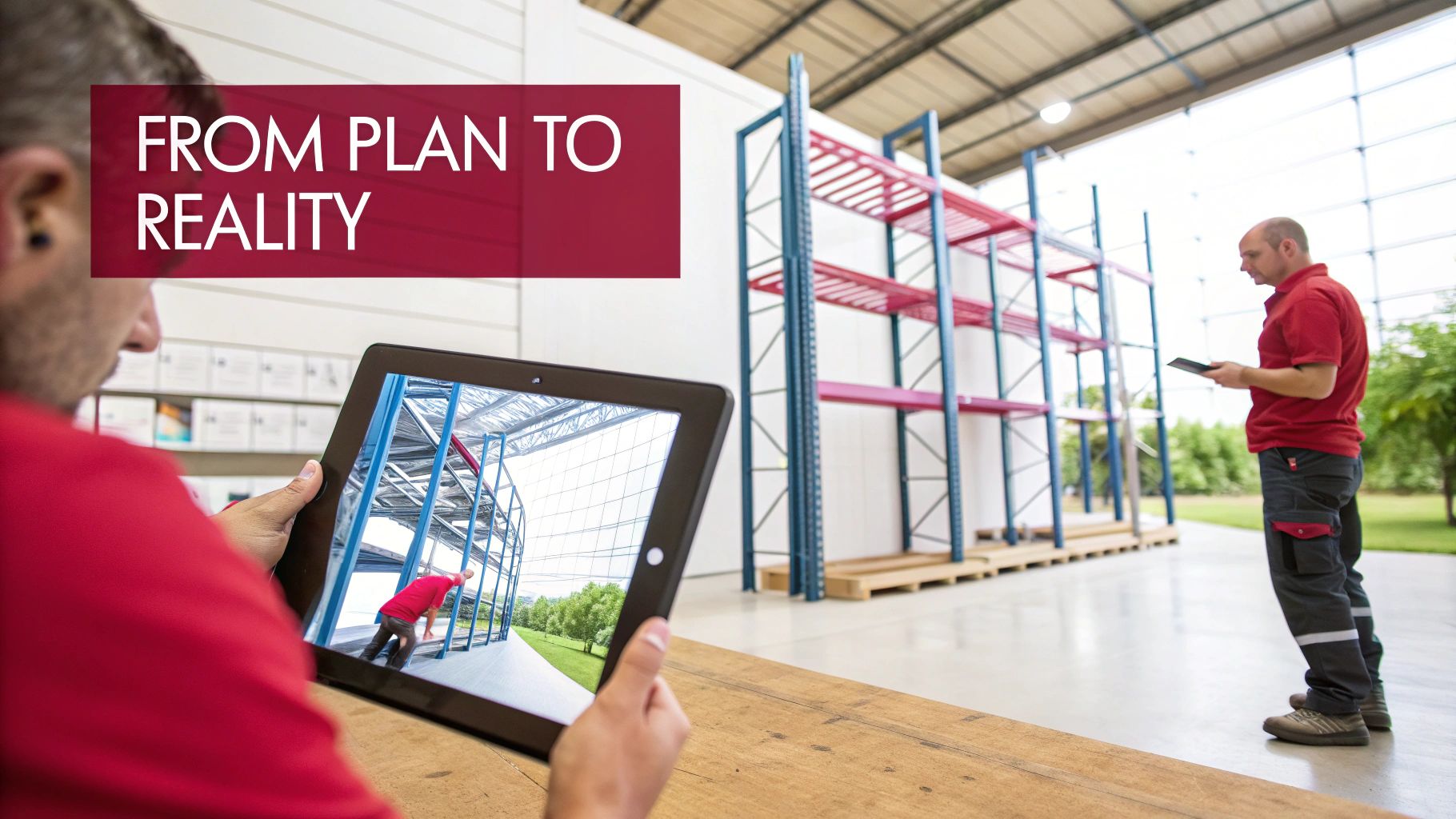
From Pixels to Pallet Racks
The first step in this transition is selecting the right material handling equipment that precisely matches your digital specifications. This involves more than just finding racks that fit; it's about ensuring every component can handle the specified loads, meets safety standards, and integrates seamlessly with your planned workflow.
This selection process includes:
- Pallet Racking: Choosing the correct type, be it selective, drive-in, or push-back, based on your inventory velocity and density goals.
- Industrial Shelving: Making sure weight capacities are appropriate for your products and that the shelving configuration aligns with your picking strategy.
- Mezzanines and Platforms: Verifying that the structural design is engineered to code and can support the intended equipment and personnel.
A digital blueprint provides the "what" and "where," but expert implementation provides the crucial "how." It ensures the physical structure is not only efficient but also robust, compliant, and built to last.
The Importance of Project Management
A smooth installation doesn't just happen. Professional project management guides your project from a purchase order to a fully operational layout, ensuring that timelines are met, materials arrive on schedule, and installation crews work efficiently and safely. With high demand for quality installers, scheduling your project sooner rather than later helps secure experienced teams and avoid potential delays in your go-live date.
This is where the industry’s growth becomes a tangible factor. The warehouse design and layout market is projected to grow to USD 10.4 billion by 2035. A significant portion of this market, nearly 58.0%, is dominated by semi-automatic solutions, which balance automation with practical, scalable systems. This trend highlights the need for precise planning and execution to integrate these systems effectively. You can discover more insights about the warehouse design market from Future Market Insights.
Bridging the Gap with Expert Design Services
This is the moment to bring in expert guidance to ensure your virtual plan becomes a powerful physical asset. While you may have a strong initial design, our team at Material Handling USA offers free layouts and designs with no obligation. We act as your expert partners, reviewing your software-generated plan to ensure it is compliant, structurally sound, and optimized with the right equipment for your budget. We can also help you explore how different systems, such as automated storage and retrieval systems (ASRS) for smart warehouse automation, can fit into your design.
By combining your software's power with our hands-on expertise, you get the best of both worlds. Contact Us or call 800-326-4403 to get a free quote and turn your digital blueprint into a competitive advantage.
Measuring the True ROI of Your New Warehouse Layout
Any major change to your operations has to answer the big question: what's the return on investment? When you're making the business case for a new layout, you have to move past vague benefits and get down to the hard data. The key is focusing on the key performance indicators (KPIs) that show real, measurable gains in efficiency.
A plan built with warehouse layout design software isn't just a drawing; it's a financial forecast. Instead of saying, "we'll be faster," you can project exactly how much faster and what that means for the bottom line. This data-driven approach gets managers and stakeholders to sign off, and it’s how you prove the project was a success long after the last rack is in place.

Key Performance Indicators to Track
To get a true picture of your ROI, you need to track the right metrics, before and after the layout change. These KPIs will tell you exactly how the new design is performing and, more importantly, where you're saving time and money.
Here are the most critical numbers to watch:
- Picker Travel Time: This is a major factor in labor costs. A well-designed layout, with high-velocity items in the right spots, can slash travel time by up to 40%. Measure the average time or distance per pick to see the difference.
- Order Fulfillment Speed: Keep an eye on your dock-to-stock time and total order lead time. When you can process orders faster, you increase your throughput and overall capacity without needing to hire more people.
- Storage Density: It's time to calculate your cubic space utilization. A smarter layout uses vertical space with the right kind of racking, which could be the one thing that saves you from a very expensive facility expansion.
- Picking Accuracy: A logical, organized layout with clear labeling naturally cuts down on mistakes. Fewer mis-picks mean you’re spending less time and money processing returns, and your customers are happier.
- Safety Incident Rates: Track the number of accidents or even just near-misses. Proper aisle widths and clear pathways make for a safer workplace, which can lead to lower insurance premiums.
A Simple Framework for Calculating Gains
You don't need an advanced degree in finance to quantify your ROI. A powerful business case can be built by focusing on a few core areas where the savings are biggest and easiest to see.
By focusing on tangible metrics like labor savings and throughput increases, you can clearly demonstrate the financial impact of a well-designed layout and justify the investment with concrete evidence.
Use this simple framework to get started.
| ROI Calculation Area | How to Measure the Financial Gain | Example Impact |
|---|---|---|
| Labor Savings | Calculate the reduction in hours spent walking, searching, and picking. Multiply saved hours by the average hourly wage. | Shaving just 20 minutes of travel time per picker each day for a team of 10 can save thousands in annual labor costs. |
| Throughput Increase | Measure the jump in orders shipped per day with the same number of staff. Assign a value to each extra order. | A 15% increase in daily orders shipped translates directly to higher revenue and profitability from the resources you already have. |
| Space Optimization | Figure out the value of the floor space you've reclaimed or, better yet, the cost of leasing additional square footage you now don't need. | Getting the most out of your vertical storage could put off a $10,000 per month warehouse expansion for several years. |
While software is great for designing the layout, turning that digital plan into a physical reality takes the right equipment and experience. We've seen companies underestimate how long it takes to plan for these projects, which disrupts their timelines. Starting the conversation early means you can lock in the resources and installation schedules you need without any last-minute scrambling.
Material Handling USA offers free layouts and designs with no obligation, which can help you sanity-check your plan and choose the absolute best equipment for maximum ROI. Contact Us today or give us a call at 800-326-4403 for a free quote.
Your Next Step Towards a Smarter Warehouse
In a world where every inch and every second counts, a well-designed warehouse isn't a luxury; it's the engine of your entire operation. As we've seen, warehouse layout design software is an incredible tool for visualizing what's possible. But its real value is realized when that digital blueprint is brought to life with the right equipment and expert guidance. The software provides the vision, but turning that vision into a high-performing physical reality requires a strategic partner.
The path forward is clear. It starts by picking software that solves your unique operational challenges, not just one with a long list of features you'll never use. From there, success is all about the data, proving the ROI with real numbers that show you're moving more product, faster.
From Digital Plan to Operational Excellence
The best results always come from blending your team's deep knowledge of your business with outside expertise in warehouse design and material handling. As you move toward a smarter warehouse, think bigger. Consider the strategies for modernizing and future-proofing facilities to make sure the layout you build today won’t become a bottleneck tomorrow. This kind of foresight separates a good layout from a great one.
Project timelines and installation schedules across the industry are filling up quickly. Kicking off the design conversation now isn't just a good idea; it's a critical strategic advantage that helps you sidestep the operational delays that can disrupt an entire supply chain.
Partner with the Experts at Material Handling USA
Don't let a brilliant digital plan lose its potential during implementation. We invite you to lean on our decades of experience to transform your design into a compliant, efficient, and rock-solid physical asset. Our team is ready with the guidance, and the high-quality equipment, to build a warehouse that truly works for you.
The journey to a high-performance warehouse begins with a single conversation. By combining your operational insights with our design expertise, you can create a layout that delivers a powerful competitive advantage.
Take the definitive step towards a truly optimized facility. We offer free layouts and designs with no obligation, giving you a clear, expert-validated path forward without any commitment.
Ready to build a smarter warehouse? Contact Us online or call 800-326-4403 today to Request a Quote and begin your free design consultation.
Frequently Asked Questions
Thinking about a new warehouse layout? You've got questions, and we've got answers based on years of experience turning digital plans into high-performance facilities.
Can I Design My Warehouse Layout Myself Using Just Software?
While design software is a fantastic starting point for visualizing your ideas, it's only one piece of the puzzle. A truly optimized layout that's also safe and compliant requires a deeper level of expertise.
Software can't tell you about local building codes, specific seismic zone requirements, or the real-world structural limits of different pallet rack systems. That's where professional experience comes in. Our free design service bridges the crucial gap between your digital concept and a functional, permitted reality, saving you from headaches and costly rework down the line.
How Long Does It Take to Implement a New Warehouse Layout?
This really depends on the scale of your project. A straightforward industrial shelving installation might only take a few days. On the other hand, a complex multi-level mezzanine with an integrated pallet rack system could be a multi-week project.
The total timeline is heavily influenced by planning, permitting, and getting the materials on-site. The best way to get a realistic schedule is to bring our design team in early. Because we have some of the fastest shipping in the industry, we can often help shorten the material delivery phase of your project.
What Is the Biggest Mistake Companies Make When Redesigning a Warehouse?
Hands down, the most common and expensive mistake is designing a layout only for today's needs. A great design has to be scalable. It needs to have the built-in flexibility to handle more SKUs, higher order volumes, or new technology you might add in the future.
Another big pitfall is not doing a deep workflow analysis. A layout can look perfect on screen but create real-world bottlenecks or force your team to walk excessive distances. Our design process is focused on both current efficiency and future scalability, making sure your investment pays off for years to come.
At Material Handling USA, we turn your optimized digital plans into high-performance physical realities. Our complimentary design services ensure your layout is not just efficient, but also safe, compliant, and built with quality materials delivered faster than anyone in the industry. Let us help you build the foundation for your future success.
Ready to start the conversation? Contact Us online or call 800-326-4403 to Request a Quote and begin your free, no-obligation design consultation.