In today’s competitive landscape, efficient inventory management is the backbone of any successful operation, whether you’re running a busy warehouse, a secure evidence facility, or a high-tech lab. Poor control over stock leads directly to tied-up capital, operational delays, and missed customer opportunities. On the other hand, mastering your inventory flow unlocks significant cost savings, improves fulfillment speed, and ensures you have the right products in the right place exactly when they are needed. The key is moving beyond basic stock-taking to a strategic, data-driven approach.
Implementing proven best practices for inventory management transforms your stock from a passive liability into a powerful strategic asset. This comprehensive guide details 10 essential strategies that provide clear, actionable steps to optimize your processes, technology, and facility layout, setting your organization up for scalable growth and improved profitability.
You will learn how to:
- Categorize inventory for prioritized control with ABC analysis.
- Minimize waste and holding costs using Just-In-Time (JIT) and Lean principles.
- Implement precise tracking with cycle counting and barcode or RFID technology.
- Optimize storage and retrieval with smart warehouse layout design.
- Maintain service levels through effective safety stock and reorder point planning.
Each practice is broken down into practical steps for implementation. Establishing these robust systems sooner rather than later allows for smoother project timelines and helps avoid the costly operational disruptions that often come with reactive, last-minute planning. By adopting these methods, you build a resilient supply chain ready to meet demand and drive your business forward.
1. ABC Analysis (Always Better Control)
Not all inventory items are created equal, and one of the most effective best practices for inventory management is to stop treating them as if they are. ABC analysis is a categorization method that segments your inventory based on the Pareto principle, often known as the 80/20 rule. This technique classifies items into three tiers to prioritize your management efforts where they matter most.
The breakdown is simple yet powerful:
- A Items: These are your most valuable products, typically representing about 80% of your inventory value but only 20% of your total stock volume. They require the tightest controls, frequent monitoring, and highest security.
- B Items: This middle category consists of items with moderate value and volume, often making up around 15% of your inventory value and 30% of your stock.
- C Items: These are the low value, high volume items. They represent just 5% of your inventory value but can constitute 50% of your total stock. Management for these items can be more relaxed.
Putting ABC Analysis into Action
Applying ABC analysis allows you to allocate resources more efficiently. For example, a manufacturing plant can use this method to closely track expensive, critical machinery components (A items) while using a simpler, automated reordering system for low cost consumables like nuts and bolts (C items).
Key Insight: By focusing your team’s time on managing high-value “A” items, you directly protect your most significant assets from stockouts, theft, or damage, which has a disproportionately positive impact on your bottom line.
To implement this, start by calculating the annual consumption value for each item (Annual Demand x Item Cost). Rank the items from highest to lowest value and then establish clear cutoffs for each category. Use this data to inform your facility’s layout. Store A items in highly secure, easily accessible areas, while C items can be placed in higher density storage further away. This strategic placement, supported by versatile solutions like industrial shelving, can drastically reduce pick times and improve operational flow.
Consider a free layout and design consultation to see how ABC principles can optimize your storage footprint.
2. Just-In-Time (JIT) Inventory System
One of the most transformative best practices for inventory management is shifting from a “just in case” to a “just in time” model. The Just-In-Time (JIT) inventory system is a lean methodology where materials arrive precisely when they are needed for production or order fulfillment. This approach drastically reduces the need for large buffer stocks, minimizing waste, storage costs, and tied up capital.
The JIT model is built on precision and reliability, synchronizing your supply chain with your production schedule or customer demand. Its core objective is to improve cash flow and efficiency by holding as little inventory as possible without risking stockouts.
- Reduced Carrying Costs: Less inventory means lower expenses for storage, insurance, and potential obsolescence.
- Improved Cash Flow: Capital is not locked into unsold stock, freeing up funds for other business areas.
- Increased Efficiency: Operations become leaner, reducing waste and improving overall productivity.
- Greater Flexibility: Businesses can adapt more quickly to changes in customer demand without being burdened by excess stock.

Putting JIT into Action
Implementing a JIT system requires strong supplier relationships and accurate demand forecasting. For instance, a Dell Computers assembly plant uses JIT to order components only as needed for its daily production queue, virtually eliminating component warehousing costs. Similarly, healthcare systems apply JIT principles to manage medical supplies, reducing their on-site storage footprint by up to 40%.
Key Insight: A successful JIT system transforms your inventory from a static, costly asset into a dynamic flow that directly supports revenue generation. This makes your entire operation more agile and responsive to market changes.
To adopt this strategy, start by building partnerships with reliable suppliers who can guarantee fast, accurate deliveries. Invest in demand forecasting software and use real time tracking like barcodes or RFID to automate reorder triggers. Your facility design must also be agile. Using flexible solutions like modular shelving allows you to quickly reconfigure storage areas to accommodate the fluctuating, minimal inventory levels inherent to a JIT system, ensuring your space is always optimized.
A free layout consultation can help you design a storage system built for the speed and flexibility JIT demands.
3. First-In-First-Out (FIFO) Inventory Method
To avoid costly spoilage and obsolescence, one of the most fundamental best practices for inventory management is to ensure the oldest stock is used or sold before the newest. The First-In-First-Out (FIFO) method is a systematic approach to inventory rotation that prioritizes the movement of items based on their arrival date. This principle is non negotiable for industries dealing with perishable goods, products with expiration dates, or items susceptible to degradation over time.
Adopting FIFO prevents products from aging unnecessarily in your facility, which directly reduces waste and maintains the quality and efficacy of your stock. It ensures customers or end users always receive fresh, reliable products, protecting your brand’s reputation and bottom line.

Putting FIFO into Action
Implementing FIFO is crucial across many sectors. For instance, pharmaceutical companies rely on it to prevent expired medications from reaching patients, while grocery retailers use it to minimize food spoilage. In a laboratory setting, chemical stocks are rotated using FIFO to maintain their potency and prevent hazardous degradation.
Key Insight: FIFO isn’t just an accounting principle; it’s an operational strategy that directly impacts product quality, customer safety, and profitability. Failing to rotate stock properly can lead to significant financial losses and compliance issues.
To implement FIFO effectively, start by marking all incoming inventory with clear date stamps or color coded labels. Design your storage layout to facilitate a natural flow, where new stock is loaded from one side and older stock is picked from the other. Storage solutions like pallet racking can be configured to create dedicated loading and picking aisles, making FIFO protocols intuitive for your team. Integrating barcode scanning can also automate date tracking and send alerts when older stock needs to be prioritized.
4. Economic Order Quantity (EOQ) Calculation
Finding the perfect balance between ordering too much and not enough is a constant challenge, but another of the best practices for inventory management involves using a proven formula to find the sweet spot. Economic Order Quantity (EOQ) is a calculation that identifies the optimal quantity of inventory to order that minimizes the total costs associated with purchasing, ordering, and holding stock.
The formula balances two key competing costs:
- Ordering Costs: These are the expenses incurred each time an order is placed, such as administrative fees, labor for processing the order, and shipping charges.
- Holding Costs: Also known as carrying costs, these are the expenses related to storing inventory until it is sold, including storage space, insurance, taxes, and potential obsolescence.
The goal of the EOQ formula is to find the point where the combined ordering and holding costs are at their lowest, helping you reduce waste and improve cash flow.
Putting EOQ into Action
Applying EOQ helps businesses avoid the financial strain of both overstocking and understocking. For instance, a retail chain can use it to determine the most cost effective number of packaging boxes to order at one time, while a manufacturing plant can apply it to critical raw materials to ensure production lines keep running without tying up capital in excess parts.
Key Insight: EOQ transforms inventory ordering from guesswork into a data driven strategy. By calculating the ideal order size, you can significantly reduce holding costs and the frequency of placing orders, directly boosting your operational efficiency and profitability.
To implement EOQ, you must first gather accurate data on annual demand, the cost per order, and the holding cost per unit. While mathematical formulas like the Economic Order Quantity (EOQ) Calculation help determine optimal order sizes, these calculations are only as good as their inputs. A critical component of ordering costs that influences EOQ is the shipping expense; therefore, understanding how to accurately calculate shipping cost is essential. Use inventory management software to automate these calculations and recalculate them periodically to adjust for changes in demand or costs. Combining EOQ with your ABC analysis allows you to apply more rigorous ordering strategies to your high value “A” items.
5. Cycle Counting and Regular Inventory Audits
Relying solely on an annual, all hands on deck physical inventory count is an outdated and disruptive practice. One of the most impactful best practices for inventory management is implementing cycle counting, a continuous verification process where small subsets of inventory are counted on a regular schedule. This method maintains high inventory accuracy year round, identifies discrepancies almost immediately, and eliminates the operational chaos of a complete facility shutdown.
The logic behind cycle counting is straightforward and effective:
- Reduces Disruptions: Instead of a massive annual count that halts all other operations, cycle counting integrates into daily workflows with minimal interruption.
- Improves Accuracy: Frequent counting quickly uncovers issues like shrinkage, receiving errors, or misplaced items, allowing for immediate root cause analysis and correction.
- Supports Operations: Accurate inventory data enables more reliable forecasting, better purchasing decisions, and a significant reduction in stockouts and backorders.
Putting Cycle Counting into Action
To implement cycle counting, start by leveraging your ABC analysis. High value “A” items, for instance, should be counted most frequently—daily or weekly. A healthcare facility might perform daily cycle counts on critical medical devices, while a law enforcement evidence room uses it to ensure a constant, verifiable chain of custody for sensitive items.
Key Insight: Continuous cycle counting transforms inventory management from a reactive annual event into a proactive, data driven daily process. This consistent oversight provides the real time accuracy needed to make smarter, more profitable business decisions.
For successful implementation, schedule “B” items for monthly counts and “C” items for quarterly or biannual counts. Use barcode or RFID scanners to automate the process and minimize human error. It is also crucial to train staff on standardized counting procedures and investigate every variance, no matter how small, to pinpoint and fix systemic problems. To ensure count integrity, consider using wire security cages to physically separate areas being counted from active receiving and picking zones, preventing cross contamination of data.
See how a well planned layout can support efficient counting processes by requesting a free consultation.
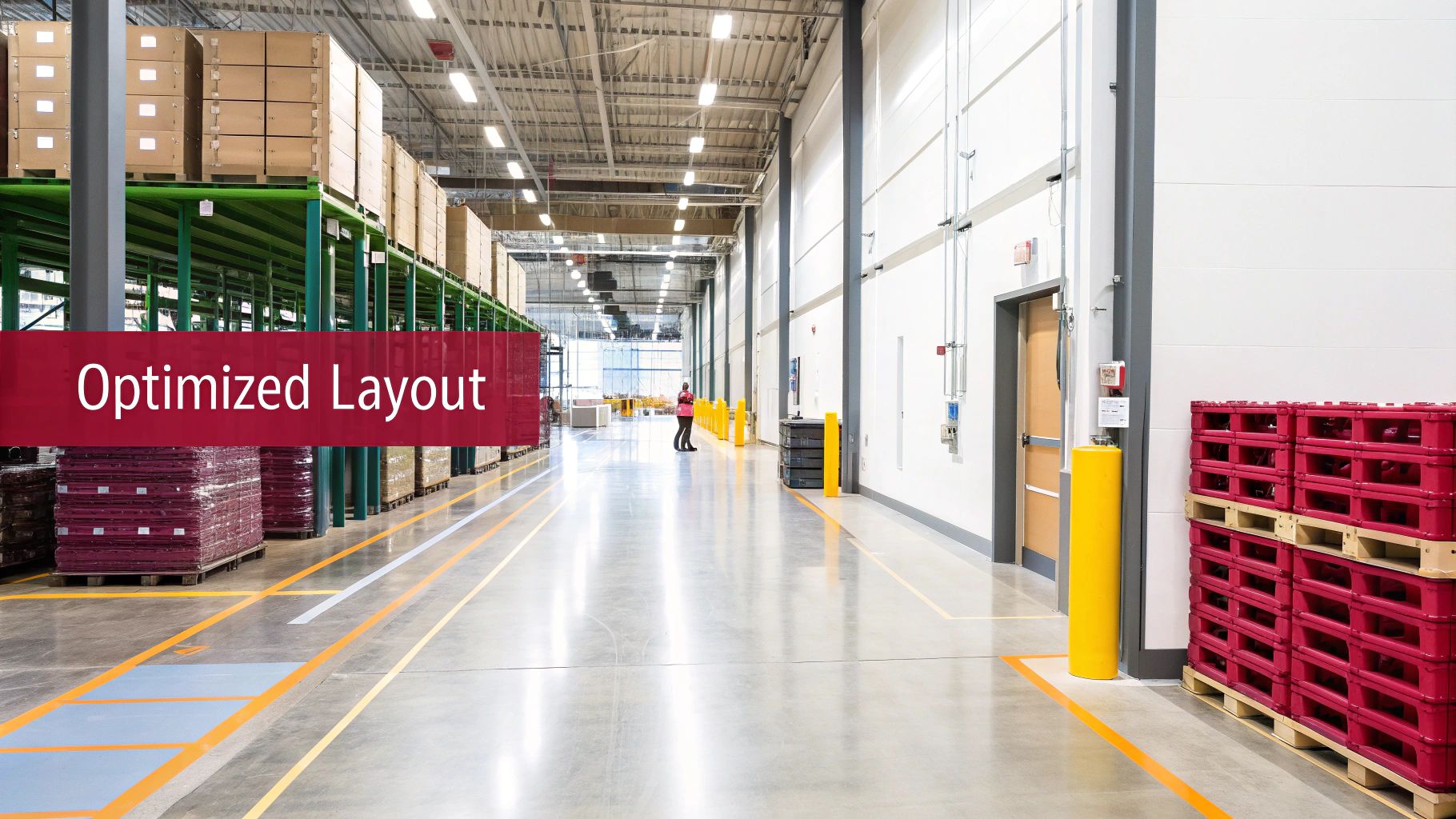
6. Warehouse Layout Optimization and Zone Organization
Your inventory management system is only as effective as the physical space it operates in. Strategic warehouse layout is one of the most impactful best practices for inventory management because it directly influences the speed, accuracy, and safety of every operation. By designing a layout based on product characteristics, access frequency, and workflow patterns, you can drastically reduce bottlenecks and improve overall productivity.
An optimized layout creates a logical flow and designated zones for key activities:
- Receiving: A dedicated area for inbound shipments to be unloaded, inspected, and processed without interfering with outbound traffic.
- Storage: Organized zones based on inventory type, such as high velocity items, bulk storage, or temperature controlled goods.
- Picking & Packing: Areas designed to minimize travel time for order fulfillment, often located near high turnover stock.
- Shipping: A clear, uncongested zone for staging, loading, and dispatching completed orders.
Putting Layout Optimization into Action
Applying these principles transforms your facility from a simple storage space into a high performance fulfillment machine. For instance, an e-commerce distribution center can analyze sales data to create a “hot zone” near the packing stations for its fastest moving products, dramatically cutting pick times. Similarly, a healthcare facility can use zone layouts to safely separate hazardous materials from general medical supplies, ensuring both compliance and staff safety.
Key Insight: A well planned layout minimizes travel distance and handling time, which are two of the biggest hidden costs in any warehouse. Every step saved translates directly into lower labor costs and faster order fulfillment.
To implement this, begin by analyzing product movement data to identify your high velocity items. Position these products in easily accessible locations, such as at waist height on wire shelving or at the front of aisles. Use clear signage and floor markings to delineate zones and direct traffic flow. For facilities with changing inventory needs, consider modular or mobile shelving systems that provide flexibility for future growth.
A thoughtful design process is critical. You can learn more about how to improve warehouse designs and explore customized layouts that fit your unique operational needs.
7. Inventory Tracking Systems (Barcode/RFID Technology)
Relying on manual counts and paper records is a direct path to costly errors and operational inefficiency. One of the most impactful best practices for inventory management is adopting automated data capture technology. Modern inventory tracking systems that use barcodes, QR codes, or RFID (Radio Frequency Identification) technology provide real time visibility, drastically reduce human error, and streamline every aspect of warehouse operations.
These automated systems create a digital trail for every item:
- Barcodes/QR Codes: These are the most common entry point into automated tracking. They require line of sight scanning but are cost effective and highly reliable for tracking product movement from receiving to shipping.
- RFID: This advanced system uses radio waves to read tags, even without direct line of sight and through packaging. RFID allows for bulk scanning of items, making it ideal for high volume environments or securing high value assets.
Putting Tracking Systems into Action
Implementing a tracking system transforms inventory control from a reactive task to a proactive strategy. For example, a busy hospital pharmacy can use barcode scanning on medications to ensure accurate dispensing and maintain patient safety. Similarly, law enforcement evidence rooms use RFID to maintain an unbroken chain of custody, automatically logging every time an item is moved. You can see a powerful example of how this technology creates a failsafe medical inventory alert system.
Key Insight: The true power of these systems lies in their integration. When your scanners feed data directly into your warehouse management system (WMS), you unlock automated alerts for low stock, pinpoint item locations instantly, and generate perfectly accurate reports on demand.
To implement this, start by standardizing your SKU labeling process, ensuring every item is tagged upon receipt. Train your staff thoroughly on consistent scanning procedures for all inventory movements, including picking, putaway, and cycle counting. When evaluating various inventory tracking systems, a critical first step is understanding how to go about finding the best inventory management software that aligns with your specific business needs. This ensures your hardware and software work together seamlessly.
8. Safety Stock and Reorder Point Planning
Unexpected supply chain disruptions and sudden demand spikes can quickly lead to stockouts, halting operations and disappointing customers. One of the most critical best practices for inventory management is implementing a strategic buffer. This involves calculating safety stock and reorder points to create a resilient inventory system that absorbs variability without carrying excessive, costly overhead.
These two concepts work together to prevent stockouts:
- Safety Stock: This is the extra quantity of an item held in inventory to reduce the risk of it running out. It acts as a buffer against unforeseen events like supplier delays, shipping issues, or a sudden surge in demand.
- Reorder Point (ROP): This is a predetermined inventory level that triggers a replenishment order. The ROP is set high enough to ensure that new stock arrives just as the safety stock is about to be used, preventing a complete depletion.
Putting Safety Stock and Reorder Points into Action
These calculations are not just theoretical; they have direct, practical applications. For instance, a healthcare facility maintains higher safety stock levels for life saving medications to prevent treatment delays, while an e-commerce retailer increases safety stock for popular items during the holiday season to meet predictable demand spikes and avoid lost sales.
Key Insight: Properly calculated safety stock and reorder points transform inventory management from a reactive guessing game into a proactive, data driven strategy. This prevents both costly stockouts and the financial drag of overstocking.
To implement this, start by calculating your reorder point using the formula: (Average Daily Demand × Lead Time in Days) + Safety Stock. Determine your safety stock by analyzing historical demand and lead time variability. Once calculated, set up automated alerts in your inventory management software to trigger replenishment orders when an item hits its ROP. Physically segregate this buffer stock using dedicated industrial shelving or marked floor space to prevent it from being used for routine orders, ensuring it remains available for true emergencies.
For expert advice on creating designated storage zones for safety stock, contact our team for a free layout and design consultation.
9. Lean Inventory Management and Waste Reduction
Adopting a lean mindset is one of the most transformative best practices for inventory management, as it shifts the focus from simply holding stock to eliminating inefficiency. Lean inventory management applies core manufacturing principles to your entire supply chain, systematically identifying and removing non value adding activities. This approach targets the “seven wastes,” including overproduction, excess inventory, waiting time, and unnecessary motion, to create a more agile and responsive operation.
The core goal is to reduce waste, which in turn lowers carrying costs and improves workflow. This creates a highly efficient system where inventory levels are minimized without compromising service.
- Overproduction: Making or ordering more than is immediately needed.
- Excess Inventory: Tying up capital and space with materials that are not in active use.
- Waiting Time: Delays between process steps that stall productivity.
- Unnecessary Motion: Wasted movement by staff to find or retrieve items.
Putting Lean Principles into Action
Implementing lean principles begins with a critical look at your current processes. For example, a hospital system can use value stream mapping to identify bottlenecks in its medical supply chain, reducing patient wait times and cutting supply waste. Similarly, a manufacturing plant can implement the 5S methodology (Sort, Set in order, Shine, Standardize, Sustain) to organize workstations, eliminating excess motion and improving throughput by as much as 25%.
Key Insight: Lean inventory management isn’t just about reducing stock; it’s about building a culture of continuous improvement where front line staff are empowered to identify and eliminate waste, leading to sustained operational excellence.
To start, use value stream mapping to visualize your current inventory flow and pinpoint areas of waste. Implement visual management tools like kanban boards or color coded labels for quick status identification. Establishing standard work procedures for repetitive tasks ensures consistency and efficiency. The physical layout is also critical; you can eliminate bottlenecks with a lean warehouse layout design that minimizes travel distances and handling time. Using modular, flexible storage systems ensures your infrastructure can adapt as you continue to refine your processes.
10. Demand Forecasting, Sales Integration and Supplier Relationship Management
Guessing your inventory needs is a surefire way to accumulate excess stock or face costly stockouts. One of the most critical best practices for inventory management is to build a proactive strategy grounded in data, collaboration, and strong partnerships. This three-pronged approach combines forecasting future demand, integrating insights from your sales team, and cultivating reliable supplier relationships to create a seamless and responsive supply chain.
This integrated method works by connecting different parts of your business:
- Demand Forecasting: Utilizes historical sales data, market trends, and predictive analytics to anticipate future customer demand for your products.
- Sales Integration: Ensures that your forecasts are not created in a vacuum by incorporating on the ground intelligence about promotions, new clients, and market shifts directly from your sales and marketing teams.
- Supplier Relationship Management (SRM): Involves building strong, collaborative partnerships with your vendors to ensure a reliable supply of quality materials, favorable terms, and clear communication.
Putting Forecasting, Integration, and SRM into Action
This holistic strategy prevents the disconnects that lead to major inventory problems. For instance, a retail chain can use point of sale data to forecast seasonal demand for winter coats, have its marketing team provide input on an upcoming “20% off” promotion, and share these updated forecasts with its suppliers so they can ramp up production accordingly. The result is having the right amount of stock at the exact moment the promotional rush begins.
Key Insight: By aligning your demand forecasts with real time sales intelligence and supplier capabilities, you transform inventory management from a reactive, cost-based function into a proactive, strategic advantage that directly supports sales growth and operational efficiency.
To implement this, start by establishing regular forecast review meetings that include leaders from sales, operations, and procurement. Use supplier scorecards to track key performance metrics like on time delivery, quality, and responsiveness. This data will help you identify top performing partners and mitigate risks by securing backup suppliers for critical items. By organizing your inventory based on demand velocity, you can use flexible storage like modular drawer cabinets to keep fast moving, promotion related items accessible, improving pick times and fulfillment speed.
Reach out to our team for a free quote on storage solutions that can adapt to your dynamic inventory needs.
Build a More Efficient Future for Your Facility
The journey toward perfecting your inventory management is a marathon, not a sprint. We have explored ten powerful best practices, moving from foundational analytical methods like ABC analysis and Economic Order Quantity (EOQ) to dynamic operational strategies such as Just-In-Time (JIT) and First-In-First-Out (FIFO). Each of these pillars, from rigorous cycle counting to advanced technology integration, represents a critical lever you can pull to drive significant improvements in your facility’s performance. Mastering these concepts is no longer a competitive advantage; it is an operational necessity.
The true transformation, however, occurs when these abstract strategies are grounded in a tangible, optimized physical environment. An effective inventory management system cannot function in a vacuum. It requires a warehouse or storage facility designed with intention, where every square foot is maximized, every process is streamlined, and every asset is secured. Without the right infrastructure, even the most sophisticated software or disciplined team will face constant friction, leading to inefficiencies, errors, and ultimately, lost revenue.
The Foundation of Lasting Efficiency
The most crucial takeaway from our discussion is that process and infrastructure are two sides of the same coin. Consider the impact of a well-planned layout on the practices we have covered:
- JIT and FIFO Implementation: A warehouse layout with intelligently designed pallet racking and flow rack systems makes following a strict FIFO protocol intuitive and efficient. Clear pick paths and designated staging areas are essential for the rapid receiving and dispatching required for JIT.
- Cycle Counting and Audits: Modular shelving and organized bin systems simplify the counting process immeasurably. When staff can easily locate and access items, audits become faster, more accurate, and less disruptive to daily operations.
- Security and Compliance: For facilities managing sensitive materials or high-value evidence, the layout is the first line of defense. Secure wire mesh partitions, evidence lockers, and controlled access points are not just accessories; they are integral components of a compliant and secure inventory management system.
By proactively planning your physical infrastructure upgrades, you are not just buying equipment. You are building the foundation upon which all these best practices for inventory management will succeed. Investing in high-quality, durable storage solutions today ensures that your processes remain efficient as your business scales, preventing costly reconfigurations and operational bottlenecks down the road.
Your Actionable Path Forward
The path to operational excellence begins with a single, decisive step. While implementing every strategy at once can seem overwhelming, you can start by identifying the most significant pain point in your current system. Is it inaccurate stock counts? Wasted time locating items? Inefficient use of vertical space?
Once identified, the solution often involves a combination of process refinement and a physical upgrade. This is where strategic partnership becomes invaluable. By engaging with experts who understand the intricate relationship between workflow and physical space, you can develop a solution that delivers both immediate relief and long-term value. Businesses that prioritize their infrastructure planning now are better positioned to secure faster installation timelines and avoid the project delays that can impact future growth.
Adopting these advanced inventory management strategies is a definitive investment in your organization’s resilience, profitability, and future. You are building a system that not only cuts costs and boosts accuracy but also enhances employee satisfaction and improves customer service. This is your opportunity to transform your facility from a simple storage space into a strategic asset that actively drives your business forward.
Ready to build the physical foundation for your inventory management success? The team at Material Handling USA specializes in providing free, no-obligation layouts and designs to optimize your facility’s flow and storage capacity. With our competitive pricing and the industry’s fastest shipping, we help you implement the high-quality infrastructure you need to turn these best practices into reality. Contact us online or call us at 800-326-4403 to request your free quote and start building a more efficient future today.