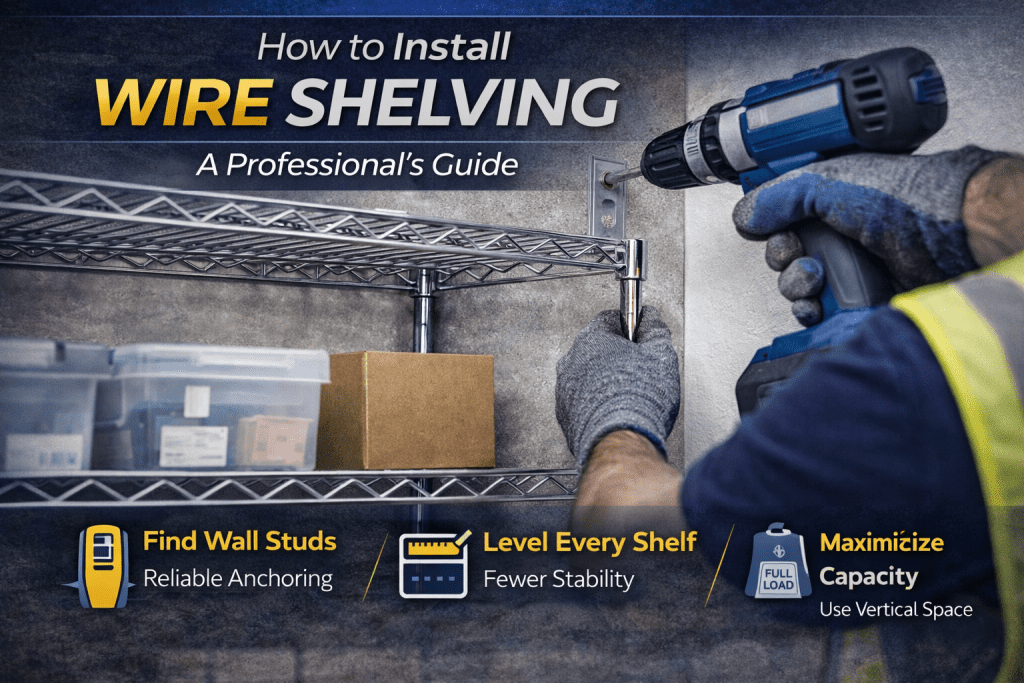
Installing your wire shelving correctly is the most critical step in creating a reliable and efficient storage system. This is about more than just snapping pieces together; it is about building a secure foundation that supports your operations safely and effectively.
Whether you are assembling a freestanding unit, a mobile system, or mounting shelves to a wall, a few key principles make all the difference. For any wall mounted installation, the absolute non negotiable is locating wall studs or using the correct anchors for your wall type. Getting this right ensures your shelves can support their full rated load capacity and will not fail under pressure.
Your Guide to a Flawless Wire Shelving Installation
A successful wire shelving installation is the bedrock of an efficient and safe storage operation. This guide is designed for facility managers and buyers who require practical, clear steps to get the job done right the first time. We will go beyond the basics to cover the essential details of assembling freestanding, mobile, and wall mounted units.
You will learn how to sidestep common mistakes like wobbly shelves or weak anchoring, which can compromise safety and drastically reduce your shelving’s load capacity. A solid installation streamlines workflow, improves inventory access, and ensures you get the full strength and value from your investment. Consider this your roadmap to transforming an empty space into a high performance storage area built for longevity.
As part of a larger facility upgrade, exploring related concepts like the best do it yourself closet systems can offer valuable insights into space optimization and installation techniques.
The Real World Impact of a Proper Install
Executing the installation correctly is not just about avoiding headaches—it is about maximizing your return on investment. The global wire shelving market reached USD 4.87 billion in 2024, highlighting how vital this equipment is for scaling businesses. In North American e-commerce logistics, a sector projected to hit $16 billion by 2029, a properly installed system can reduce picking errors by up to 25% through better organization and visibility.
A small detail can have a big impact: if a shelf is off level by just 1/8 of an inch, its load capacity can drop by as much as 15%. Precision from the start is non negotiable for safety and performance.
Our team specializes in designing layouts that prevent these exact problems. You can browse our gallery of successful projects to see how different configurations look in practice: wire shelving images.
As you plan your project, remember that our free design services are available to help you avoid common pitfalls and create a system tailored to your space. Planning ahead allows you to secure materials and schedule installation without being caught in the rush of increasing demand, ensuring a smoother project timeline.
Quick Glance Installation Checklist
Before beginning, it helps to have a clear map of the process. This checklist breaks down the critical stages for any wire shelving project, ensuring no step is missed from planning to final inspection.
| Phase | Key Actions | Objective |
|---|---|---|
| Preparation | Measure space, check wall material, confirm load needs, gather tools. | Ensure the plan is solid and you have everything you need before starting. |
| Assembly | Attach clips, slide on shelves, level the first shelf. | Build the core structure accurately and securely. |
| Anchoring | Locate studs, drill pilot holes, securely fasten supports. | Guarantee stability and safety, especially for wall mounted systems. |
| Finalization | Install remaining shelves, perform a final level check, and test for stability. | Complete the installation and verify it meets safety and performance standards. |
Following these phases in order prevents backtracking and ensures a professional grade result every time. For personalized advice or to get a no obligation design for your facility, Contact Us or call our team at 800-326-4403.
Preparing Your Space for a Smooth Installation
A solid installation begins with smart preparation. Before unboxing a single shelf, you need to assess your environment and line up the right equipment. This upfront planning is what separates a smooth project from one plagued by costly rework and delays.
A few minutes spent thinking through the entire process can save hours of frustration. A quick measurement and site inspection can be the difference between a fast setup and a project that requires constant adjustments.

Essential Tools and Hardware Checklist
Having the right tools ready makes installing wire shelving a much cleaner process. There is nothing more disruptive than stopping mid installation to find a forgotten tool.
Here is a practical list of what you will almost certainly need:
- Measuring Tape: Absolutely essential for checking your space’s dimensions and keeping shelf spacing consistent.
- Level: A good carpenter’s level is non negotiable for ensuring your shelves are perfectly horizontal. A crooked shelf is an unstable shelf.
- Rubber Mallet: Use this to gently but firmly seat shelves onto their split sleeves without damaging the finish.
- Stud Finder: If you are mounting anything to the wall, this is critical for locating secure anchoring points.
- Drill and Bits: You will need these for creating pilot holes for screws and setting your anchors.
For facility managers planning multiple installations, creating a dedicated ‘shelving install kit’ can dramatically speed up future projects and reduce downtime between setups.
Choosing the Right Hardware for Your Walls
The hardware you use is just as important as the shelving itself, especially for wall mounted units. The type of wall you are working with directly dictates the fasteners you will need for a secure, reliable hold.
- Drywall: For lighter loads, a standard plastic anchor might work. For any significant weight, you must find the wall studs and drill directly into them. If studs are not available where you need them, your next best options are heavy duty toggle bolts or molly bolts.
- Concrete or Block: These durable surfaces demand specialized masonry anchors, like sleeve anchors or lag shields. Using incorrect hardware in concrete will result in a weak, unsafe installation.
- Metal Studs: These require special fine threaded drywall screws or self tapping screws designed specifically to grip steel.
Getting the hardware right is non negotiable for safety and for achieving the manufacturer’s specified load capacity. When in doubt, our experts can guide you. Just contact us for a free consultation.
Site Assessment and Measurement
Before bringing materials into the area, perform a proper site assessment. Accurate measurements are the bedrock of a successful installation.
First, measure the total width, depth, and height of the space where the shelving will go. Look for any obstructions like light switches, electrical outlets, pipes, or fire sprinklers that could interfere.
Next, check the floor with your level. An uneven floor can cause freestanding units to lean, creating a major safety hazard. If the floor is slightly off, you will need to adjust the leveling feet on the bottom of the posts to compensate. Taking these simple steps ensures your new shelving will be stable, safe, and fit perfectly. For complex layouts, our team offers free layout and design services to map out a precise plan.
Assembling Freestanding and Mobile Shelving
Freestanding and mobile shelving units are the workhorses of any versatile storage plan, valued for their quick assembly. Correct assembly from the start is key to ensuring they are stable, safe, and ready for use. Unlike wall mounted systems, the entire structure’s integrity depends on how well each part connects to the next.
The process is simple by design, which is a significant advantage in a fast paced warehouse or stockroom. However, this simplicity can make it easy to rush and miss small details that compromise the unit’s strength. Taking a few extra minutes to follow the steps correctly separates a wobbly, unreliable shelf from a rock solid storage asset.
Building the Foundation Post by Post
The foundation of any freestanding unit begins with the tapered split sleeves, often called clips. These small plastic pieces are essential for a level and secure shelf. You will notice each post is grooved at one inch intervals, giving you precise control over shelf heights.
First, determine the height for your bottom shelf. Snap a pair of split sleeves into the appropriate groove on one post. You should hear a solid “click” as they lock, and always ensure the arrow marked “TOP” is pointing up. Repeat this for the other three posts, making sure the sleeves are in the exact same numbered groove on every post. This step is the most critical for getting your first shelf perfectly level.
Seating Shelves for a Secure Fit
Once the split sleeves are in place on all four posts, it is time to install the first shelf. Gently guide the shelf down over the tops of the posts until it rests snugly on the sleeves.
Now, you need to seat the shelf firmly. This is where a rubber mallet is your best friend. Give each corner of the shelf a few light taps, directly above the post. This action forces the shelf’s collar down over the tapered sleeves, creating an incredibly tight friction fit. You will feel the shelf lock into place. After seating the first shelf, check it with your level to ensure it is perfectly horizontal before moving on.
A common mistake is using a steel hammer. This can dent the posts or chip the shelf’s protective finish, which can lead to rust. A rubber mallet provides all the necessary force without causing damage.
Repeat this process for the remaining shelves. Set the split sleeves at your desired heights and seat each shelf securely as you build your way up. For great ideas on different setups, see our guide on easily adjustable wire shelving from Metro.
Installing Casters on Mobile Units
For a mobile unit, you will start by installing the casters. Most are threaded and simply screw into the bottom of each post. Hand tighten each one, then use the small wrench that is typically included to give it a final quarter turn to secure it.
It is important to consider where you place your locking casters. Best practice is to put both locking casters on the same end of the unit, usually the side you will push or pull from. This makes it easy to lock the unit down with your foot, preventing it from rolling while you load or unload inventory.
Aligning Multiple Units for Cohesive Storage
When setting up a row of shelving units, matching the shelf heights perfectly is crucial. This not only provides a clean, professional look but also improves daily operations by allowing you to slide bins or boxes from one unit to the next without obstruction.
The easiest way to achieve this is to build your first unit completely, using it as a template. As you build the second unit, lay your level across a shelf on the first unit and extend it to the posts of the new one. This creates a perfect straight line to mark the exact groove for your split sleeves, guaranteeing flawless alignment down the entire row.
For help with larger projects or to get a custom layout designed for your space, Request a Quote or call our team at 800-326-4403. We are happy to provide free layouts with no obligation.
A Secure Guide to Wall Mounted Shelving
Wall mounted wire shelving is an excellent way to reclaim vertical space, but its strength depends entirely on how well it is attached to the wall. A secure installation is not a suggestion; it is non negotiable for safety and performance. This process is more involved than assembling a freestanding unit and demands precision at every step to ensure your shelves are rock solid.
We will walk through exactly how to mount these systems safely. It all starts with understanding what is behind your drywall and using that structure to your advantage. Get this part right, and your shelves will hold their rated capacity without question.
Locating and Marking Wall Studs
First, you must find the wall studs. These vertical wooden or metal beams are the skeleton of your wall and provide the strongest possible anchor points. Drilling directly into a stud is the gold standard for any heavy duty wall installation.
Use an electronic stud finder to scan the wall horizontally. When it beeps or lights up, you have found an edge; mark it with a pencil. Continue scanning to find the other edge, then mark the center point between them. Most commercial and residential buildings have studs spaced 16 inches or 24 inches apart on center.
Once you find one stud, you can usually measure over to find the next, but always confirm its location with your stud finder. Marking these points clearly gives you the blueprint for a perfect installation.
This diagram shows the basic assembly for a standard unit, where every connection is critical for stability.

Just as each part must connect securely on a freestanding unit, your wall mounted system is completely dependent on a solid connection to the building itself.
Anchoring Without Studs
What happens if there are no studs where you need to hang a shelf? This is where wall anchors come in, but not all anchors are created equal. Choosing the right one is absolutely critical.
- For Drywall: Your best options are heavy duty toggle bolts or molly bolts. These are designed to expand behind the drywall, spreading the load over a much larger surface area. Do not use standard plastic anchors for anything that needs to bear significant weight.
- For Concrete or Block Walls: You will need masonry anchors. Sleeve anchors are a popular and reliable choice; they expand to create an incredibly tight fit inside a pre drilled hole.
To ensure your shelving is as stable and safe as possible, you must understand the importance of quality fasteners. Using the right hardware for your wall type is not optional—it is essential.
Installing Vertical Standards and Brackets
With your anchor points marked, you are ready to install the vertical supports, often called standards or uprights. Hold the first one against the wall and use a carpenter’s level to ensure it is perfectly plumb (vertically level). Mark your drill holes through the openings on the standard.
Next, drill pilot holes on your marks. If you are not hitting a stud, install your chosen anchors. Then, securely fasten the standard to the wall. Repeat for the second standard, using your level and a tape measure to ensure it is parallel to the first and spaced correctly for your shelf length.
A common challenge is dealing with walls that are not perfectly flat. If you notice a gap behind a standard after installing it, slide shims in to fill the space. This ensures the support is completely flush and will not flex under a heavy load.
Once the standards are secure, insert the shelf brackets at your desired heights. Place your wire shelves onto the brackets, and you are ready to organize.
If you are planning a more complex layout and could use expert guidance, our team offers free, no obligation designs. Contact Us or call us at 800-326-4403 to get started.
Optimizing for Load Capacity and Safety
Once the shelving is assembled, the job is not quite done. The next step—optimizing your setup for real world performance and long term safety—is what transforms a simple installation into a strategic asset for your business.
It is time to move beyond the instruction manual and think like a professional. This means understanding how weight, spacing, and stability all work together. Getting this right prevents dangerous overloading, makes inventory easier to access, and creates a much safer environment for your team.

Interpreting Load Capacity Ratings
Every wire shelf comes with a manufacturer’s load capacity rating, but that number is not as simple as it looks. The golden rule is that the rating assumes the load is evenly distributed across the entire shelf. Piling heavy items in the middle can cause the shelf to bow or fail, even if the total weight is under the limit.
You also must know the difference between static and mobile capacity.
- Static Capacity: This is the maximum weight a stationary unit can hold. It is the number you typically see advertised, usually between 600 to 1,000 pounds per shelf for quality commercial grade units.
- Mobile Capacity: This is the total weight a unit on casters can safely handle while moving. It is always much lower than the static capacity because movement concentrates stress onto the casters and posts.
Shelf Spacing and Accessibility
Smart shelf spacing is a game changer for efficiency. Before you lock in the shelf clips, think about what you are storing. You need enough vertical room to get items in and out without scraping your knuckles or damaging the inventory.
A practical tip from the field: place your most frequently picked items on shelves between waist and shoulder height. This simple ergonomic trick minimizes bending and reaching, which reduces physical strain and dramatically improves picking speeds.
If you are storing a mix of items, always put the heavy, bulky boxes on the bottom shelves. This lowers the unit’s center of gravity and makes it far more stable. Lighter, smaller items can go on top. It is a basic strategy that boosts both safety and usability.
Securing Units and Ensuring Stability
For any freestanding unit, stability is non negotiable. If you are in an area with seismic activity or a high traffic warehouse aisle, it is a smart move to secure your units to a wall to prevent tipping. Using “L” brackets or other seismic bracing hardware to anchor the top of the posts to wall studs is a small step that provides a huge safety upgrade.
The demand for these reliable, adaptable storage systems is growing. Global production of wire shelving is on track to hit 41.5 million units by 2025, with the market projected to reach USD 3.7 billion by 2032. This is not just for warehouses; sectors like healthcare rely on NSF certified wire shelving to maintain sterile environments. Discover more insights about these market trends and you will see why a perfect installation matters more than ever.
Factoring these safety measures into your initial layout plan ensures you order the right hardware from the start. Our team can help you map out a secure and efficient setup. For a no obligation consultation, Request a Quote or call us at 800-326-4403.
Conclusion: Build Your Ideal Storage Solution
You now have the knowledge to plan and install a wire shelving system that works as hard as you do. From site prep to final assembly, you are equipped with the insights to build a storage solution that genuinely improves your workflow and brings your inventory under control.
A well installed shelving system is more than just storage; it is a strategic asset. As demand for quality storage continues to climb, planning your project now helps you sidestep potential supply chain issues and secure a better timeline for completion. This proactive approach ensures your operations can expand without delay.
Now, let’s turn that knowledge into a real world solution. Our team is here to help. With our expertise in providing free layouts and no obligation designs, we can map out the perfect system for your space, no matter the project’s size or complexity.
Turning a detailed plan into a fully functional storage area is what we do best. Moving forward with a free design consultation secures your spot on our schedule. This ensures your project receives the priority it deserves and is delivered with the industry leading speed and competitive pricing we’re known for.
Ready to see what is possible? Check out our extensive catalog of high quality wire shelving units and Shop Now to buy online today. For more detailed project planning and a free layout, Request a Quote online or give our expert team a call at 800-326-4403.
Common Questions About Wire Shelving Installation
Even the most straightforward installation can present challenges. After years of helping managers and buyers outfit their spaces, we have heard just about every question. Addressing these common concerns before you start can be the difference between a quick job and a frustrating rework.
Here are the questions that come up most frequently.
How Do I Get My Wire Shelves Perfectly Level?
It all comes down to precision from the very first step. The key is snapping the plastic split sleeves into the exact same numbered groove on every single post. That is your foundation.
Once you have seated the first shelf, double check it with a carpenter’s level. If it is slightly off, a rubber mallet is your best tool. A few gentle taps on the high corners will nudge it down until the bubble is perfectly centered. For wall mounted systems, the same logic applies: ensure your vertical standards are perfectly plumb with your level before you drill any holes.
What’s the Single Biggest Mistake People Make?
The most critical mistake we see is improper anchoring for wall mounted shelves or misunderstanding the load capacity on freestanding units. It is an easy but dangerous error.
With wall mounts, failing to secure brackets directly into studs or using the wrong type of drywall anchor for the load is a recipe for disaster. We have seen entire systems fail because of it.
For freestanding shelving, the common slip up is misinterpreting the load capacity. People often pile heavy items in the middle, but you absolutely must distribute weight evenly across the whole shelf to maintain stability and safety.
Can I Just Add Wheels to Any Freestanding Unit?
Not so fast. While it is tempting to make any unit mobile, not all are built for it. You can add casters to many freestanding systems, but the wheels must match the post’s diameter and threading perfectly for a secure fit.
More importantly, adding casters drastically lowers the unit’s total weight capacity. The entire load is now focused on four small points instead of being spread across the post legs. Always check the manufacturer’s specs. If you know you need mobility, your safest bet is to purchase a dedicated mobile shelving unit designed for that purpose.
How Do I Connect Multiple Shelving Units Together?
That is a great way to improve stability, and it is very easy to do. You can use simple accessories like “S” hooks or specialized post clamps to join adjacent units. These connectors hook onto the shelves of two different units at the same height, locking them into a single, unified system.
This is a technique we highly recommend for setting up long rows of shelving, especially in a busy stockroom or warehouse. It keeps individual units from shifting or tipping, a simple step that massively boosts the safety and rigidity of your entire setup.
At Material Handling USA, we are here to provide solutions, not just sell products. If you are planning a large scale installation or just want an expert eye to ensure your layout is safe and efficient, our team is ready to help.
For custom projects and professional advice, Contact Us or call 800-326-4403 for a free, no obligation layout and quote.