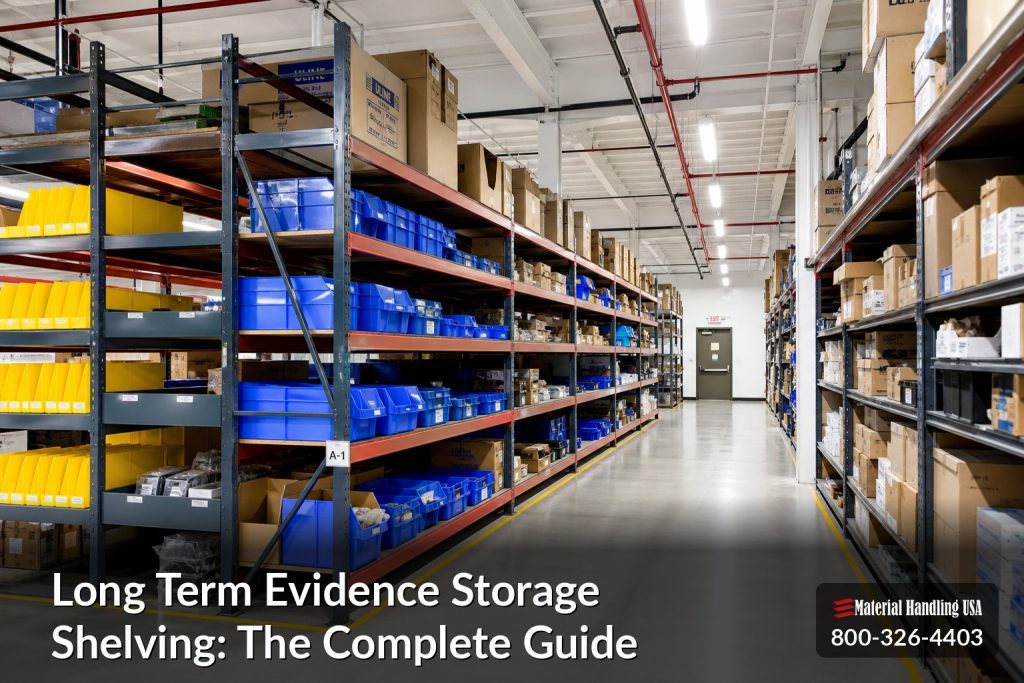
When an evidence room starts filling up, the same problems show up fast. Older retained items get pushed deeper into the room, boxed evidence starts consuming aisle space, and retrieval gets slower every month. New submissions keep coming in, but the room footprint stays the same.
That's where long term evidence storage shelving stops being a simple shelving purchase and becomes a planning decision. If your agency needs to retain evidence for years, sometimes much longer, the right shelving system has to support secure organization, predictable retrieval, and future growth without turning the archive into a bottleneck.
The Growing Challenge of Long Term Evidence Storage
Long-term retention pressure usually builds over time. A department starts with a workable evidence room layout, then older case materials begin staying longer than expected, archive boxes multiply, and staff lose usable floor space to overflow storage. What looked manageable a few years ago can become hard to control.

The core issue isn't just capacity. It's the combination of space limits, chain-of-custody discipline, retrieval speed, and preservation needs. A crowded room creates more handling, more workarounds, and more chances for misplaced items or inconsistent organization.
What fails first in a crowded archive
In practice, these are the first warning signs that your current setup isn't holding up:
- Aisles become storage space and staff have to move boxes just to reach older material.
- Shelf locations lose consistency because overflow items get placed wherever space is open.
- Archive retrieval slows down because older evidence is stored by convenience instead of by system.
- Growth planning disappears and every new intake creates another temporary fix.
Practical rule: If your retained evidence is being managed with short-term habits, the room will keep getting harder to use.
Long term police evidence storage needs a different mindset. You're not just trying to fit more boxes on shelves. You're building an archive that stays usable over time, even as retention demands continue.
What a better system should do
A well-planned evidence archive shelving system should help you:
- keep retained items organized by case, year, type, or policy-driven category
- reduce unnecessary handling
- preserve clean access paths
- support future expansion within the room you already have
- make retrieval straightforward for authorized staff
That's why many agencies shift from ad hoc shelving toward archive-style layouts designed for retained evidence, boxed materials, and lower-frequency access.
What Makes Long Term Evidence Storage Different?
Not all evidence storage works the same way. Active evidence storage is built around frequent intake, rapid movement, and regular access. Long term evidence storage is different because the access pattern changes and the preservation burden increases.
According to the Evidence Management Institute summary of NIST standards, long-term evidence storage is defined as any location where evidence may be stored for more than 72 hours. That threshold matters because preservation, security, and organization requirements become more demanding once evidence moves beyond short-term holding.
Why the shelving strategy changes
Long-term evidence usually needs:
- higher storage density because the volume grows over time
- more disciplined organization because older items are easier to lose in weak filing systems
- better environmental planning because unstable conditions can affect stored materials
- clean retrieval paths so staff can find retained items without disrupting nearby storage
Temperature and humidity control also matter in many archives. If your team is reviewing preservation factors during planning, this guide to climate controlled storage gives a useful general overview of why environmental stability matters for stored materials.
Long-term evidence shelving works best when the room is designed for retention first, not adapted from a short-term intake layout.
Active storage and archive storage serve different jobs
A practical way to separate the two is simple:
- Active evidence storage supports intake, temporary holding, and frequent retrieval.
- Long term evidence storage supports retention, order, preservation, and controlled access over a much longer cycle.
That distinction affects shelf depth, aisle strategy, labeling, box standardization, and whether static shelving is still enough.
Static Shelving vs High Density Mobile Shelving
For most agencies planning evidence archive shelving, the main choice is between traditional static shelving and compact mobile systems. Both can work. The right fit depends on room size, access frequency, workflow, and budget.
The biggest difference is how each system uses aisle space. Static shelving keeps fixed aisles between every row. Mobile shelving compresses storage rows together and opens only the aisle you need at the moment.
According to this overview of long-term evidence storage systems, high-density mobile shelving can store at least two times as much evidence in the same physical footprint as static shelving. For departments trying to avoid room expansion, that's often the deciding factor.
Comparison of Long Term Evidence Storage Shelving Systems
| Feature | Static Archive Shelving | Mechanical Assist Mobile Shelving | Powered Mobile Shelving |
|---|---|---|---|
| Storage density | Lower density because every aisle stays open | Higher density with compact movable ranges | Highest convenience for dense storage layouts |
| Retrieval frequency fit | Good for frequent open access | Good for moderate archive retrieval | Good for larger archives with regular staff use |
| Organization potential | Simple and familiar | Strong for structured archive zoning | Strong for structured archive zoning |
| Scalability | Limited by fixed aisles and room footprint | Better use of existing footprint | Better use of existing footprint |
| Control options | No moving controls | Hand wheel or mechanical assist | Electric controls |
| Ideal use case | Smaller archives or lower-density rooms | Departments balancing density and operator effort | Larger archive rooms or taller, denser installations |
| Budget range | Lower initial cost | Mid-range investment | Higher initial cost |
When static shelving still makes sense
Static evidence room shelving is often the right call when:
- The room is small and the archive volume is still controlled.
- Access is frequent across many rows and staff need immediate visibility.
- The budget is tight and the agency needs a straightforward archive solution first.
Static shelving is simple. It's easier to explain, easier to bid, and often faster to adopt. But once a room starts running out of space, static rows usually force one of two bad outcomes: off-site storage or crowding.
When mobile shelving is the better long-term move
Mechanical assist and electric systems make more sense when:
- The archive will keep growing
- The room footprint can't expand
- The agency wants denser box storage
- Older retained evidence is accessed less often than active evidence
Many buyers start their research with a broader high density shelving overview to compare compact systems before narrowing the design to an evidence archive application.
If your main problem is fixed aisles consuming too much floor space, adding more static shelving won't solve it. It will just organize the limit you already hit.
Planning Your Evidence Archive Layout and Workflow
A good shelving system can still underperform if the layout is weak. Long term evidence storage works best when the room is planned around box sizes, retrieval patterns, security zones, and growth.

According to this public safety storage planning reference, mobile shelving systems remove fixed aisle space by placing shelves on carriages that slide on tracks and maintain only one movable access aisle. That design is what allows facilities to recover up to 50% of floor space previously used for aisles.
Start with box logic, not shelf logic
One mistake I see often is selecting shelves before standardizing stored containers. Archive shelving performs better when the agency first decides:
- which evidence will be boxed
- which box sizes will become standard
- how retained items will be labeled
- what needs separate storage because of size, material, or handling rules
That gives you a stronger basis for shelf depth, shelf spacing, and row planning.
Build the room around retrieval behavior
Not every retained item should sit in the same zone. A workable archive usually separates:
- more frequently retrieved retained items
- older, low-touch retained evidence
- oversize or irregular items
- restricted categories requiring tighter access control
A layout should also protect workflow. Staff shouldn't have to shift through archive rows designed with no thought for movement, staging, or location naming.
Departments evaluating room layouts often benefit from a dedicated evidence storage room design resource before finalizing shelving counts and carriage runs.
Plan for growth before the room feels full
The best archive layouts leave room for expansion in the filing logic, not just the floor plan. Case year ranges, shelf numbering, and zone naming should all scale cleanly. If they don't, the room gets harder to manage long before it's physically full.
A 6-Step Checklist for Your Storage Project
A storage project goes smoother when the agency makes decisions in order instead of jumping straight to product quotes.

Use this checklist before you buy
-
Review current retained inventory
Count what is staying long term, what format it's stored in, and where overflow is already happening. -
Separate active and archive functions
If long term evidence storage is mixed into daily intake space, the layout will stay inefficient. -
Measure the room correctly
Include clear dimensions, ceiling height, obstructions, doors, and any structural limits that affect shelving runs. -
Define access and security needs
Decide who needs access, how often items are retrieved, and whether the archive needs zoning by category. -
Compare system types
Review static, mechanical assist, and electric mobile systems based on retrieval habits and future growth. -
Get a layout before final pricing
A room-specific plan will prevent costly assumptions and help procurement compare real options.
Save this checklist for your capital request file. It helps keep the project grounded in operational need instead of just equipment specs.
How to Justify the Investment and Choose a Partner
Budget review usually comes down to more than shelf price. Procurement teams often need a clear reason why one system deserves capital funding over another.

As noted in this MH-USA article on space-saving evidence room planning, procurement teams often need total cost of ownership and ROI calculations that account for labor efficiency, risk reduction, and possible elimination of off-site rental costs. That's a more useful frame than simple upfront price comparison.
What a funding justification should focus on
A stronger internal case usually includes:
-
Space recovery value
Dense storage may delay the need for room expansion or outside storage. -
Operational efficiency
Better organization can reduce wasted staff time during retrieval and audits. -
Risk reduction
Cleaner archive structure lowers the chance of inconsistent placement and hard-to-find retained items. -
Long-term fit
A system that matches projected archive growth is easier to defend than another short-term patch.
How to compare suppliers
Don't just compare equipment lists. Compare planning support.
Look for a supplier that can help with layout development, storage strategy, sizing guidance, installation coordination, and quote clarity. Material Handling USA offers public safety and archive-focused law enforcement evidence storage solutions along with free layouts and designs, quote support, and system planning for dense retained evidence storage.
Practical decision guide for common agency scenarios
-
Building a dedicated long-term evidence archive
Mobile shelving usually deserves a close look because density becomes central to the project. -
Separating active evidence from retained evidence
Use the archive room for lower-frequency retrieval and reserve the active room for faster daily access. -
Planning dense box storage for many years
Standardize container sizes early so the shelf layout works harder. -
Choosing static or compact shelving
If aisles are already the space problem, static shelving may preserve the problem. -
Planning for growth without room expansion
Compact systems often provide the flexibility static layouts can't. -
Improving organization for older retained items
Better zone planning and shelf naming may matter as much as the shelving itself.
Frequently Asked Questions About Evidence Shelving
Can long term evidence storage shelving be used for boxed evidence only
No. Many archives center on boxed and containerized evidence, but shelving plans can also include areas for irregular or oversized items. Those categories usually need separate treatment in the layout.
Is mobile shelving always the right answer
No. Static shelving can still be a solid choice for smaller archives, lighter growth, or rooms where open access matters more than density.
What should buyers ask for in a quote
Ask for a room-specific layout, shelf dimensions, system type, access method, and any installation assumptions. A simple equipment list won't tell you enough.
How should an agency organize older retained evidence
Use a consistent location system tied to your evidence policy. Common structures include year, case range, item class, or archive zone.
Does long term evidence storage need environmental planning
Often, yes. Long-retained materials are more vulnerable to poor room conditions than many teams expect, so storage planning should align with internal preservation standards.
What if the archive room is already crowded
Start with a layout review before buying more shelves. In many rooms, the problem is aisle loss, inconsistent box sizing, or poor zoning.
Can electric mobile shelving be worth the extra cost
It can be, especially in larger or denser archive rooms where operator effort and smooth access matter more. The right answer depends on room use and project goals.
What is the next step before procurement
Get a design review. A proper layout will help you compare systems on fit, not guesswork.
If you're planning long term evidence storage shelving, don't wait until overflow forces a rushed decision. A well-designed archive can improve organization, support future growth, and make budget review easier when the layout and system choice are clear. For planning help, free quotes, and no-obligation layouts, Contact Us or call 800-326-4403. If you're ready to price system options, request a quote and keep your project moving while current production and installation schedules are still easier to plan around.
Related Resources
- Evidence Storage Guide — Complete guide to designing compliant evidence storage rooms
- Security Cages — Secure evidence areas with wire partition cage systems
- Mobile Storage Systems — High-density shelving to maximize evidence room capacity