A messy warehouse isn’t just an eyesore; it’s a hidden tax on your entire operation. That chaos leads to wasted labor, more fulfillment errors, and valuable space that isn’t making you a dime. When you truly organize a warehouse, you are not just tidying up. You are building a strategic system for layout, workflow, and inventory that transforms a cost center into a growth engine and a real competitive advantage.
This is especially critical as e-commerce demand continues to explode.
Why Warehouse Organization Is a Profit Strategy
A cluttered or inefficient warehouse hits your bottom line, plain and simple. We see it all the time: operations where a chaotic layout creates a massive financial drain through lost productivity and friction at every turn. This is not about looking neat; it’s a fundamental business strategy that unlocks profitability.
When you strategically organize your warehouse, you kick off a ripple effect of positive results. Everything from labor costs to order accuracy starts to improve.
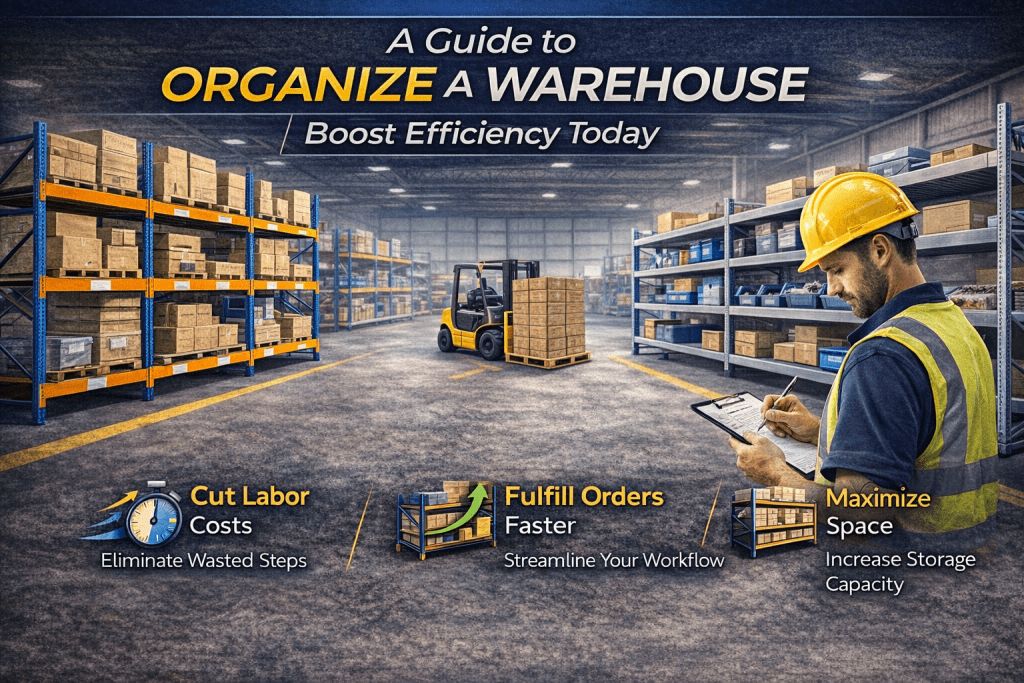
- Slash Labor Costs: Optimizing the travel path for pickers and putting your fastest moving items in easy to reach spots cuts down on wasted steps. Those steps account for a huge chunk of your operational expenses.
- Boost Order Accuracy: A clear, logical system with well defined zones and proper labeling drastically reduces picking errors. Fewer mistakes mean fewer costly returns and much happier customers.
- Maximize Every Square Foot: Getting organized, especially by using vertical space with mezzanines or high density racking, lets you store more product in the same footprint. This helps you avoid the massive expense of moving or expanding your facility.
- Fulfill Orders Faster: An organized workflow gets rid of bottlenecks. Products move like clockwork from receiving to storage to picking and out the door, letting you hit tight delivery windows and crush peak season demand without breaking a sweat.
The Financial Case for Getting Organized
The link between organization and financial health could not be clearer. The global warehousing market is projected to skyrocket by an incredible USD 643.2 billion between 2025 and 2029. The facilities driving that growth are the ones built on pure efficiency.
Think about it: since 2000, manufacturing warehouse space has grown by 86.2%. That kind of scale up is only possible with organized systems like pallet racks and industrial shelving. For any operations manager, this data confirms that investing in layout and equipment is a direct path to cutting costs and errors.
A disorganized warehouse creates friction at every touchpoint. Every misplaced pallet, every extra step a picker takes, and every minute spent searching for an item is a small tax on your profitability that compounds over time.
Turning Your Warehouse into a Competitive Advantage
In today’s market, speed and accuracy are non negotiable. An organized warehouse is your best weapon for delivering both. It lets you scale up smoothly, adapt to shifting inventory, and navigate supply chain headaches with far more resilience. Just thinking about how to organize a warehouse is the first step toward building a more robust and profitable operation.
And the benefits do not stop with your internal team. Customers absolutely notice when their orders show up fast and right the first time. That reliability builds powerful brand loyalty and gives you a serious edge over competitors who are still wrestling with chaotic, inefficient systems. For a deeper dive into making your facility more efficient, check out our guide on warehouse optimization.
The demand for our free layout and design services is high, and our project calendars are filling up fast. Moving forward now secures your spot for a professional consultation, which means faster implementation and avoiding costly delays. To see what a new layout could do for your facility, Request a Quote for a free, no obligation design today.
Mapping Your Ideal Warehouse Workflow
The best warehouse layouts are all about one thing: movement. An efficient workflow is the blueprint that guides everything from your physical setup to your team’s daily hustle. To really get your warehouse organized for peak performance, you have to start by mapping out the ideal journey for your products from the second they hit your receiving dock to the moment they are shipped out.
This is not just about theory. It is about getting practical and plotting the actual flow through your facility. The whole point is to create a seamless path that cuts down on handling, minimizes how far your team has to travel, and gets rid of those expensive bottlenecks that kill productivity.
Starting with Data-Driven Insights
The bedrock of any solid workflow map is an ABC analysis. This is a tried and true method for categorizing your inventory based on how fast it sells.
- A-Items: These are your rock stars. They are the top 20% of your SKUs that usually drive 80% of your sales. They need to be in prime, easy to grab locations.
- B-Items: Your steady, middle of the road sellers. This group makes up the next 30% of SKUs and about 15% of your sales.
- C-Items: These are the slow movers. They represent the bottom 50% of your SKUs but only account for a tiny 5% of sales. You can tuck these away in less accessible areas.
Once you know your A-Items, you can strategically place them right near your packing and shipping stations. It sounds simple, but this one change can drastically slash your pickers’ travel time, which is almost always one of the biggest labor costs in any warehouse.
This infographic shows the clear path from operational chaos to profitability through strategic organization.

As you can see, moving from tangled, inefficient routes to a structured, grid like system directly unlocks more revenue. It is that straightforward.
Designing Your Workflow Zones
With your product velocity data in hand, it is time to carve out dedicated zones for each key function. A logical sequence is crucial here, it prevents people and equipment from running into each other and ensures products flow smoothly in one direction.
A typical, highly efficient workflow looks something like this:
- Receiving: This is where shipments arrive. They get unloaded, checked for accuracy, and logged into your inventory system.
- Quality Control: An optional but often critical stop. Here, you can inspect goods for damage or defects before they officially enter your stock.
- Bulk Storage: The main area for full pallets, especially for your B and C-Items. This zone often uses high density racking to maximize space.
- Forward Picking: The real heart of your operation. This is where you keep smaller, ready to go quantities of your fast moving A-Items for quick order fulfillment.
- Packing: Where orders are brought together, boxed up, and labeled for shipment.
- Dispatch/Shipping: The final stop. Packages are sorted by carrier and loaded onto trucks.
Planning your workflow is not just about arranging racks. It is about choreographing the movement of people, equipment, and inventory. You are creating a system where every single step adds value and waste is systematically rooted out.
Critical Details That Make a Difference
The details are what separate a layout that just works from one that is truly high performance. Getting these things wrong can lead to daily friction and expensive fixes down the road.
Pay close attention to these factors:
- Aisle Width: Your aisles have to be wide enough for forklifts, pallet jacks, and other equipment to move safely and turn without issue. But make them too wide, and you are just wasting valuable storage real estate. It is a critical balancing act.
- Pedestrian Pathways: Do not forget about foot traffic. Clearly marked and separated walkways are non negotiable for safety and compliance. They help prevent dangerous accidents between your team and heavy machinery.
- Future Growth: Always plan for tomorrow, not just for today. A good layout should have room for future SKU growth and changes in your order profiles. Using flexible, modular storage systems is a smart move, as it lets you adapt without a complete, disruptive overhaul.
Mapping this all out can feel overwhelming, especially with project timelines already filling up for the season. Getting expert input now ensures you can implement these changes faster and start seeing those efficiency gains sooner. Our team provides a free, no obligation layout and design to help you visualize a more profitable workflow. Contact Us or give us a call at 800-326-4403 to unlock efficiencies you never knew you had.
Selecting the Right Storage and Handling Equipment
Now that you have mapped out your ideal warehouse flow, it is time to choose the hardware that brings it all to life. This is where you select the physical systems that will define your warehouse’s efficiency and how much you can actually store. The right equipment does not just support your workflow; it makes it faster, safer, and more profitable.
Making the right choices here is a critical investment. Get it right, and you could double your usable space and make every single touchpoint, from receiving to picking, smoother than you thought possible.

Matching Pallet Racking to Your Inventory
Pallet racking is the backbone of most warehouses, but it is definitely not a one size fits all solution. Your decision should be driven by your inventory mix, specifically, your SKU count and how fast each product moves.
Let’s break down the common types:
- Selective Racking: This is the most common and versatile option out there. It gives you direct access to every single pallet, which is perfect for operations with a high number of different SKUs and lower quantities of each. If you need to be able to pick from any pallet at any time, this is your go to.
- Drive-In Racking: When you need to store huge quantities of the same product, drive in racking offers incredible storage density. Forklifts drive right into the rack structure to place or retrieve pallets, making it a Last In, First Out (LIFO) system. It is ideal for bulk goods that are not time sensitive.
- Push-Back Racking: This system strikes a great balance between density and selectivity. Push back racking stores pallets on nested carts that slide on inclined rails. It gives you much higher density than selective racking while still allowing access to different SKUs in each lane.
To make the best choice, it is essential to understand the trade offs. For an even deeper look, check out our comprehensive guide to selecting pallet rack.
This comparison table can help you narrow down the best fit for your specific needs.
Warehouse Storage System Comparison
| Storage System | Best For | Space Density | Accessibility | Relative Cost |
|---|---|---|---|---|
| Selective Racking | High SKU count, low volume per SKU | Low | High (100% access) | Low |
| Drive-In Racking | Low SKU count, high volume per SKU | Very High | Low (LIFO) | Medium |
| Push-Back Racking | Medium SKU count, high density needs | High | Medium (LIFO) | High |
| Cantilever Racking | Long, bulky items (lumber, pipe) | Varies | High | Medium |
| Pallet Flow Racking | High volume, perishable goods (FIFO) | Very High | High (FIFO) | Very High |
Ultimately, the best system aligns with your product velocity and picking strategy, turning your storage into a competitive advantage.
Expanding Your Space Without Construction
When you are out of room but a full blown expansion is not in the budget, it is time to think vertically. Maximizing the cubic footage you already pay for is one of the smartest moves you can make to prepare your warehouse for growth.
Mezzanines are a complete game changer for this. These elevated platforms essentially add a second or third story to your facility, which can double or even triple your usable space for storage, offices, or light assembly work. They cost a fraction of new construction and can be designed around your existing layout.
In the same vein, modular offices let you create quiet, climate controlled workspaces directly on the warehouse floor. They integrate seamlessly without the dust, noise, and disruption of traditional construction, providing essential space for managers, supervisors, and administrative staff.
Investing in vertical space is not just about adding storage; it is a strategic move to defer major capital expenses. A well designed mezzanine can delay the need for a new facility by years, delivering a massive return on investment.
Specialized Storage and Handling Solutions
Beyond standard racking, your operation might need specialized equipment for certain products or security protocols. Wire security cages are essential for protecting high value inventory from theft or damage by creating a secure, visible enclosure right within your larger warehouse space.
For things like parts storage or archives where you need high density, mobile shelving systems are incredibly efficient. These shelving units are mounted on tracks and can be compacted together, eliminating fixed aisles and dramatically boosting storage capacity in a small footprint.
Finally, remember that your storage systems and material handling equipment have to work in harmony. The conveyor systems, pallet jacks, and forklifts you use must align perfectly with your aisle widths and picking processes. When your handling equipment is suited for the job, you create a truly seamless operation.
Our team specializes in designing these kinds of integrated solutions. With project calendars filling up fast, securing a consultation now ensures you can get these powerful systems in place sooner and avoid frustrating delays. Request a Quote for a free, no obligation design and discover how the right equipment can completely transform your space. You can also call us directly at 800-326-4403 to speak with an expert today.
Fine-Tuning Your Inventory and Picking Processes
A great warehouse layout is just the beginning. The real magic happens when you dial in your daily processes, how you manage inventory and how your team actually fulfills orders. With a solid physical footprint now in place, it is time to implement the systems that will slash errors, cut down on travel time, and really speed up your fulfillment.
These processes are what bring a well designed space to life. Think of them as the engine that turns your organized racks and aisles into a high performance fulfillment machine.
The Power of Smart Inventory Slotting
At the heart of any efficient picking operation is inventory slotting. This is all about the strategic placement of products based on how fast they sell. Once you have run an ABC analysis to pinpoint your fastest moving items, slotting is how you put that data to work. You will place those high demand products in the most accessible, ergonomic spots, usually close to your packing and shipping stations.
Effective slotting is not a “set it and forget it” task. Product popularity shifts with seasons and market trends, so it needs regular review. By consistently moving your best sellers to “golden zone” locations (between waist and shoulder height), you not only make picking faster but also make the job safer for your team by cutting down on unnecessary bending and reaching.
Barcodes, QR Codes, and Your WMS
To truly get your warehouse organized, you need a way to track every single item with absolute accuracy. This is where barcode and QR code labeling becomes non negotiable. By assigning a unique ID to every product, bin, and shelf location, you are essentially creating a digital map of your entire facility. This gets rid of the guesswork and the costly time wasted hunting for misplaced items.
A Warehouse Management System (WMS) is the brain that ties it all together. It integrates with your barcode scanners to give you real time visibility into inventory levels, locations, and movements. A good WMS will guide your pickers along the most efficient routes, manage automatic stock replenishment, and spit out the data you need to make smarter operational calls.
The e-commerce boom has massively increased demand on warehouses, making organization the lynchpin for managing huge order volumes. In fact, the market is projected to grow from USD 1,079.8 billion to USD 1,726.7 billion by 2030. A well organized layout powered by a WMS directly slashes packing errors and transit damage, which is critical for staying competitive in this expanding market.
Choosing the Right Picking Method
Different types of orders call for different picking strategies. Matching the right method to your operation is key to getting the most productivity out of your team.
- Single Order Picking: A picker fulfills one complete order at a time. It is simple and highly accurate, which makes it perfect for smaller warehouses or operations dealing with complex, multi item orders.
- Batch Picking: A picker grabs items for multiple orders at the same time. This is incredibly efficient because it dramatically reduces travel time, a picker can visit a single location to pull items for several different orders at once.
- Zone Picking: The warehouse is divided into zones, and pickers are assigned to a specific area. Orders move from one zone to the next until they are complete. This approach really shines in large facilities with high order volumes.
A common mistake I see is operations trying to force a single picking strategy on everything. The most efficient warehouses often use a hybrid approach, applying different methods to different order types or product categories.
To take your inventory operations to the next level, you should adopt proven methodologies for smarter processes, including effective picking strategies and precise stock control. For a deeper dive, check out these best practices for inventory management.
Finally, maintaining accuracy is an ongoing battle. Cycle counting, the process of regularly counting small subsets of your inventory, is a much less disruptive way to stay on top of things than shutting down for a full annual inventory. It helps you catch discrepancies early and keep your inventory count highly accurate all year round.
Putting these smart processes into place is the final step in making your newly organized warehouse truly work for you. Contact us or call 800-326-4403 to discuss how our systems can support your new, more efficient operation.
Future-Proofing Your Operations with Technology
So, you have organized your warehouse. What is the next move? This is where we start talking about technology, not just for the sake of it, but to build on the solid foundation you have already created. The goal is to make your well organized facility even more powerful, creating a dynamic environment that practically runs itself.
It is easy to get intimidated by terms like automation and artificial intelligence, but you do not need a complete overhaul to see a major impact. Think of it this way: a smart physical layout is the launchpad. Technology is the rocket fuel.

Making Automation Approachable
When managers hear “automation,” they often picture a massive, fully robotic facility. That is one way to do it, but the reality is far more flexible. You can integrate technology step by step, working with your existing pallet racking and shelving.
- Automated Storage and Retrieval Systems (AS/RS): These are game changers. They bring goods directly to your operators, which slashes travel time and dramatically increases storage density. You can implement an AS/RS in just one zone of your warehouse to handle your fastest moving SKUs and see an immediate difference.
- Robotics: This is where things get really interesting. Autonomous Mobile Robots (AMRs) can transport goods from storage to packing stations, freeing up your team for more complex, valuable work. They are designed to work alongside people, not replace them, boosting overall throughput.
- Conveyor Systems: Sometimes the simplest solution is the best. A basic conveyor system can create a massive efficiency lift by automating the movement of goods between receiving, packing, and shipping.
The trick is to start by identifying a clear problem. Is it long pick times? Is it a bottleneck in order flow? Solve that first. For those looking to get ahead of the curve, adopting a system for predictive maintenance for manufacturing is a smart move that can prevent equipment failures before they happen.
The Role of AI and Data
This is where your warehouse starts getting truly smart. An AI powered Warehouse Management System (WMS) does not just track inventory; it analyzes sales data and velocity in real time. It constantly suggests better slotting arrangements to keep your fastest moving products in the most accessible locations.
This creates a self optimizing system that adapts to demand without you having to manually reconfigure everything.
The numbers do not lie. The global warehouse automation market is projected to reach USD 63 billion by 2030, while AI in logistics has already hit USD 20.8 billion in 2025. This is not a futuristic fantasy; forward thinking companies are already making these investments and seeing the returns.
A well organized physical warehouse is the launching pad for technology. Automation amplifies the efficiency you’ve already built through smart layout and process design; it does not replace it.
Integrating these systems is about more than just current efficiency, it is about being ready for what is next. If you want to dive deeper into how this works in practice, take a look at our article on how to future-proof your operations with smart warehouse automation design.
Demand for this technology is surging. Planning your integration now means you can secure installation timelines and get ahead of your competition. You will be positioned to gain a serious advantage by putting these powerful tools to work sooner rather than later.
Ready to Transform Your Warehouse?
This guide has laid out the roadmap to a highly efficient warehouse, not as a far off theory, but as an achievable, practical goal. By digging deep into your real needs, designing smarter flows, picking the right equipment, and locking in solid processes, you can completely overhaul your operations from the ground up. The path to a more organized and profitable facility is right in front of you.
We are here to make that a reality. We bring competitive pricing, an unwavering commitment to quality, and some of the fastest shipping times in the industry to the table. We do not just sell equipment; we provide the partnership and expertise to get the job done right.
A decision to organize your warehouse is a commitment to future growth. Taking action now means you are ready for shifting market demands and can scale without the friction caused by inefficiency.
Project timelines are already filling up fast for the season. Securing your spot for a professional layout consultation is more critical than ever. Acting now means you can realize these powerful efficiency gains sooner and dodge the costly delays that come from waiting. Let our experts create a free, no obligation design and quote to show you exactly what is possible for your space.
A more productive, streamlined, and profitable operation is within your grasp.
Contact Us today or call 800-326-4403 to turn your vision into a reality.
Common Questions on Warehouse Organization
When you are staring down the barrel of a full scale warehouse reorganization, a lot of questions pop up. It is a big project, and you want to get it right the first time. Here are some of the most common questions we hear from managers, along with our straightforward, practical advice.
Where Do I Even Start with Organizing My Warehouse?
The temptation is to start moving racks around, but hold on. The absolute first step is to get a clear picture of what is happening right now. Before you touch a thing, map out your current product flow from receiving to shipping.
Pinpoint where the slowdowns are happening. Is it the picking process? Are things getting jammed up at the packing station? A great way to do this is with an ABC analysis, which uses your sales data to show which products are flying off the shelves (your ‘A’ items) and which are gathering dust. This data is gold, it tells you exactly what problems your new layout needs to solve. A quick consultation with a layout expert can help you make sense of this data and turn it into an actionable plan.
How Do I Pick the Right Pallet Racking?
Choosing the right racking really boils down to three things: how much stuff you need to store (density), how many different products you have (SKU count), and how quickly you need to get to each one (accessibility).
- Selective Racking: If you have a high number of different SKUs and need to access any pallet at any time, this is your go to. It is the most common and cost effective solution for direct access.
- Drive-In or Push-Back Racking: If you are storing large quantities of the same product, these systems are a game changer. They pack pallets in tight, dramatically increasing your storage density. You trade some accessibility for a massive gain in space.
Our team can walk you through the pros and cons for your specific inventory. Request a Quote to see a side by side comparison.
Can I Actually Do This on a Tight Budget?
Absolutely. You do not need a massive budget to make a huge impact. The key is to focus on process improvements first, as they often deliver the biggest bang for your buck.
Start by optimizing the space you already have. Use that ABC analysis to move your fastest selling items closer to the shipping docks. This simple change can slash labor time and costs almost overnight. Next, implement a crystal clear labeling system. It sounds basic, but it drastically reduces picking errors and wasted search time.
If you have vertical space, use it! Cost effective industrial shelving or even a phased in mezzanine installation can double your footprint without a massive upfront investment.
How Often Should I Re-evaluate My Warehouse Layout?
Think of your warehouse layout as a living part of your business, not a one and done project. Things change, and your layout needs to keep up.
We strongly recommend a formal review at least once a year. You should also trigger a review anytime your business has a major shift. This could be anything from launching a new product line, seeing a big change in your average order size, or bringing in new handling equipment like different forklifts. Staying proactive ensures your layout is always helping, not hindering, your operations as you grow.