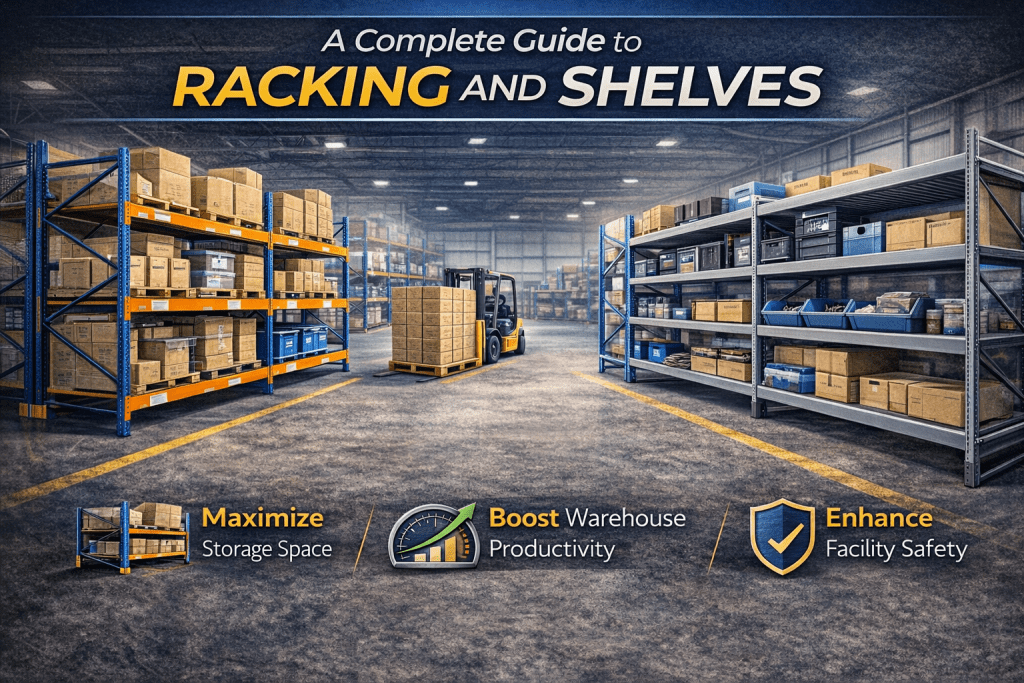
Every square foot of your facility holds potential. With e-commerce growing and supply chains becoming more complex, unlocking that potential is essential for staying competitive. This guide treats racking and shelves as the fundamental tools for transforming your storage from a simple cost center into a strategic asset.
Optimizing Your Warehouse with Racking and Shelves
We’ll walk through how the right system directly shapes your daily efficiency, keeps your team safe, and gives you the room to grow. Think of this as your roadmap for navigating the options, from high-density pallet racking to versatile industrial shelving. You’ll learn how to select, design, and implement a solution that fits your inventory and workflow, turning storage headaches into a powerful advantage.

From Cost Center to Strategic Asset
At its core, racking is about using your vertical space. But the real value appears when it organizes your inventory for fast throughput. A well-designed system slashes pick times, reduces product damage, and creates a much safer environment for your team.
For managers and buyers, this is a critical investment. Getting it right pays off for years to come:
- Improved Space Utilization: You can store significantly more product in the same footprint, which could delay or even eliminate the need for a costly facility expansion.
- Increased Productivity: A logical layout means less travel time for people and equipment. The result is faster order fulfillment and higher customer satisfaction.
- Enhanced Safety: Systems that are properly specified and professionally installed are the foundation of warehouse safety. They prevent accidents, protecting both your people and your products.
Understanding the Big Picture
A smart storage layout is one piece of a larger logistics puzzle. The internal organization from your racking is crucial, but the overall flow of your operation also depends on critical access points, like modern warehouse loading docks. When these elements work together, you create a seamless current from receiving to shipping.
Investing in a professional layout is not just about placing racks; it is about designing a workflow that supports your business goals today and prepares you for future growth.
With product demand staying consistently high, planning your layout and securing materials sooner rather than later is key to locking in faster installation timelines. This proactive approach helps avoid potential project delays and keeps your operations running smoothly.
To start turning your space into a high-performance asset, contact us for a free, no-obligation layout and design.
Call 800-326-4403 or Request a Quote to get started.
Pallet Racking vs. Industrial Shelving
Understanding the difference between pallet racking and industrial shelving is the first step toward an optimized warehouse. While they both fall under the umbrella of racking and shelves, they are built for different jobs. Making the right choice directly impacts how efficiently you can move, store, and access your inventory.
A simple analogy is to think of it as building a city’s road system. Pallet racking is your interstate highway, engineered to handle heavy, high-volume traffic moving at speed. Industrial shelving, on the other hand, is the network of local streets, designed for smaller loads and more direct, frequent stops.
What Is Pallet Racking?
Pallet racking systems are heavy-duty steel structures built for one thing: storing goods on pallets. Because these loads are almost always large and heavy, they are handled by machinery like forklifts, reach trucks, or pallet jacks. The entire system, from the height of the beams to the width of the aisles, is designed around mechanical handling.
This focus on palletized loads makes these systems the backbone of most distribution centers, manufacturing facilities, and large-scale storage operations.
Pallet Racking Takeaway: Choose pallet racking when your inventory arrives on pallets, moves on pallets, and ships out on pallets. It is built for high capacity and high-density storage managed with heavy equipment.
Common types include:
- Selective Racking: The most popular option, it gives you direct access to every single pallet. This is perfect for operations with many different SKUs but not a large quantity of each one.
- Drive-In/Drive-Thru Racking: This system is all about density. Forklifts drive into the racking structure to place or retrieve pallets. It is a fantastic fit for storing large quantities of the same product in a Last-In, First-Out (LIFO) or First-In, First-Out (FIFO) setup.
- Push Back Racking: A high-density LIFO system where pallets sit on nested carts that slide along inclined rails. When you load a new pallet, it pushes the others back one spot.
What Is Industrial Shelving?
If pallet racking is for machines, industrial shelving is built for manual handling. These systems are about storing individual items like cartons, bins, parts, or any other non-palletized goods that people pick and put away by hand. While some shelving can hold a surprising amount of weight, its purpose is organizing smaller items for quick, easy access.
Industrial shelving is incredibly versatile. You will find it in e-commerce fulfillment centers, auto parts rooms, retail stockrooms, and document archives.
Key types of industrial shelving include:
- Steel Shelving: Often called “clip shelving,” this is the workhorse. It is a durable, all-purpose solution for storing everything from spare parts and tools to boxed inventory.
- Wire Shelving: Perfect for places where cleanliness and visibility are critical, like food service, healthcare, and electronics labs. The open-wire design boosts airflow and stops dust from building up.
- Rivet Shelving: Also known as boltless shelving, it is popular because it is so simple to assemble without tools. It strikes a great balance between strength and cost for general-purpose storage.
The decision comes down to one question: how is your inventory handled? If the answer is “by forklift,” you need pallet racking. If it is “by hand,” you need industrial shelving. Getting this right from the start ensures your operation is not just efficient, but safe.
How To Choose The Right Storage System
Picking the right storage system is a strategic decision that can impact your operation’s efficiency. You need to take a hard look at what you are storing, how you move it, and the physical space you are working with. This guide provides a practical framework to help you invest in a system that boosts productivity and avoids costly mistakes.
The first question is the simplest, but it immediately splits your options in two: will your team be moving items with forklifts or by hand? This visual guide will set you on the correct path right away.

As you can see, if forklifts are doing the heavy lifting, you are in the world of pallet racking. If your team is picking items manually, you will be focusing on the various types of industrial shelving.
Load Capacity and Product Dimensions
Before you look at a product catalog, you must know your product inside and out. The weight, size, and shape of your inventory are the non-negotiable starting points that dictate your system’s core requirements. Overloading is one of the most frequent causes of rack failure, making this the most critical step for ensuring a safe workplace.
Start by getting concrete answers to these questions:
- What is the absolute heaviest a single pallet will be? Or the total weight of items on one shelf?
- What are the dimensions of your biggest and smallest items?
- Are all your products a uniform size, or are you managing a mix of SKUs?
Answering these will directly inform the beam capacity, upright frame strength, and shelf dimensions you need. Always build in a safety buffer. You never want to design a system that is running at 100% capacity day in and day out.
Storage Density vs. Product Selectivity
Next is the classic warehouse trade-off: packing more in (density) versus getting to it easily (selectivity). A high-density system lets you store more product in a smaller footprint. A high-selectivity system gives you immediate access to any single item at any time.
Key Takeaway: High-density systems are perfect when you have large quantities of the same SKU. High-selectivity systems are the clear winner for operations with a diverse, fast-moving mix of inventory.
For instance, Drive-In racking provides incredible density but uses a Last-In, First-Out (LIFO) model. Standard Selective pallet racking gives you 100% selectivity to every pallet, but it uses valuable floor space for aisles. Your choice depends on how quickly your products move and how varied they are.
This reference table compares common systems to help you narrow down your options.
Racking and Shelving System Comparison
| System Type | Best For | Density | Selectivity | Common Use Case |
|---|---|---|---|---|
| Selective Rack | Maximum access to a wide variety of SKUs | Low | Very High | Retail distribution, 3PLs, general warehousing |
| Drive-In/Drive-Thru | Large volumes of a few identical products | Very High | Low | Cold storage, bulk goods, seasonal items |
| Push Back Rack | Moderate SKU counts, LIFO rotation | High | Medium | Food & beverage, manufacturing |
| Pallet Flow Rack | Date-sensitive products needing FIFO rotation | High | High | Perishable goods, pharmaceuticals, electronics |
| Industrial Shelving | Manual picking of small, non-palletized items | Medium | Very High | Parts storage, e-commerce picking, archives |
Seeing the options laid out like this makes it easier to spot which systems align with your operational needs.
Inventory Throughput and Workflow
Think about how your inventory moves through the building. The flow of goods from receiving to shipping will determine whether you need a First-In, First-Out (FIFO) or Last-In, First-Out (LIFO) system.
FIFO is non-negotiable for perishable goods or anything with an expiration date. LIFO is fine for durable items where stock rotation is not a priority. Pallet Flow is a classic FIFO system, while systems like Drive-In and Push Back are built for LIFO.
If your operation is more about people picking individual items, your workflow will benefit most from well-organized industrial shelving designed for easy access.
Facility and Environmental Factors
Finally, your building itself has a say in what is possible. Do not forget to account for these physical constraints:
- Ceiling Height: What is your true clear height after accounting for sprinklers and lights?
- Floor Slab: Can your concrete floor handle the immense point loads created by fully loaded rack uprights?
- Environmental Needs: Are you operating in a freezer or cooler? These environments demand specific materials like galvanized steel to prevent corrosion.
- Safety and Compliance: Your final design has to meet all local building codes and national standards.
The demand for well-designed warehouse systems is high right now. Finalizing your layout early can help you lock in faster installation timelines. A free, no-obligation layout from our team can help you answer these questions with confidence. Request a Quote or call us at 800-326-4403 to start designing a system that works for you.
Advanced and Custom Storage Solutions
At some point, standard racking and shelving will not cut it. As your operation gets more complex, you will face challenges that off-the-shelf solutions cannot handle. This is where advanced and custom storage systems come in, transforming your facility from a simple storage box into a dynamic operational hub.
These solutions are not just about storing more product. They are about reimagining the space you already have. By thinking vertically, you can boost capacity and efficiency without the cost of new construction.
Unlocking Vertical Space with Structural Mezzanines
The most powerful way to expand your footprint is to build up, not out. A structural mezzanine is a freestanding steel platform that creates a second floor inside your facility. It is like adding a new level to your building without pouring a new foundation.
For any facility hitting its physical limits, this approach is a game-changer. You can instantly double your usable floor space.
Here’s how our clients typically use them:
- More Storage: Add lighter-duty racking or shelving on top to increase inventory capacity.
- Work Platforms: Create elevated zones for assembly, packing stations, or quality control.
- Office Space: Build new offices above the busy warehouse floor, keeping staff close to the action.
For complex space optimization, integrating solutions like commercial mezzanine floors is key to making every vertical inch count. Warehouses leveraging vertical storage can see a 50-100% capacity increase.
Securing High-Value Assets with Wire Cages
Not all inventory is created equal. For your high-value products or sensitive equipment, you need more than a shelf. Secure wire cages give you a tough, enclosed area with controlled access, offering a cost-effective way to build a high-security zone inside your facility.
These modular cages are popular for a few reasons:
- Controlled Access: Lockable doors mean only authorized people get in.
- Visibility: The open mesh design lets you see what is inside without compromising security.
- Flexibility: The modular panels can be configured to any size or shape you need.
Secure cages are a critical tool for loss prevention and tight inventory control. They let you partition off vital areas for everything from IT server racks to pharmaceutical storage.
Creating Designated Workspaces with In-Plant Offices
As your team grows, you will need dedicated, climate-controlled spaces for supervisors or meetings. Modular buildings and in-plant offices are pre-fabricated structures that can be assembled quickly on your warehouse floor.
This gives you an immediate solution for creating quiet, clean, and comfortable workspaces. Because they are often classified as equipment rather than permanent construction, they can also offer significant tax advantages.
The demand for these custom solutions is climbing as businesses look to get value out of every square foot. Planning for these advanced systems from the start ensures they integrate smoothly with your workflow and helps you lock in faster installation times.
Ready to see how a custom solution could transform your space? Request a Quote for a free, no-obligation layout. You can also Call 800-326-4403 to talk with a specialist today.
Warehouse Layout Design and Safety Principles
Great racking is only half the battle. A successful storage system is built on a smart warehouse layout and a commitment to safety. When you get the design and safety protocols right, your investment will pay you back with better productivity, less risk, and a more efficient environment.

Here, we will cover the best practices for bringing your new system to life, from the core principles of an intelligent layout to the long-term safety and maintenance that will protect your people and your investment.
Optimizing Product Flow and Layout
A professional layout is not about cramming racks into a building; it is about designing a workflow. The goal is to cut down on travel time, get rid of bottlenecks, and create a smooth path for inventory from receiving to shipping.
An efficient layout always considers:
- Product Slotting: Placing your fastest-moving items closest to the shipping doors can dramatically slash travel time.
- Aisle Width: Aisle dimensions must give forklifts and other equipment enough room to operate safely without hitting the racking.
- Work Zones: Grouping related tasks together, like creating dedicated zones for packing and staging, keeps workflows organized.
A well-planned layout is your first line of defense against inefficiency. It turns your floor plan into a strategic tool that directly impacts daily output.
Given the high demand for warehouse equipment right now, locking in your design early is a smart move. It helps you secure better installation timelines and avoid project delays. Let our team draw up a free, no-obligation layout to get the process started. Contact Us to learn more.
Foundational Safety and Maintenance Practices
Once your racking is installed, safety becomes a daily discipline. A properly maintained system helps build a culture of safety that protects your team. Regular inspections and strict adherence to load capacities are mandatory for safe operation.
Here are the essential safety practices every facility must have in place:
1. Clear Load Capacity Labeling: Every rack beam and bay needs a clearly visible plaque stating its maximum load capacity. This is a non-negotiable requirement. Overloading is a top cause of rack failure.
2. Routine Rack Inspections: Damage is inevitable, usually from forklift impacts. Regular visual inspections are crucial for catching problems early. You can learn more in our guide on how to keep warehouse racking safe.
3. Protective Guarding: Your rack uprights are most vulnerable at the base and at the end of each row. Installing column protectors and end-of-aisle guards is a low-cost, high-return investment that absorbs impacts and prevents damage.
Common Rack Damage to Look For
During inspections, your team needs to be trained to spot specific kinds of damage that can weaken the entire structure. Even minor-looking issues can have catastrophic consequences.
| Damage Type | What It Looks Like | Why It’s a Problem |
|---|---|---|
| Column Damage | Dents, twists, or punctures on vertical uprights | Weakens the primary support, risking collapse of the entire bay. |
| Beam Damage | Bent or sagging horizontal beams | Reduces the beam’s capacity to hold its rated load safely. |
| Missing Components | Safety pins, anchors, or braces are gone | Compromises the system’s stability and ability to resist forces. |
| Leaning Frames | The entire rack structure is out of plumb | Indicates severe underlying issues like anchor failure or overload. |
If you spot any of these problems, the affected section must be offloaded immediately and inspected by a professional. Proactive maintenance is always safer and cheaper than dealing with a failure.
A safe, well-designed warehouse is an efficient warehouse. To ensure your system meets the highest standards, partner with experts. Request a Quote or Call 800-326-4403 for a free design consultation.
Let’s Build a Smarter Storage System, Together
Choosing the right racking and shelving is a foundational investment in your business’s future. When you understand the nuances between systems, analyze your needs, and make design and safety a priority, you are building a competitive advantage.
A solid plan today is your best defense against tomorrow’s challenges. With project backlogs becoming common across the industry, securing your design and materials sooner is critical. It can be the difference between hitting your go-live date and getting stuck in a costly delay.
Expertise That Makes a Real Difference
We know this process can be overwhelming. Our job is to cut through the complexity and deliver a solution that makes sense for your operation and your budget.
Here is our promise to you:
- Competitive Pricing: We deliver top-tier materials and smart designs without the sticker shock.
- Fastest Shipping and Delivery: Our logistics are dialed in. We get you the materials you need, when you need them, keeping your project on track.
- Free Layouts and Designs: Let our experts show you what is possible with a custom, no-obligation layout for your space.
- Free Quotes: You will get a clear, detailed quote upfront so you can make an informed decision.
Your Next Step Toward a More Efficient Warehouse
We are here to help you design and build a storage system that solves today’s problems and prepares you for what is next. Whether you are trying to maximize your current footprint or building out a new facility, our team is ready to help.
Do not let an outdated storage system dictate your growth. Taking action now puts you in control, with a warehouse built for peak performance and safety.
A successful warehouse project is built on a partnership of expertise and reliability. Let’s work together to design a system that works as hard as you do.
Ready to see what an optimized storage system looks like for your facility?
Request a Quote for your free, no-obligation design, or give us a Call at 800-326-4403 to talk directly with a storage specialist today.
Questions We Hear All the Time
When you are planning a warehouse overhaul, questions always come up. To help you sort through the options, we have put together answers to the questions our team hears most often from managers like you.
How Do I Figure Out the Right Load Capacity for My Racking?
Getting the load capacity right is the single most important decision for the safety and lifespan of your system. It starts with knowing the absolute maximum weight of your heaviest pallet or the total weight you plan to put on a single shelf. You have to be precise; guessing is not an option.
Once you have that number, build in a safety buffer. You should never run your system at 100% of its rated capacity. Our experts can help you determine these numbers during a free design session.
What’s the Real Difference Between Roll Formed and Structural Steel Racking?
The difference comes down to how they are made, their durability, and their cost.
-
Roll Formed Racking: This is what you see in most warehouses. It is made from coils of steel that are bent into their final shape. It is lighter, more affordable, and simpler to install, making it a great choice for general warehousing and distribution centers.
-
Structural Steel Racking: This is the heavy-duty option. It is forged from hot-rolled C-channel or I-beam steel. It is much heavier and can take a serious impact from a forklift. Structural racking is the go-to for tough environments like freezers, coolers, and high-traffic facilities.
The right choice depends on your budget, your environment, and how hard your team works the system.
Can I Just Install Pallet Racking Myself?
While some smaller shelving systems like rivet shelving are simple enough for a DIY setup, pallet racking is a completely different ballgame. Given the major safety risks involved, professional installation is not just recommended, it is often required.
Professional installers know local seismic codes, the right way to anchor everything, and how to ensure the entire system is perfectly plumb and level.
A botched installation can void your manufacturer’s warranty. More importantly, it creates a massive safety hazard for your people and your inventory. Investing in a professional crew is an investment in peace of mind.
How Long Does It Take to Get a Custom Layout and Quote?
At Material Handling USA, we move fast. After our first chat, you can expect to have a free, no-obligation layout design and a detailed quote in your hands within 24 to 48 hours.
Demand across the industry is high, and installation schedules are booking up fast. The sooner you start the design process, the better your chances are of locking in an early installation date. The first step is a quick conversation. Request a Quote or give us a Call at 800-326-4403 to get your free design process rolling today.