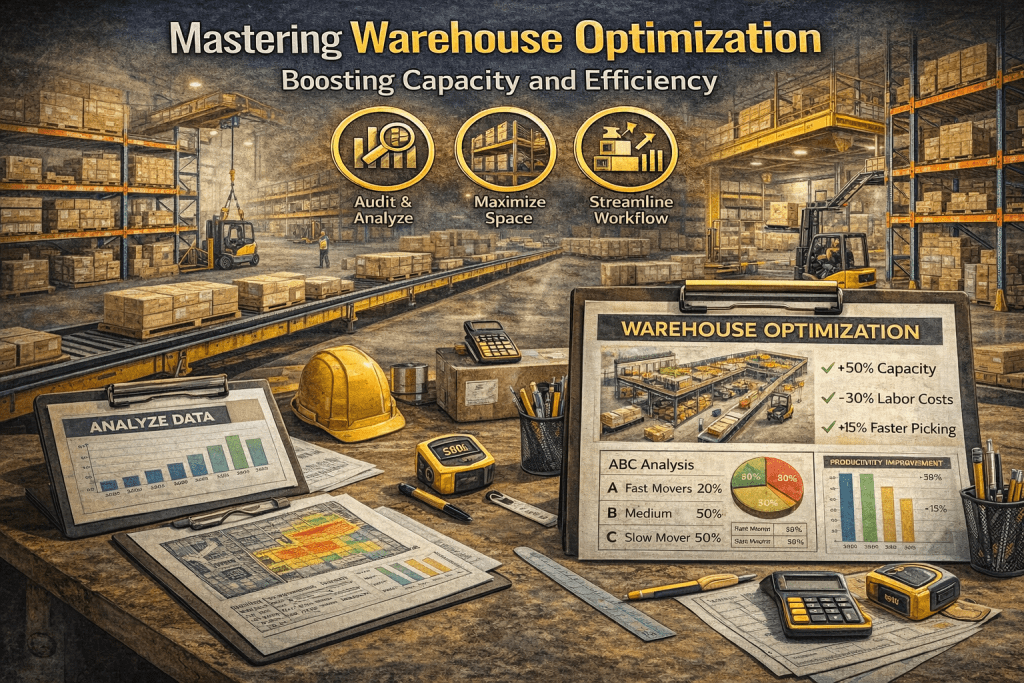
Warehouse slotting optimization is the strategic placement of inventory to maximize picking efficiency, utilize available space, and boost overall productivity. By organizing SKUs based on data, like pick frequency and physical size, you can slash labor costs and get orders out the door much faster.
Why Smart Warehouse Slotting Is No Longer Optional
Inefficient inventory placement is a silent profit killer. It quietly drains resources through wasted labor, frustrating picking errors, and slow fulfillment times that impact customer satisfaction. Many managers might see a disorganized warehouse as just a messy floor, but the hidden costs are substantial, hitting everything from your labor budget to customer loyalty.
Turning that liability into a competitive advantage is what strategic slotting is all about.
What used to be a “nice to have” is now a core operational necessity. This is not just a trend; it is a direct response to rising customer expectations for lightning fast delivery and the relentless growth of e commerce. A chaotic layout means slower picking, which leads to delayed shipments and unhappy customers. On the other hand, a well slotted warehouse empowers your team to pick orders faster and with fewer mistakes, which flows directly to the bottom line.
The Real World Costs of Poor Organization
A warehouse without a deliberate slotting strategy is not just inefficient, it is actively working against you. Every extra step a picker takes to find a slow moving item buried in a prime, easy to reach spot is a measurable cost. When you multiply that by thousands of picks a day, the numbers add up quickly.
Here is where the pain really shows up:
- Bloated Labor Expenses: It’s a surprising statistic, pickers can spend up to 70% of their time just traveling within the warehouse. A disorganized layout maximizes this travel time, inflating labor costs without adding value.
- High Picking Errors: When similar looking items are stored next to each other or your fastest movers are stuck on a high shelf in the back corner, the chances of grabbing the wrong SKU increase significantly. This leads to costly returns, rework, and annoyed customers.
- Capped Throughput: Wasted travel time and traffic jams in popular aisles create bottlenecks. These choke points limit the number of orders your facility can process in a day, putting a hard ceiling on your growth potential.
To see the direct impact, let’s contrast the daily struggles of a poorly organized warehouse with the benefits of a well executed slotting strategy.
Poor Slotting Challenges vs Optimized Solutions
| Common Challenge | Impact on Operations | Optimized Slotting Solution |
|---|---|---|
| High Labor Costs | Pickers spend most of their shift walking, not picking. Overtime becomes standard to meet demand. | Places fast moving items in easily accessible “golden zone” locations, drastically cutting travel time and labor expenses per order. |
| Frequent Picking Errors | Similar items stored together cause mix ups, leading to returns and customer complaints. | Groups items by attributes (size, type) but separates similar looking SKUs to minimize confusion and improve accuracy. |
| Warehouse Congestion | Multiple pickers crowd the same aisles for popular items, causing traffic jams and slowing everyone down. | Spreads high velocity items across different zones or uses heat maps to design pick paths that prevent bottlenecks. |
| Poor Space Utilization | Small, fast moving items occupy large pallet locations while bulky, slow items clog smaller bins. | Matches SKU size and velocity to the appropriate storage medium (bins, shelving, pallet racks), reclaiming wasted space. |
| Slow Order Fulfillment | The combination of long travel, searching, and errors means orders take longer to process and ship. | Streamlines the entire picking process, enabling faster turnaround from order receipt to shipment and improving customer satisfaction. |
The difference is significant. A thoughtful slotting plan does not just clean up the warehouse floor; it fundamentally improves every key performance metric you track.
A Strategic Imperative for Growth
The modern warehouse is a complex, demanding environment. To keep up, you have to embrace smarter solutions. Technologies like augmented reality in warehouses are already changing the game by boosting efficiency and accuracy, which makes a solid slotting foundation more critical than ever.
The market sees this shift loud and clear. Investment in optimization tools is growing, with the global warehouse slotting optimization software market hitting USD 2.13 billion this year. It is projected to grow at a compound annual rate of about 12%. This is not just tech hype; it is a clear signal that organizations understand strategic inventory placement is essential for survival and growth.
Adopting a data driven approach to warehouse slotting is your chance to get ahead of the competition. Do not let an outdated, inefficient layout dictate your facility’s potential. Planning for a smarter layout now will help you avoid future headaches and ensure you’re ready to handle future demand.
Our team offers free layouts and designs to help you visualize what a more productive and profitable operation could look like. Contact us to learn more.
Building Your Foundation with a Data Driven Audit
Effective warehouse slotting is not about guesswork or gut feelings; it is a science. Like any good science, it starts with solid data. Before you can think about moving a single bin, you need a crystal clear picture of what is happening on your floor right now. A comprehensive, data driven audit is the only way to get the objective insights needed to make changes that actually stick.
This is not just a quick walkthrough. We are talking about digging into the details of every single Stock Keeping Unit (SKU) in your inventory. You need to understand not just what you have, but how it moves, how big it is, and any special quirks it has. Getting this initial data collection right is the most critical step, everything else you do will be built on this foundation.
Gathering Your Essential SKU Data
The mission here is to build a complete profile for each product. Think of it as creating a detailed biography that tells you exactly where that SKU should “live” in your warehouse. Vague assumptions are your enemy; they lead to poor placement and wasted motion. Precision is everything.
Start by pulling together the following details for every SKU:
- SKU Velocity: How often is each item picked over a set period? This is arguably the most important metric you will look at.
- Product Dimensions: Get the exact length, width, and height of the item in its sellable unit (e.g., a single box, not the whole pallet).
- Product Weight: Record the weight of that sellable unit. This is a huge factor for ergonomics and making sure your racking can handle the load.
- Special Handling Needs: Does it need to be refrigerated? Is it hazardous, fragile, or just plain oversized? These requirements often trump any velocity based placement rules.
A common mistake is analyzing only a few weeks of data. To see the full picture of demand, you need to pull at least 52 weeks of rolling historical order data. This is the only way to account for seasonal spikes, lulls, and other trends a shorter snapshot would completely miss.
Applying ABC Analysis to Prioritize Inventory
Once you have your data, it is time to make it talk. The best place to start is with an ABC analysis, a classic inventory categorization method that segments products based on their value and movement.
This whole concept is built on the Pareto Principle, the 80/20 rule. In your warehouse, this means a small fraction of your SKUs drives the vast majority of your picking activity. Knowing which products fall into which category is a game changer.
Here is how you will break down your inventory:
- ‘A’ Items: These are your superstars. They are the top 15-20% of your SKUs that account for 70-80% of your total picks. These products get prime real estate in the most accessible, ergonomically friendly locations to slash travel time.
- ‘B’ Items: This next group is your steady performers. They make up about 30% of your SKUs and drive around 15-25% of your movement.
- ‘C’ Items: These are the slow movers. They represent 50% or more of your total SKU count but only contribute to about 5% of picks. These can be placed in less convenient spots, like higher up on the racks or in aisles farther from the packing stations.
Getting a handle on these categories is fundamental. Our guide on WMS-integrated warehouse design dives deeper into how this data first mindset is the key to building a truly efficient layout.
Mapping Your Current Warehouse Reality
With your SKUs neatly categorized, the last piece of the audit puzzle is to map out your physical world. This means getting out on the floor and observing how your team actually works.
Walk the pick paths. Identify the bottlenecks where people and equipment always seem to get stuck. Map out the most common travel routes and note any areas with constant congestion. You are looking for the story the building is telling you.
This physical audit, when combined with your SKU data, shines a bright light on the disconnect between your current layout and an optimal one. You will probably discover ‘A’ items tucked away in the back corner or see pickers constantly crisscrossing the same aisle, creating mini traffic jams. This evidence removes all subjectivity and builds an undeniable case for change.
Designing Your Optimal Warehouse Layout Strategy
Once you have solid, actionable data from your audit, you can finally move from analysis to design. This is where you translate all those numbers and observations into a physical layout that actively makes your operation faster, safer, and more efficient. A well designed warehouse layout strategy is not just about shuffling pallets around; it is built around proven methodologies that align your inventory with your real world operational goals.
This whole process is about creating a logical flow that minimizes travel time, reduces unnecessary handling, and makes every picker’s job easier. The right strategy will always depend on your unique product mix, order profiles, and the physical constraints of your building.
Matching Slotting Methods to Your Inventory
There is no single “best” method for warehouse slotting. The most effective approach usually combines several strategies to handle the different characteristics of your inventory. The key is matching a product’s velocity and physical attributes to the right location and the right type of storage.
Three foundational strategies are a great starting point:
- Slotting by Product Velocity: This is the most common approach for a reason. It uses the ABC analysis from your audit to place your fastest moving ‘A’ items in the most accessible and ergonomic locations, often called the “golden zone” (between a picker’s waist and shoulders). Slower ‘B’ and ‘C’ items get stored in less prime real estate.
- Slotting by Size and Weight: Heavy or bulky items should always be stored on lower levels to improve safety and ergonomics, regardless of how fast they sell. This simple rule prevents potential injuries from lifting heavy loads overhead and makes them much easier to handle with equipment.
- Grouping Related Items: If you know certain SKUs are almost always picked together, storing them side by side just makes sense. This move dramatically reduces the total distance a picker has to travel to complete a multi line order.
This visualization shows how you turn raw data into an actionable plan, moving from collection and analysis to actually mapping out efficient new paths for your team.
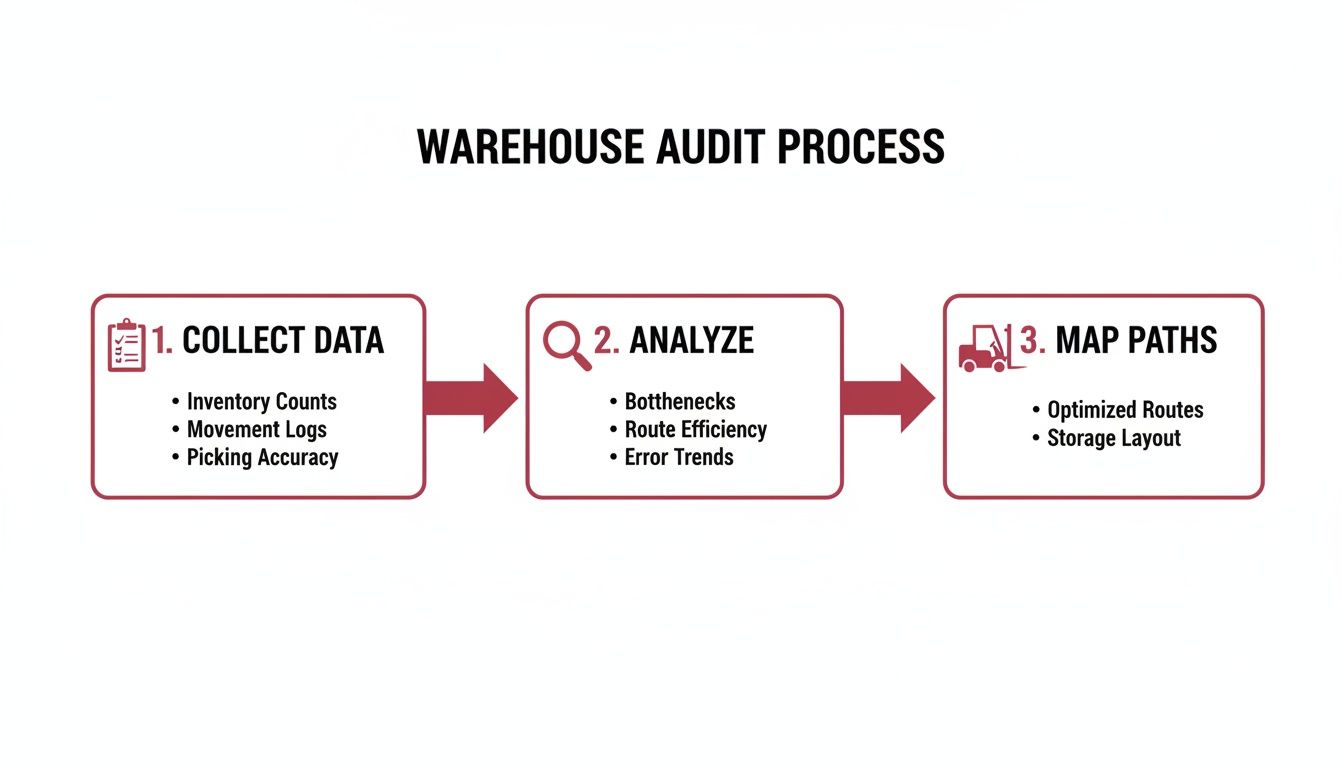
The biggest takeaway here is that a logical, sequential approach stops you from guessing. It ensures your final layout is based on the reality of your operation, not just assumptions.
Visualizing Pick Density with Heat Maps
A warehouse heat map is a powerful visual tool that brings your data to life. By mapping SKU pick frequencies directly onto your warehouse layout, you can instantly see which areas are “hot” (high activity) and which are “cold” (low activity). This visualization makes spotting inefficiencies almost effortless.
For instance, a heat map might reveal a surprising concentration of picks in a distant back corner, forcing every picker to travel the full length of the warehouse for popular items. It can also highlight major aisle congestion where too many fast movers have been crammed together. Armed with these insights, you can redesign pick paths to be more direct and strategically spread out high velocity items to balance the workflow.
Choosing the Right Racking for the Job
Your slotting strategy is only as good as the physical infrastructure that supports it. Selecting the right type of racking and shelving is absolutely critical for turning your plan into reality. The goal is simple: match the storage medium to the item’s characteristics and velocity.
Think about these common pairings:
| Storage Solution | Best For | Why It Works |
|---|---|---|
| Carton Flow Racks | Fast moving, small items (‘A’ SKUs) | Uses gravity to bring the next item forward, ensuring first in, first out (FIFO) rotation and minimizing replenishment time. Ideal for high volume picking. |
| Selective Pallet Racking | Slower moving, palletized goods (‘B’ & ‘C’ SKUs) | Offers excellent flexibility and direct access to every single pallet. It’s a cost effective solution for items with lower pick frequencies. |
| Industrial Shelving | Hand picked, medium velocity items | Provides high density storage for items that are not palletized, keeping them organized and easily accessible for manual picking. |
The right equipment does more than just hold inventory; it actively enhances your picking strategy. Investing in the proper storage solutions is a direct investment in your team’s productivity and your facility’s overall throughput.
Putting these strategies into practice can seem complex, but the payoff in efficiency is massive. The most successful warehouses see slotting not as a one time project, but as a process of continuous improvement. As your business evolves, your layout should, too.
Our team specializes in creating these kinds of efficient, data driven layouts. If you would like to explore what an optimized design could do for your facility, check out our approach to warehouse design and see how we can help.
A brilliant slotting design is a great start, but it is just a plan on paper. The real test is putting it into action on the warehouse floor. A thoughtful, well managed implementation is what separates a smooth transition from total operational chaos.
Executing your new slotting strategy is not a single event; it is a project. It requires careful coordination to keep disruptions to a minimum and get your team picking more efficiently as quickly as possible. Every step, from communicating the changes to updating your Warehouse Management System (WMS), needs to be handled with precision. Rushing this stage often leads to mistakes that undo all your hard design work.
Managing The Physical Move
The physical relocation of inventory is where the rubber meets the road. It is also the most hands on part of the process. A common pitfall is underestimating the labor and time required, which can lead to expensive downtime. To avoid bringing your entire operation to a standstill, a phased approach is almost always the best strategy.
Consider breaking down the move into manageable chunks:
- By Zone: Tackle the move one zone or aisle at a time. Scheduling this during off peak hours or over a weekend helps contain any potential issues to a small, manageable area.
- By Velocity: Start with your slowest moving ‘C’ items first. This method has the least impact on daily order fulfillment and gives your team a chance to get comfortable with the process before tackling the fast movers.
- By Product Group: If your inventory is organized into distinct product categories, you can move them one group at a time.
No matter which approach you choose, clear communication is everything. Your team needs to understand the “why” behind the changes. When pickers know how the new layout makes their job easier, they become advocates for the project, not sources of resistance.
Your Implementation Checklist
A successful rollout depends on getting the details right. Using a checklist ensures no critical tasks are overlooked during the transition. Planning ahead also helps you lock in the necessary resources and timelines, which is especially important for new equipment installations that can face long lead times during busy seasons.
Slotting Implementation Checklist
This checklist provides a simple framework to guide you through the process, from initial prep to post launch review, ensuring a structured and successful transition.
| Phase | Key Task | Primary Consideration |
|---|---|---|
| Preparation | Communicate Plan to Team | Get buy in by explaining how the new layout makes their jobs easier and more efficient. Address concerns early. |
| Preparation | Finalize Equipment Layout | Confirm that all new racking, shelving, or mezzanines are fully installed and ready for inventory. |
| Execution | Update WMS Locations | Ensure every new bin and pallet location is accurately reflected in your system before a single product is moved. |
| Execution | Physically Relocate SKUs | Move inventory according to your phased plan, physically verifying that each item is placed in its correct new location. |
| Execution | Validate Inventory Counts | Perform cycle counts as items are moved. This maintains inventory accuracy throughout the transition. |
| Post-Launch | Conduct Team Training | Hold sessions to walk the team through the new pick paths. Let them ask questions and provide feedback. |
| Post-Launch | Monitor Initial Performance | Immediately track key metrics like pick rates and travel times to identify and fix any early issues. |
Remember, a structured plan prevents chaos. A smooth implementation ensures you start reaping the rewards of your hard work right away.
The single most overlooked task? The WMS update. If your system’s data does not perfectly match the physical reality on the floor, you will create a frustrating, error prone environment for your pickers. Double check all data entry before giving the green light.
Putting a new slotting plan into motion is a significant undertaking, but the efficiency gains are well worth the effort. Proper slotting can dramatically save time picking fast movers and boost your overall throughput.
Our team does not just design efficient layouts; we help you plan for a successful implementation. By working with us, you can often secure faster installation timelines for new equipment and avoid the delays that are so common during peak seasons.
Ready to put a better plan in motion? Request a Quote or call our design specialists at 800-326-4403 for a free, no obligation layout consultation.
Measuring Success and Driving Continuous Improvement
Warehouse slotting is not a “set it and forget it” project. The initial rollout will give you some impressive wins right out of the gate, but the real, long term value comes from treating it as a cycle. You have to constantly measure, tweak, and improve. This is how your warehouse stays nimble enough to handle new SKUs, shifting customer demand, and whatever else the market throws at you.
How do you know the new layout is actually working? You have to track the right Key Performance Indicators (KPIs). These numbers cut through the guesswork and give you objective proof of what is working, what is not, and where your next big opportunity for improvement lies.

Key Performance Indicators That Matter Most
To see the impact of your slotting efforts, focus on a handful of core metrics that tie directly to efficiency and your bottom line. These KPIs provide a data backed health check for your operation.
- Pick Rate Improvements: This is your most direct measure of success. Start tracking the number of lines or units picked per hour, per employee. A smart slotting strategy should cause a significant jump here because your team is spending less time walking and searching.
- Reduced Travel Time: Whether you use your WMS or time studies, measure the average distance a picker travels to fill an order. Slashing travel time is the whole point of slotting, so a major drop here is a huge win.
- Order Accuracy Rates: A well organized warehouse is a more accurate one. Keep a close eye on your pick accuracy rates. If you see a decline in mis picks, it is a great sign your new layout is reducing confusion and making the right item the easy item to grab.
- Dock to Stock Time: This metric tells you how fast incoming inventory gets put away and becomes available for sale. Better slotting almost always simplifies the putaway process, which means your receiving team can get products ready for picking much faster.
The Power of Continuous Slotting Maintenance
Markets change, new products launch, and demand patterns evolve. The layout that was perfect six months ago could be creating new bottlenecks today. That is why ongoing slotting maintenance is absolutely critical for long term success.
Think of your warehouse layout like a garden. It needs regular tending to thrive. If you simply plant it and walk away, weeds will eventually take over. Regular maintenance ensures you continue to harvest the benefits of your initial hard work.
So, what does that “tending” look like in practice?
- Quarterly Reviews: A quick check in every quarter is a solid habit. Look at your velocity data for any major shifts and make small, targeted adjustments.
- Annual Reslotting: Plan for a full, deep dive re evaluation of your entire slotting strategy at least once a year. This means analyzing 52 weeks of rolling data to properly account for seasonality and bigger trends.
- Trigger Based Reviews: Do not wait for the calendar. Be ready to act when big changes happen, like adding a new product line or seeing a sudden, sustained spike in demand for a group of SKUs.
This proactive approach ensures your warehouse layout grows and adapts right alongside your business. The broader warehouse management system market, which relies on this kind of optimization, is projected to grow from USD 4.57 billion to USD 10.04 billion over the next five years. As market analyses show, companies are chasing the cost efficiencies that come from smart analytics. You can learn more about these warehouse management trends and see why this is becoming standard practice.
Building an Agile Infrastructure
Maintaining an optimized layout is much easier when your physical infrastructure is not fighting you every step of the way. Choosing flexible storage solutions from day one makes future adjustments far less disruptive and costly.
Solutions like selective pallet racking and industrial shelving give you the versatility to adapt as product dimensions and velocities change over time.
This idea of planning for future agility is a core part of our design philosophy. When we create a free layout for a client, we are not just solving today’s problem. We are building a foundation that is ready for tomorrow’s challenges. The sooner you get that flexible, optimized foundation in place, the better prepared you will be to handle growth without having to shut down for a major overhaul.
Ready to build an agile and efficient warehouse? Contact Us for a free design consultation or call 800-326-4403 to speak with a specialist.
Partner with Experts for Your Optimization Project
Rethinking your warehouse layout is a major move, but you do not have to go it alone. A well executed slotting optimization plan is not just about shuffling boxes around; it delivers real, measurable wins: lower labor costs, quicker fulfillment, and pinpoint order accuracy. Bringing in experienced pros helps you achieve those results without the headaches of trial and error.
At Material Handling USA, we are the bridge between your operational data and a high performance physical layout. Our team offers free, no obligation layouts and designs to turn your goals into a workable blueprint. We make sure your plan is built for maximum efficiency from the start.
From Blueprint to Reality
We understand a great design is only half the battle. It needs the right equipment and a smooth rollout to actually make a difference.
That is why we focus on what really matters to get your project across the finish line:
- Competitive Pricing: We source high quality racking, shelving, and storage solutions that work with your budget, making sure you see a strong return on your investment.
- Quality Materials: Our products are built to last. From heavy duty pallet racking to versatile industrial shelving, we provide a reliable foundation for your operations for years to come.
- Fastest Shipping in the Industry: We get your new equipment on site fast, cutting down project timelines so you can start banking those efficiency gains much sooner.
Investing in a professional design and the right equipment is not an expense, it is a strategic move. Getting the layout right the first time prevents costly reconfigurations and builds a more resilient, profitable operation.
The demand for optimized warehouse space is only growing. Planning ahead is the key to locking in equipment and scheduling installations without hitting frustrating delays. Starting the conversation now puts your project on the fast track to a smoother, quicker completion.
Take the next step toward a warehouse that works harder for you. Let our experts craft a custom layout that unlocks your facility’s true potential.
Request a Quote online or give our team a call at 800-326-4403 to get started with your free design.
Common Questions About Warehouse Slotting
Even the best laid plans run into real world questions. When you are facing a full scale slotting optimization project, it is natural for some practical concerns to pop up. Let’s tackle some of the most common questions we hear from warehouse managers to get your team aligned and confident from the start.
How Often Should We Re-Slot Our Warehouse?
This is a big one. For a major, deep dive review, you should plan on doing it annually. This gives you a full year’s worth of data, capturing all the seasonal trends and demand shifts that happen over 12 months.
But that does not mean you set it and forget it. You should be keeping a close eye on performance at least quarterly to spot any major changes. If you are bringing in a lot of new SKUs or see a sudden, unexpected spike in demand for a particular product, you will need to be ready to make targeted adjustments much sooner.
The real secret to long term efficiency is not just the big annual overhaul; it is the continuous monitoring. A static plan in a dynamic business is a recipe for inefficiency. Staying agile is what keeps your operation humming.
Do I Need Expensive Software for This?
Not necessarily. While a dedicated WMS module can offer powerful, dynamic slotting recommendations for massive, complex operations, you can achieve incredible improvements with simpler tools.
For many small to medium sized facilities, a well organized spreadsheet paired with a detailed ABC analysis can deliver fantastic results. The most critical factor is not the price tag of your software; it is having a logical, data driven process behind your decisions. Our team is skilled at designing layouts that work with the systems you already have, so you can reap the benefits of optimization without a massive upfront investment.
What is the Biggest Mistake When Re-Slotting?
The most common and costly mistake is failing to involve the warehouse team. Your pickers, packers, and receivers are on the ground every single day. They have invaluable insights into the daily workflow, the frustrating bottlenecks, and the practical challenges that no dataset can fully capture.
When you do not bring them into the planning process or fail to train them properly on the new layout, you get resistance, confusion, and a plan that looks great on paper but fails in practice. This one oversight can completely undermine the project’s success. Get buy in from your team early and often, it makes for a much smoother transition and delivers far better results.
How Should We Handle Oversized Items?
These “problem children” of the warehouse need their own dedicated strategy. Do not try to force them into your standard velocity based slotting rules. They need to be placed in designated zones with the right storage solutions, like specialized cantilever racking, to keep them safe and prevent damage to other products.
The goal here is simple: get them into accessible, purpose built locations where they will not obstruct the main pick paths for your faster moving, standard sized items.
A successful layout from Material Handling USA takes all of these factors into account. Our free design and layout services help you build a plan that truly works for your unique inventory and operational flow. Contact us today or give our experts a call at 800-326-4403 for a no obligation consultation.