Hospital supply rooms are the logistics backbone of patient care — when nurses can’t find supplies quickly, patient care suffers. Effective hospital supply room organization combines the right storage systems, smart layout design, and inventory management practices to ensure critical supplies are always accessible when needed.
Common Hospital Supply Room Challenges
- Space constraints — Hospital real estate is expensive ($400-$800/sq ft to build). Supply rooms compete with clinical space.
- Product proliferation — Modern hospitals stock 3,000-5,000 different supply items per unit.
- Access speed — Nurses spend 10-20% of their shift looking for supplies. Every minute counts in emergencies.
- Infection control — Storage systems must support cleaning and prevent contamination.
- Inventory accuracy — Expired products, stockouts, and overstock waste millions annually.
Storage Solutions for Hospital Supply Rooms
Mobile Shelving Systems
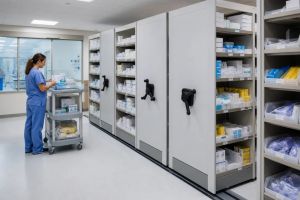
Mobile (compact) shelving is the single most impactful upgrade for hospital supply rooms. By compacting shelves on movable carriages, mobile shelving saves 50-70% of floor space compared to static shelving. Electric mobile shelving provides push-button access and ADA compliance.
Wire Shelving Systems
NSF-certified wire shelving is the healthcare standard for supply storage. Open wire design allows sprinkler penetration, air circulation, and easy cleaning. Available in chrome, stainless steel, and antimicrobial polymer-coated finishes.
Bin Shelving Systems
Sloped shelving with removable bins for small supplies. FIFO (first-in, first-out) design ensures older stock is used first. Color-coded bins speed up visual identification during time-critical situations.
Automated Dispensing Cabinets
Computer-controlled cabinets for medications and high-value supplies. Track usage by caregiver and patient. Integrate with hospital information systems for automatic reordering.
Hospital Supply Room Layout Design Principles
- Zone by frequency — High-use items (gloves, syringes, gauze) at eye level near the door. Medium items on upper/lower shelves. Low-use items in the back.
- Separate clean from dirty — Sterile supplies and clean linen must be stored away from soiled utility areas. Maintain clear traffic flow to prevent cross-contamination.
- Maintain aisle clearance — ADA requires 36″ minimum. For cart access, 42″ minimum aisles are recommended.
- Plan for par levels — Each item needs enough shelf space for maximum par level plus a buffer. Undershelf labels should show item name, par level, and reorder point.
- Consider workflow — Items used together should be stored together. Wound care supplies in one zone, IV supplies in another, catheter kits in a third.
Need help designing your supply room? Request A Free Layout Consultation — Material Handling USA provides free facility layout design for every healthcare storage project.
Inventory Management and Organization Systems
Two-Bin Kanban System
Each supply item has two bins. When the front bin empties, the card triggers a reorder while the back bin moves forward. Simple, visual, and nearly eliminates stockouts.
Par Level Management
Set minimum and maximum stock levels for every item. Review monthly and adjust based on actual usage. Modern supply chain software automates this tracking.
Barcode/RFID Integration
Scan items at point of use for real-time inventory tracking. RFID cabinets can automatically detect when supplies are removed and update inventory systems.
Infection Control and Cleanability Requirements
- Use non-porous shelving materials that can withstand hospital-grade disinfectants
- Antimicrobial coatings on wire shelving inhibit bacterial growth between cleanings
- Keep sterile supplies in original packaging until use. Store in enclosed cabinets when possible.
- Maintain 8-12″ clearance between the lowest shelf and the floor for cleaning access
- Conduct regular expiration date checks — organize by expiration with shortest dates in front
Frequently Asked Questions
What is the best shelving for hospital supply rooms?
Mobile shelving systems are the gold standard for hospital supply rooms — they save 50-70% of floor space while keeping all supplies accessible. Wire shelving is popular for its ventilation and NSF compliance. Antimicrobial wire shelving adds infection control.
How can I maximize space in a small hospital supply room?
Mobile shelving (compact shelving) is the most effective space maximizer — it eliminates fixed aisles and can double your storage capacity. Also use vertical space with tall shelving, door-mounted organizers, and overhead bins. Color-coded bin systems improve pick speed.
What are the infection control requirements for hospital storage?
Hospital storage must support cleaning protocols. Use non-porous shelving materials (stainless steel, chrome-plated wire, polymer). Keep sterile supplies in closed cabinets or covered carts. Follow Joint Commission and CMS guidelines for storage of medications, clean supplies, and sterile instruments.
How do I organize a hospital supply room efficiently?
Use ABC analysis: A items (high-use) at ergonomic height and closest to the door. B items (medium-use) on higher/lower shelves. C items (low-use) in back areas. Label everything with bin locations and par levels. Implement a two-bin Kanban system for automatic reordering.
Related Resources
- How to organize medical supplies step by step, including put-away after an inventory count
- mobile storage systems
- electric mobile shelving
- facility layout design
- request a free layout consultation
Need Help? Get a Free Quote
Material Handling USA provides expert guidance, free quotes, and layout assistance. Our specialists can help you find the right solution for your specific needs.
Call: (800) 326-4403
Email: sales@mh-usa.com