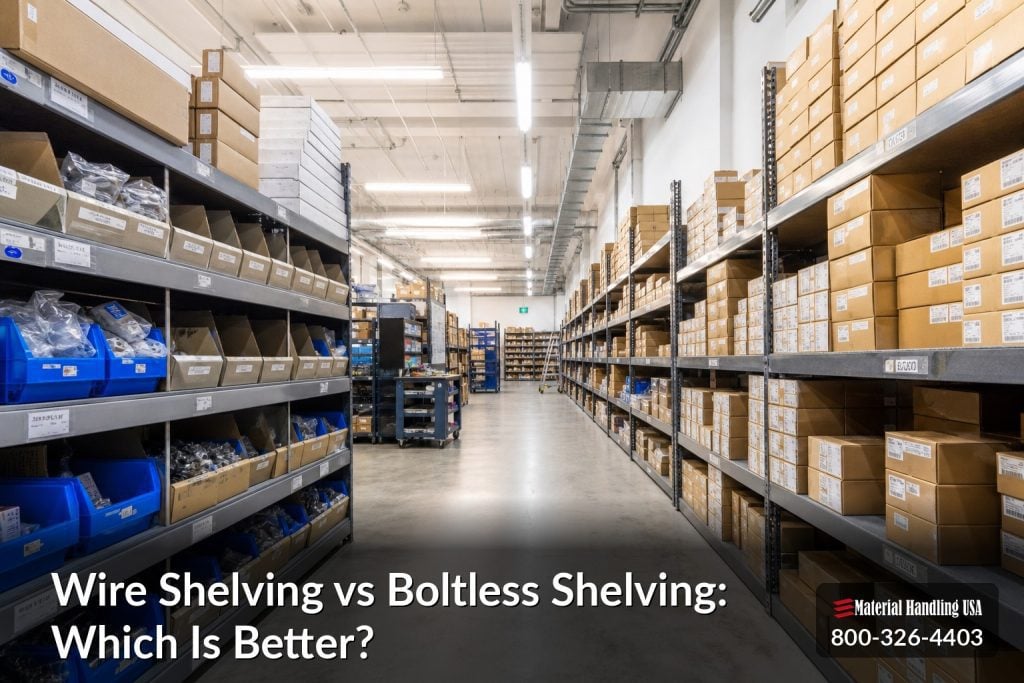
You're probably looking at the same basic question many buyers face. Two shelving options both look practical on paper, both can be configured in multiple sizes, and both can work in stockrooms, backrooms, and light industrial spaces. But once you start comparing real operating needs, the choice gets less simple.
A warehouse supervisor storing cartons, a facilities manager outfitting a supply room, and a buyer planning a mixed-parts area may all start with the same shortlist: wire shelving or boltless shelving. The right answer depends on what you store, how heavy it is, how often layouts change, and whether airflow and cleaning matter more than flat shelf support.
The bigger mistake is choosing by sticker price alone. Total cost of ownership often comes from labor, cleaning time, replacement cycles, item fit, and how well the system supports daily work. That's where the key difference between wire shelving vs boltless shelving shows up.
Choosing Your Ideal Storage Wire Shelving vs Boltless Shelving
Most shelving decisions start with a space problem, but they end as an operations decision.
A stockroom manager might need better visibility for fast picks. A plant maintenance team might need shelves that can handle boxed parts, tools, and heavier items without second-guessing load limits. A healthcare buyer might care more about cleanability and corrosion resistance than maximum shelf strength. All of them are comparing valid options, not a good choice versus a bad one.
That's why wire shelving vs boltless shelving is such a common buying question. Both are open shelving systems. Both are widely used. Both can improve organization quickly. But they solve different problems well.
Practical rule: Start with the inventory and environment, not the shelf style you already recognize.
If you need open visibility, airflow, and easier cleaning, wire often makes more sense. If you need stronger support for boxes, tools, and denser loads, boltless usually takes the lead. The best result comes from matching the shelving to the actual work happening in the room.
At a Glance Wire Shelving Compared to Boltless Shelving
Some comparisons don't need a long explanation. Buyers usually want a fast side by side view first, then details after.
Wire Shelving vs. Boltless Shelving Comparison
| Feature | Wire Shelving | Boltless Shelving |
|---|---|---|
| Airflow | Excellent | Limited with solid decking |
| Visibility | Excellent | Good |
| Ease of cleaning | Strong choice for wipe-down environments | Depends on deck material and stored items |
| Best item type | Supplies, visible inventory, ventilated storage | Boxes, tools, parts, heavier mixed inventory |
| Adjustability | Flexible | Flexible |
| Expansion options | Good for modular stockroom layouts | Strong for modular storage growth |
| Ideal use case | Supply rooms, food-adjacent areas, labs, visible stockrooms | Warehouses, parts rooms, backrooms, boxed inventory |
| Budget range | Can cost more upfront in some applications | Often cost-effective for general industrial storage |
The table points to the core trade-off. Wire shelving compared to boltless shelving is usually a question of environment versus load style.
Wire shelving favors visibility, ventilation, and easier housekeeping. Boltless shelving favors flat shelf support, dense storage, and heavy-duty utility. If your operation stores mixed inventory, the better answer may even be using both in different zones rather than forcing one system everywhere.
What buyers usually miss
The most common comparison mistake is treating all shelving as if it performs the same once it's installed. It doesn't.
A shelf that works well in a clean supply room may be the wrong fit for archived boxes, bulk parts, or dense cartons. A system that handles heavy goods well may create headaches if airflow or easy wipe-down cleaning is part of the job. That's why a real industrial shelving comparison has to look beyond appearance.
An In-Depth Look at Wire Shelving Systems
Wire shelving uses an open-grid shelf surface, usually supported by steel posts and coated finishes. That construction is why it performs so well in spaces where airflow, visibility, and routine cleaning matter.

Where wire shelving works best
Wire shelving is a strong fit for supply rooms, food-adjacent spaces, healthcare environments, and organized stockrooms where staff need to see items quickly. The open shelves help reduce trapped dust and moisture, and they let air circulate around stored goods.
That matters over time. In regulated or humid environments, wire shelving can make a better long-term business case. One industry source notes that wire shelving's epoxy or chrome finishes resist corrosion 2x longer in 70 to 90% humidity, can reduce replacement by 30%, and may deliver 15 to 25% lower total cost of ownership over 7 years in regulated markets such as healthcare, evidence storage, and e-commerce fulfillment, according to this wire shelving lifecycle comparison.
If that sounds like your environment, it's worth reviewing available wire shelving units for stockroom and clean storage use.
Where wire shelving falls short
Wire isn't automatically the better answer just because it looks cleaner.
Small loose items can be awkward on open grids unless you add bins or shelf liners. Boxed inventory may sit fine on wire, but the experience is usually less forgiving than a flat solid deck. For buyers doing a stockroom shelving comparison, that detail matters because it affects day to day handling, not just specifications.
Wire shelving is often easier to live with in clean, visible environments. It's less forgiving when the inventory itself needs a solid, flat landing surface.
An In-Depth Look at Boltless Shelving Systems
Boltless shelving is the workhorse option in many warehouse and backroom applications. It uses interlocking steel frames and beams that assemble without traditional nuts and bolts, usually with simple rivet-style connections.

Why boltless is so common in industrial spaces
Boltless shelving earns its place because it handles the kind of inventory many facilities store. Boxes, tools, equipment, packaged parts, and mixed heavier goods are usually more comfortable on a solid deck than on wire.
A standard 48" x 24" x 72" boltless shelving unit can achieve up to 600 lbs per shelf and a total capacity of 3000 lbs, while broader industry data shows boltless shelving averaging 1,000 to 3,800 lbs per shelf compared with wire shelving's typical 600 to 800 lbs per shelf, according to this boltless versus wire shelving analysis.
That strength is a big reason buyers looking for boltless shelving for inventory often choose it for parts rooms, warehouse overflow, and stock areas with dense boxed storage. You can review common boltless shelving configurations here.
Assembly and practical use
The other advantage is setup. Boltless systems are designed for fast assembly and straightforward reconfiguration. That helps when spaces need to go live quickly or change as inventory shifts.
For many buyers, that's its key appeal. Boltless shelving usually isn't chosen because it looks lighter or cleaner. It's chosen because it supports a lot of everyday industrial storage problems without becoming complicated.
A caution buyers should keep in mind
Not every boltless setup belongs in every room. If your operation depends on airflow, visible wipe-down cleaning, or corrosion resistance in humid conditions, wire may still be the better fit. That's why boltless shelving vs wire shelving should always be judged by use case first.
How to Choose Key Decision Factors for Your Operation
Most buyers don't need more product theory. They need a short list of questions that leads to a confident choice.

Start with weight and item type
Shelf strength changes the decision quickly. One source notes that wire shelving offers 600 pounds per shelf, while boltless systems can support up to 800 pounds per shelf, a 25% increase in per-shelf capacity that becomes important when facilities store dense, heavy items and need to maximize vertical space, as explained in this shelving load comparison.
If you store boxed inventory, tools, denser parts, or mixed goods with uneven weight, boltless often makes more sense. If you store lighter supplies, visible inventory, or goods that benefit from ventilation, wire becomes more attractive.
Consider environment and handling routine
A clean supply room and a backroom parts area don't operate the same way.
Wire shelving for stockrooms works well when teams need to scan inventory fast, keep air moving, and maintain cleaner presentation. Boltless shelving for inventory works well when cartons, packaged goods, and heavier items need flat support with fewer handling annoyances.
For mixed applications, some buyers choose boltless shelving with wire decks for hybrid storage needs. That can be useful when you want some airflow without giving up the boltless frame style.
Look at total ownership, not just purchase price
The shelf cost is only one line item. Buyers also need to weigh:
- Installation labor: Boltless systems are often easier to assemble and rework.
- Cleaning routine: Wire is usually easier in spaces with frequent wipe-downs.
- Inventory fit: Small parts may need bins on wire. Heavy cartons usually sit better on solid shelving.
- Change frequency: Teams that move layouts often should favor modular simplicity.
- Facility risk: If shelving is part of a relocation or expansion, planning also includes protection of stored goods and fixtures. This guide on ensuring your warehouse move is secure is a useful reminder that storage decisions and move planning often overlap.
Buyer checklist: If your inventory is boxed and heavy, start with boltless. If your environment is clean, humid, or visibility-driven, start with wire. If both conditions matter, compare hybrid layouts instead of forcing one answer.
Six-step checklist for choosing between the two
- List your main inventory types. Boxes, tools, supplies, bins, or mixed parts.
- Estimate shelf loading. Focus on the heaviest normal use case, not the average day.
- Check the room conditions. Humidity, cleaning demands, and airflow needs matter.
- Think about item size. Small items may need bins or liners on wire shelves.
- Map future changes. Frequent resets favor systems that are easy to reconfigure.
- Review layout support before buying. A good plan usually prevents wasted space and bad shelf depth choices.
Why Your Shelving Partner Matters as Much as the Shelving
A shelving mistake rarely shows up on the quote. It shows up six months later in extra install hours, damaged cartons, cleaning slowdowns, and a layout that no longer fits the work.
That is why the partner matters as much as the product. In a lab, the wrong recommendation can add cleaning time every week. In a parts room, a poor shelf depth decision can force overhang, crush boxes, and slow picking. The purchase price may look fine, but the operating cost keeps climbing.
A good supplier helps prevent those errors before material arrives on site. The job is not just to price wire shelving or boltless shelving. The job is to match shelf type, dimensions, decking, and layout to how the space runs.
What a good supplier helps you get right
The best guidance usually shows up in a few practical areas:
- Load fit: Shelf capacity should match actual stored product, including dense cartons, loose parts, and reserve stock.
- Layout efficiency: Shelf depth, bay width, and aisle spacing should support picking and replenishment without wasting floor space.
- Reconfiguration planning: Operations that reset often need a system and layout that can be changed without high labor cost.
- Installation scheduling: Fast assembly helps, but only if the sequence fits the rest of the project and keeps downtime under control.
- Damage prevention: The right deck style and sizing reduce box overhang, snag points, and product loss.
Assembly speed is a good example of why planning affects total cost of ownership. Boltless shelving's tool-free interlocking design can reduce installation time by up to 70% per unit compared to traditional bolted shelving, according to this comparative analysis of boltless shelving and traditional racking. That time savings matters most when labor is tight, the area has to go live quickly, or the layout may change again next year.
Earlier planning also helps buyers avoid common procurement mistakes. Ordering the wrong shelf depth, mixing incompatible accessories, or underestimating future expansion usually leads to change orders and rework. Those costs are easy to miss during vendor comparison because they do not sit on the initial line-item price.
Material Handling USA is one example of a supplier buyers use for this process. The company provides shelving options, layout assistance, quote support, and installation coordination for commercial and industrial applications.
The right shelving partner helps control labor, protect inventory, and reduce the cost of fixing avoidable layout mistakes later.
Frequently Asked Questions
Is wire shelving or boltless shelving better for boxed inventory
Boltless is usually the better fit for boxed inventory, especially when boxes are dense, heavy, or stacked often. Flat shelf support makes everyday handling easier.
Which shelving system is better for airflow
Wire shelving. Its open-grid design promotes airflow and visibility better than solid-shelf boltless setups.
Which one is easier to clean
Wire shelving is often easier in environments that require regular wipe-downs and better air circulation. Boltless can still work well, but the deck style and stored items make a difference.
Which system is faster to assemble
Boltless shelving is usually faster to assemble because of its interlocking design. That can help reduce labor and shorten setup disruption.
Is wire rack vs boltless shelving only about weight capacity
No. Weight matters, but so do cleaning routines, humidity, item size, visibility, and how often your layout changes.
What works better for parts and boxes
For mixed small and medium items, the answer depends on packaging. Boxed parts often work better on boltless. Loose or visible stocked items often work better on wire with bins.
Can one facility use both shelving types
Yes. That's often the most practical answer. A warehouse may use boltless shelving for boxed inventory and heavier goods, then use wire shelving in cleaner supply or visible pick areas.
How should I compare suppliers
Look at product fit, quote support, layout help, shipping timing, and whether the supplier can help you match shelving to the job instead of just pushing one system.
If you're still weighing wire shelving vs boltless shelving, the best next step is to match the shelf to the inventory, room conditions, and daily workflow before you buy. That usually leads to fewer layout changes, faster installation planning, and better long-term use. For help with shelving selection, free layouts and designs, quote support, and availability, Contact Material Handling USA or Request a Quote. If you're ready to move forward, call 800-326-4403 or email Sales@MH-USA.com.