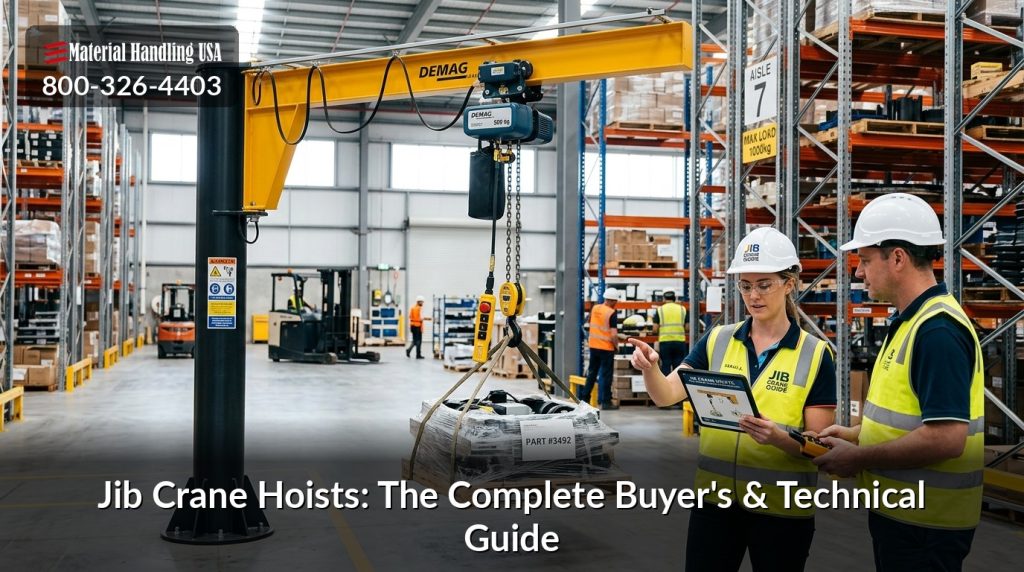
Jib Crane Hoists: The Complete Buyer’s & Technical Guide
URL slug: jib-crane-hoists
Meta title: Jib Crane Hoists Buyer’s Guide
Meta description: Compare jib crane hoists by type, duty, and install needs. Get practical buying guidance and request a quote today.
A skilled crew can still lose time at one workstation.
It shows up the same way. A heavy part has to be loaded into a fixture, a tool has to be positioned twice per cycle, or a packed item needs a controlled lift onto a bench. Two employees step in, the task gets done, and the line keeps moving. But that repeated workaround slows the cell, ties up labor, and adds avoidable strain.
That is where jib crane hoists earn their keep. They solve a specific problem. They put controlled lifting exactly where the work happens. In most facilities, that matters more than adding another general-purpose forklift or asking operators to keep improvising with carts and muscle.
The buyers who get the best long-term value look past headline capacity first. They ask harder questions. How many lifts will this station see? How much headroom do we have under the boom? Will the hoist become the maintenance bottleneck? Is manual operation acceptable, or will motorization make the work cell run cleaner and faster?
Those are the questions that separate a purchase that lifts from one that improves the whole process. Moving sooner also helps planning. It is easier to coordinate layout, concrete review, electrical work, and installation windows before demand stacks up against your maintenance calendar.
Introduction Why Your Workflow Needs a Jib Crane Hoist
A jib crane hoist is rarely bought because a facility wants another piece of equipment. It gets bought because a process has started showing stress.
In a machine shop, that may be a vise, die, or workpiece that operators handle several times per shift. In a shipping area, it may be a dense carton or awkward product that needs controlled placement on a packing station. In maintenance, it may be a motor or pump that has to come out without damaging nearby equipment.
The common issue is not a lack of effort. It is a lack of localized lifting control.
What changes after installation
The practical benefit is simple. The jib handles horizontal reach and rotation. The hoist handles vertical lifting. Together, they let one operator move a load within a defined area without waiting for shared lifting equipment.
That changes more than ergonomics.
- Labor use improves: Fewer two-person lifts are needed for routine tasks.
- Workstation flow gets cleaner: Operators stop waiting on a fork truck for small repetitive moves.
- Placement gets more consistent: Loads can be lowered into the same spot with better control.
- Safety oversight gets clearer: A dedicated lifting zone is easier to train and inspect than improvised handling.
Key takeaway: If one cell repeatedly stops for a lift, the issue is not staffing. It is a workstation design problem.
Why buyers should think in total ownership cost
The cheapest hoist on paper can become the most expensive choice in use.
A unit that is undersized for duty, poorly matched to available power, or too tall for your headroom creates workarounds from day one. A better buying process looks at the full picture. Duty cycle, installation complexity, available rotation, service access, and operator fit matter just as much as rated capacity.
Understanding Jib Crane Hoists Core Components and Function
A jib crane hoist system works best when you treat it as an integrated lifting assembly, not as separate catalog items.
The easiest way to think about it is this. The jib crane is the structure. The hoist is the lifting device. One creates the working envelope. The other does the up-and-down work.

Historically, that basic idea has lasted a long time. The jib crane’s origins trace back to ancient Greece around 500 BCE, and later Roman improvements added winches. During the Industrial Revolution, steel replaced wood, increasing load-bearing from 5 tons to over 20 tons, and the first cast iron jib crane appeared in 1834, according to Munck Cranes’ short history of jib cranes.
For a broader overview of crane layouts in facilities, this guide to types of cranes and their uses is a useful reference.
The mast and boom
The mast is the vertical support. On a freestanding or mast-type jib, this member transfers load into the floor or building structure.
The boom is the horizontal arm. It creates reach across the workstation and supports the trolley and hoist.
If the boom length increases, the structural demand on the system increases too. Longer reach is useful, but it is never free. It affects headroom, load behavior, and in some designs the practical lifting capacity at the outer end.
The trolley and hoist
The trolley carries the hoist along the boom. Depending on the application, it may be manual, motorized, or pneumatic.
The hoist does the lifting. This is the component buyers focus on first, but it only performs correctly if it is matched to the crane, the trolley, and the duty of the station.
Key decisions include:
- Lift method: Manual, electric chain, or electric wire rope
- Control style: Pendant, remote, or other application-specific controls
- Travel behavior: Manual push, geared travel, or powered trolley movement
- Protection features: Overload and thermal protection can matter in demanding cycles
If your team is reviewing motor controls and protection devices, this overview of a thermal overload switch gives helpful context on why motor protection matters in repetitive-use equipment.
Why mismatches happen
The most common specification mistake is assuming that if a hoist has the right rated lift, it will automatically work on any jib.
It will not.
A hoist can be too large for available headroom. A trolley can be wrong for the beam profile. The combined weight of hoist and trolley can affect the design basis of the jib. That is why experienced buyers specify the system as a package.
Choosing Your Hoist Type Electric Wire Rope vs Electric Chain vs Manual
The hoist is the part operators feel every day. If the hoist choice is wrong, the entire jib crane feels wrong.
Most buying mistakes come from overvaluing purchase price and undervaluing how the station functions. The right comparison is not just feature against feature. It is workflow against ownership cost.

Existing content on motorized versus manual jib cranes often misses that business decision framework. Analysis cited by EMH Cranes on jib crane questions and answers notes that buyers often do not get enough guidance on labor savings, throughput improvement, or payback, even though the decision affects layout, staffing, and total cost of ownership.
Hoist type comparison
| Feature | Electric Wire Rope Hoist | Electric Chain Hoist | Manual Hoist |
|---|---|---|---|
| Best fit | Heavy-duty lifting and demanding cycles | General plant and warehouse work cells | Infrequent lifts or no-power locations |
| Lift feel | Smooth and precise | Controlled and versatile | Operator-dependent |
| Speed profile | Faster relative performance | Moderate | Slow |
| Upfront cost | Higher | Mid-range | Lowest |
| Maintenance profile | More involved system upkeep | Typically simpler to support | Low mechanical complexity, but labor-heavy in use |
| Headroom considerations | Can require more planning depending on model | Often a strong fit where compactness matters | Depends on mounting and manual travel setup |
| ROI profile | Best where high use justifies the investment | Best all-around balance for many applications | Best only when lift frequency stays low |
Electric wire rope hoists
Wire rope hoists are the right answer when the application is demanding enough to justify them.
They fit better in operations where buyers care about lift performance, controlled handling, and repeated use under tougher service conditions. In fabrication or maintenance areas with heavier loads and long lifts, they often feel more refined than a manual setup or a lightly specified chain hoist.
What works well:
- Higher-use stations
- Applications needing smoother lifting behavior
- Situations where speed and handling quality matter
What does not work well:
- Tight budgets without an operational need for the upgrade
- Very simple stations where the added investment will sit underused
- Cases where service support is weak and the facility wants minimal complexity
Electric chain hoists
For many buyers, the electric chain hoist is the practical sweet spot.
It handles repetitive workstation lifting well, supports precise positioning, and is easier to fit into common jib crane applications. If a buyer wants one hoist type suitable for the broad middle of manufacturing, warehousing, assembly, and maintenance, chain hoists are often where the conversation lands.
This is also where motorization starts making sense fastest. If the same lift happens over and over, powered lifting reduces strain and keeps the task more consistent. Even without a universal ROI formula, the operational gain is obvious in cells that run all shift.
Practical advice: If the station sees routine daily use, start the conversation with an electric chain hoist and then justify moving up or down from there.
Manual hoists
Manual hoists still have a place. They are not obsolete. They are easy to misuse.
For low-frequency lifting, service areas, backup stations, or locations where power access is difficult, a manual hoist can be a clean and sensible choice. It keeps the system simple and avoids unnecessary electrical work.
The problem starts when buyers use manual equipment to avoid capital cost in a station that clearly needs powered lifting. That savings comes back as slower cycles, more operator effort, and more reluctance to use the equipment for every lift.
Manual tends to work when:
- The lift is occasional
- Speed is not critical
- Power is unavailable or undesirable
- The load is manageable within the intended manual operating pattern
Manual tends to disappoint when:
- Lifts are repetitive
- Throughput matters
- Operators need to position loads frequently
- Consistency matters more than low initial cost
The Trade-off
Motorized equipment costs more upfront. That part is obvious.
The less obvious part is that manual systems can hide operating cost in labor assignment, slower moves, and inconsistent use. Buyers often discover this after installation when the hoist technically works, but the process still feels clumsy.
A better question is not “Which hoist is cheapest?” It is “Which hoist will operators use properly every time the task comes up?”
How to Specify Your Jib Crane Hoist Capacity Duty Class and Lift Height
A facility manager sees the problem after startup. The jib crane can lift the load, but the station still feels slow, operators avoid using it for every move, and maintenance starts asking for parts sooner than expected.
That traces back to specification. Capacity matters, but total cost of ownership is driven by how often the hoist runs, how far it needs to travel, how much headroom the station really has, and how hard the installation constraints force your equipment choices.

Start with true lifting capacity
Rated capacity needs to cover more than the product itself. It must also account for the hoist, trolley, and the actual conditions of the lift.
As noted by O’Brien Lifting Solutions on jib crane specifications, proper calculation uses Capacity = Load + Hoist/Trolley (10-20%) + Impact (20-50%). The same source also notes that a 5m span crane rated for 1 ton may need to be derated to 500 kg at the tip because the longer moment arm increases stress.
That point affects both safety and cost. If the system is undersized, service life drops. If it is oversized without a clear reason, buyers often pay more for the hoist, supporting structure, electrification, and installation than the job requires.
Specify duty class based on actual shift conditions
Duty class is where ROI gets decided.
Two hoists can carry the same load and have very different ownership cost over five years. A lightly used maintenance jib and a production support jib should not be specified the same way, even if the hook load is identical. The busy station will expose weak duty assumptions fast through brake wear, contactor issues, chain or rope wear, and more unplanned downtime.
Use the operating pattern, not optimism, to scope the station:
- Occasional use: maintenance lifts, repair work, backup positions
- Moderate repetitive use: assembly support, machine loading, pack-out cells
- High-cycle use: production handling throughout the shift, repeated pick-and-place work, stations where the hoist is part of normal throughput
If the application sits between two duty levels, the safer business decision is often to specify for the heavier service. That raises purchase price, but it can lower lifetime cost by reducing interruptions, extending maintenance intervals, and avoiding an early replacement conversation.
A simple check helps here. Count estimated lifts per hour, note average load as a percentage of rated load, and ask whether the hoist is a convenience tool or a production asset. Production assets deserve production-grade duty.
Lift height and headroom decide whether the station works
Lift height is the required hook travel for the task. Headroom is the vertical space available for the hoist body, trolley, hook, and below-the-hook device.
Buyers mix those up all the time.
A station may have enough rated lift on paper and still fail in practice because the load cannot clear a machine door, land on a fixture, or stack to the top pallet position. Low headroom designs can solve that problem, but they may change cost, lead time, and maintenance access. That is a significant trade-off, not a catalog detail.
Measure the lift path from start to finish:
- Pick point: floor, pallet, cart, machine base, or bench
- Set point: fixture, rack, maintenance stand, conveyor, or trailer
- Below-the-hook gear: slings, spreaders, magnets, vacuum lifters, or custom tooling
- Required clearance: enough space to travel safely without dragging or side loading
- Available boom height: the actual vertical envelope under the jib
One missed dimension can turn a good-looking quote into a field modification.
Speed and control should match the process
Lift speed affects throughput, operator control, and wear.
Fast speeds help when the hoist supports repetitive movement across a busy shift. Slower, more controllable speeds often make more sense for maintenance work, precise placement, or fragile loads. Dual-speed or variable-speed control can improve handling, but those features need to earn their cost through cycle time reduction, better placement, or less product damage.
Power availability matters just as much. Verify site voltage, phase, control voltage, and pendant or radio control requirements before finalizing the hoist. I have seen projects stall over electrical details that should have been settled before the order was placed.
Build the specification around ownership cost
A clean specification sheet should include:
- Maximum load
- Below-the-hook device weight
- Hoist and trolley allowance
- Required lift height
- Available headroom
- Estimated lifts per hour
- Average load as a percentage of rated capacity
- Shift pattern or duty expectation
- Available power
- Required lift speed and control method
A hoist that is matched to the work costs less to own, even if it does not have the lowest upfront price. That is the standard worth using.
Mounting Options and Jib Crane Compatibility
A hoist that looks right on a quote sheet can still become an expensive fit problem once it meets the building.
Mounting choice affects more than coverage. It changes installation cost, usable hook travel, maintenance access, and how much of the operator’s day is spent making clean lifts versus working around the equipment. Facilities that evaluate the hoist and jib together usually avoid the field fixes that drive up total project cost.

Freestanding and mast-type jibs
Freestanding jibs make sense when a work cell needs broad coverage and the load path is unlikely to change. They give the buyer more freedom on boom length, rotation, and placement, but that flexibility often comes with higher installation cost because the foundation work is more involved.
Mast-type jibs are often a better retrofit choice in existing plants. They can reduce floor disruption compared with a full freestanding installation and still provide strong coverage for maintenance bays, fabrication stations, and packaging lines. The trade-off is that the building structure and slab conditions have to be verified early, not after the purchase order is cut.
That timing matters for ROI.
If engineering review, anchoring, or electrical routing turns into a late-stage surprise, the lower equipment price stops mattering.
Wall-mounted and column-mounted jibs
Wall-mounted and column-mounted jibs fit best where floor space is tight and the lift serves a defined point of use, such as a machine tool, assembly bench, or loading position.
These designs often lower installation cost because they avoid a new floor-mounted support, but they are less forgiving if the process expands. A restricted arc can be perfectly acceptable for a dedicated station and a poor investment for an area that may be reconfigured within a year or two. Buyers should judge these options by future workflow as much as current footprint.
Good compatibility work starts with the building, not the catalog. Facilities planning layout changes should review OSHA-compliant warehouse design and engineering safety into your floorplan before finalizing crane location.
Foundation and structural risk
The most expensive assumption in a jib project is that the slab is adequate.
Manufacturers of foundationless jib cranes often place concrete verification on the customer. Spanco discusses that issue in its guidance on foundationless jib crane safety questions. That affects more than approval paperwork. It affects who carries the risk if slab thickness, reinforcement, seam distance, or anchor performance do not match the application.
I advise facility managers to price the structural review into the project from the start. It is cheaper than rework, delayed startup, or load restrictions that reduce the value of the crane after installation.
Electrical compatibility deserves the same discipline. Hoist voltage, disconnect location, festoon routing, and maintenance lockout access should be reviewed alongside NFPA 70E electrical safety guidance, especially when the crane is being added to an older area of the plant.
Questions to settle before approval
- What support conditions does the manufacturer require for this mounting style?
- Who is verifying slab or structural capacity in writing?
- Will the selected jib allow the needed swing area without creating aisle or pedestrian conflicts?
- Can the hoist trolley, hook approach, and boom profile reach the load without wasted motion?
- How will service technicians access the hoist, electrification, and anchors over the life of the system?
Compatibility comes down to geometry and cost over time
A hoist can match the rated capacity of the jib and still underperform in the field. Headroom loss, trolley fit, boom deflection, hook approach, and interference with racks or guarding all affect whether the operator gets a clean pick.
Here, long-term ownership value shows up clearly. The right combination is not the one that lifts the load. It is the one that fits the structure, supports the duty cycle, avoids unnecessary installation complexity, and keeps maintenance straightforward for years.
Installation Safety and OSHA Compliance
A jib crane hoist should never be treated like a bolt-on accessory.
Installation affects structural integrity, electrical safety, operator confidence, and long-term serviceability. If the installation is rushed, the equipment may work, but the facility inherits avoidable risk.
For electrical portions of the project, maintenance teams often benefit from reviewing practical NFPA 70E electrical safety guidance before hookup and commissioning.
Facilities planning broader compliance upgrades may also want to review this resource on OSHA-compliant warehouse design and engineering safety into your floorplan.
Installation checkpoints that matter
- Foundation review: Confirm slab or support conditions match the approved design before anchoring.
- Anchor and structure verification: Check installation details against the manufacturer’s instructions.
- Electrical confirmation: Match voltage and control setup before energizing the hoist.
- Load path review: Confirm the boom swing area is clear of racks, doors, piping, and pedestrian conflict points.
- Commissioning test: Verify controls, travel, lift, lowering, and stops before release to production.
Daily operator inspection checklist
Before use, operators should look at the system with fresh eyes.
- Hook condition: Check for visible deformation, damage, or latch issues.
- Chain or wire rope: Look for wear, twist, kinks, or abnormal condition.
- Controls: Verify pendant or remote functions respond correctly.
- Trolley travel: Make sure travel is smooth and unobstructed.
- Area condition: Keep the swing zone and landing area clear.
OSHA basics to keep visible
OSHA expectations generally center on clear rated load marking, trained operators, and regular inspection discipline. The rules are not hard to understand. The hard part is staying consistent after the first month.
A good system stays safe because managers reinforce daily use habits, not because the equipment arrived with a manual.
Common Jib Crane Hoist Applications by Industry
Jib crane hoists show their value fastest in places where the same lift happens again and again.
Manufacturing and fabrication
A common setup supports CNC loading, fixture loading, weldment positioning, or die handling at one station. The biggest benefit is control. Operators do not have to wait for shared lifting equipment to make a short, precise move.
Warehousing and logistics
In warehouse cells, jib crane hoists help with dense cartons, awkward products, pallet build and break tasks, and lifting onto benches or packing stations. These are not always the heaviest lifts in the building. They are often the most disruptive when done manually.
Automotive and maintenance work
Maintenance teams use these systems for motors, pumps, gearboxes, and component removal where access is limited. In automotive settings, engine and transmission handling are common fits.
Labs and controlled environments
Some buyers need careful positioning more than raw lifting. A properly selected jib and hoist can support delicate equipment handling where smooth movement matters and floor space is tight.
The pattern is consistent across industries. The best applications are local, repetitive, and awkward enough that forklifts are not the best answer.
Your Purchase Checklist and Partnering with Material Handling USA
Before you request pricing, tighten up the scope.
Final buyer checklist
- Maximum load: Include the load itself and what hangs below the hook
- Lift frequency: Define whether the use is occasional, moderate, or high-cycle
- Required lift height: Measure the actual start and finish positions
- Available headroom: Confirm the hoist body will fit under the boom
- Rotation needs: Decide whether partial rotation or full coverage is required
- Mounting constraints: Review floor, wall, column, or overhead support conditions
- Power availability: Verify the electrical service at the installation point
- Control preference: Pendant, remote, or another setup based on the task
If you are ready to compare equipment and layouts, review lifting and material transport equipment and use that as a starting point for a more exact conversation.
Good planning pays twice. It avoids buying the wrong hoist, and it reduces installation delays that can push projects into busier periods when labor and scheduling are harder to line up.
Frequently Asked Questions About Jib Crane Hoists
Can I buy the hoist first and choose the jib later
That is backwards.
The hoist, trolley, boom profile, headroom, and support structure all need to work together. Buying the hoist first often narrows your options too early and can create fit or clearance problems.
Is electric always the better choice
No.
Electric is better when the station sees routine use, when operator effort matters, or when cycle consistency affects productivity. Manual is still a valid choice for occasional lifts and simpler service areas.
How much extra capacity should I plan for
Do not guess. Use the actual lifting package.
That means the load, the hoist and trolley allowance, and dynamic impact must all be considered in the rating basis. Overbuying without a reason adds cost. Underbuying creates safety and reliability problems.
What is the most overlooked part of the purchase
Headroom is high on the list.
Buyers often measure the room, but not the full lifting geometry. The hook approach, hoist body, trolley arrangement, and below-the-hook hardware all consume space.
Are foundationless or retrofit-friendly systems easier to approve
Sometimes they are easier to fit into an existing building. That does not make structural review optional.
If the manufacturer places slab verification on the customer, the facility needs to close that gap before installation.
Should I motorize rotation too
It depends on how the operator uses the station.
If loads are frequent, awkward, or hard to move smoothly by hand, powered rotation may improve the station. If the moves are simple and infrequent, manual rotation may remain the better ownership-cost decision.
What tells me a jib crane hoist will deliver good ROI
Look for repeat use in a defined area.
If the same task needs controlled lifting every day, if two people are regularly involved in one-person work, or if a fork truck keeps getting pulled into short local moves, a jib crane hoist deserves a serious review.
Material Handling USA helps buyers turn these requirements into a workable system. For practical guidance, free layouts and designs with no obligation, competitive pricing, free quotes, and some of the fastest shipping and delivery in the industry, visit Material Handling USA. To move your project forward, Request a Quote, Contact Us, Buy Online, or Call (800) 326-4403. You can also email Sales@MH-USA.com for help matching the right jib crane hoist to your facility, timeline, and budget.
Need Help With Your Project?
Our team provides free layout designs, competitive pricing, and professional installation across the United States.
Request a Free Quote → | Call (801) 328-8788
Who This Is For
Our jib crane hoists solutions are designed for:
- Warehouse managers and operations directors
- Facility planners and engineers
- Property managers
- Government facility coordinators
- Manufacturing plant managers
- Distribution center operators
Common Applications
Warehouse & Distribution
Optimize storage capacity and material flow with jib crane hoists.
Manufacturing
Improve organization and efficiency with industrial-grade jib crane hoists.
Government & Military
Meet security and compliance requirements with certified jib crane hoists solutions.