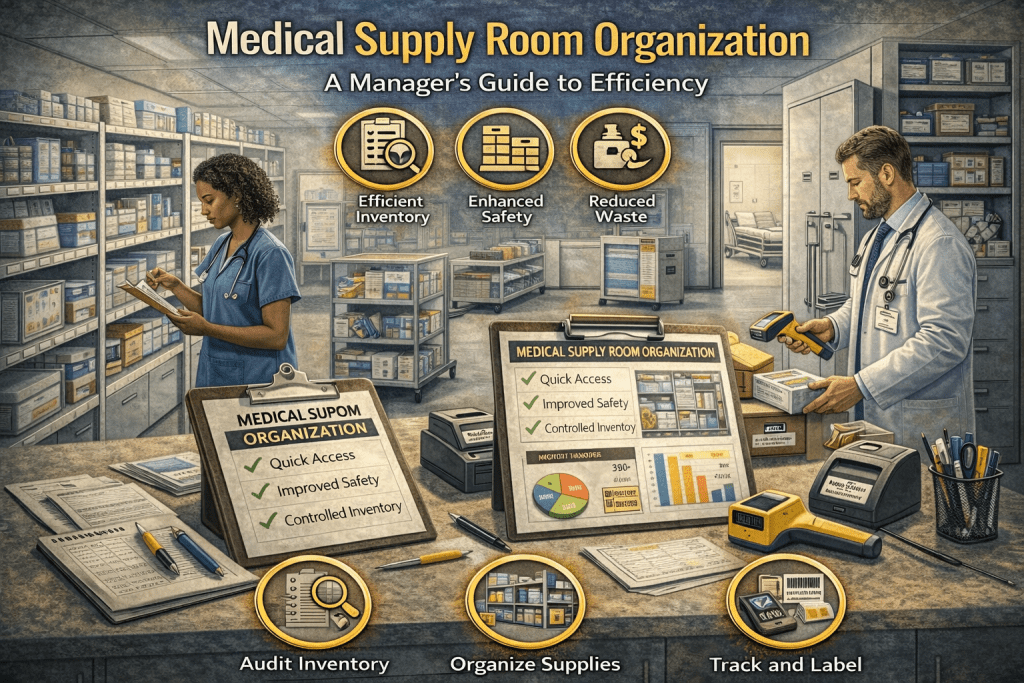
A well-organized medical supply room is more than just a tidy space—it’s the backbone of an efficient healthcare facility. It’s about systematically arranging supplies and equipment to maximize efficiency, bolster safety, and cut down on waste. At its core, a smart layout with proper shelving and clear inventory systems gives your staff quick access to critical items, which is a direct line to better patient care and smoother operations.
The Hidden Costs of a Disorganized Medical Supply Room
A chaotic supply room isn’t just an eyesore; it’s a serious operational and financial liability. When staff can’t find what they need, a ripple effect begins, compromising patient safety, draining your team’s energy, and inflating your budget. What seems like a minor inconvenience—a few minutes hunting for a specific catheter or bandage—quickly snowballs into a major systemic problem.
This operational drag hits your most valuable asset the hardest: your clinical staff. Nurses and technicians are forced to waste precious minutes digging through clutter instead of being with their patients. This not only fuels stress and burnout but also introduces delays in care that can have serious consequences. A well-organized room, on the other hand, empowers your team to work confidently and efficiently, boosting morale and letting them focus on what they do best.

The Financial Impact of Inefficiency
The financial toll of poor organization is staggering. Without a clear system, supplies get over-ordered “just in case,” leading to mountains of excess inventory that expires on the shelf. This isn’t a small problem. One study revealed that major U.S. hospitals discard unused surgical supplies valued at $15.4 million annually per facility. That figure throws a harsh spotlight on the severe financial drain of inefficient inventory control. You can dive deeper into the data with this in-depth research on medical product disposal.
By implementing a structured medical supply room organization plan, facilities can often reduce inventory search times by up to 40-50%, directly translating to recovered staff hours and improved operational throughput.
Unseen Risks and Compliance Issues
Beyond the direct financial losses, disorganization opens the door to significant compliance and safety risks. Expired products might be used on patients by mistake. The inability to find emergency supplies in a critical moment could be catastrophic. And let’s not forget that proper storage means adhering to strict standards for sterile goods, which demand specific environmental controls and separation from non-sterile items.
Tackling your medical supply room organization addresses these hidden costs head-on. It turns a chaotic space into a strategic asset that supports your facility’s mission of providing excellent care while maintaining financial health. Recognizing these consequences is the first step toward building a better system. As the demand for healthcare services grows, optimizing every corner of your operation—starting with the supply room—is no longer an option. The opportunity to improve efficiency and avoid future installation delays is available now, and delaying only means more financial loss and operational friction.
Get a Clear Picture: Auditing Your Current Space and Inventory
Before you can build a better system, you need an honest, unfiltered look at your current reality. A thorough audit isn’t just a preliminary step; it’s the foundation for any successful medical supply room overhaul. This is where you move past assumptions and gather hard data that will inform every single decision, from the layout you design to the shelving you buy.
The process kicks off with a detailed physical inventory count. This is more than just tallying boxes. You’re trying to understand the lifecycle of your supplies. The goal is to clearly separate the high-turnover items you use daily from the supplies that might sit on a shelf for months. This data is the key to creating an intelligent, efficient layout later on.
Measure the Physical Space
Once you have a grip on what you’re storing, turn your attention to the room itself. Get out the tape measure and document everything: the full dimensions of the space, ceiling height, and the exact locations of doors, windows, support columns, or any fixed equipment. Don’t just get the total square footage; calculate the usable storage capacity of your existing shelves and cabinets.
Many facilities are shocked to discover a huge gap between their available space and what they actually need. Documenting this shortfall gives you a powerful argument for investing in space-saving solutions like high-density mobile shelving, which can massively boost your capacity without knocking down a single wall. For a deeper dive, our team has put together a great resource on conducting a comprehensive assessment of your facility’s needs.
Map Your Workflow and Talk to Your Team
An organized room that fights against how your team actually works is completely useless. Spend some time just observing the current flow of supplies. How do things come in? Where do they go? How does staff grab what they need? Mapping this out will immediately highlight the bottlenecks, like congested aisles or high-use items tucked away in the back corner.
The most valuable insights almost always come from the clinical staff using the supply room every day. They know what’s frustrating, what’s inefficient, and what would genuinely make their jobs easier.
Pull your nurses, techs, and other staff aside and ask them about their biggest headaches with the current setup. Their firsthand feedback is gold. It helps you design a user-focused room that solves real problems, not just theoretical ones. This collaborative approach also builds buy-in, ensuring a smoother rollout when it’s time for the changes to happen.
Your Go-To Audit Checklist
A structured approach makes sure you don’t miss anything important. Use this checklist to guide your audit and ground your new design in the day-to-day operational reality of your facility.
- Inventory Deep Dive:
- Categorize everything (e.g., disposables, instruments, PPE).
- Pinpoint high-turnover vs. slow-moving supplies.
- Log expiration dates to get a handle on waste.
- Space Evaluation:
- Measure room dimensions (Length x Width x Height).
- Calculate current storage capacity in cubic feet.
- Identify all underused vertical space—this is your hidden opportunity.
- Specialty Storage Needs:
- Map out areas for sterile vs. non-sterile storage.
- List any supplies needing temperature or humidity control.
- Security Assessment:
- Identify all high-value equipment and controlled substances.
- Review current access controls and security weak points.
Finishing this audit gives you the blueprint for change. For a professional evaluation and a path forward, Request a Quote from our team. We offer free layouts and designs with no obligation.
Designing a Layout for Optimal Workflow
With your audit complete, you have the data you need to design a medical supply room that works for your team, not against them. A thoughtful layout is more than just fitting everything in; it’s about creating an intuitive, efficient, and safe environment that minimizes staff movement and slashes search times. The whole process starts by mapping the natural flow of supplies, from receiving to dispensing.
The goal is to establish dedicated zones that guide staff logically through the space. Imagine a clear path: supplies arrive at a receiving zone, are processed and moved to the appropriate storage area, and are then easily accessed from a dispensing or “pick” zone. This zoned approach prevents cross-contamination of sterile and non-sterile goods and eliminates the chaotic traffic jams that plague disorganized rooms.
This infographic breaks down the foundational audit process that informs a great layout.
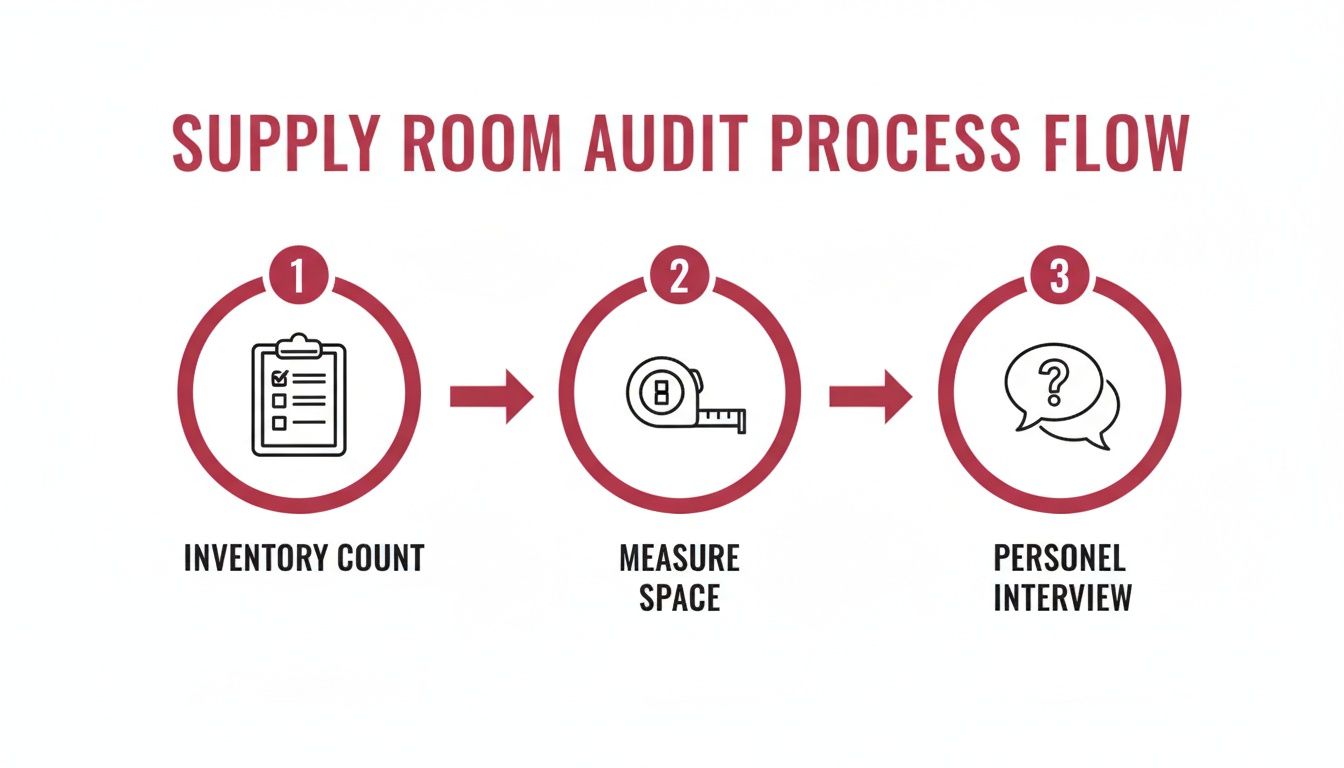
As you can see, a successful layout is built on the pillars of inventory analysis, spatial measurement, and—most importantly—staff consultation.
Strategic Placement for Maximum Efficiency
Where you put your supplies within this new layout is everything. Your inventory audit should have identified the high-turnover items—the gloves, gauze, and saline solution your team grabs constantly. These need to be placed in the most accessible locations, like near the entrance or in a dedicated rapid-access zone, to cut down travel time for routine tasks.
Conversely, less-frequently used or bulk items can be stored in more distant areas or on higher shelves. It’s a simple principle: place items based on usage frequency. This dramatically improves workflow. For a deeper dive, check out these efficient layout strategies; the design principles used in professional kitchens translate surprisingly well to a medical setting.
A well-designed flow isn’t just a convenience; it’s a productivity multiplier. Facilities that optimize their supply room layout often see a significant reduction in wasted motion and a corresponding boost in staff efficiency and morale.
Vertical Space and Layout Configurations
When floor space is limited, the only way to go is up. Maximizing vertical space is one of the most effective ways to increase storage capacity. Solutions like tall shelving units or even structural mezzanines can effectively double your storage footprint without an expensive expansion. This is a game-changer in older facilities that often have high ceilings but constrained square footage.
Different room shapes also lend themselves to specific layouts. Each has its own benefits:
- Linear Flow: This is perfect for long, narrow rooms. Supplies enter at one end, move through storage zones in the middle, and are dispensed at the other. Think of it as a clear, assembly-line-style process.
- U-Shaped Flow: Best for more square-shaped rooms, this layout puts receiving and dispensing zones near each other, with storage along the three walls of the “U.” This design minimizes the distance staff need to travel between key tasks.
Designing the perfect layout can feel complex, but you don’t have to do it alone. The right plan can transform your operations. Our team provides free layouts and designs with no obligation. Request a Quote or Call (800) 326-4403 to see how we can help you visualize and implement a layout that truly works.
Selecting the Right Shelving and Secure Storage
The physical hardware you choose is the backbone of your entire supply room strategy. Getting the shelving and secure storage right isn’t just about finding a place to put things; it’s a serious investment in staff efficiency, patient safety, and regulatory compliance. The choices you make here directly impact how fast your team can find supplies, how well sterile items are protected, and how secure your high-value inventory is.
A classic mistake is thinking all shelving is created equal. It’s not. The needs of a lab storing chemical reagents are a world away from a surgical suite that depends on mobile, sterile-friendly carts. Material choice is a perfect example. For sterile environments, you’ll almost always see stainless steel or specific polymer shelving because of its non-porous surface and ability to stand up to harsh cleaning agents.
Matching Shelving Types to Supply Needs
The guiding principle is simple: match the storage solution to the item.
Open wire shelving, like the popular Metro-style systems, is a fantastic choice for many sterile supplies. Its design promotes critical airflow, helping maintain environmental standards and cutting down on dust. This isn’t just a “nice-to-have”—it’s a key consideration for staying compliant with industry standards.
When planning your storage, remember that improper handling and storage can force facilities to discard or resterilize supplies, which drives up operational costs and creates unnecessary waste. The right equipment is your first line of defense.
For all those small, high-turnover items, think modular bins paired with louvered panels or rail systems. They let staff quickly grab exactly what they need without digging through big, disorganized boxes. Of course, for your heavy or bulk items, you’ll need to spec out industrial-grade steel shelving with higher weight capacities to guarantee safety and stability.
Maximizing Your Footprint with High-Density Solutions
Most facilities are fighting a constant battle for space. You’re asked to store more inventory in the same, or even smaller, footprint. This is where high-density mobile shelving becomes a game-changer. These systems put shelving units on wheeled carriages that glide along floor tracks, letting you compact aisles and practically double your storage capacity.
By getting rid of the need for a dedicated aisle for every single row of shelving, you reclaim a massive amount of floor space. While it’s a bigger initial investment, the long-term return in space optimization is huge, especially where real estate is at a premium.
Securing High-Value and Controlled Substances
No supply room plan is complete without thinking about security. High-value equipment, pharmaceuticals, and controlled substances simply cannot be left on open shelves. This demands dedicated, secure storage.
Here’s a quick breakdown of your most common options:
| Storage Type | Primary Use Case | Key Features |
|---|---|---|
| Security Cages | Securing large equipment, bulk supplies, or creating a controlled access zone within a larger room. | Open wire mesh for visibility and airflow; heavy-duty locking mechanisms. |
| Locking Cabinets | Storing controlled substances, pharmaceuticals, and smaller high-value items. | Solid steel construction for maximum security; often available with different lock types. |
| Mobile Security Carts | Transporting and securing supplies between the main supply room and point-of-use locations. | Lockable doors, durable casters for mobility, wire or solid construction. |
For specialized applications, options like Hallowell Medsafe Cabinets offer features built specifically for healthcare, including heavy-gauge steel and secure locking systems that are critical for compliance and loss prevention.
Investing in the right mix of quality materials and secure storage transforms your supply room from a cluttered closet into a high-functioning logistical hub. Our team specializes in creating these systems. We provide free layouts and designs to help you visualize the most effective combination of solutions for your unique needs. Contact Us or Call (800) 326-4403 to discuss your project.
Mastering Your Inventory with Smart Management Practices
Once you’ve got the physical layout and shelving dialed in, it’s time to focus on the brains of the operation: your inventory management system. This is what keeps the chaos from creeping back in. Think of it as the set of rules that governs how supplies move, ensuring everything is used efficiently, waste is cut down, and you never run out of critical items.
A perfectly organized room means nothing if there aren’t clear protocols for tracking and restocking. These aren’t just systems for huge hospitals; they’re scalable practices that bring predictable order to any facility, big or small. The goal is to shift from last-minute, reactive ordering to a proactive, data-driven approach that protects both your patients and your budget.
Core Inventory Control Methods
Two simple but incredibly powerful methods form the bedrock of any solid medical inventory system: First-In, First-Out (FIFO) and the two-bin system.
Implementing FIFO is completely non-negotiable. This practice ensures that the oldest stock gets used before newer items, which is absolutely critical for anything with an expiration date. To make it work, train your team to place new deliveries at the back of the shelf, pushing the older stock to the front where it’s grabbed first. It’s a simple habit that prevents costly waste.
The two-bin system is a brilliantly simple, visual way to manage restocking for high-turnover, low-cost supplies like gauze or alcohol wipes. Each item gets two identical bins. Staff take supplies from the front bin until it’s empty. That empty bin then gets moved to a specific reorder area, signaling it’s time to restock, while the team starts using the second bin. It’s a nearly foolproof visual cue that makes stockouts a thing of the past.
For those looking to automate this process, technology like an RFID-based medical inventory alert system can take it to the next level.
Develop a Clear and Consistent Labeling Strategy
Your inventory system is only as good as its user interface—and in a supply room, that’s your labels. A strong labeling strategy means anyone, from a new hire to a seasoned veteran, can find what they need in seconds.
Here are a few techniques that work wonders:
- Color-Coding: Assign colors to entire categories. For example, blue for respiratory supplies, red for first aid, and green for wound care. This allows staff to navigate to the right section of the room instantly, even from a distance.
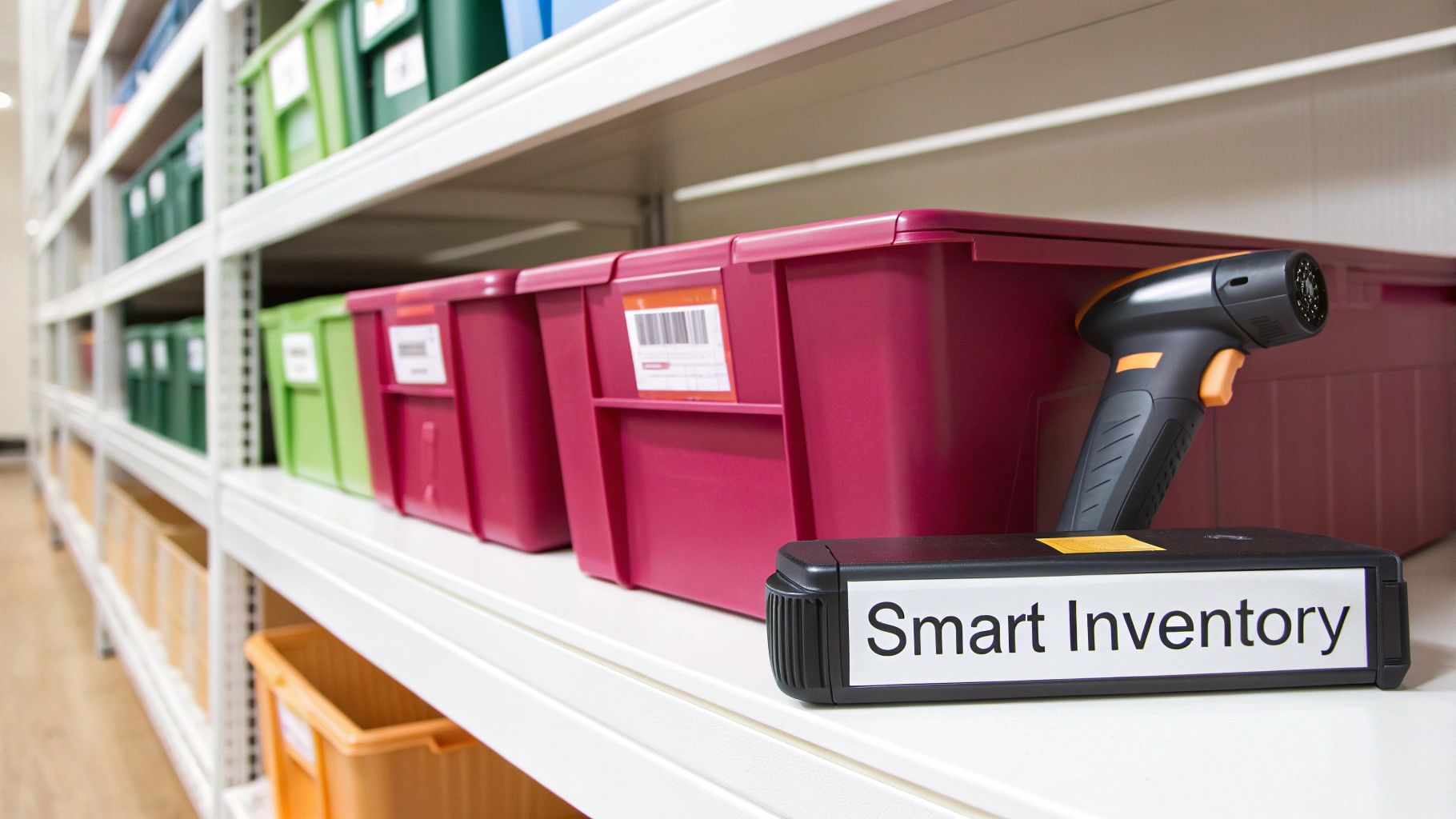
- Barcoding: This is a game-changer for accuracy. Barcode labels for every item and even the shelf locations themselves. Scanning items as they’re used can trigger automatic reorders and give you incredible data on your true usage patterns.
- Clear Text: Every label needs the item name, product number, and expiration date in a large, easy-to-read font. Ditch the confusing jargon or internal abbreviations that only a few people understand. Clarity is key.
By putting these inventory practices into place, you’re building a system that’s not just organized, but resilient. Our team can help bake these practices right into your free layout design. Request a Quote to see how we can get you started.
Ready to Build Your High-Efficiency Supply Room?
Moving from a cluttered, inefficient supply closet to a purpose-built, organized system is a game-changer. The payoff isn’t years down the road; it’s immediate. You’ll see real savings in operational costs, a noticeable boost in staff productivity, and a direct, positive impact on patient safety.
Deciding to tackle this project now means you get ahead of the curve. You can lock in faster installation timelines and sidestep the supply chain disruptions and construction backlogs that delay so many facility upgrades.
This isn’t just about getting organized; it’s about giving your team the tools they need to succeed, especially as facilities are constantly pushed to do more with less. A well-planned project, executed quickly, allows for proper training and a seamless transition for your clinical staff. They can start enjoying an optimized workflow right away instead of fighting a frustrating system for another quarter.
We’re More Than a Supplier—We’re Your Partner
At Material Handling USA, we get it. We understand the specific challenges you face in a healthcare environment, from maintaining strict sterility standards to securing high-value equipment and medications.
Our approach is built on providing durable, high-quality products designed for the rigors of a medical facility, all backed by competitive pricing and the industry’s fastest shipping. We don’t just sell shelves and cabinets; we engineer complete, turn-key solutions.
Our expert team is ready to provide a free, no-obligation design consultation to help you map out the ideal solution for your specific needs and space.
Taking that first step with a professional consultation is the smartest move you can make. It ensures your investment is based on a solid, data-driven plan, not guesswork. This prevents costly changes down the road and aligns your new storage infrastructure with your facility’s long-term goals.
This is where the real work begins. We’ll collaborate with your team to analyze inventory, map out workflows, and select the perfect mix of high-density shelving, mobile systems, and secure storage to maximize every square foot of your space and budget. The result isn’t just a supply room—it’s a strategic asset.
Don’t let another day of inefficiency drain your resources and frustrate your staff. It’s time to move toward a more organized, compliant, and productive operation. Our specialists are on standby to help transform your space.
Start your free design process today.
Call (800) 326-4403 or Request a Quote online.
Frequently Asked Questions
Planning a major supply room overhaul always brings up a lot of questions. Here are some of the most common things managers and buyers ask, with practical answers to help you get your project moving.
How do I determine the right shelving for different medical supplies?
Choosing the right shelving isn’t a one-size-fits-all deal; it’s about matching the storage to the supply. Think of it like using the right tool for the job.
For your heavy, bulk items like cases of saline or boxes of gowns, you absolutely need industrial-grade steel shelving that can handle the weight without buckling. Then you have your sterile supplies that need airflow to prevent dust and moisture—that’s where classic Metro-style wire shelving is the undisputed champ. For small, high-turnover items, modular bins on louvered panels or high-density mobile shelving systems are a game-changer. And of course, anything high-value or controlled requires lockable cabinets or secure wire cages. No exceptions. Our team can walk you through the best mix of these quality products during a free design consultation.
What is the first step to reorganize a cluttered supply room?
Before you order a single shelf or bin, the most critical first step is a full-scale inventory audit and declutter. You simply cannot organize what you don’t need.
Start by sorting every single item into three piles: keep, discard (for expired or damaged goods), and relocate. This process immediately clears out the junk. More importantly, it gives you a true, real-world picture of what you actually need to store. Only after you know your real inventory can you start planning a smart layout and picking the right hardware.
How can I get buy-in from my staff and management?
Getting everyone on board means framing the project around what matters to them. For your clinical staff, talk about ending the daily scavenger hunts and emphasize how an organized system saves them precious minutes on every shift—time they can give back to patient care.
For management, it’s all about the numbers and the return on investment (ROI). Arm yourself with data. Show them the real cost savings from cutting down on expired product waste, slashing expensive rush orders, and boosting overall staff productivity. Our free quotes and layout designs are perfect for this, giving you concrete figures and visuals to build a powerful business case.
How long does it typically take to receive and install new storage systems?
The timeline really depends on the scale of the project and what you’re ordering. The good news is that at Material Handling USA, we pride ourselves on having the fastest shipping and delivery in the industry for a huge number of our in-stock items.
Naturally, custom solutions or larger projects will have a longer lead time. The key is to start the conversation early. Kicking off the planning process with one of our specialists now will make for a much smoother, faster installation down the road and help you sidestep those common delays that can bring facility upgrades to a halt.
Ready to turn your medical supply room into a model of efficiency? The team at Material Handling USA offers complimentary design services to help you plan the perfect solution.