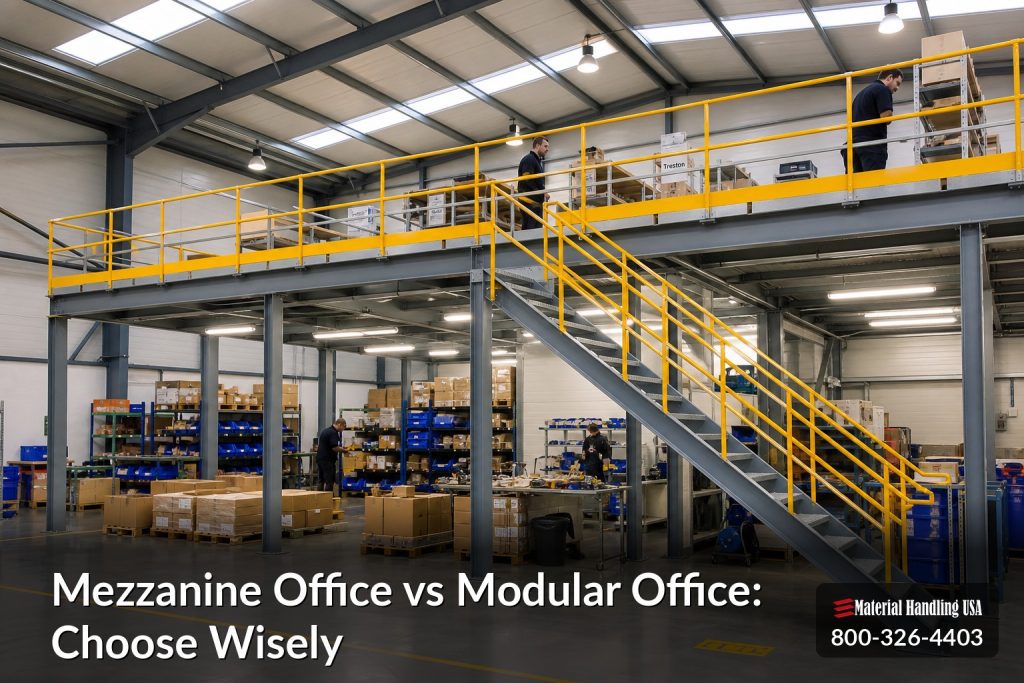
Mezzanine Office vs Modular Office: Choose Wisely
When a warehouse runs out of office space, the problem usually isn't just square footage. It's disruption. You still need supervisors close to the floor, admin staff in a usable workspace, and room for future changes, but you don't want a long buildout that interrupts shipping, production, or inventory flow.
That is why buyers keep comparing mezzanine office vs modular office options. Both solve real space problems inside active facilities. Both can be faster and simpler than conventional construction. But they solve different problems well.
A mezzanine office helps when floor space is too valuable to give up. A modular office helps when speed, enclosure, and future relocation matter most. The wrong choice can create aisle conflicts, poor access, or a layout that works for six months and becomes a headache after that.
Choosing Your Next Warehouse Office An Introduction

Most facility managers start in the same place. They need office space now, but they also need to protect throughput, preserve storage capacity, and avoid a project that drags on. In a busy building, every office decision affects travel paths, forklift visibility, staging areas, and who can work where during installation.
A mezzanine office is often the first answer when the building has height to spare. It uses vertical space instead of taking up more floor area, which is why many teams looking at warehouse mezzanine systems start there first. A modular office is usually the faster route when you need a clean enclosed room built within your existing footprint.
Practical rule: If your operation is already fighting for floor space, start by asking whether the air above you is more useful than the concrete below you.
The decision is not only build up versus build within. It is also how each option affects operations during installation, how easy it is to expand later, and whether the office will still fit your workflow years from now.
Understanding the Two Core Solutions

A mezzanine office is an enclosed office built on a raised structural platform inside an existing building. In plain terms, it lets you build up instead of out. That is a strong fit in warehouses and plants with clear height available over storage, packing, or production support areas.
The market reflects that demand. The mezzanine floor market is projected to grow from USD 8.8 billion in 2025 to USD 15.8 billion by 2035, driven by vertical space optimization in warehousing and manufacturing, according to Future Market Insights on the mezzanine floor market.
What a mezzanine office does well
A mezzanine office works best when you need to preserve floor space and improve oversight of operations. Upper-level offices are common for supervisors, quality control, production support, and admin teams that need visual connection to the floor.
It can also support mixed use planning. Some facilities use the platform itself for office use, while others combine office space with storage or circulation below and around it.
What a modular office does well
A modular office is a prefabricated enclosed structure assembled inside your facility. It is designed for speed, clean installation, and easier future reconfiguration. If you need an enclosed room on the plant floor, a modular office system usually gives you the most direct path.
According to Microflex Space's modular office overview, modular office installations can cut timelines by 30 to 50 percent, with typical installation in 2 to 4 months versus 6 to 12+ months for conventional builds. The same source notes construction waste can be under 10 percent compared with up to 30 percent in traditional methods, and modular office systems can scale from 200 square feet to over 30,000 square feet.
A modular office is usually easier to justify when the business values quick enclosure, easier relocation, and less commitment to a fixed long-term layout.
Side-by-Side Comparison Mezzanine Office vs Modular Office
The biggest mistake in a warehouse office comparison is treating these systems as interchangeable. They are not. One is a structural platform strategy. The other is a prefabricated enclosure strategy.
| Factor | Mezzanine Office | Modular Office |
|---|---|---|
| Floor space impact | Preserves more ground-level space by using overhead volume | Uses existing floor area inside the building |
| Vertical space use | Excellent fit for high-clearance buildings | Limited unless paired with another structure |
| Installation time | Depends on structural design, site conditions, and access | Often faster than conventional construction because units are prefabricated |
| Flexibility | Flexible, but usually more tied to the original layout and elevation plan | Strong fit for future reconfiguration or relocation |
| Disruption to operations | Can affect access, lift paths, and staging during steel installation | Can reduce major construction activity, but still requires planning for utilities and workflow |
| Expansion options | Can support office, circulation, and in some cases storage-focused platform use | Can expand by adding or reworking modular sections |
| Ideal use case | Facilities that need office space without giving up valuable floor area | Facilities that need a fast enclosed office buildout on the floor |
| Budget range | Varies by platform size, loads, stairs, engineering, and finishes | Varies by enclosure size, wall system, utilities, and interior features |
Where the structural difference matters
Load capacity is one of the clearest technical differences. According to Cassone's review of modular mezzanine systems, mezzanine systems can support 80 to 125 PSF for office use and over 500 PSF for heavy storage. By contrast, modular offices are typically engineered for occupancy loads of 40 to 50 PSF.
That matters if your plan includes more than desks and people. If you may want inventory, files, equipment, or dual-purpose platform use, the mezzanine office system has a different structural role than a modular in-plant office.
What the table doesn’t show
A modular office often wins the first conversation because it feels simpler. A mezzanine office often wins the second conversation because the layout impact is lower over time. Good planning means testing both against your aisle layout, ceiling height, access points, and future headcount.
Strategic Use Cases When to Choose Which System

Some choices become clear when you look at the facility, not the product sheet.
Choose a mezzanine office when floor space is the priority
If your warehouse needs office space without losing pick faces, staging lanes, or equipment parking, a mezzanine office usually makes more sense. This is especially true in high-ceiling buildings where the unused upper volume is doing nothing for the operation.
It also fits teams that want supervisors above the floor with clear visibility. In many plants, that line of sight improves communication and response time more than a ground-level office tucked behind racking.
Choose a modular office when speed and future change matter most
If you need a quiet enclosed office added near production, shipping, or receiving, a modular office is often the cleaner answer. It is also a good fit in leased spaces, or in operations that expect to move, expand, or rework the layout later.
A hybrid option can also make sense. Some facilities place a modular building on a raised structure when they need enclosure plus height, as shown in this modular building installed on top of a mezzanine.
In-plant office comparison gets easier when you ask one blunt question. Do you need to save floor space, or do you need to save project time?
Common decision scenarios
- A warehouse is out of room at floor level: A mezzanine office usually deserves the first look.
- A facility needs supervisor space near production: Either system can work. The tie breaker is whether visibility or speed matters more.
- An operation needs a fast enclosed office buildout: A modular office often fits better.
- A buyer is deciding whether to build up or build within existing space: Start with ceiling height, aisle constraints, and long-term workflow.
- A facility may relocate the office later: Modular usually has the edge.
- A company is planning around ceiling height and workflow: Mezzanine wins only if the building height and circulation plan support it cleanly.
Your 6-Step Decision Checklist for a New Warehouse Office

Use this checklist before you ask for pricing. It helps prevent a quote on the wrong concept.
- Assess space needs. Define who will use the office, what functions must happen inside it, and whether that need is likely to grow.
- Check vertical versus horizontal space. If the floor is crowded but the building has height, a mezzanine office moves up the list.
- Look at future flexibility. If you may reconfigure departments or relocate later, modular often stays easier to work with.
- Compare timeline and project complexity. Modular offices can install faster than conventional construction, but every facility still needs utility and access planning.
- Model operational impact. MH-USA's guidance on modular office planning notes that many comparisons skip the true cost of downtime, safety risks, and production disruption. That hidden cost can change which option delivers better total ROI.
- Review compliance and fit-out details. Stairs, railings, utilities, HVAC, egress, and local code review all need to be part of the early plan.
If you're building an internal evaluation sheet, this outside resource is useful too: Constructive-IT's office fit-out checklist. It is not warehouse-specific, but it helps teams organize planning questions before final design.
Watch for this: The cheapest-looking option can become the more expensive one if it blocks travel paths, forces utility rerouting, or creates install-day conflicts with production.
Frequently Asked Questions
Is a mezzanine office better than a modular office
Not in every facility. A mezzanine office is often better when ground space is tight and the building has usable height. A modular office is often better when speed, enclosure, and future relocation matter more.
Which warehouse office is better for fast installation
Modular offices are commonly chosen for faster installation because much of the work is prefabricated. Actual timing still depends on utilities, approvals, and site access.
Can a mezzanine office support storage too
It can, depending on how the system is engineered. That is one reason mixed-use planning often starts with structural load review.
Do both options need utilities
Yes. Electrical, lighting, data, HVAC, and sometimes fire protection all need planning. Utility routing is one of the first things that should be reviewed during layout development.
Which option causes less disruption
There is no universal answer. Both can be installed while operations continue, but disruption depends on staging area, access routes, noise, lift activity, and how the project is phased.
Are these systems customizable
Yes. Buyers usually customize room size, window placement, doors, finishes, and utility packages. The right level of customization depends on how permanent the office needs to feel.
What if the office may need to move later
That usually pushes the decision toward a modular office. Relocation and reconfiguration are major reasons buyers choose prefabricated office systems.
Can a facility use both
Yes. Some operations use a mezzanine for space efficiency and place enclosed modular rooms within the overall plan where privacy or environmental control is needed.
Next Steps Design Your Ideal Warehouse Office with MH-USA
The right answer in a mezzanine office vs modular office decision comes from layout, workflow, and long-term flexibility, not from a generic pros and cons list. If floor space is under pressure, mezzanine-supported office space often leads. If speed, enclosure, and future relocation are bigger priorities, modular usually moves ahead. Planning earlier usually gives teams better layout choices, smoother installation windows, and fewer avoidable delays as demand for warehouse office solutions stays active.
For help comparing a prefabricated modular building with a mezzanine-supported office layout, Contact Us for free layouts and designs with no obligation, a free quote, and project support from sizing through installation coordination. You can also Request a Quote, email Sales@MH-USA.com, or Call (800) 326-4403 to discuss availability, competitive pricing, and fast shipping and delivery.