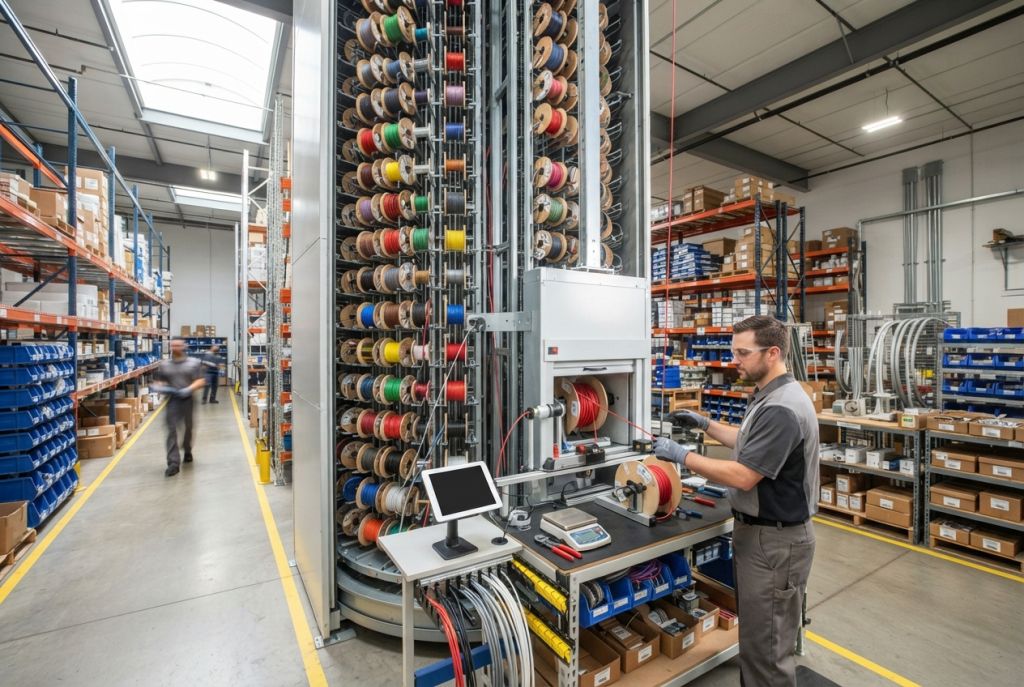
If you're comparing a Vidir wire spool carousel vs reel rack, you're probably already feeling the pressure somewhere on the floor. The wire area is crowded. Operators spend too much time walking, reaching, and searching. Heavy spools create safety concerns, and every extra rack row eats space you could use for staging, assembly, or shipping.
That decision usually starts as a storage question, but it doesn't stay there for long. It turns into a throughput question, a labor question, and eventually a total cost of ownership question. A reel rack is the familiar option. A Vidir wire spool carousel is a motorized vertical retrieval system that changes the workflow itself.
Choosing Your Ideal Wire Storage Spool Carousel vs Reel Rack
In most facilities, the wire area grows one urgent purchase at a time. A few more reels come in, another rack section gets added, then someone carves out a little more aisle space. Over time, the area works, but only in the loosest sense of the word. People know where things are because the same few employees have memorized it.
That setup is where the actual comparison begins. A traditional reel rack stores spools in a simple, visible format. A Vidir wire spool carousel stores them vertically and brings the selected reel down to the operator at a safe access point through a goods-to-person workflow, as described in MH USA's overview of wire spool carousel vs wire reel rack.

Here is the early decision filter buyers usually need:
| Criterion | Vidir Wire Spool Carousel | Traditional Reel Rack |
|---|---|---|
| Access method | Machine presents the spool | Operator walks to the spool |
| Space use | High-density vertical storage | Horizontal rack footprint |
| Labor style | Goods-to-person | Walk-and-pick |
| Upfront complexity | Higher | Lower |
| Best fit | Frequent picking, dense inventory, tighter floor plans | Lower activity, simpler handling, budget-first projects |
Practical rule: If wire is a core part of your daily operation, storage method affects more than organization. It affects how people work every shift.
The right answer depends less on what looks efficient on paper and more on how your team issues, moves, and controls spooled inventory.
When Do Standard Wire Reel Racks Make Sense
A reel rack still makes sense in plenty of operations. Buyers sometimes assume that if automation exists, manual storage must be obsolete. It isn't. In the right environment, a reel rack is the smarter purchase.
The biggest reason is straightforward. A reel rack is simpler to buy, install, understand, and maintain. If your wire inventory is limited, your pick frequency is moderate, or your team needs direct visual access to each spool, that simplicity has real value.

Where reel racks perform well
- Low-volume storage: If operators don't access wire constantly, the labor savings from automation may not justify the added system cost.
- Stable SKU counts: A small, predictable wire assortment is easier to manage on open racking.
- Visual verification: Some teams want to see every spool immediately, especially in environments where manual confirmation is part of the routine.
- Basic budget planning: A rack is often easier to fit into a near-term capital budget when the project priority is simple storage, not workflow redesign.
What a reel rack does not solve well
A reel rack doesn't change the labor model. Staff still travel to the inventory. They still reach, pull, and manually identify what they need. As reel counts grow, the rack layout tends to sprawl. That can work for a while, but it usually becomes less efficient as the operation gets busier.
Open racking works best when the process around it is already lean. If the process is disorganized, a rack won't fix that. It only stores the problem more neatly.
For smaller shops, maintenance departments, and lower-velocity stockrooms, that's often acceptable. For high-activity operations, it usually isn't.
How Vidir Wire Spool Carousels Transform Operations
The strongest case for a carousel starts with floor space. Vidir states that its wire spool carousel can recover up to 70% of floor area compared with conventional cable reel storage, and some sources describe footprint reduction as high as 80% by consolidating numerous racks into one automated unit, according to Vidir's wire carousel product information.
That space recovery matters because it changes what a facility can do next. You can open up aisles, create better staging lanes, reduce congestion near pick zones, or postpone the need to rework other parts of the building.

The workflow change is the real value
A carousel isn't just denser storage. It's an operational shift. Instead of an operator walking the aisle, climbing, reaching, or coordinating extra handling equipment, the system rotates the selected spool to a safe working height.
That changes several things at once:
- Labor use becomes more focused: Workers spend less time searching and more time issuing or dispensing material.
- Safer retrieval becomes part of the process: The system reduces ladder use and overhead access.
- Inventory control gets tighter: Specific SKU retrieval is more disciplined when the machine presents the correct location.
For operations with frequent wire handling, those workflow gains often matter more than the footprint reduction. That's where a motorized wire spool carousel fits best. It supports environments where wire isn't just stored, but regularly picked, dispensed, and tracked.
Where the carousel earns its keep
The carousel tends to make the most sense when wire is tied directly to production output, service turnaround, or order fulfillment. Manufacturing plants, electrical distributors, and high-mix stockrooms usually feel the difference fastest because every extra touch on a spool has a labor cost attached to it.
Field observation: Facilities rarely regret adding density. They do regret buying manual storage when their real problem was retrieval time.
The trade-off is clear. You spend more upfront for a system that does more than hold inventory. It retrieves it, presents it, and compresses the storage footprint into a smaller operating envelope.
Wire Carousel vs Reel Rack A Direct Comparison
When buyers compare these systems seriously, the conversation usually shifts from purchase price to total cost of ownership. That's the right move. A lower initial cost can still be the more expensive choice if it locks you into slower picking, more manual handling, and wasted floor area.
Wire Spool Carousel vs. Reel Rack at a Glance
| Criterion | Vidir Wire Spool Carousel | Traditional Reel Rack |
|---|---|---|
| Storage approach | Vertical automated storage and retrieval | Static horizontal storage |
| Footprint impact | Designed to consolidate wire into a smaller area | Requires more floor area as inventory expands |
| Access | Push-button retrieval to operator position | Manual access by worker |
| Labor profile | Less walk-and-pick activity | More travel and manual handling |
| Safety profile | Safer ergonomic access point | More reaching, lifting, and possible ladder use |
| Visibility | Controlled retrieval by selected position | Open visual view of reels |
| Best economic fit | Higher-throughput operations | Lower-throughput operations |
| Purchase complexity | More planning required | Easier to implement quickly |
The carousel's hard specs matter
One commercial listing reports that a Vidir Wire Carousel can hold up to 36 wire spools, handle spools with a maximum diameter of 30 inches, support 13,000 pounds total capacity, and retrieve at 21 feet per minute, as detailed in this Vidir Wire Carousel specification listing.
Those numbers are useful because they show the carousel isn't a light-duty organizer. It's a storage and retrieval system designed for serious spool handling.
Cost isn't just what you pay to install
A reel rack usually wins on initial simplicity. Less equipment. Fewer moving parts. Faster approval in budget meetings that focus on immediate capital outlay.
But TCO isn't just equipment cost. It includes questions like these:
- How much labor is spent walking and searching?
- How much floor space is tied up in static storage?
- How often do operators handle reels in awkward positions?
- What happens when the inventory grows again next year?
A carousel often makes more financial sense when labor is expensive, floor space is constrained, or SKU control matters. A rack often makes more sense when access frequency is lower and the process around the storage is already simple.
Inventory control and handling discipline
Open racks make visual checks easy. That's useful. But they also depend heavily on operator consistency. In busy environments, that can lead to misplaced reels, partial reels drifting into the wrong locations, and more time spent validating stock physically.
A Vidir wire carousel changes that dynamic by making retrieval more intentional. The machine presents a selected reel rather than leaving every reel open to constant traffic. For many facilities, that doesn't just improve organization. It improves issue discipline.
Buyers often ask which system is better. The better question is which system reduces the most expensive form of waste in your operation.
If wasted space is the pain point, the answer may be obvious. If labor consistency or inventory control is the bigger issue, the carousel often gains ground quickly.
Selecting the Right System for Your Industry
The right storage method depends on how wire moves through your operation, not just where it sits between uses. Industry fit matters because retrieval frequency, security needs, and handling practices vary more than most product pages admit.

Electrical distribution and manufacturing
Electrical wholesalers usually benefit from a carousel when the wire room supports frequent order picking across many spool types. Fast access and denser storage help keep service levels up without letting the wire area consume too much floor space.
Manufacturing plants often reach the same conclusion for a different reason. They care less about retail-style picking and more about keeping production fed without tying up people on retrieval tasks.
A Vidir vertical storage solution is relevant when the issue is broader than wire alone and the facility is evaluating vertical storage as part of an overall layout change.
Retail counters and low-activity stockrooms
A rack may be the better fit when staff need constant visual access, when issue volume is modest, or when the operation values low-complexity equipment over denser retrieval. That often applies in smaller retail backrooms, maintenance shops, and branch locations that stock wire but don't handle it in heavy daily volume.
Secure and regulated environments
Many comparisons fall short because most discussions focus on warehouse efficiency. They do not spend enough time on secure or regulated settings.
According to Cisco-Eagle's discussion of wire spool carousel use cases, there is limited guidance on how these systems perform in healthcare, labs, and evidence rooms, where chain-of-custody, contamination risk, and fire-code constraints can matter more than raw density.
That matters because the answer isn't automatic.
- Choose a carousel when controlled access, reduced handling, and organized retrieval support the way your team documents and secures inventory.
- Choose a rack when visual confirmation, straightforward auditing, and passive storage align better with your procedures.
- Pause and review both options when your process depends on strict sign-out controls, restricted personnel access, or environmental separation requirements.
In secure storage, the winning system isn't the one that stores more. It's the one your staff can control, document, and operate reliably.
For those environments, layout planning deserves more attention than the equipment brochure. Clearance, egress, access permissions, and operating procedures need to be reviewed together.
Making the Right Investment in Your Wire Storage
If your operation is low-volume, simple, and budget-driven, a reel rack can still be the right call. If your operation is dense, active, and short on floor space, a Vidir wire spool carousel usually brings a stronger long-term return because it changes retrieval, labor flow, and control.
The mistake is judging the decision by purchase price alone. The better approach is to look at total cost of ownership across space use, labor demands, safety exposure, and inventory discipline. Facilities that plan earlier usually have more flexibility on layout, budgeting, and installation timing, and they avoid forcing the project into a rushed redesign later.
Material handling projects tend to move faster once the floor plan is defined. If you're weighing a reel rack against a carousel, Material Handling USA can help you compare options, review your space, and build a no-obligation layout. Request a Quote, Contact Us, or Call (800) 326-4403 to discuss your wire storage project. If you need standard facility products alongside the storage system, you can also Shop Now or Buy Online through the store.
Related Products & Resources
- security cages — Wire partition security cages for warehouse, server rooms, and evidence storage
- evidence storage solutions — Complete guide to law enforcement evidence room design and storage
Related Solutions