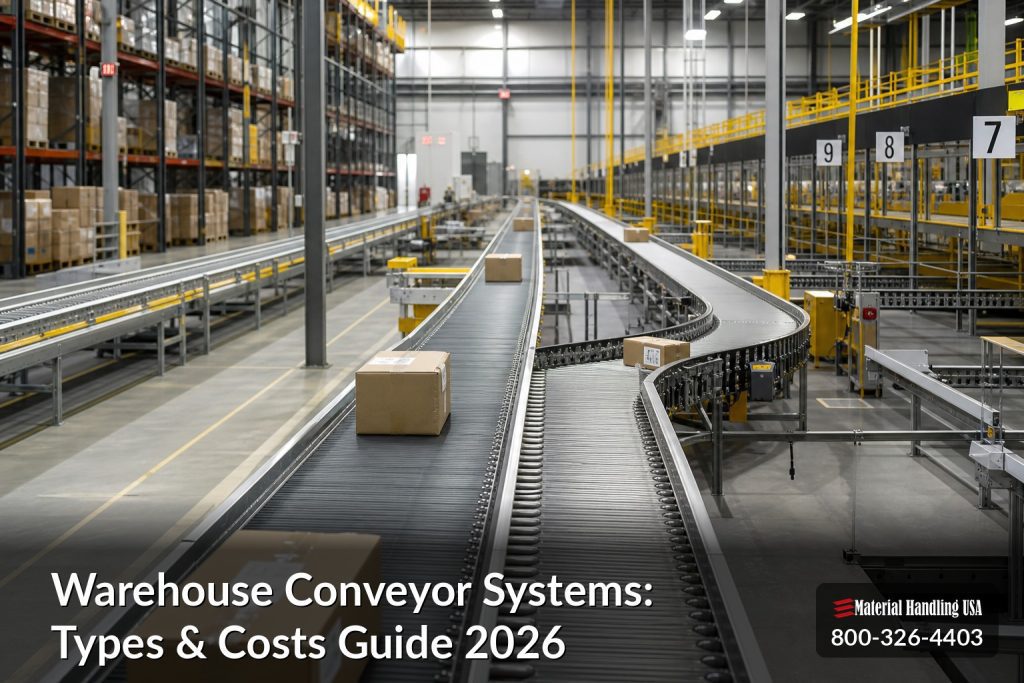
A lot of conveyor projects start the same way. Shipping is backed up, people are carrying cartons too far, pallet movement keeps crossing pedestrian traffic, and every workaround adds another small delay. At that point, warehouse conveyor systems stop being a nice idea and become a layout decision that affects labor, safety, and daily flow.
The best buying advice is simple. Choose the system around your product, your peak load, and your building, not around a favorite conveyor type. A good conveyor layout should reduce touches, support safe movement between zones, and fit the way your warehouse runs today.
Your Guide to Warehouse Conveyor Systems

Conveyors have been shaping industrial flow for a long time. A major milestone came in 1913, when Henry Ford introduced conveyor-belt assembly lines at his Michigan factory, and one industry history source says that change reduced production time for a car from 12 hours to 1 hour and 33 minutes. Conveyor development reached back even earlier, with the modern heavy-duty belt commonly dated to 1892 through Thomas Robbins, followed by steel conveyor belts from Sandvik AB in 1901. That history helps explain why conveyors became core infrastructure for factories, warehouses, and logistics operations, not just a specialty add-on. Those dates are summarized in this history of conveyor belt development.
Today, that importance still shows up in market demand. The global conveyor system market is projected to grow from USD 10.44 billion in 2024 to USD 14.81 billion by 2030, a 6.0% CAGR, according to MarketsandMarkets' conveyor system market projection. For warehouse buyers, the practical takeaway is that conveyors remain a core part of long-term automation investment across supply chains.
Warehouse conveyor systems are more than moving tracks between point A and point B. In a modern facility, they often work as part of a fixed-path transport network using belts, rollers, drives, sensors, and controls. When tied into warehouse control logic, routing, accumulation, and sortation can be coordinated automatically instead of being managed by constant manual handoffs.
Practical rule: A conveyor that moves product well in an open sketch can still fail in a real warehouse if it ignores merge points, operator stations, scan points, and traffic lanes.
If you're comparing options, start with flow. Ask where product enters, where it pauses, where it gets checked, and where labor still has to touch it. That's usually where the right conveyor design earns its value.
Common Types of Warehouse Conveyor Systems

A conveyor type should be chosen by how it fits the work around it. The key question is not "What moves product?" It is "What moves product at the required rate, fits the building, and does not create new problems at packout, inspection, replenishment, or pedestrian crossings?" If you want a broader equipment overview before narrowing the design, review our full range of conveyor solutions.
Belt conveyors
Belt conveyors carry loads on a continuous belt and give the product full support. They are usually the right answer for small cartons, polybags, irregular packages, and any item with a bottom surface that would chatter or skew on rollers.
They also help when product presentation matters. In packing, labeling, and manual induction areas, a belt keeps spacing and orientation more predictable. That reduces jams at scan tunnels, weigh stations, and transfers. The trade-off is cost and maintenance. Belts generally ask for more attention to tracking, tension, and wear than a simple gravity line.
Roller conveyors
Roller conveyors earn their place because they are easy to configure and easy to expand when the product is right. Flat-bottom cartons, totes, trays, and cases usually move well on rollers, especially when the operation needs merges, spur lines, or accumulation zones.
Two versions show up in most warehouses:
- Gravity roller conveyors use slope or manual push. They fit low-cost flow lanes, short runs, and simple packout areas where operators already touch the product.
- Powered roller conveyors use driven rollers to control release, speed, and accumulation. They make more sense when cartons need to queue at stations, merge from multiple feeds, or move through a fixed sequence without manual intervention.
Here is the trade-off I usually point out to operators. Gravity looks inexpensive on paper, but a poor slope, inconsistent carton quality, or too many human touches can turn it into a labor problem. Powered rollers cost more upfront, but they often pay back when flow control matters.
Pallet conveyors
Pallet conveyors are built for heavy unit loads and repetitive pallet travel between fixed points. Common applications include transfers between production, stretch wrapping, staging, and shipping. They can remove a surprising amount of short forklift traffic, which helps both throughput and aisle safety.
This category also punishes bad assumptions. Pallet size, stringer direction, deck board condition, load overhang, and total weight all affect whether the system will run cleanly. A layout that works with uniform captive pallets can struggle fast when CHEP, white wood, and damaged pallets all enter the same line.
Flexible conveyors
Flexible conveyors are used where the path changes often or floor space has to serve more than one purpose. Shipping docks, receiving lanes, and seasonal overflow areas are common examples.
They are useful, but they are not a substitute for a well-planned fixed system. Flexible sections solve short-term routing and trailer interface problems. They are less effective when the operation needs high throughput, repeatable controls, or tight integration with scanning and sortation. In constrained buildings, though, they can be the practical answer because they can be moved out of the way when the floor has to do something else.
Conveyor crossovers
Conveyor crossovers support the layout rather than the product flow. When a conveyor line cuts across a travel path, people still need a safe way to reach pick modules, maintenance points, offices, or opposite work zones. A crossover preserves that access without forcing operators to walk around a long line or step through equipment.
That matters more than many buyers expect. A good conveyor design has to protect forklift routes, emergency egress, service access, and daily pedestrian movement. If the project also includes moving loads between levels, this roundup of VRC lift information for Michigan adds useful context for vertical material flow.
Good conveyor design supports the whole warehouse. Product flow, labor flow, lift traffic, access for maintenance, and future changes all need to work on the same floor.
How to Choose the Right Conveyor for Your Application
Most buyers don't need more options. They need a way to narrow them down. Start by matching each conveyor type to the actual work zone.
Conveyor system comparison at a glance
| Conveyor Type | Best For | Key Benefit | Relative Cost |
|---|---|---|---|
| Belt conveyor | Small cartons, irregular bottoms, gentle handling | Stable product movement | Medium |
| Gravity roller conveyor | Simple carton flow, low-intervention zones | Lower operating complexity | Low |
| Powered roller conveyor | Controlled carton flow, merges, accumulation | Better routing and zone control | Medium |
| Flexible conveyor | Shipping and receiving areas with changing layouts | Easy repositioning | Low to Medium |
| Pallet conveyor | Repetitive pallet transfer between fixed points | Reduces forklift touches on short moves | High |
| Conveyor crossover | Pedestrian access over conveyor lines | Safer access without breaking flow | Medium |
A key design issue is load capacity. Conveyor selection should be driven by the item's weight, size, and material characteristics so the system can handle peak operating load rather than average flow. Underspecifying can cause failure, while overspecifying adds cost and energy use without improving performance, as explained in this warehouse conveyor design guide.
Match the conveyor to the task
Shipping lines usually benefit from controlled carton flow and clear accumulation zones. That's where powered roller or belt systems often make sense.
Picking lines are different. If operators are placing mixed cartons or totes onto the line, product stability and easy access matter more than raw speed.
For pallet movement, focus on repetitive travel that doesn't need a forklift. If pallets are moving between the same stations all day, pallet conveyor can clean up traffic and reduce unnecessary handling.
For growth projects in tight buildings, vertical and curved solutions may outperform long straight runs. If your operation is evaluating compact flow paths, spiral conveyor options from Ambaflex are worth reviewing for applications where floor space is limited.
Think in touches, not just feet
A conveyor isn't valuable because it's long. It's valuable if it removes unneeded touches, shortens operator travel, and keeps work zones balanced. In many warehouses, the best return comes from fixing a few repeated handoff points rather than automating an entire aisle.
Layout, Safety, and Integration

The hardest part of conveyor design usually isn't picking the conveyor. It's fitting the system into a live building without creating new problems.
Modern warehouse conveyor systems are often integrated with warehouse control systems so routing, accumulation, and sortation can be coordinated automatically. In practice, that means throughput depends not just on conveyor speed, but also on control logic, merge geometry, and how well the conveyor matches the warehouse process. This technical view is outlined in Lafayette Engineering's overview of warehouse conveyor systems.
Conveyor crossovers and access
A line that blocks doors, pedestrian paths, or forklift aisles can hurt the operation even if the conveyor itself performs well. That's why conveyor crossovers matter. They preserve safe access without forcing workers to walk long detours or step through unsafe gaps.
Crossovers are especially useful when a conveyor line must pass through a busy packing or shipping zone. If people need to get across the line dozens of times a day, that access should be designed in from the start, not added after complaints.
Designing for your facility
Real layouts always have constraints. Columns show up where you don't want them. Doors swing into your ideal run. Floor elevations change. A workstation needs to stay open. The best layout usually comes from adjusting the path, using shorter runs, adding transfers, or combining straight sections with curves.
Independent industry coverage has highlighted 90-degree transfers, modular belt systems, and spiral conveyor designs as practical ways to preserve flow while using less floor space in constrained buildings. That makes retrofits a design problem, not just an equipment problem, as discussed in this article on space-saving conveyor transfers and compact layouts.
Safety and maintenance basics
Conveyor safety isn't limited to one guardrail or one emergency stop. It includes the way operators approach the system, clear visibility at transfer points, and how maintenance teams access drives, sensors, and controls.
Keep these issues on the table early:
- Emergency stops and alarms should be easy to reach and easy to identify.
- Barriers and guarding should protect pinch points and busy traffic crossings.
- Environment-specific materials matter if the operation involves abrasive or corrosive product.
- Maintenance access should be planned so routine service doesn't require workarounds.
Teams that manage labor and process flow together often get better results than teams that treat conveyor design as a stand-alone project. For broader context on staffing and workflow planning, this guide to effective warehouse management strategies is a useful companion read.
The final system should match the real workflow, not just the drawing.
If you're working around an existing building, getting a layout review early usually prevents expensive revisions later. A detailed warehouse design and layout service can help surface issues like traffic conflict, access gaps, and poor transfer placement before equipment is ordered.
A 5-Step Checklist for Planning Your Conveyor Project

A solid conveyor project usually starts with better questions, not faster pricing. Use this checklist before you request a quote.
Define the product and the peak load
- List what rides the line. Cartons, totes, pallets, trays, and odd-shaped items may each need different handling.
- Look at peak conditions. The system has to stay stable on your busiest day, not just on an average shift.
Map the real workflow
Walk the building in sequence from receiving through shipping.
- Mark every handoff where product stops, waits, gets scanned, or changes direction.
- Note traffic conflicts with forklifts, doors, staging lanes, and pedestrian crossings.
Build a realistic budget
Don't price only the conveyor frame. Include supports, controls, safety items, electrical work, and installation conditions. Layout complexity often changes cost more than buyers expect.
Check safety and ergonomics
- Protect access points with guarding, crossovers, and clear walk paths.
- Reduce unnecessary carrying so operators aren't bridging gaps the system should handle.
Bring in design support early
The first layout is rarely the final one. Site review often reveals columns, clearance limits, floor changes, or aisle conflicts that weren't obvious on a simple drawing.
For operations planning around fulfillment growth, this guide to modern ecommerce fulfillment and warehouse automation offers useful perspective on where flexibility matters most.
Buy the system for the process you want to run repeatedly, not for the single path that looks cleanest on paper.
Frequently Asked Questions About Warehouse Conveyors
What are warehouse conveyor systems used for
They move products between work zones such as receiving, picking, packing, sortation, staging, and shipping. The best systems reduce unnecessary carrying and improve flow between fixed process points.
What's the difference between gravity and powered conveyors
Gravity conveyors rely on slope or manual push. Powered conveyors use motorized movement and are better when you need controlled flow, accumulation, or long flat runs.
When does pallet conveyor make sense
It makes sense when pallets move between the same stations again and again. If forklifts are doing short repetitive pallet trips all day, pallet conveyor may reduce traffic conflict and unnecessary touches.
Are conveyor crossovers worth adding
Yes, when people need to cross active conveyor lines regularly. A crossover helps preserve safe access without breaking the conveyor route.
Can conveyors work in older buildings
Yes, but retrofit work needs careful layout planning. Columns, doors, low clearances, and traffic aisles usually shape the final design.
What affects conveyor cost the most
Type of conveyor, length, controls, supports, transfers, safety features, and the complexity of fitting the system into your building all affect cost.
Can conveyors integrate with warehouse software
Many systems can integrate with controls and warehouse process logic, especially where routing or sortation needs to be coordinated across multiple zones.
Is it better to start with one area or automate everything at once
That depends on your bottleneck. Many operations get better results by fixing one high-friction area first, then expanding after the process proves out.
Conclusion: Design Your Path to Efficiency
A conveyor project pays off when the layout fits the operation, not just the floor plan. The strongest systems reduce touches, protect travel paths, and support how work moves through receiving, storage, picking, packing, and shipping.
That usually means making a few hard choices early. A lower equipment cost can create labor waste if operators still walk around poor transfer points. A high-speed line can miss the mark if pack-out, scanning, or pallet staging cannot keep up. In retrofit buildings, columns, low clearances, fire doors, and forklift aisles often shape the final design more than the catalog does.
Good conveyor design is process design.
If you're comparing options, request a free conveyor system quote from Material Handling USA. You can also explore conveyor crossovers or browse material handling equipment solutions. For pricing, layouts, and product guidance, Request a Quote, Contact Us, email Sales@MH-USA.com, or Call (800) 326-4403. A no-obligation layout review can help you catch fit, access, and flow issues before the system is built.