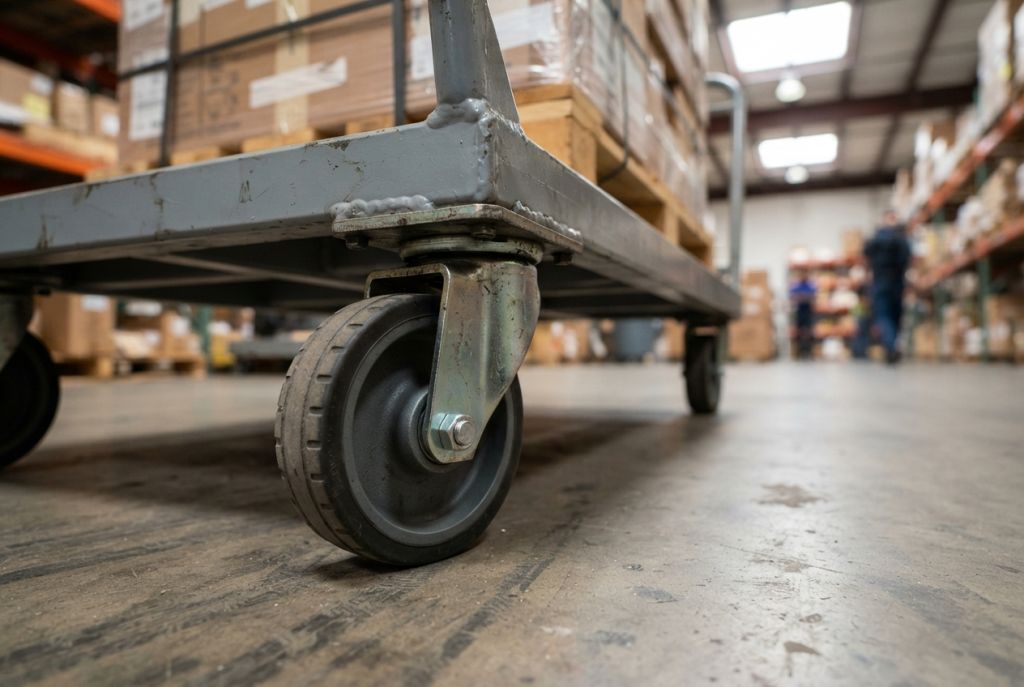
A cart that should glide across the floor starts fighting the operator halfway down the aisle. It drifts on straight runs, chatters over joints in the slab, and needs an awkward shove to line up at the workbench. Most managers blame the cart, the floor, or the load. In practice, the problem often starts much lower. The casters are wrong for the job.
That matters more than many buyers expect. Casters affect how safely people move inventory, how much abuse equipment takes, and how well your floors hold up over time. A poor match can turn an otherwise solid cart, rack, workstation, or mobile bench into a constant source of friction.
If you're comparing options across carts, stockroom equipment, or facility upgrades, it helps to think of casters as part of the whole material handling system, not as an afterthought. The right choice usually isn't the most expensive caster on the page. It's the one that matches the load, floor, turning space, and operating environment.
The Hidden Engine of Your Operation
Casters rarely get attention until something goes wrong. A new buyer might focus on frame strength, shelf count, or equipment dimensions, then accept whatever wheel package comes with the unit. That shortcut is where a lot of avoidable problems begin.
I've seen the same pattern in warehouses, labs, and healthcare settings. The equipment itself is fine, but the mobility package doesn't fit the application. A hard wheel on a rough surface transmits too much shock. A swivel-heavy setup feels unstable on long straight runs. A brake that only stops the wheel still lets the cart pivot when someone leans into it.
The caster is the part your team feels every day, even if nobody mentions it by name.
The good news is that caster selection doesn't need to be complicated. Once you understand the main mobility types, wheel materials, mounting options, and environment-specific trade-offs, most buying decisions become much clearer.
The Foundation of Mobility Rigid vs Swivel Casters
The basic split in the types of casters starts with rigid and swivel. In caster design, the two foundational mobility types are rigid (fixed) and swivel casters. A rigid caster rolls only in a straight line, while a swivel caster adds a 360-degree rotating joint that lets equipment change direction without lifting or repositioning the load, as outlined in the Wikipedia overview of caster design.

What rigid casters do well
Rigid casters are the tracking wheels. They help a cart hold a line and stay predictable under load. If your team moves product over longer distances in straight aisles, rigid casters usually make that trip feel more controlled.
They're often a better fit when the load is heavy and the route is repetitive. Straight-line travel is their strength. Tight maneuvering isn't.
Where swivel casters earn their keep
Swivel casters solve the turning problem. The rotating joint lets the wheel assembly change direction quickly, which is why swivel designs show up on office chairs, hospital beds, shopping carts, and mobile equipment that has to move around people, fixtures, and narrow clearances.
That same principle matters in healthcare. If you want a quick real-world example outside industrial handling, these swivel casters for patient lifts show how maneuverability becomes essential when staff are working in confined rooms around patients and furniture.
Why mixed setups are common
Most facility equipment shouldn't use all rigid or all swivel casters. A mixed setup is usually the practical middle ground. Rigid casters contribute straight tracking. Swivel casters provide steering control.
Consider this checklist when you're reviewing mobile equipment such as rolling tool carts:
- Long aisle travel: Lean toward including rigid casters for better tracking.
- Frequent turning: Add swivel casters where operators need directional control.
- Shared-use equipment: Mixed caster layouts are often easier for different employees to handle consistently.
- Crowded spaces: Too many rigid wheels can make repositioning frustrating.
Practical rule: If operators complain that a cart won't go straight or won't turn cleanly, the wheel layout is often the first thing to review.
Choosing Your Caster Wheel Material
Wheel material usually has more impact on day-to-day performance than buyers expect. For wheel-material selection, caster performance is dominated by the material's trade-off between rolling resistance, impact absorption, floor protection, and environmental resistance. Polyurethane wheels are widely used in medium-load continuous-duty applications because they are easy to push, resistant to abrasion, and able to withstand shock loads. Pneumatic or foam-filled casters are preferred on rough surfaces because the compliant tread absorbs vibration, according to Caster Connection's wheel material guide.
Start with the floor, not the catalog
A smooth sealed concrete floor asks for a different wheel than cracked pavement, tile, epoxy, or a washdown area. Buyers often start by asking, "Which caster is strongest?" A better question is, "What surface is this wheel living on all day?"
Hard wheels usually roll easier on smooth surfaces, but they can be louder and less forgiving. Softer or more compliant wheels absorb vibration better and are usually easier on both the load and the floor, but they may wear faster or push harder in some conditions.
Caster wheel material comparison
| Material | Load Capacity | Floor Protection | Rolling Ease | Best For |
|---|---|---|---|---|
| Polyurethane | Good for medium-load continuous-duty applications | Good | Easy to push | General warehouse carts, stockroom equipment, continuous-use applications |
| Pneumatic | Application-dependent | Good | Good on rough surfaces | Outdoor movement, uneven ground, sensitive loads |
| Foam-filled / cushion-ride | Application-dependent | Good | Good on rough surfaces | Rough floors, cracks, expansion joints, vibration control |
| Nylon | Often chosen where a harder wheel is acceptable | Lower on sensitive floors | Typically rolls easily on smooth surfaces | Dry, smooth environments where floor marking is less of a concern |
| Steel | Often suited to severe-duty conditions | Low on delicate floors | Strong on suitable hard surfaces | Heavy industrial use where floor finish is not the priority |
| Phenolic | Often selected for demanding service | Moderate to low depending on floor | Generally suited to firm surfaces | Areas where heat resistance is part of the requirement |
What usually works and what usually doesn't
Polyurethane is the safe starting point for many indoor facilities because it balances pushability, wear resistance, and floor protection well. If a manager tells me they need one material that can handle continuous use without being overly harsh on floors, polyurethane is often where the shortlist begins.
Pneumatic and foam-filled wheels are different. They shine where the surface isn't smooth. Expansion joints, rough concrete, and transitions between indoor and outdoor areas are where compliant wheels help most. They absorb vibration that a harder wheel would send directly into the frame and payload.
What doesn't work well is treating wheel material like a minor accessory choice. Common mistakes include:
- Choosing for load only: A wheel may support the weight but still perform poorly on the actual floor.
- Ignoring noise: Hard wheels in quiet environments can become an operations complaint quickly.
- Overlooking floor finish: A wheel that works in a plant may be a bad fit in healthcare, labs, or front-of-house areas.
- Forgetting debris and liquids: Chemical exposure, washdown conditions, and dirty floors change what lasts.
If the payload is delicate, the roughest part of the route should drive the wheel decision.
Mounting Styles and Essential Brake Options
A good wheel on the wrong mount still fails in service. Mounting style affects strength, fit, and long-term reliability.
The caster category expanded well beyond simple furniture wheels because specialized variants were developed for operational demands, including locking, plate-mounted, stem-mounted, and kingpinless casters. That shift reflects how mounting method now plays a direct role in strength and durability, as described by Atlanta Caster.

The main mounting choices
Top plate mounts are the standard for many heavier carts and platform trucks. The rectangular plate spreads load across a larger attachment area and usually gives a stronger connection to the equipment frame.
Stem mounts are common on lighter-duty equipment, workstations, institutional equipment, and some lab furnishings. Grip ring stems are convenient where quick insertion into tubing or sockets makes sense. Threaded stems fit better where a more precise, secure connection is needed.
Bolt-hole mounts simplify attachment with a single bolt point. They can be useful where the equipment design doesn't suit a full plate mount, but they still need to match the application correctly.
Brakes are not all the same
Buyers often treat brakes like a box to check. That's a mistake. A simple wheel brake stops rolling, but it may still allow the caster to swivel. In some settings, that's fine. In others, it creates a false sense of stability.
Use this quick guide:
- Side or tread brake: Stops the wheel from rolling, but swivel action may remain.
- Total lock brake: Locks both the wheel and the swivel mechanism for better stability.
- Face contact brake: Often used where a compact, reliable stopping method is appropriate.
A mobile workstation isn't really parked if the wheel is locked but the caster can still rotate under side pressure.
Matching Casters to Your Specific Application
The best types of casters always depend on the environment. Surface conditions, turning space, hygiene requirements, and load behavior matter more than product labels.

Caster selection in regulated facilities also has to account for noise, floor scuffing, corrosion resistance, and washdown compatibility. General buying guides often stop at mobility and mounting style, but niche materials such as stainless steel for chemical exposure or phenolic for high-temperature service are often the primary decision points in hospitals, labs, and food areas, as noted by C. Plauman's caster selection guidance.
Warehouses
Warehouse buyers usually need durability, predictable tracking, and low operator effort. In many facilities, a mixed rigid and swivel configuration paired with a practical indoor wheel material gives the best balance between aisle travel and maneuvering at pick faces or packing stations.
Load sizing matters here. Grainger recommends dividing the total loaded weight by the number of casters, then applying a safety factor by removing one caster from the calculation sotheremaining casters can still support the load if one becomes temporarily unloaded or disabled, as explained in Grainger's caster and wheel guide.
That rule catches a common mistake. Buyers calculate for ideal conditions, but real carts hit joints, thresholds, and uneven loading. One wheel doesn't always carry its share.
A few warehouse-specific checks:
- Tow or continuous travel: Favor wheel materials that handle ongoing use without excessive floor wear.
- Aisle congestion: Keep enough swivel action for positioning at racks and benches.
- Operator fatigue: If carts feel heavy to start or steer, revisit wheel material and layout before blaming the frame.
- Upgrade planning: If you're rethinking mobile equipment strategy, this guide on powered carts no one knows about can help you evaluate when manual mobility starts reaching its limit.
Labs and healthcare
These environments punish bad caster choices quickly. Noise becomes a staff complaint. Floor marks become a maintenance issue. Corrosion and washdown exposure affect service life.
Quiet-rolling, non-marking wheels are usually worth the attention. Stainless steel components make more sense where water, chemicals, or repeated cleaning are part of normal operations. If heat is part of the environment, materials such as phenolic or fiberglass-based options may belong on the shortlist rather than as an afterthought.
Retail, garment handling, and light-duty professional use
Not every caster decision happens in a warehouse. Garment transport, stockroom presentation, and light-duty mobile fixtures have their own priorities. Maneuverability, appearance, and quiet rolling often matter just as much as load handling. If you're comparing lighter mobile display applications, this overview of mobile garment rails for professionals is a useful example of how wheel choice affects ease of movement in customer-facing spaces.
One buying shortcut worth using
When a buyer wants a practical place to compare mounting and mobility options without starting from scratch, the casters by type category from Material Handling USA is one straightforward way to narrow choices by application rather than guessing from generic specs.
Conclusion Your Next Step to Better Mobility
The right caster does more than help a cart roll. It reduces push effort, improves control, protects floors, and keeps mobile equipment usable instead of irritating. Most costly mistakes come from mismatches between caster type and real operating conditions. The route is rougher than expected. The turning space is tighter. The brake doesn't hold the way the team assumed it would.
A few habits will keep caster performance consistent after purchase:
- Inspect regularly: Look for flat spots, debris buildup, and loose mounting hardware.
- Match maintenance to environment: Washdown, chemicals, and heat shorten service life if the caster wasn't selected for them.
- Watch operator feedback: If teams avoid certain carts, the problem is often mobility related.
- Replace in sets when needed: Mixed wear can make a cart track and steer poorly.
Choosing sooner rather than later also helps with planning. When mobile equipment decisions get delayed, installs, workstation changes, and replacement schedules can slip with them. Getting the caster package right early keeps more options open.
If you're evaluating mobility equipment, Material Handling USA can help you compare options for your facility with competitive pricing, fast shipping, quality products, and free quotes. For online product purchases, Shop Now or Buy Online through the store. For layout help or a broader equipment plan, Request a Quote, Contact Us, call 800-326-4403, or email Sales@MH-USA.com for free, no-obligation guidance.
Related Resources
- mobile shelving systems — Rolling shelving systems designed for smooth, reliable movement
- industrial mezzanines — Platforms and structures with integrated mobility options
- pallet racking systems — Stationary and mobile racking solutions for warehouses