
Home / Material Handling
Material Handling Equipment & Supplies
More than 7,000 material handling products — dock equipment, lifting and ergonomic equipment, carts and trucks, ladders, protective barriers, storage and consumables — backed by in-house design, nationwide installation and 40+ years of project experience.
14
Product categories
7,000+
Items in stock online
50
States served
40+
Years in business
One Source for the Equipment That Moves Your Product
Material Handling USA has supplied and installed handling equipment out of Salt Lake City for more than four decades, and this page is the front door to the equipment side of that catalog. Fourteen product categories cover everything from a single replacement caster to a 30,000 lb dock leveler, and the great majority of those items are manufactured by Vestil Manufacturing — the Angola, Indiana builder whose drum trucks, lift tables, Edge-O-Dock levelers, yard ramps and barriers make up most of the model numbers you will see below.
Most buyers arrive here with one of three problems: something is being lifted by hand that should not be, something is getting damaged in transit or at the dock, or the building has outgrown the way material moves through it. The sections below are organized that way — by the job, not by the brand — so you can go straight to the equipment family that solves your problem and see real capacities before you ask for a price.
- In-house design and layout support, including drawings for permitting and installation
- Nationwide delivery and installation, with teardown and relocation on retrofit projects
- Small orders welcome — consumables and accessories ship from our online store
- Specification help that starts with load, travel and cycle count, not a catalog page
Shop Material Handling by Category
Every category below is live on mh-usa.com with current pricing and specifications. Item counts were verified in August 2026.
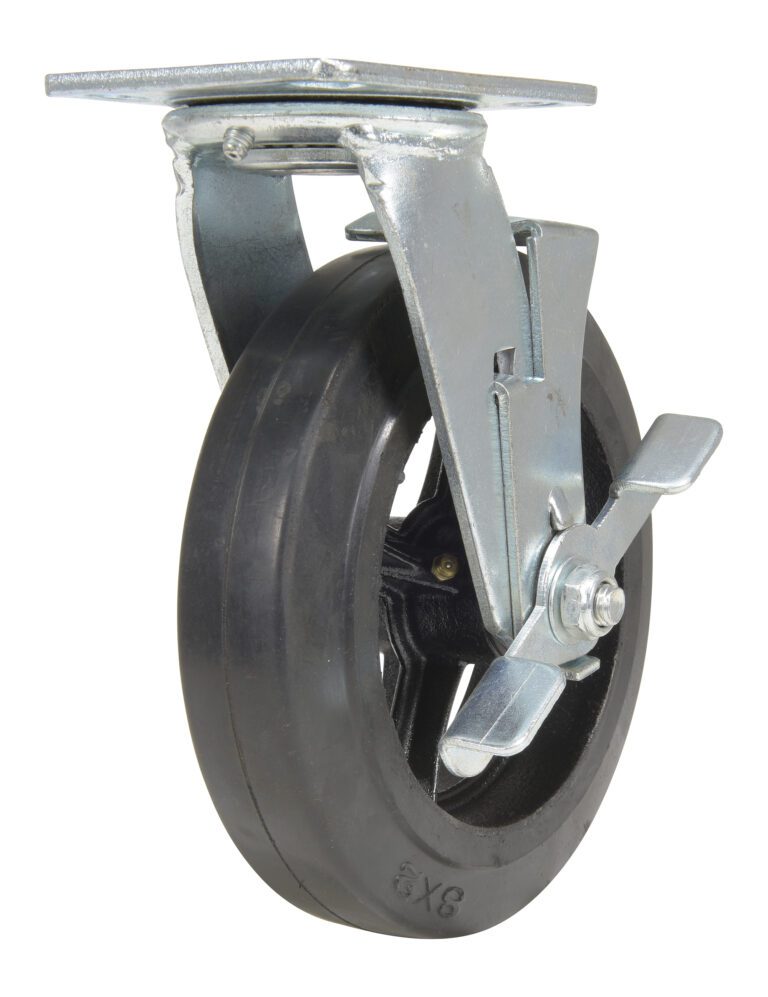 Casters & Wheels (257 items)Swivel, rigid and brake casters in mold-on rubber, polyurethane, phenolic and pneumatic tread — plus stem, plate and kingpinless configurations for carts, racks, work benches and platform trucks.
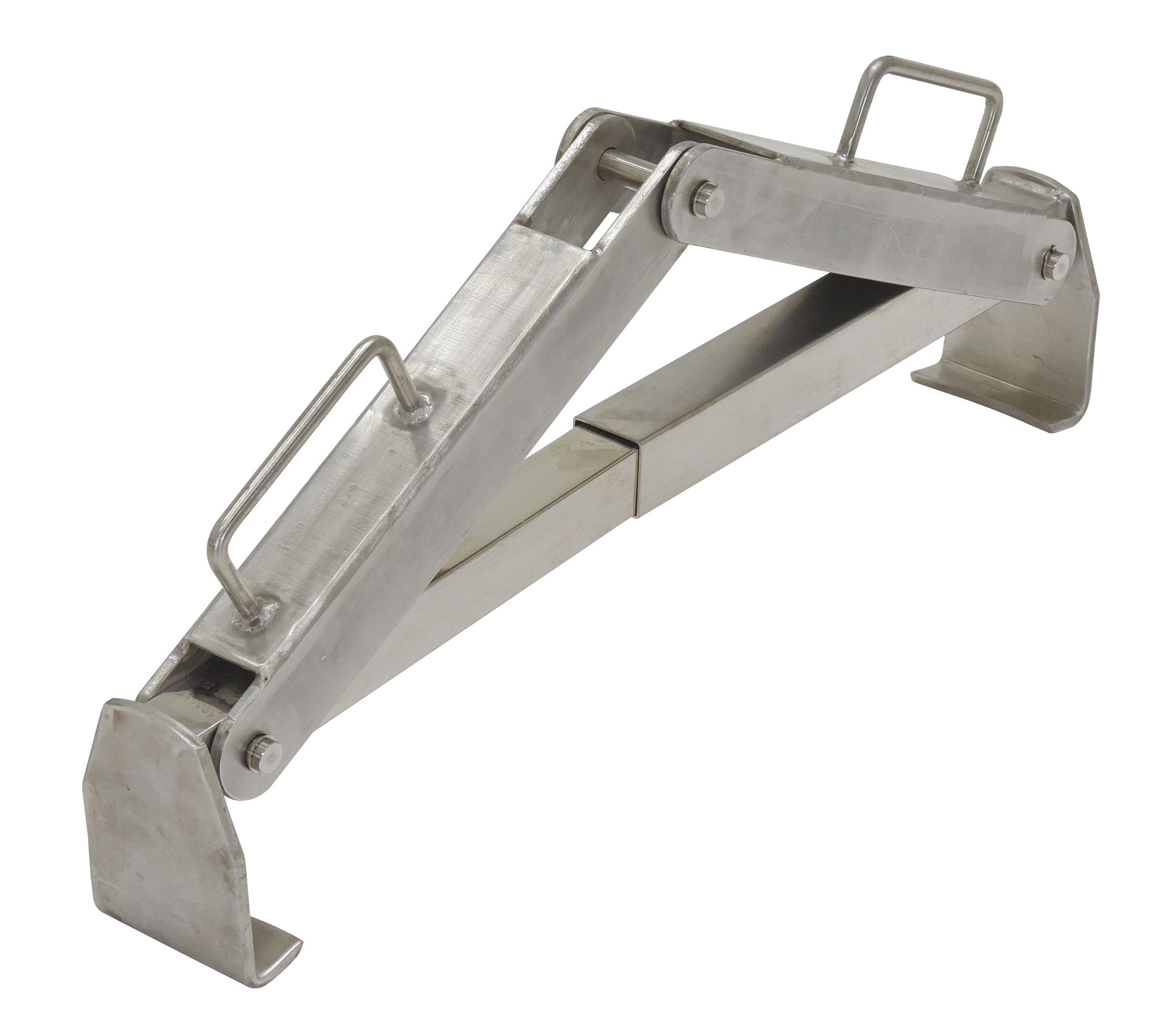 Drum Handling Equipment (490 items)Drum trucks and cradles, drum lifters and rotators, faucets, pumps, spill pallets and secondary containment for 30 and 55 gallon steel, plastic and fiber drums.
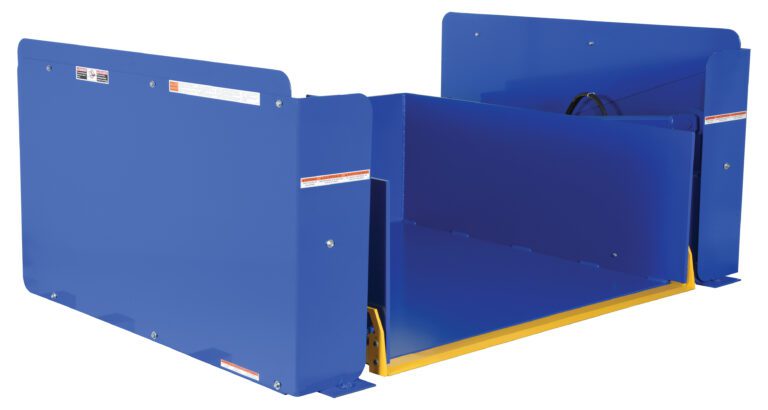 Ergonomic Solutions (936 items)Scissor lift tables, lift-and-tilt tables, turntables, pallet positioners, work platforms and lifts that bring the load to the worker instead of asking the worker to bend for it.
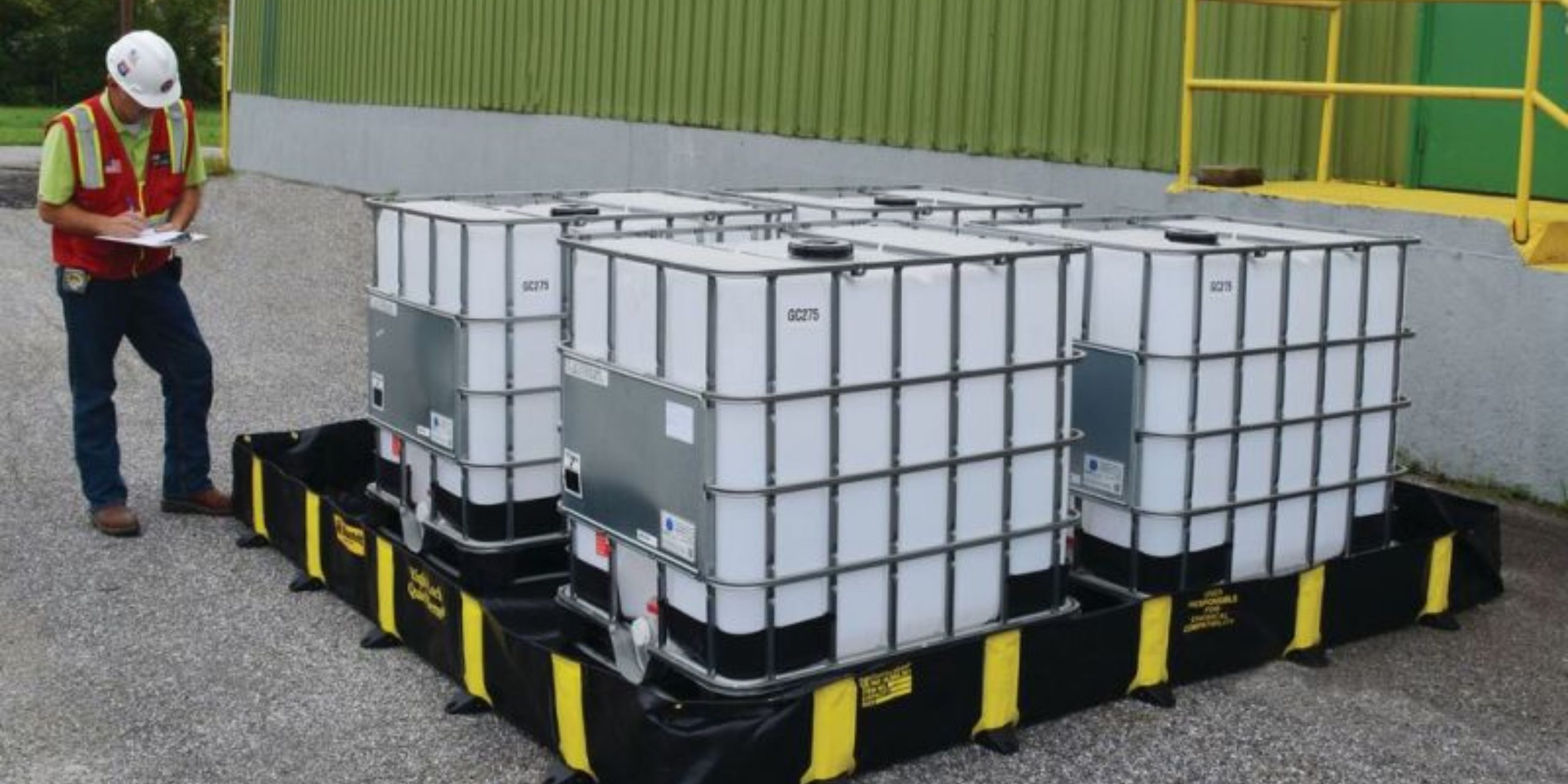 Facilities Maintenance (487 items)Spill control and secondary containment, drum storage, safety cans, absorbents, floor and wall protection, and the day-to-day hardware that keeps a plant running.
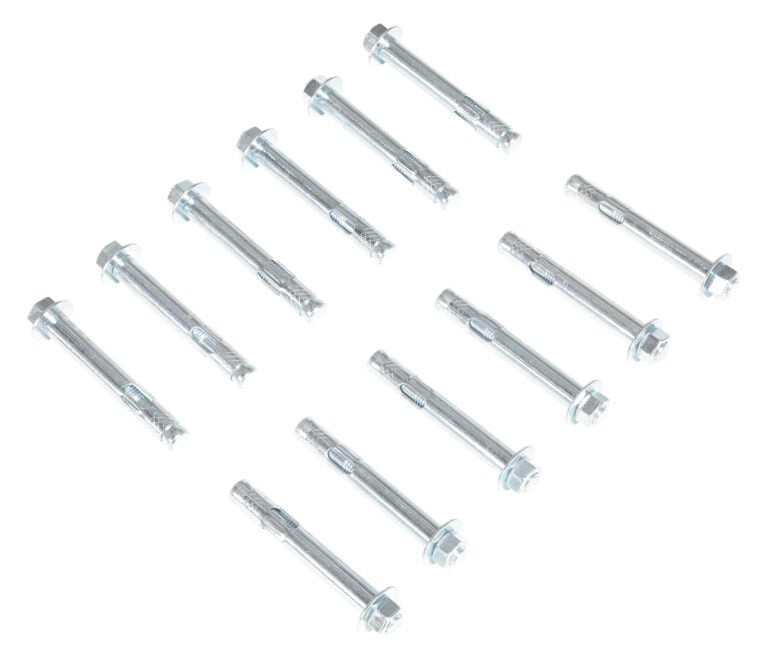 Hardware (12 items)Concrete anchors, mounting kits and fasteners sized for anchoring racks, guard rail, bollards, ladders and lift equipment to a concrete slab.
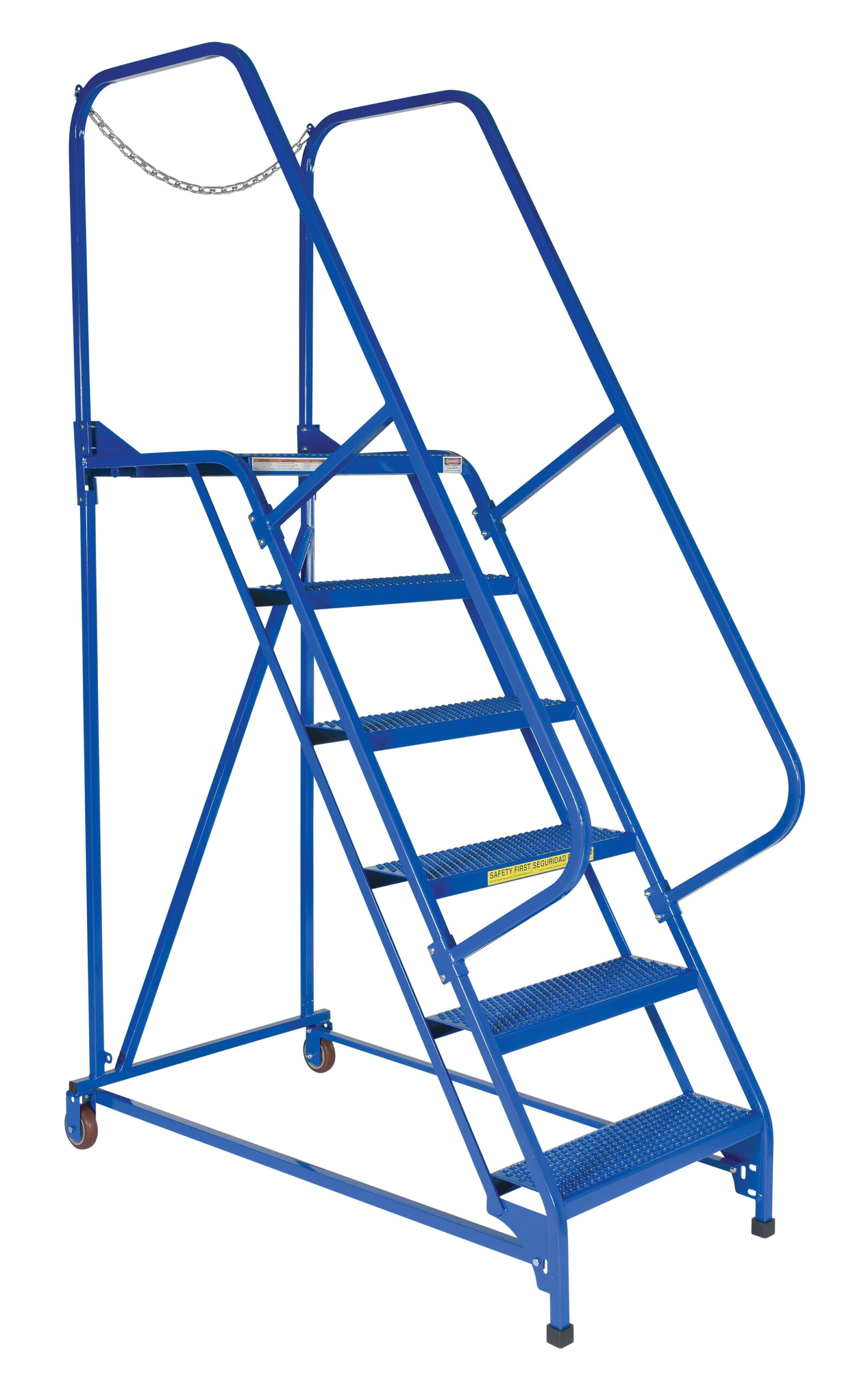 Industrial & Commercial Ladders (375 items)Rolling ladders, step stands, maintenance ladders, mezzanine ladders and mobile work platforms built to ANSI duty ratings for daily industrial use.
 Industrial Storage Solutions (373 items)Cantilever arms, bar and sheet storage, bin and drawer units, cabinets and racks for the long, heavy and awkward items shelving alone cannot handle.
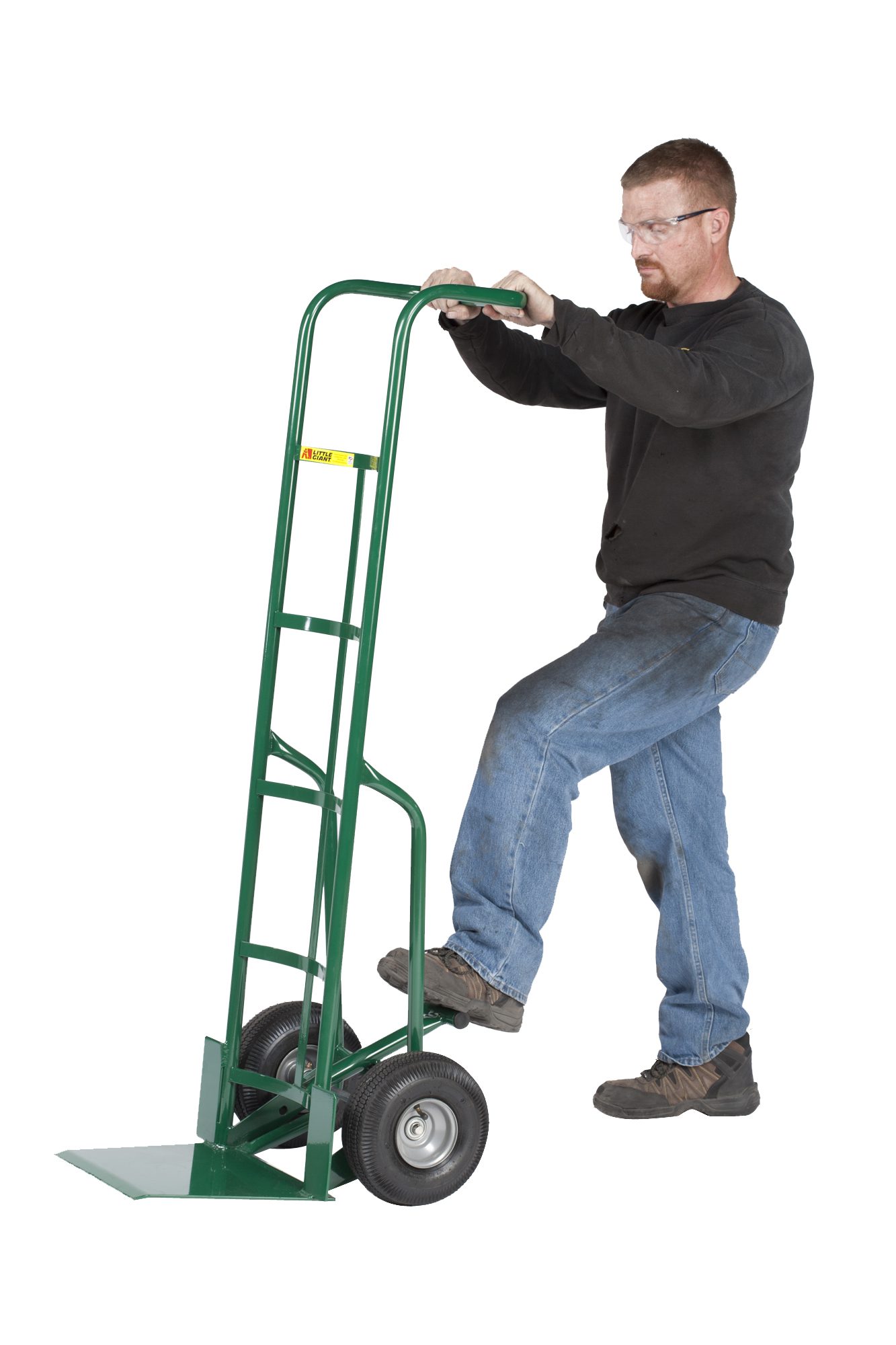 Carts, Trucks & Dollies (506 items)Hand trucks, platform trucks, dollies, panel carts, tilt trucks and utility carts for the short moves that make up most of the material handling in a building.
 Janitorial Supplies (400 items)Brooms, mops, sweeping compound, waste receptacles, janitorial carts and cleaning chemicals for warehouse, plant and office housekeeping programs.
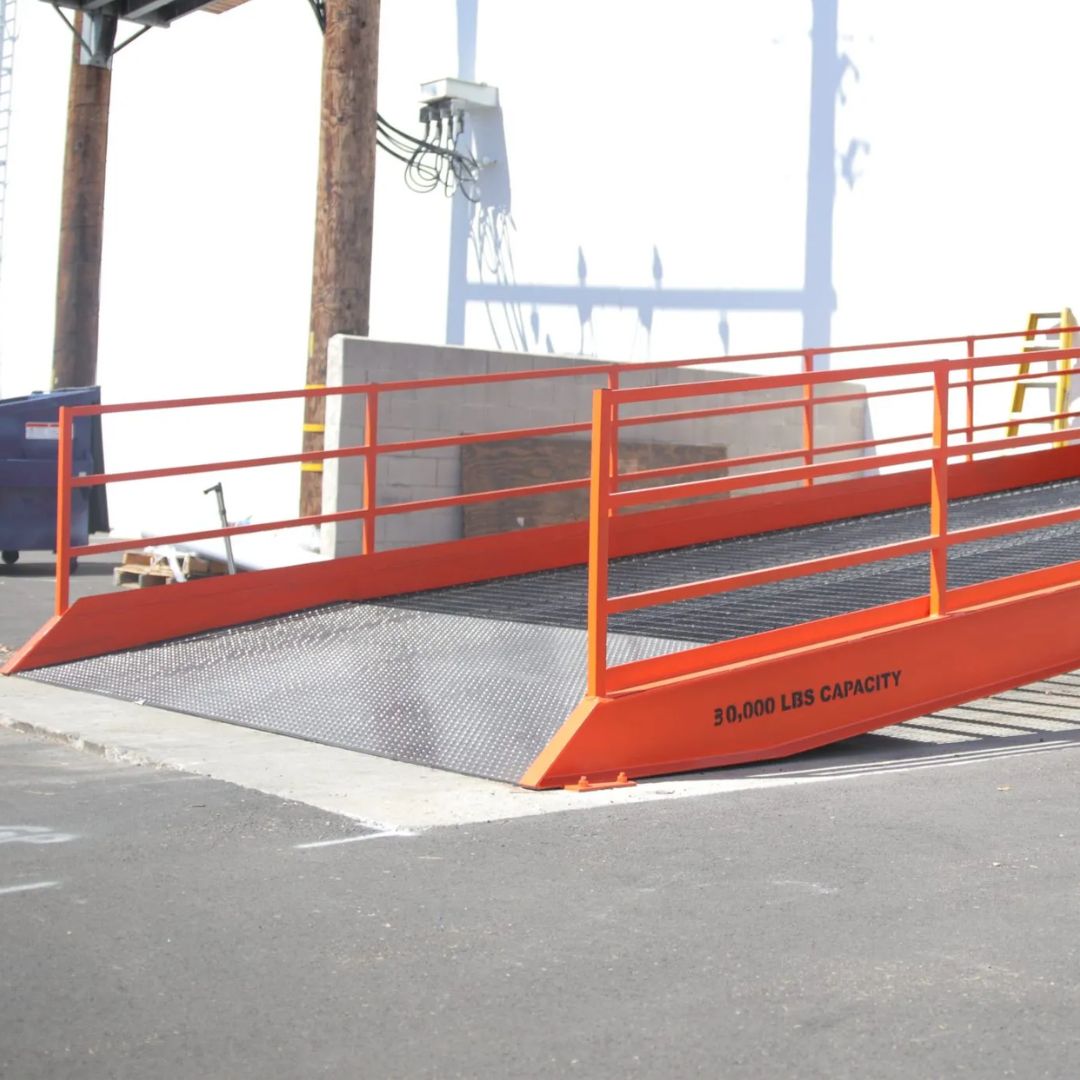
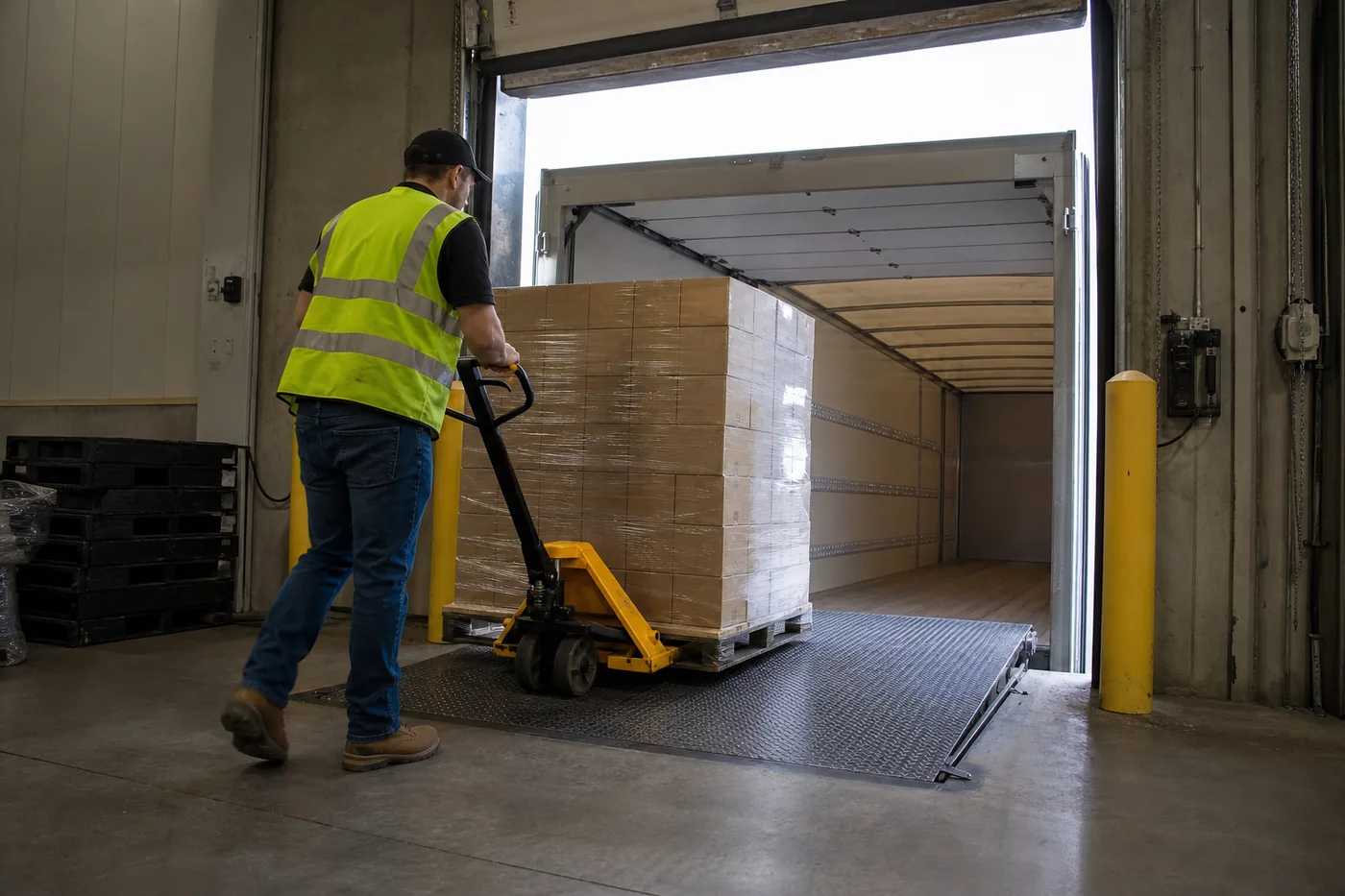 Loading Dock Equipment (1716 items)Edge-O-Dock levelers, dock boards and plates, yard ramps, dock lifts, bumpers, wheel chocks, trailer jacks and restraints — the largest category on the site.
 Protective Barriers (1179 items)Bollards, guard rail, column and rack protectors, machine guarding, safety gates, mirrors and traffic control that keep forklifts away from people and structure.
 Public Health & Safety (65 items)Sanitizer stands and dispensers, protective screens, queue management and facility hygiene products for lobbies, plants and shared workspaces.
 Safety Products (38 items)Personal protective equipment, lockout/tagout, signage, first aid and the safety consumables that support an OSHA-compliant facility.
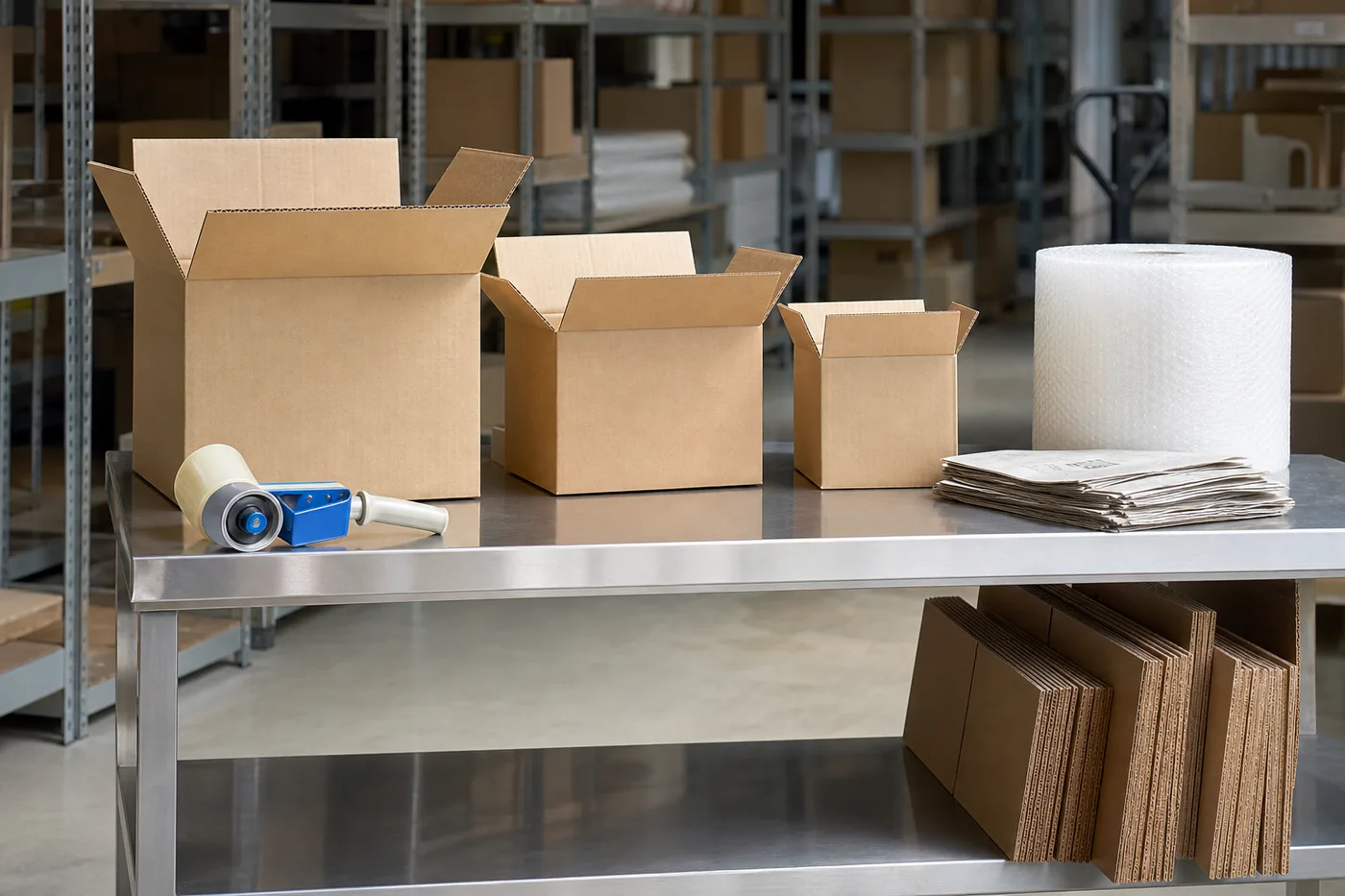 Warehouse Supplies (227 items)Stretch film, tape, strapping, corrugated, mailers, label holders, humidity indicators and the shipping-room consumables that run out fastest.
Not sure which category your problem lives in?
Tell us the load, the distance and how many times a day it moves. Our team will point you at the right equipment family — and tell you when the real fix is a layout change instead of a purchase.
Moving Loads: Carts, Trucks, Dollies and Pallet Jacks
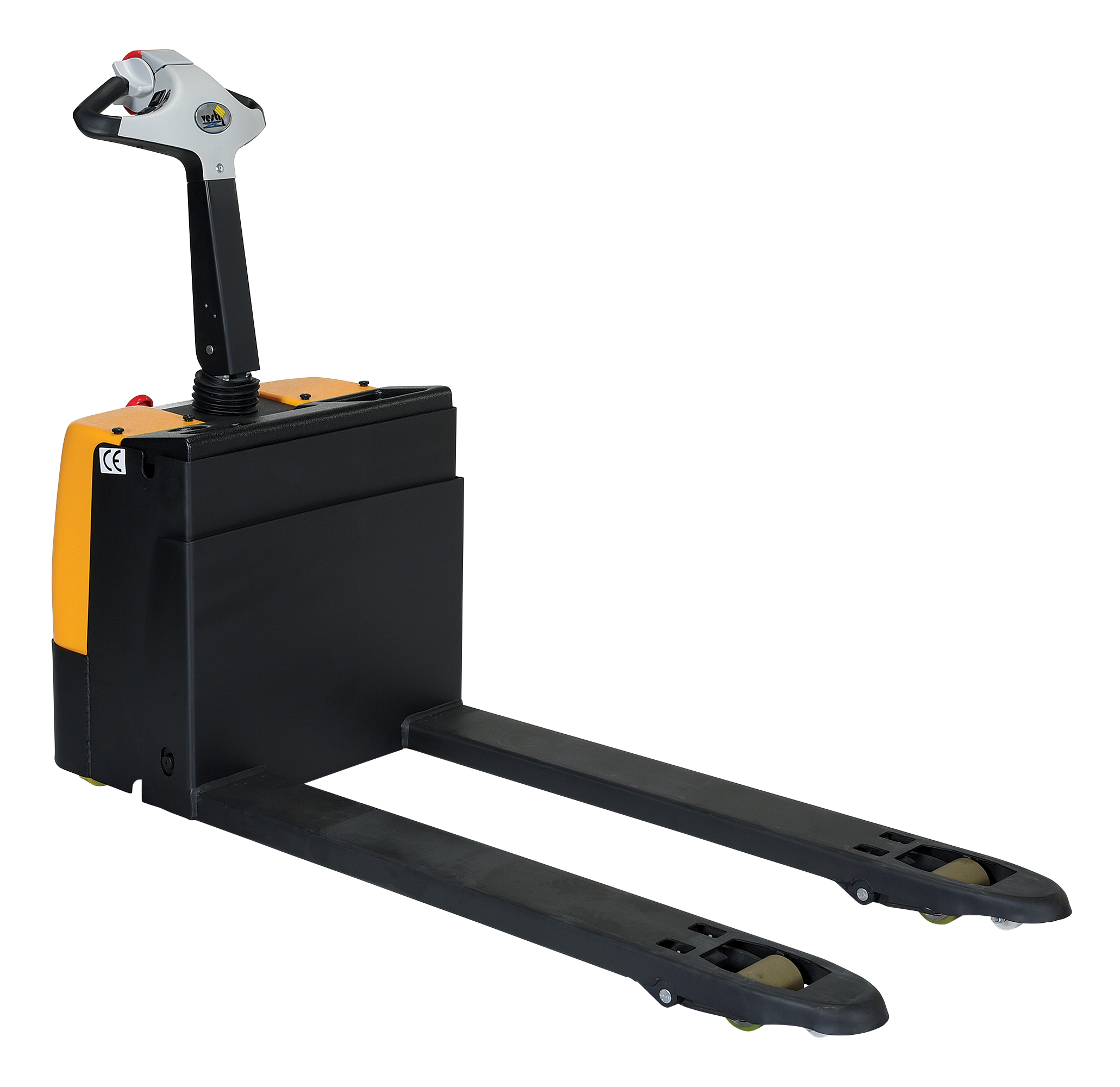
Most of the material handling in a building is not done by a forklift. It is done in short moves — a pallet from the dock to a staging lane, a tote from a pick face to a packing bench, a die cart from storage to a press. Equipment for those moves is chosen on four numbers: load weight, floor condition, travel distance and how many trips per shift.
Manual pallet jacks handle pallet moves up to roughly 5,500 lb on smooth concrete; low-profile versions clear pallets and skids that a standard jack cannot enter. Hand trucks and appliance trucks handle single cartons, drums and cased goods. Platform trucks and tilt trucks handle bulk. Utility and bin carts handle small parts and order picking. When the trip count gets high enough, or the load starts to exceed what one person should push, the answer moves up to a powered pallet truck or a powered cart.
Floor condition beats capacity every time
A cart rated for 2,000 lb on smooth concrete can be unusable on a cracked slab, a dock plate lip or an outdoor apron. Larger-diameter wheels, pneumatic tread and swivel/rigid layout matter more than the nameplate rating on rough surfaces — which is why the caster and wheel category exists as its own line rather than as an accessory.
Lifting and Ergonomics: Bring the Load to the Worker
Ergonomic handling equipment is the highest-return category on this page, because the cost of one lifting injury usually exceeds the cost of the equipment that would have prevented it. The principle is simple: keep the work between knuckle and shoulder height, eliminate the bend and the twist, and stop asking people to do what a 400 lb table can do for them.
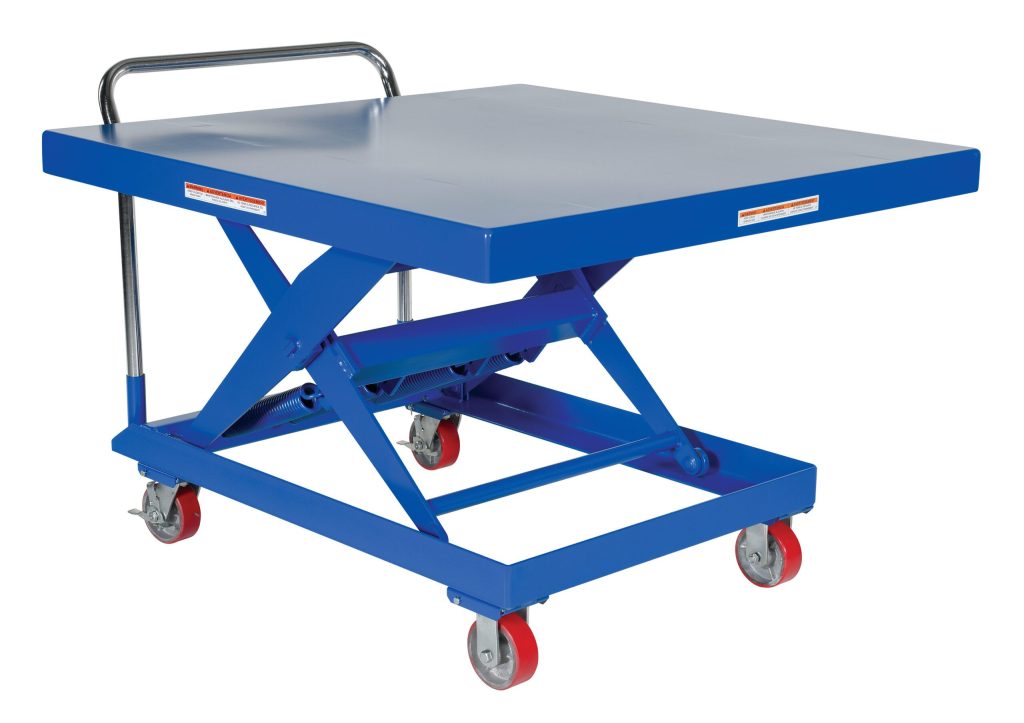
Scissor lift tables are the backbone of the category. Vestil builds them in several families: EHLT electric/hydraulic tables for general assembly and pallet loading, EHLTX low-profile tables that a pallet jack can drive onto, EHLTS “Shorty” tables for tight footprints, portable PST tables that roll to the work, and EHLTT lift-and-tilt tables that raise and tip a container so the operator never reaches into the bottom of a bin.
Around those tables sit pallet positioners and turntables so a pallet can be built from one side, upenders and rotators for coils and dies, and stackers and floor cranes for the lifts that a table cannot reach. When the lift is overhead rather than vertical from the floor, the answer is a jib or gantry crane — see Vestil cranes for floor-mounted, wall-mounted and portable configurations.
Rate the table for how the load actually sits
Published lift table capacities assume a uniformly distributed load. On Vestil EHLT tables, end loading is derated to 75% of the rating and side loading to 50%. On the low-profile EHLTX series it is 50% end and 25% side. If a forklift or pallet jack will place a pallet toward one end of the platform, size the table from the derated number.

Fixing an ergonomic problem, not buying a part number?
Send us the lift — weight, height, reach, frequency and the space you have. We will come back with two or three workable options and their real derated capacities.
Drum Handling and Containment
Drums are the most common thing people hurt themselves on, because a full 55 gallon drum weighs 400–500 lb and rolls. The equipment falls into three groups: trucks and cradles that move and dispense drums, lifters and rotators that pick drums up with a forklift or hoist, and containment that catches what leaks.
| Vestil drum truck family | Capacity | Accepts | Best fit |
|---|---|---|---|
| DBT (barrel/drum truck) | 800 lb | Steel, plastic and fiber drums | Two-wheel tilt truck for short moves on smooth floors |
| DBT deluxe tilt-back | 1,000 lb | 55 gallon steel and plastic drums | Larger wheels (10″ to 15-3/4″) and a tilt-back frame for rough floors |
| DBT with spring assist | 1,000 lb | Plastic drums (poly-on-poly) | Spring assist helps tilt the drum back without a second operator |
| RDBT multi-purpose truck/cradle | 1,000 lb | Steel and plastic drums | Doubles as a cradle so a drum can be dispensed where it was parked |
| DBT-SS stainless | 1,000 lb | Steel, plastic and fiber drums | Stainless construction for washdown, food and pharmaceutical areas |
| PSDT pallet-straddling truck | 550 lb | 55 gallon steel drums | Straddles a pallet and grips the drum rim to lift drums on and off pallets |
Specify drum equipment by drum material first — a plastic drum has no chime for a steel truck to grab, which is why poly-on-poly and spring-assist versions exist. Then confirm floor condition and whether the drum has to be lifted onto a pallet, poured, or only moved.

Containment is the other half of the category and the half that inspectors look at. Spill pallets, drum decks and vertical drum retention units hold the required sump volume under the drums; safety cans, faucets and pumps control dispensing; absorbents and berms handle what still gets out. If the material is flammable or a hazardous waste, pair the containment with a rated storage cabinet rather than open shelving.
- Match the truck to the drum material — steel, plastic or fiber — before capacity
- Add a cradle or rotator anywhere drums are dispensed rather than only moved
- Size secondary containment to the sump volume your local authority requires
- Stainless drum trucks for washdown, food and pharmaceutical areas
Loading Dock Equipment
With 1,716 items, loading dock equipment is the largest category on this page — and the one where a wrong specification costs the most. Everything a trailer touches has a rating: the leveler, the plate, the bumper, the chock and the jack.
| Model / series | Actuation | Lip width | Capacity | Typical application |
|---|---|---|---|---|
| FM-0648 | Mechanical | 48″ | 6,000 lb | Light-duty docks and box trucks |
| FM-2566 | Mechanical | 66″ | 25,000 lb | Standard forklift traffic, wide lip |
| FM-2572 | Mechanical | 72″ | 25,000 lb | Wider trailers and side-shifting loads |
| FM-3066 | Mechanical | 66″ | 30,000 lb | Heavy forklift traffic (29-13/16″ ramping) |
| PP series | Hand pump hydraulic | 66″ / 72″ | 20,000–30,000 lb | One-person positioning without lifting the deck by hand |
| PE series | Powered hydraulic | 66″ / 72″ | 20,000–30,000 lb | High cycle counts and multi-shift docks |
Vestil Edge-O-Dock levelers mount to the face of an existing dock, so no concrete recess is required, and they ship with two 2″ x 8″ x 18″ bumpers. Standard ramping length is 29″, or 29-13/16″ on 30,000 lb units; a 36-5/8″ ramping length is available on the hydraulic PP and PE series where the grade change between dock and trailer bed is shallower.
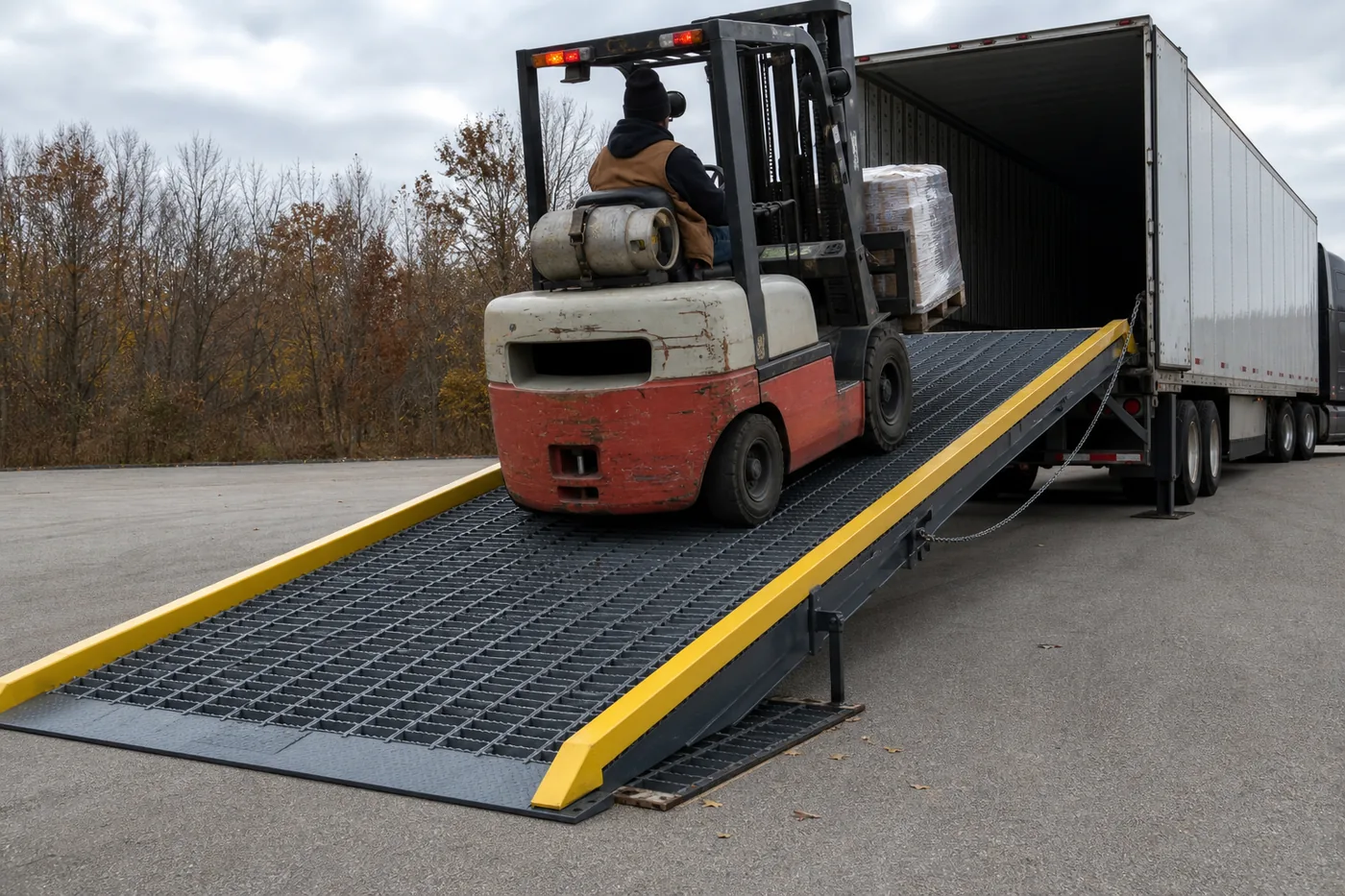
Where there is no dock at all — a new tenant space, a yard, a temporary operation — a yard ramp does the job of the dock. Steel and aluminum ramps are rated from roughly 16,000 lb to 30,000 lb, with serrated grating for traction, safety curbs and either a level-off top plate for trailer loading or a straight incline for ground-level access. Dock lifts do the same work vertically when floor space is too tight for a ramp.
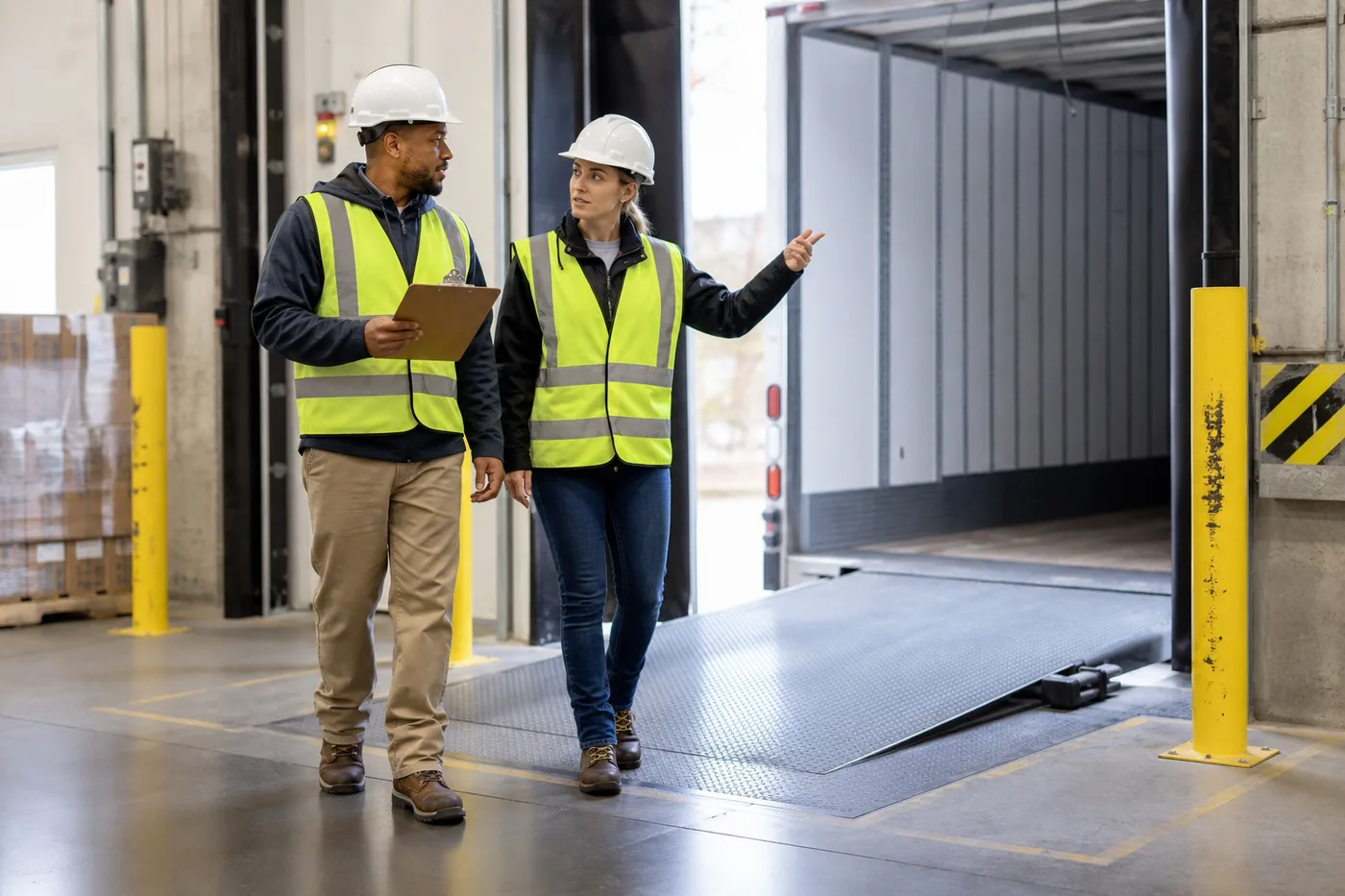
The cheapest dock upgrade is usually restraint and chocking
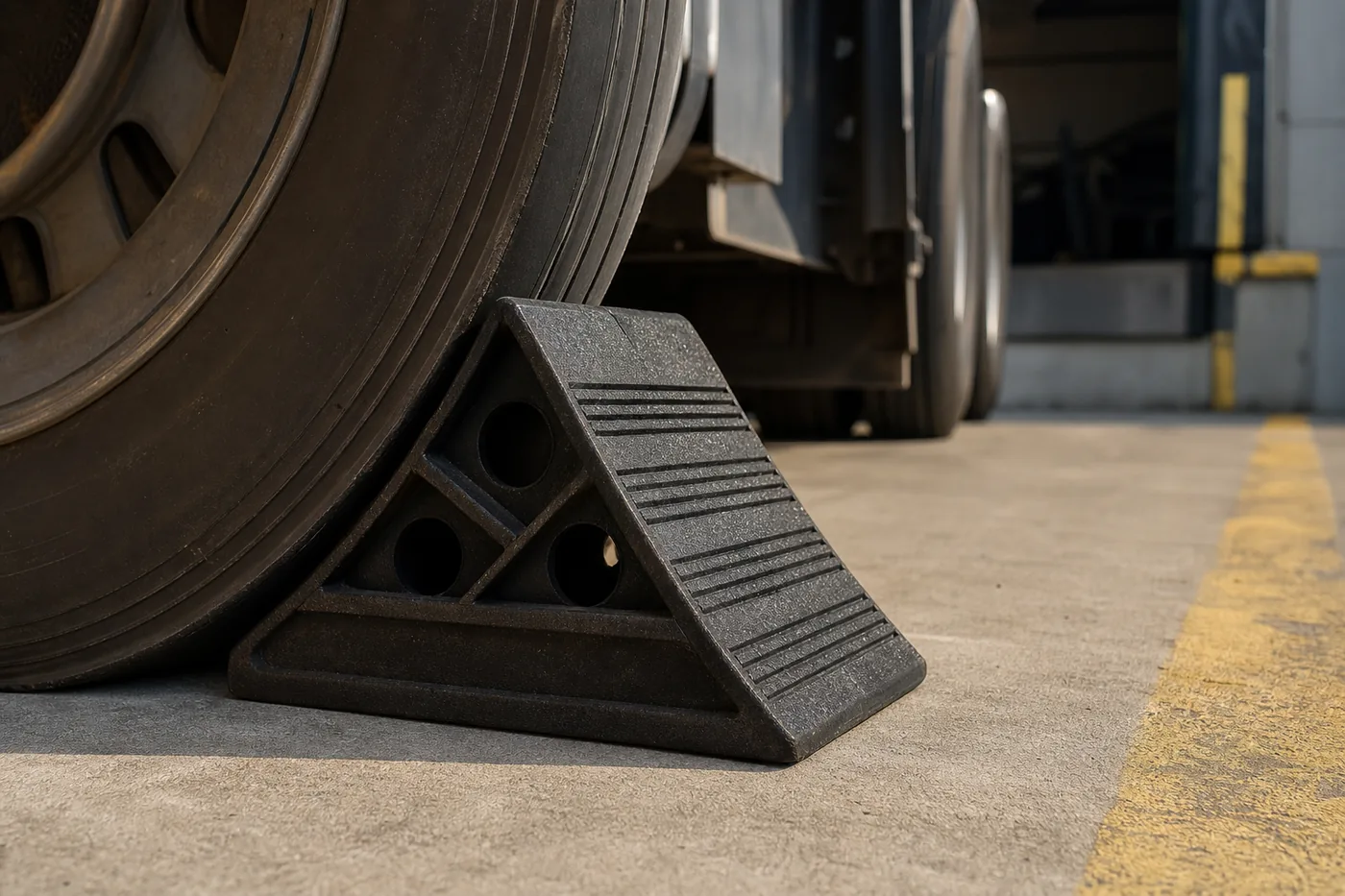
Trailer creep and early departure are the two failure modes that injure people at a dock. Wheel chocks, chock holders, trailer stabilizing jacks and wheel risers cost a fraction of a leveler and address both. OSHA 29 CFR 1910.176 also requires safe clearance at loading docks and clear, unobstructed aisles — worth checking on the same walkthrough.
Retrofitting an older dock?
Send us dock height, trailer mix, forklift weight and the condition of the existing bumpers. We will quote the leveler, plate, bumper and restraint package as one scope so nothing is under-rated.
Ladders, Step Stands and Work Platforms
Access equipment is bought on duty rating, not on price. The duty rating is the total working load — the person plus clothing, tools and whatever they carry up — and ANSI A14.2 defines five classes.
| ANSI A14.2 duty rating | Working load | Where it belongs |
|---|---|---|
| Type IAA — Special Duty | 375 lb | Heavy industrial and utility work with tools and material |
| Type IA — Extra Heavy-Duty | 300 lb | Most warehouse, plant and maintenance use |
| Type I — Heavy-Duty | 250 lb | General industrial and contractor use |
| Type II — Medium-Duty | 225 lb | Light commercial and facility work |
| Type III — Light-Duty | 200 lb | Household duty — not appropriate for industrial use |
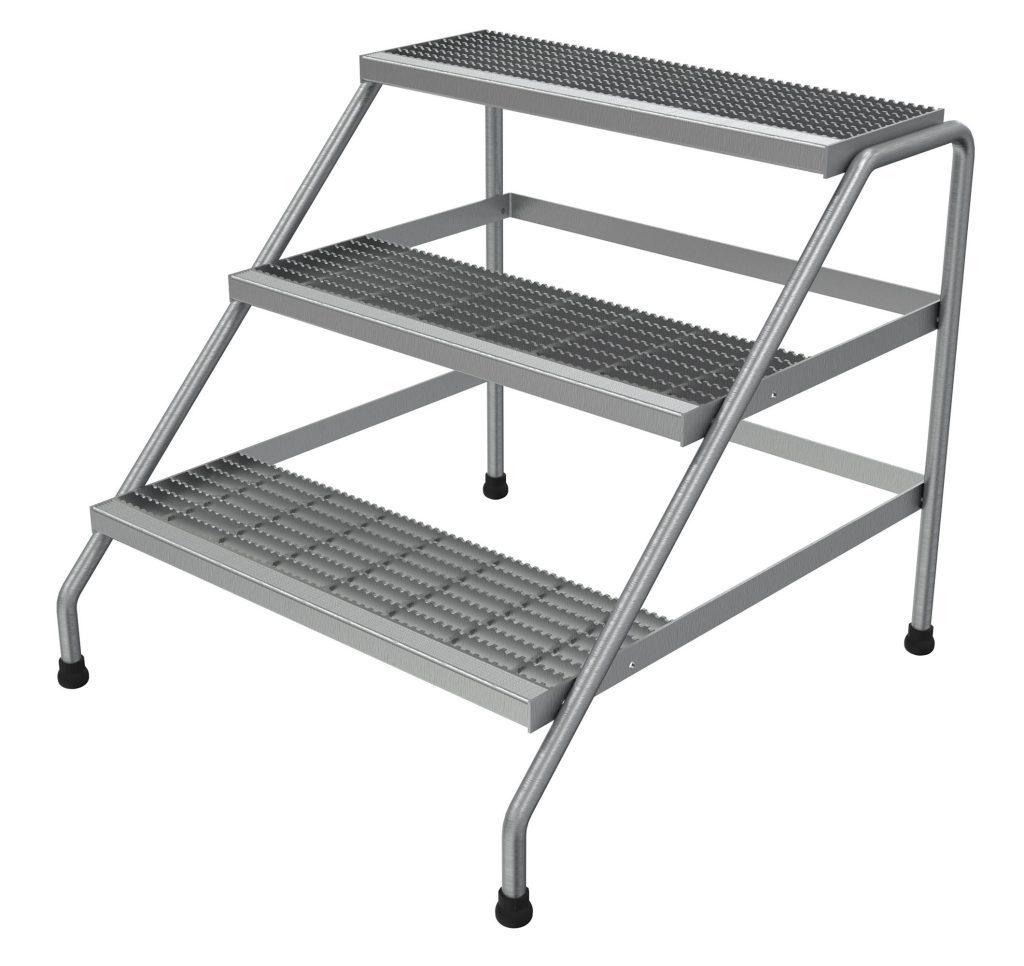
For warehouse, plant and maintenance work, specify Type IA (300 lb) or Type IAA (375 lb). Household Type III ladders should never be in an industrial building. OSHA 29 CFR 1910.23 backs this up on the use side: ladders may not be loaded beyond their maximum intended load, and rungs and steps on portable metal ladders must be corrugated, knurled, dimpled or otherwise slip-resistant.
Above about 4 ft of repeated access, a rolling ladder or work platform is safer and faster than a step ladder: both hands stay free, the operator stands on a full step rather than a rung, and spring-loaded casters lock under load. Step stands cover the 1–3 step reach at pick faces and benches. Mezzanine and folding ladders handle permanent elevated access — and when the access is daily, a fixed stair with handrails is the correct answer instead of any ladder.
Protective Barriers, Guarding and Facility Safety
Protective barriers are the second-largest category here for a reason: forklifts and people share the same floor, and steel is cheaper than either an injury or a rack rebuild. The category runs from bollards and guard rail to column protectors, rack guards, safety gates, machine guarding, mirrors and floor marking.
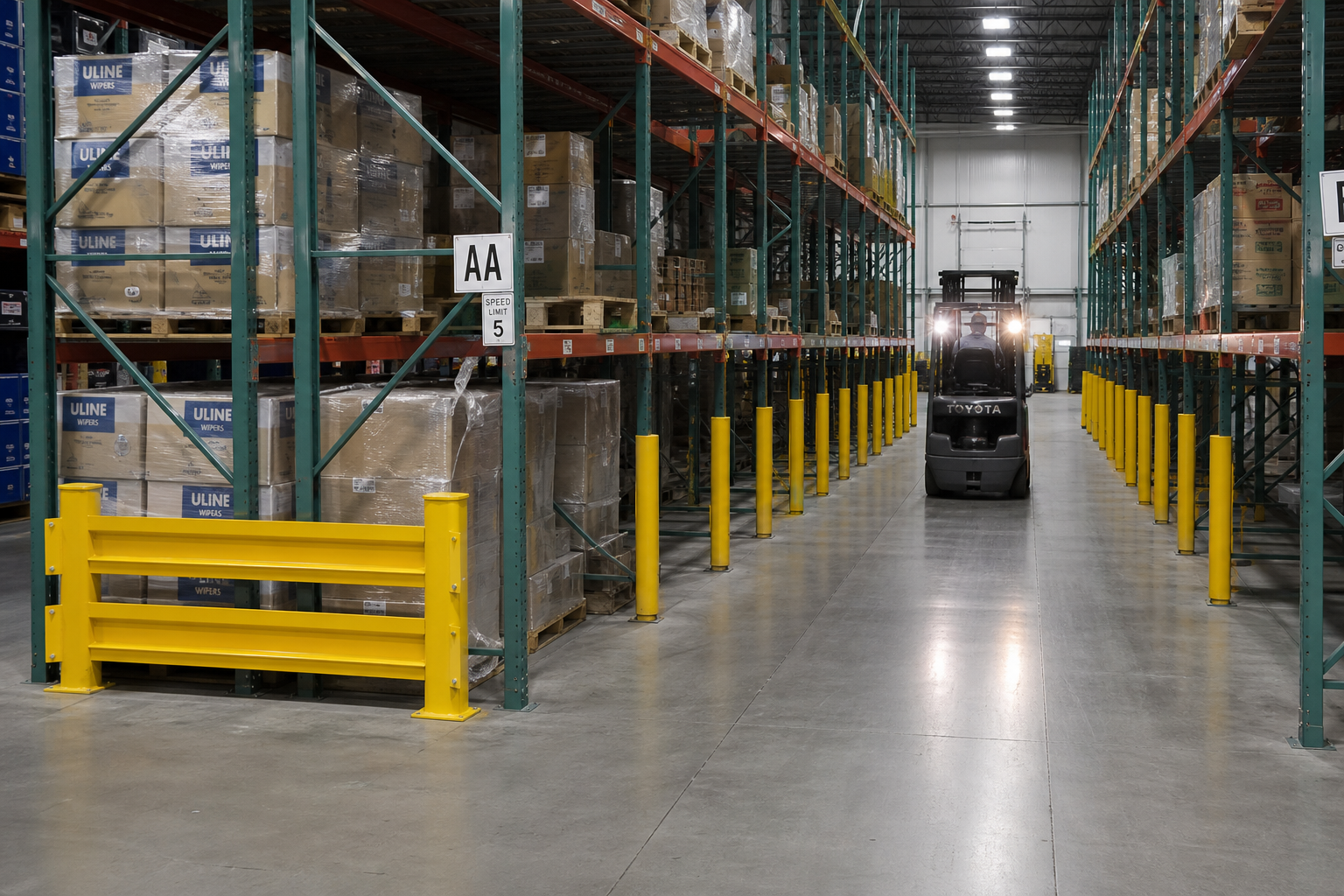
Start where the damage already is. Scuffed uprights at the end of a rack row need rack guards and column protectors. Traffic crossing a pedestrian route needs guard rail and marked lanes. Exposed drive-and-pinch points on conveyors and machines need wire mesh guarding. Open mezzanine edges and elevated pick faces need gates and netting rather than a chain across the gap.
Facilities maintenance, public health and safety products round out the same job on the housekeeping side: spill control and containment, safety cans, absorbents, sanitizer stands, signage and PPE. None of it is glamorous, and all of it shows up in an audit.
OSHA on storage and aisles
29 CFR 1910.176 requires that stored material be stacked, blocked, interlocked or otherwise secured against collapse, that sufficient safe clearance be provided at aisles, docks, doorways and turns, and that aisles be kept clear and in good repair. Barriers, floor marking and rack protection are how most facilities actually meet that standard day to day.
Warehouse Supplies, Janitorial and Consumables
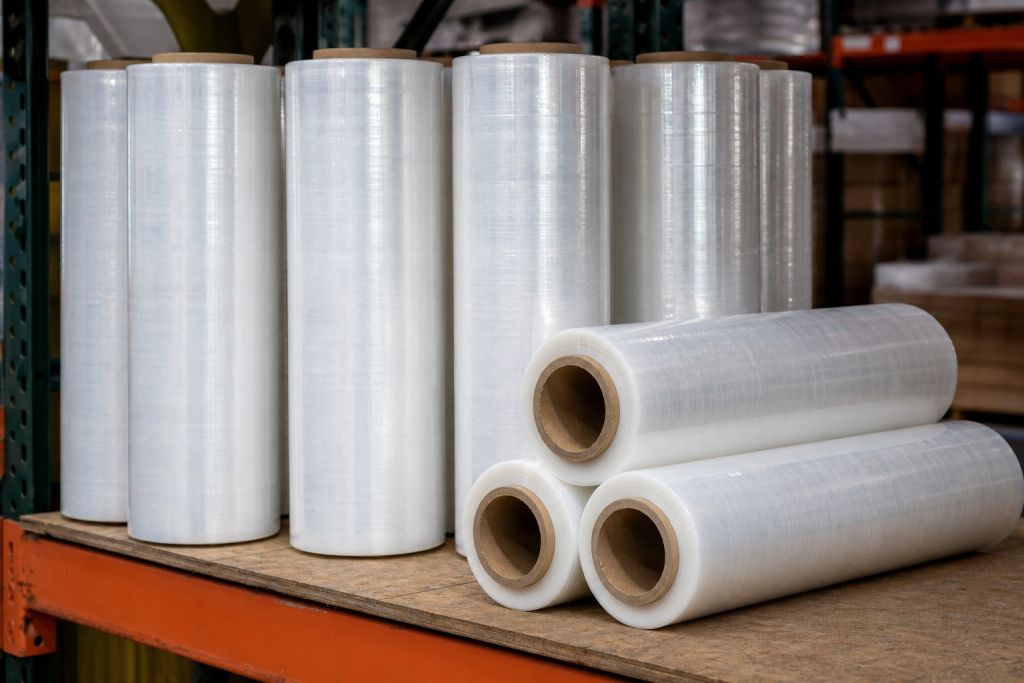
Equipment is a project; consumables are a habit. Warehouse supplies cover stretch film, tape, strapping, corrugated, mailers, void fill, edge protectors, label holders and humidity indicators — the items that stop a shipping room when they run out. Janitorial supplies cover brooms, mops, sweeping compound, receptacles and carts for the housekeeping program that keeps aisles clear.
Because these are re-order items rather than engineered purchases, most customers buy them online. Our e-commerce store carries the same catalog with live pricing, and our wholesale shipping supplies and janitorial equipment pages cover how to size and standardize an order so you stop paying for six box sizes you do not need.
Shop Online at MaterialHandling-USA.com
Consumables, casters, hand trucks and dock accessories ship directly from our online store with live pricing and stock:
How to Specify Material Handling Equipment
Describe the move
Weight, dimensions, container type, distance, elevation change and trips per shift. Almost every wrong purchase traces back to a missing number here.
Check the floor and the space
Slab condition, aisle width, door heights, dock height and trailer mix. These decide wheel size, ramp length and whether equipment can even reach the work.
Size for the real load case
Apply off-center derates on lift tables, wheel loads rather than pallet loads at the dock, and duty ratings rather than list price on ladders.
Design the layout, then buy
Use the free online design tools to lay out rack, cages or benches so equipment is chosen to fit the layout instead of the layout bending around a purchase.
Install, train and re-check
Anchor what needs anchoring, train the operators, then walk the aisles again 30 days later. Fresh scuff marks tell you exactly what still needs a barrier.
Design it before you buy it
Our free browser-based tools let you lay out pallet rack, cantilever rack, security cages, lab benches and modular buildings, then send the configuration straight to our team for pricing.
Open the Design Tools Pallet Rack Designer Call (800) 326-4403
Material Handling FAQ
What does “material handling” actually cover?
Do I need a lift table or a lift truck attachment?
How much capacity do I lose on a lift table when the load is off center?
What capacity edge-of-dock leveler should I buy?
Which ladder duty rating do we need?
Can you install and service what we buy?
Do you sell single items or only large projects?
Related Products & Resources
 Vestil Loading Dock EquipmentEdge-O-Dock levelers, dock boards, yard ramps, dock lifts, bumpers and trailer restraints with model-by-model capacities.
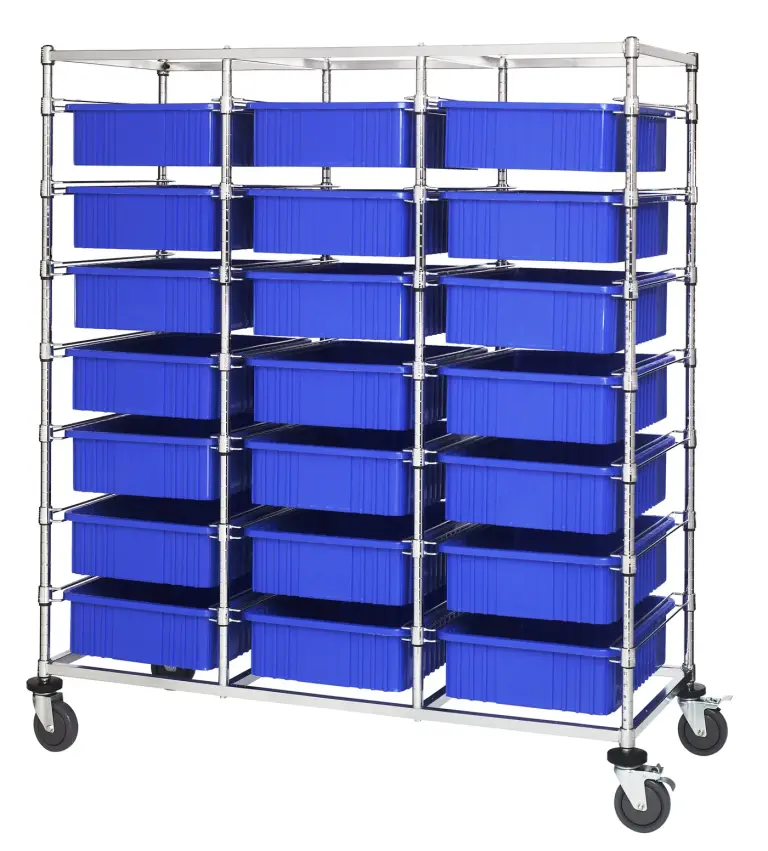 Industrial Utility CartsWire, bin, enclosure and platform carts for order picking, stockroom moves and clean-room transport.
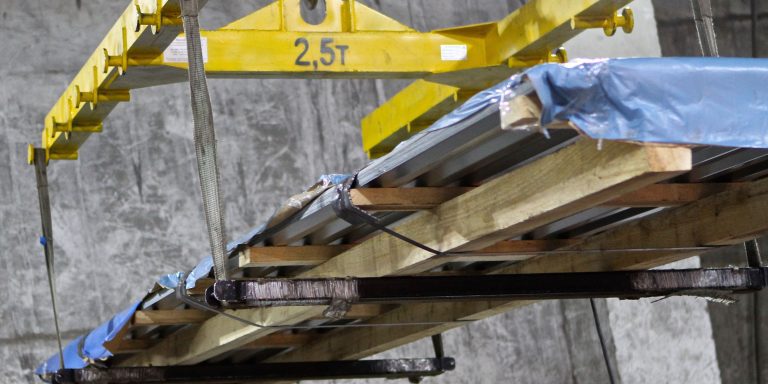 Lifting & Material Transport EquipmentCranes, hoists, lift tables, stackers and pallet jacks, and how to choose between them for a given move.
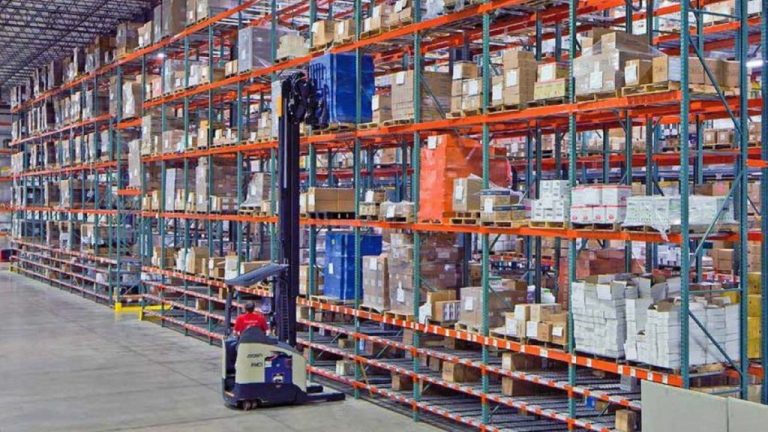 Pallet Rack SystemsSelective, drive-in, push-back, pallet flow and cantilever rack, with capacity and aisle planning guidance.
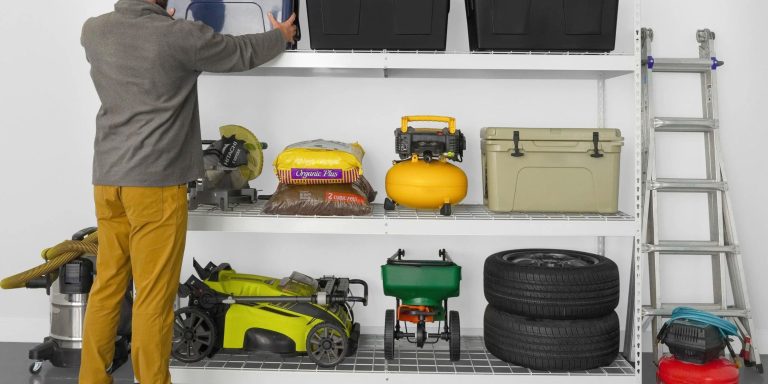 Shelving SolutionsIndustrial, rivet, closed-back, wire and mobile shelving for parts rooms, stockrooms and archives.
 Wholesale Shipping SuppliesCorrugated, mailers, tape, stretch film, void fill and labels in wholesale quantities.
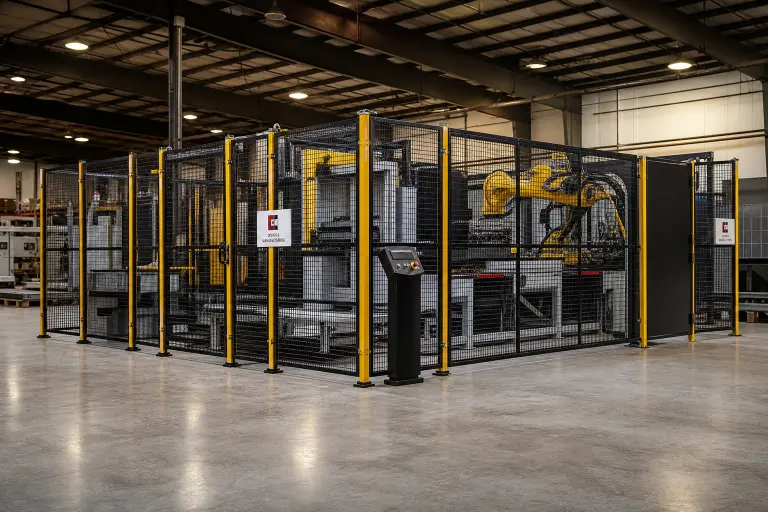 Machine GuardingWire mesh guarding, conveyor guards and safety enclosures that keep people out of moving equipment.
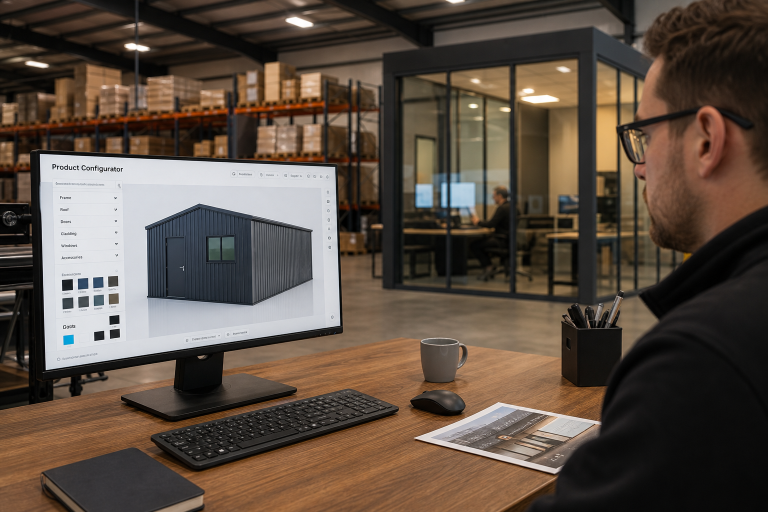 Free Online Design ToolsLay out pallet rack, cantilever rack, security cages, lab benches and modular buildings before you request a quote.
Talk to a Material Handling Specialist
Tell us what needs to move, lift or store. We will size it, draw it and install it — nationwide, from Salt Lake City. Call (800) 326-4403 or request a quote.