
Vestil Loading Dock Equipment
Edge-of-dock levelers, yard ramps, dock lifts, trailer jacks, dockboards, bumpers, and chocks — the full Vestil dock line, specified correctly for your dock and in stock in our online store.
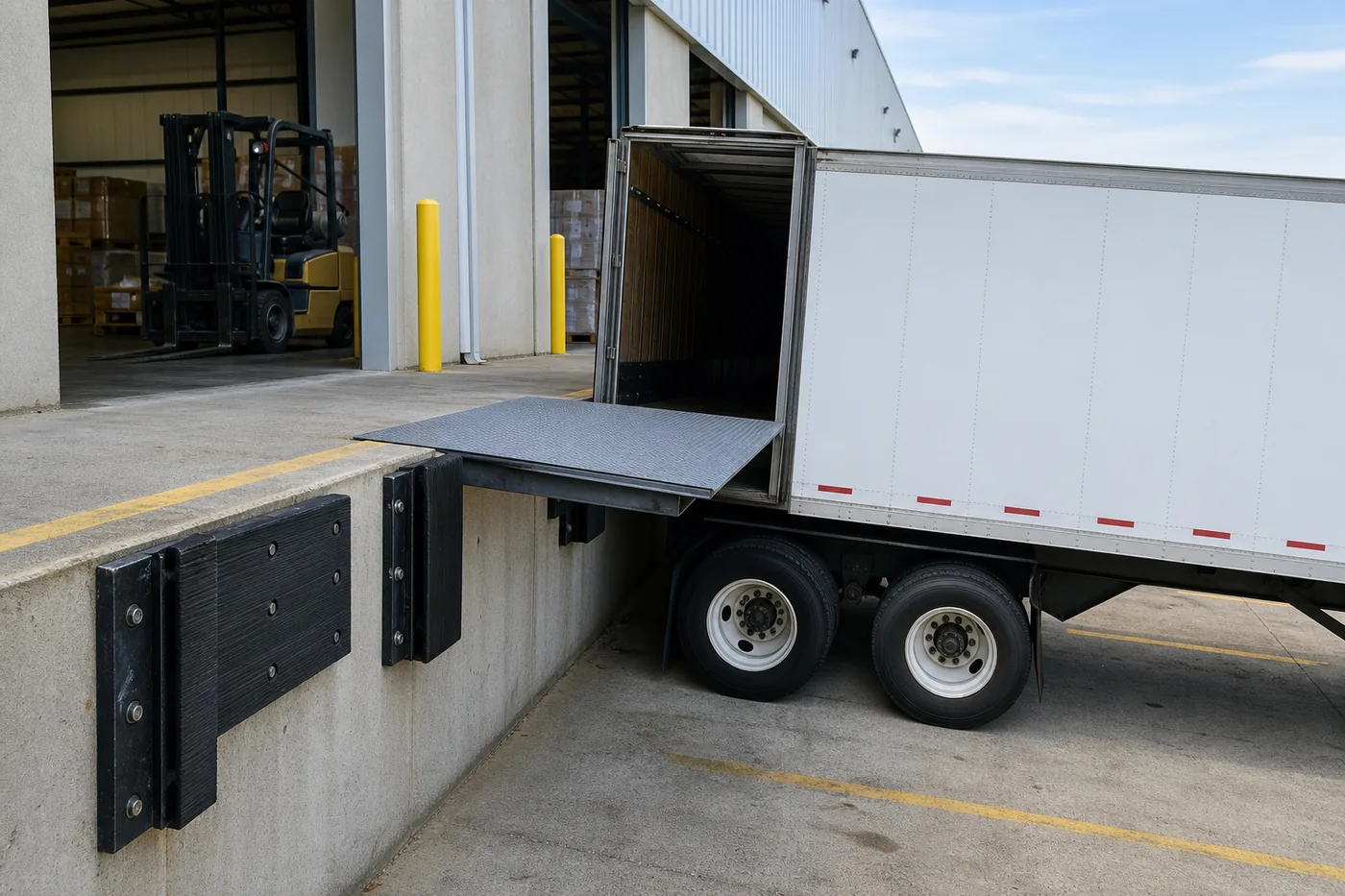
The Loading Dock Is Where Damage and Downtime Concentrate
Almost everything your facility ships or receives crosses the loading dock, and most of the ways a warehouse hurts people and product — trailer separation, forklift runoff, unsecured dock plates, collapsing landing gear — happen in that same few feet.
Vestil Manufacturing builds one of the broadest loading dock equipment lines in the industry, and MH-USA carries it end to end: the leveler or ramp that bridges the gap, the jack that keeps an uncoupled trailer from upending, the chock that keeps the trailer from creeping, and the bumpers that keep trailer impacts out of your building. This page walks through each equipment family, what it does, and how to choose between them — with the OSHA requirements that apply at the dock.
Edge-of-Dock Levelers
Face-mounted levelers that bridge dock to trailer for routine pallet traffic, in capacities to 30,000 lb.
Yard Ramps
Steel and aluminum ramps that create a dock anywhere a trailer can park — up to 30,000 lb capacity.
Truck Scissor Dock Lifts
Hydraulic platforms that lift loads from grade to trailer height where no raised dock exists.
Trailer Stabilizing Jacks
Ratchet and hydraulic jacks that support uncoupled trailers during loading and unloading.
Dock Plates & Dockboards
Aluminum and steel spans for pallet jacks and forklifts, sized to the total moving load.
Bumpers, Chocks & Accessories
Laminated dock bumpers, wheel chocks, wheel risers, holders, and storage racks.
Edge-of-Dock Levelers
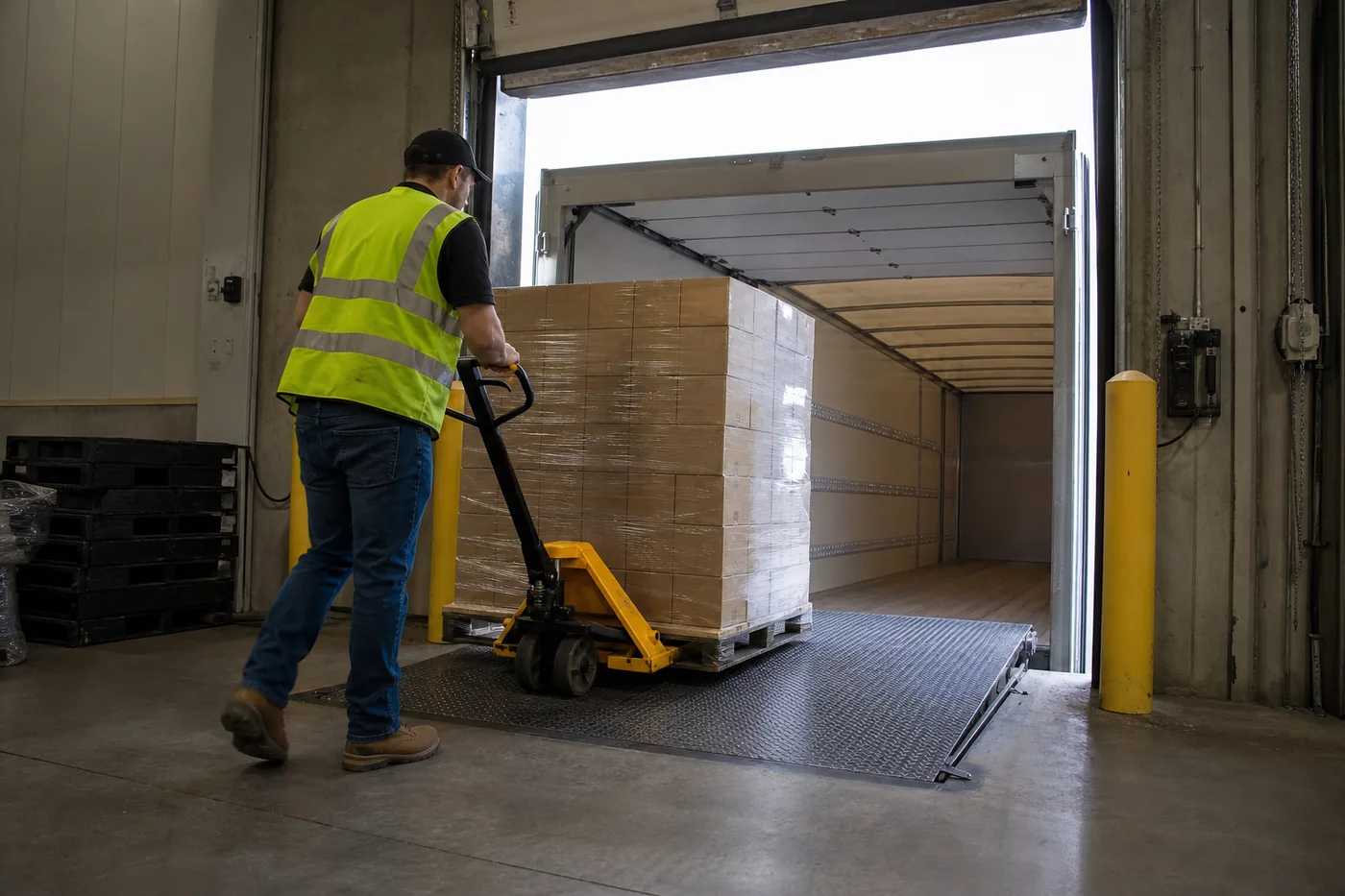
Hand pump Edge-O-Dock levelers bridge routine pallet traffic into the trailer.
An edge-of-dock leveler mounts to the face of the dock and swings up and over onto the trailer bed, bridging the gap without the pit and concrete work a recessed leveler requires. For docks that serve trailers close to dock height with pallet jack and forklift traffic, it is the most economical permanent bridge you can install.
Vestil’s hand pump Edge-O-Dock levelers use a hydraulic hand pump to raise the deck — no bending and lifting with a pry bar. Capacities run from 15,000 to 30,000 lb in 66″ and 72″ usable widths, with a standard ramp reach of 29″ and an extended 36-5/8″ ramp option where you need a gentler grade. Units ship with dock bumpers and installation instructions.
If your trailers vary widely in bed height, or you move heavy powered traffic all day, tell us — that is where a pit leveler or dock lift earns its cost, and we will say so.


Steel and Aluminum Yard Ramps
A yard ramp is a portable loading dock: park a trailer anywhere on your lot, roll the ramp to its rear, and drive a forklift from the ground into the trailer. For buildings with no dock, overflow during peak season, or ground-level container work, it is usually the fastest way to add loading capacity without construction.
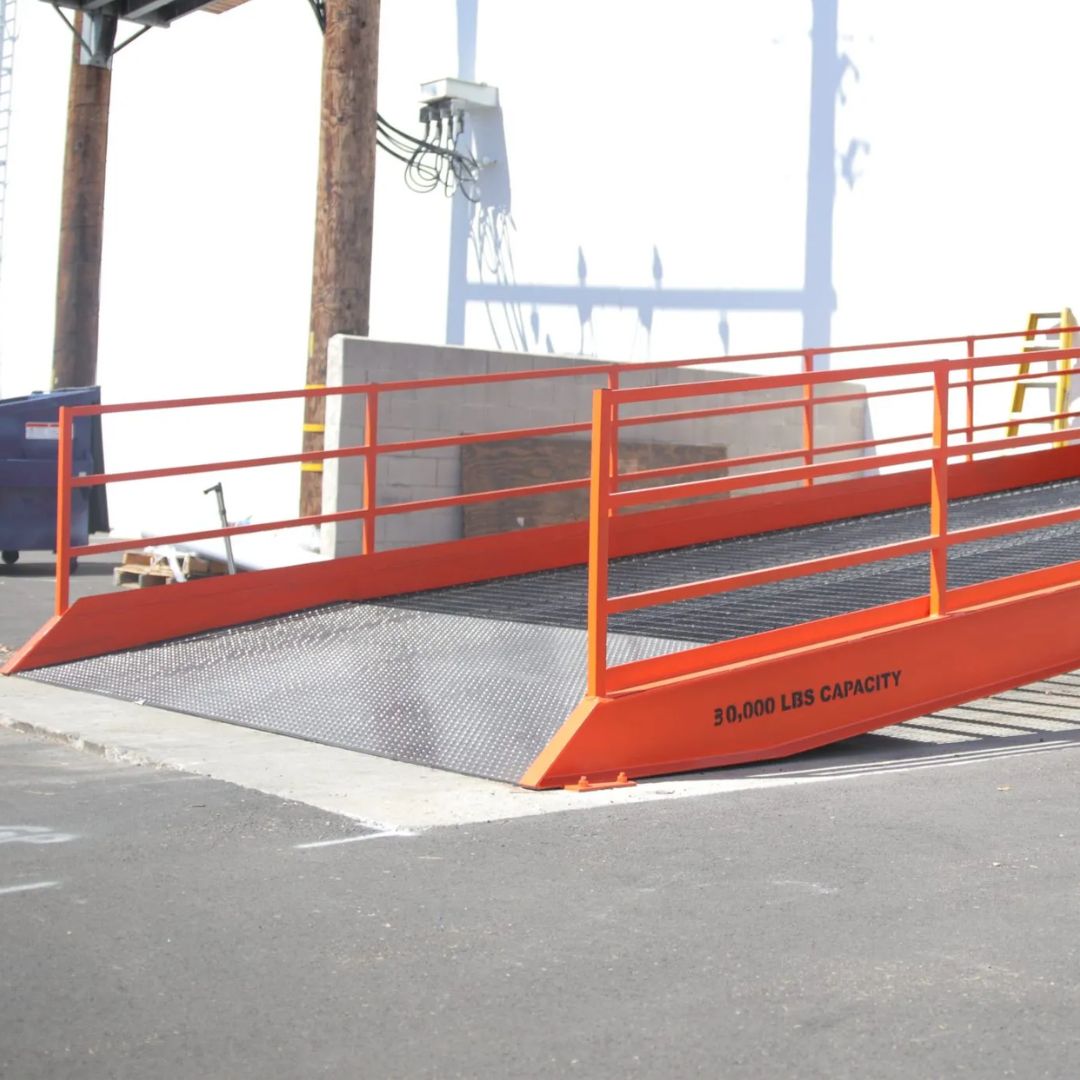
Vestil steel yard ramps use open serrated grating that gives forklift tires positive traction and lets rain and snow fall through, with high steel side curbs to prevent runoff and safety locking chains that secure the ramp to the trailer. Dock-level models (16,000 and 20,000 lb capacities) serve a fixed dock; full yard ramps in the 36-foot class reach trailer beds with a service height range of roughly 45″ to 55″.
Positioning is by hand crank on mechanical models or a hydraulic pump on hydraulic models, and aluminum ramps deliver up to 30,000 lb capacity at far lower weight with no rust.
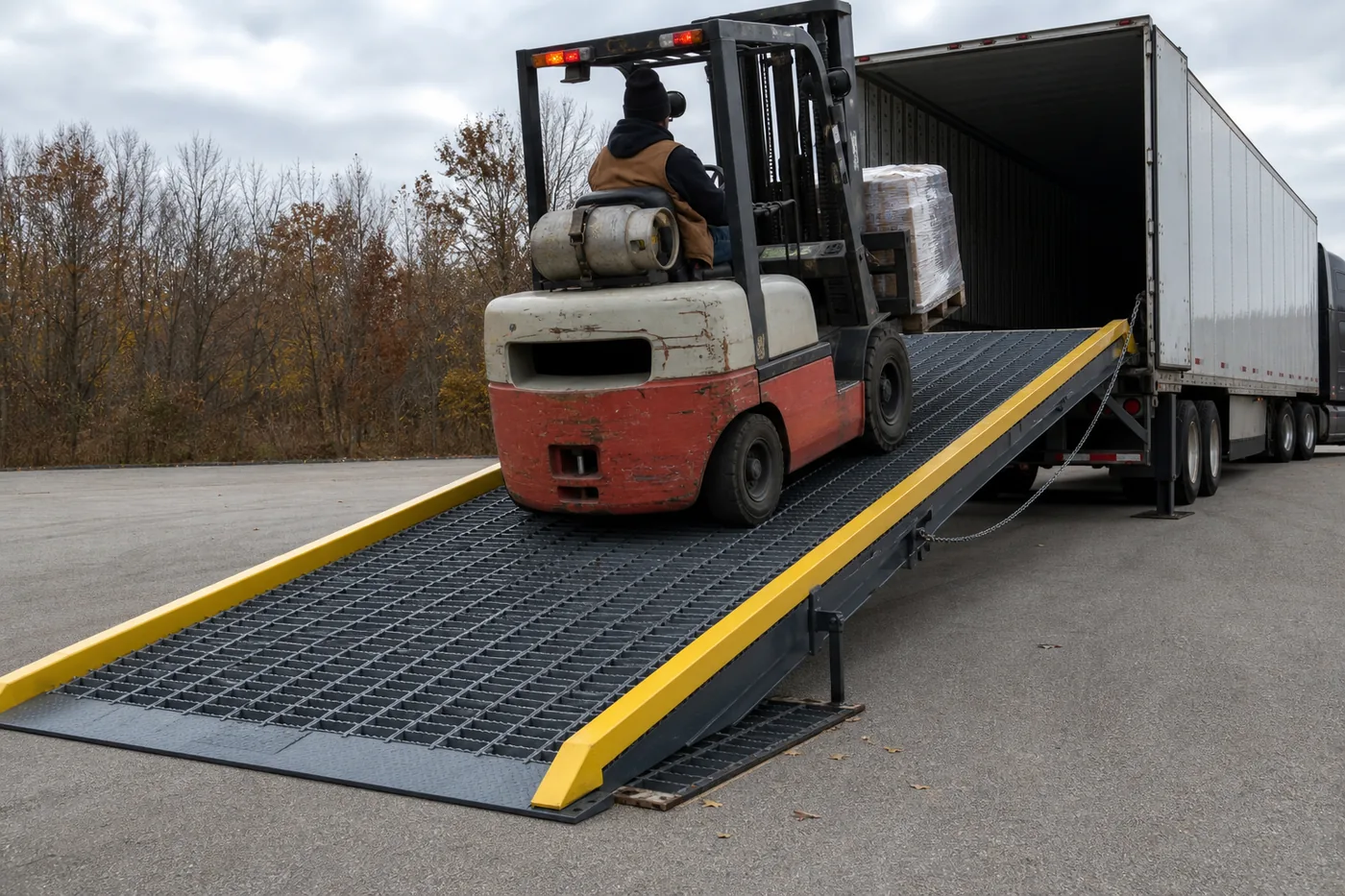
Open grating, side curbs, and locking chains are standard on Vestil steel ramps.
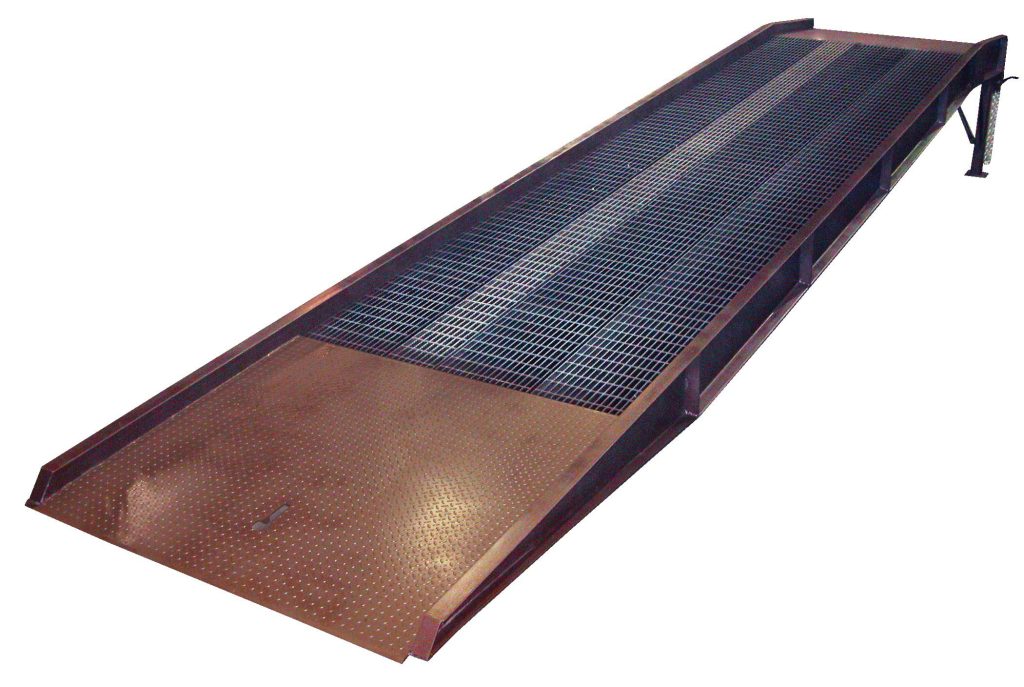


| Ramp family | Material | Capacities | Positioning | Best for |
|---|---|---|---|---|
| Dock-level steel ramps (YRDS) | Steel, serrated grating | 16,000 & 20,000 lb | Hand crank or hydraulic | Serving a fixed dock from grade |
| Overlap-style steel yard ramps (YR) | Steel, serrated grating | Up to 30,000 lb | Hand crank | Heavy trailer and container unloading anywhere in the yard |
| Aluminum yard ramps (AY) | Aluminum, grated deck | 25,000 & 30,000 lb | Hand crank | Corrosive, washdown, coastal, or frequently repositioned applications |
Options include tow bars, fork positioning loops, pneumatic tires, and yellow curb paint. We confirm exact widths, lengths, and service heights per model at quote.
Sizing tip
Size a ramp by the heaviest loaded forklift that will use it — truck weight plus maximum load plus operator — not by the pallet weight alone. If your forklift weighs 9,000 lb and carries 4,000 lb, a 16,000 lb ramp is already close to its limit.
Truck Scissor Dock Lifts
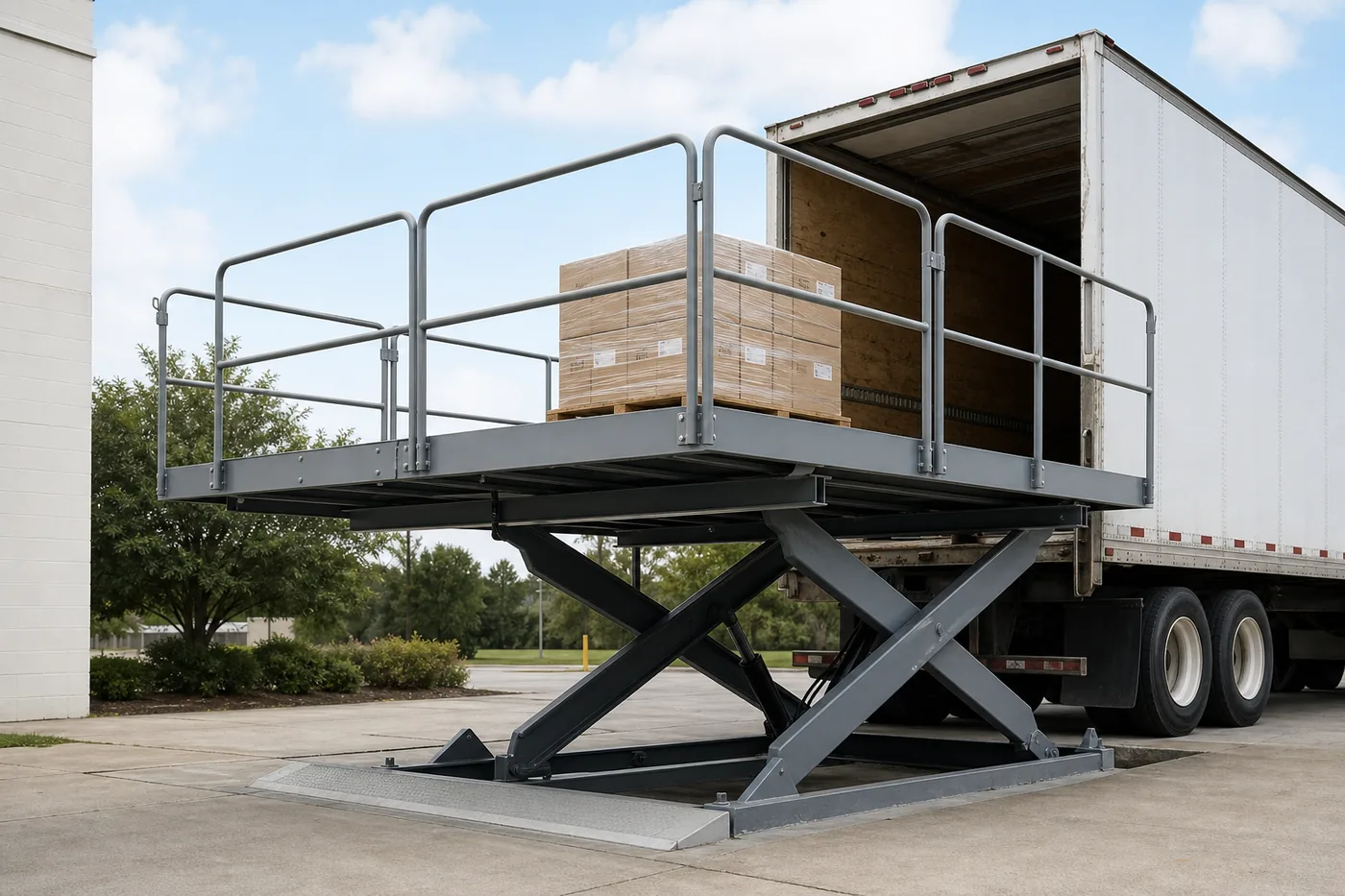
A scissor dock lift turns a ground-level door into a working dock.
When there is no raised dock and a ramp will not work — tight lots, mixed delivery vehicles, or freight too heavy to drive up a grade — a truck scissor dock lift raises the load instead. The platform sits at grade, freight rolls on, and the hydraulic scissor lifts it to the trailer bed, where a bridge spans the last gap. One person with a pallet jack can work an entire trailer.
Vestil’s premium truck scissor dock lifts come in 6,000 and 8,000 lb capacities with platform sizes from 6×8 up to 8×10 ft. A deep options list tailors the lift to the site: handrails with toeboards, split steel or aluminum bridges, approach ramps, mobile wheel kits, stop sign signals, and warning beepers with strobes.
Because a dock lift also serves delivery vans, box trucks, and flatbeds at their own bed heights, it is often the right answer for facilities that receive from many different vehicle types.


Trailer Stabilizing Jacks
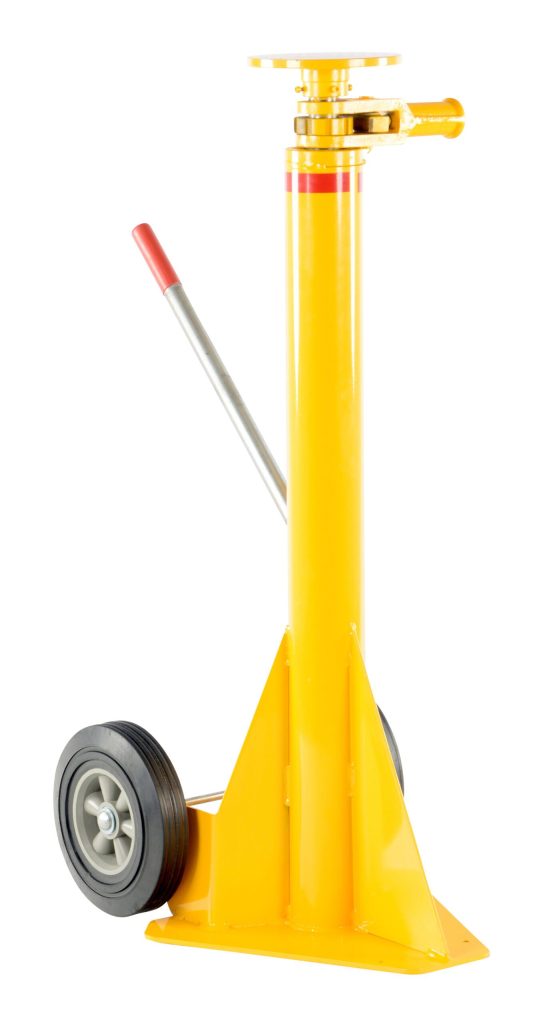
An uncoupled semitrailer at a dock is balanced on its landing gear. Drive a loaded forklift toward the nose and the trailer can tip forward or the landing gear can collapse — one of the most severe accident types that happens at a dock. OSHA’s powered industrial truck standard, 29 CFR 1910.178(k)(3), notes that fixed jacks may be necessary to support a semitrailer and prevent upending during loading or unloading when the trailer is not coupled to a tractor.
Vestil trailer stabilizing jacks position under the trailer nose and take that load. Ratchet models are raised with a two-speed ratchet action and provide 40,000 to 50,000 lb of lifting capacity with supporting capacities up to 100,000 lb, on wide triangular bases with wheels for one-person positioning. A hydraulic beam-style jack raises the trailer with a pump instead of a ratchet.
Run two jacks per trailer — one under each side of the nose — as standard practice for drop-and-hook docks.

Stabilizing jacks control the upending risk on uncoupled trailers.

Dock Plates and Dockboards
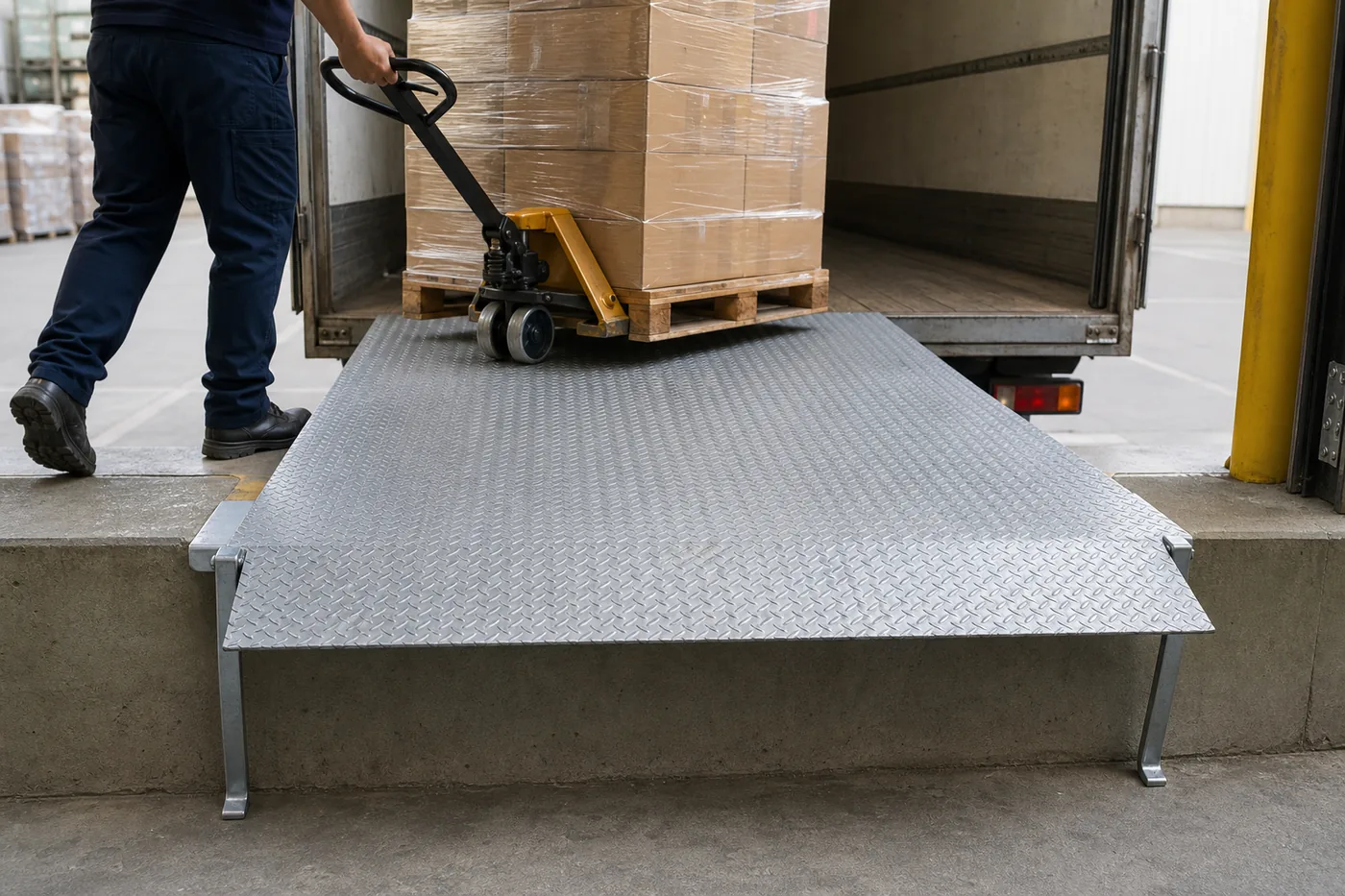
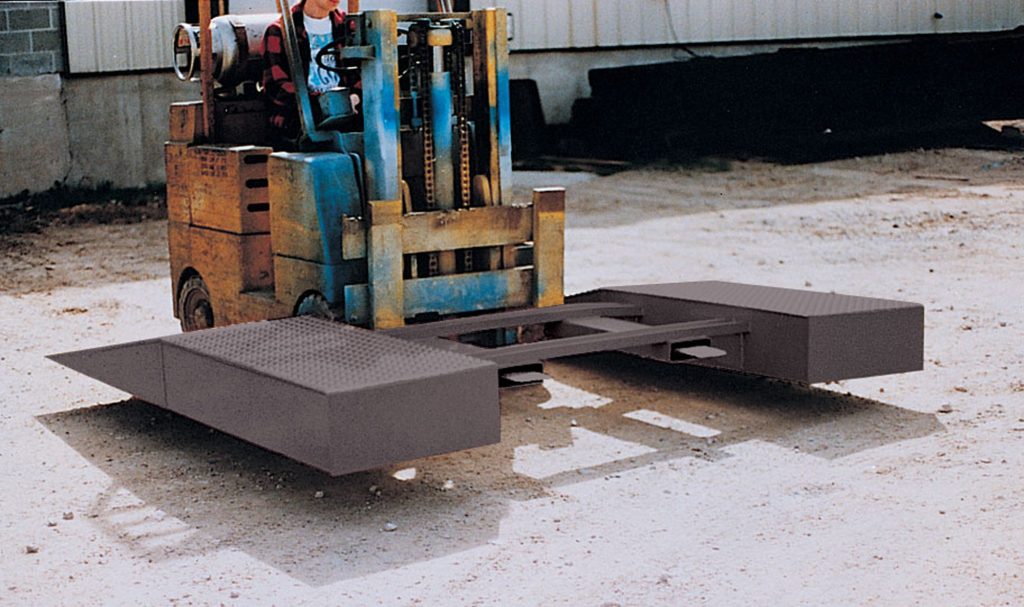
Aluminum plates handle manual traffic; curbed dockboards handle forklifts.
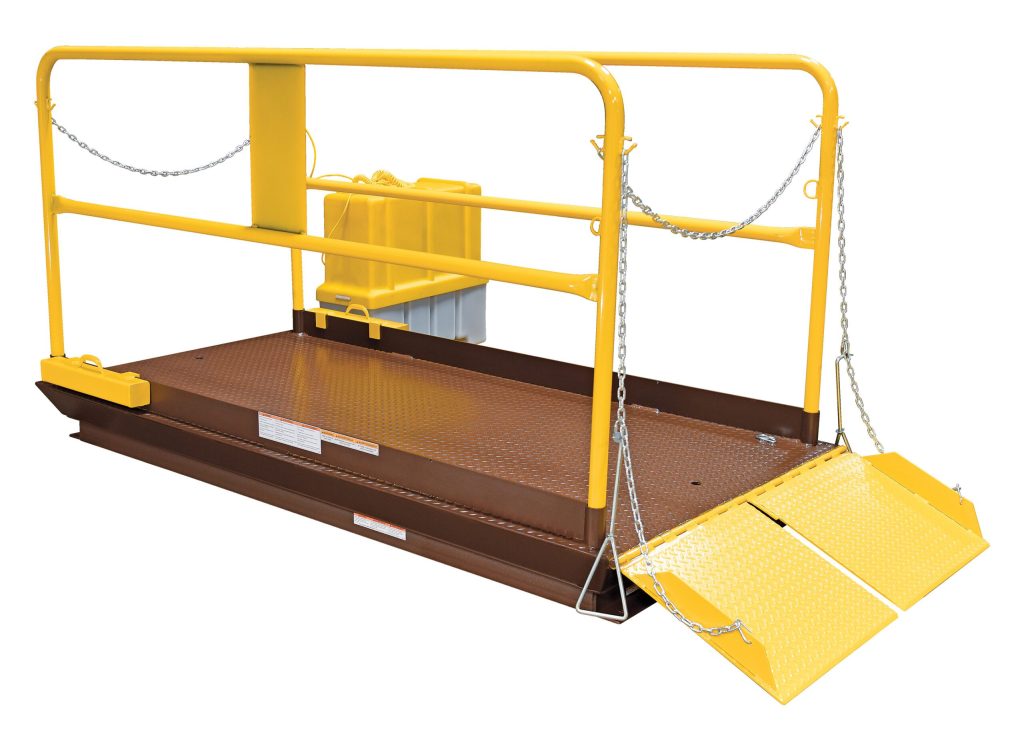
Dock plates and dockboards are the portable spans of the dock world. A dock plate — typically smooth-lifting aluminum with a diamond tread surface — is rated for manual equipment: pallet jacks, hand trucks, and foot traffic. A dockboard is the heavier version with raised side curbs, rated for powered equipment like forklifts. The curbs are not decoration; they are what keeps a forklift wheel from running off the edge.
OSHA 29 CFR 1910.26 sets the rules: dockboards must support their working load, must be secured by anchoring or by devices that prevent them from moving out of a safe position, and portable dockboards must have handholds or other means for safe handling. Size every plate and board by the total moving load — equipment, operator, and cargo together.
Store them properly, too: a dock plate leaned against a wall is a tip-over hazard and gets damaged. Vestil’s dock plate storage rack holds boards upright and out of the traffic path, and a leverlift option makes moving a heavy board a one-person job.
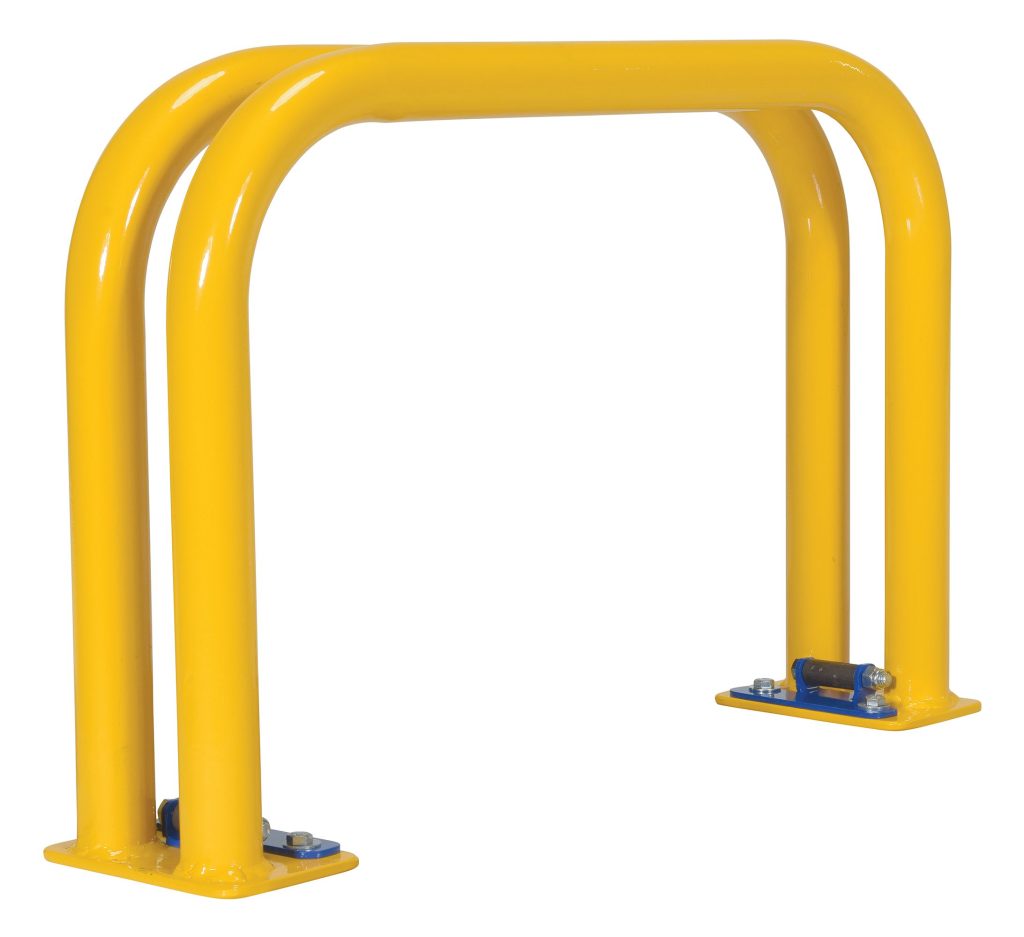

Dock Bumpers, Wheel Chocks, and Accessories
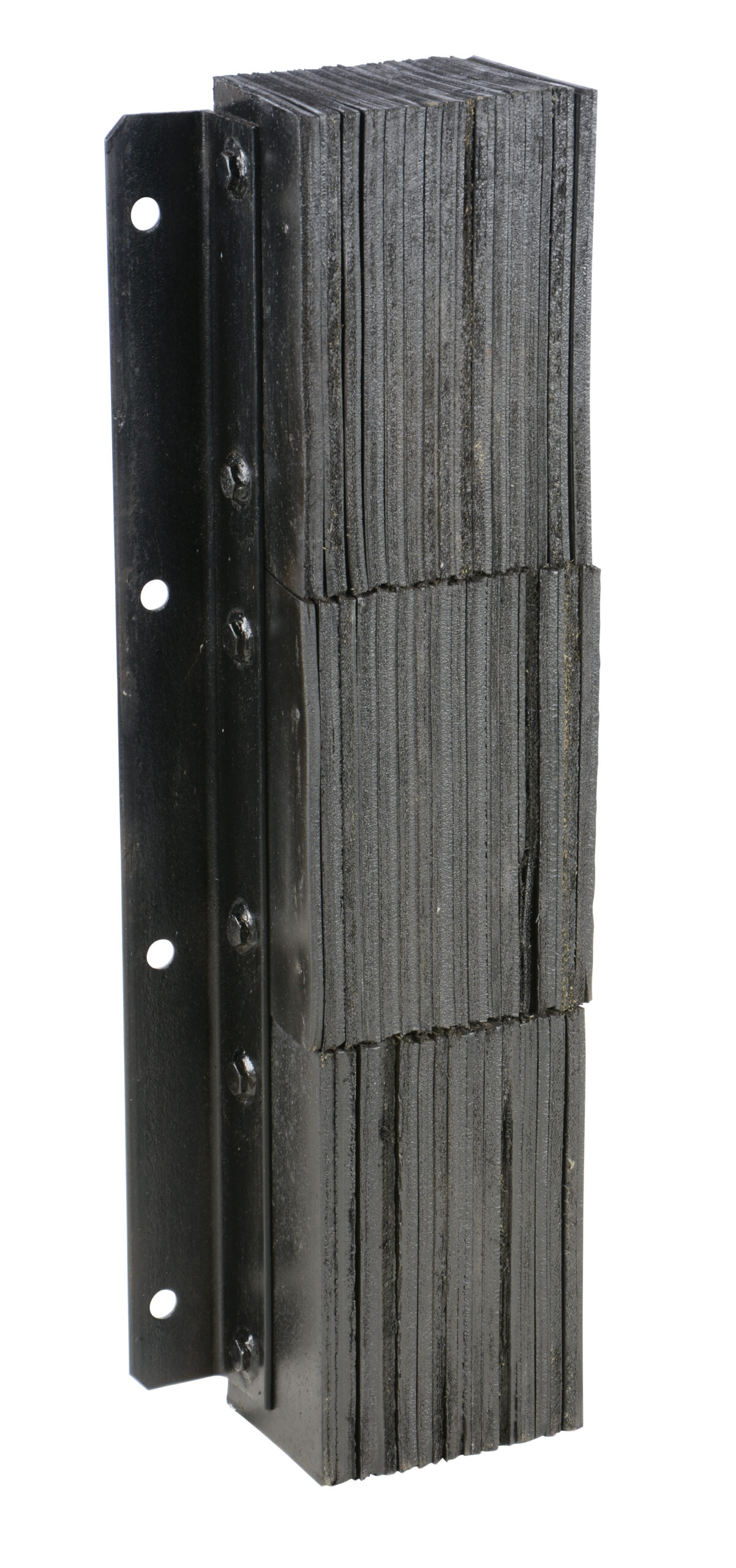
The small hardware at the dock does outsized work. Laminated dock bumpers — layered rubber pads compressed between steel angles — absorb the impact of every trailer that backs in, protecting the dock face and the building structure behind it. Vestil builds them in heights from 20″ to 36″ with 4.5″ and 6″ projections, so you can match bumper height to your dock and trailer mix.
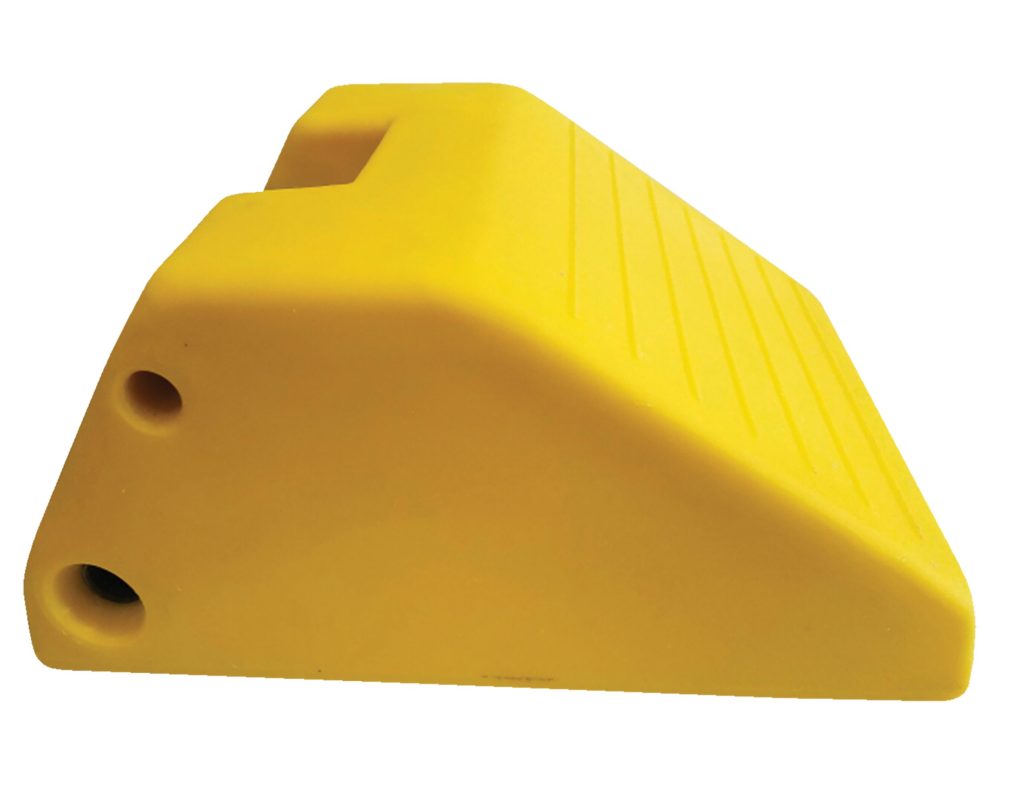
Wheel chocks keep the trailer from creeping away from the dock as forklifts work inside it. OSHA 29 CFR 1910.178(k)(1) requires brakes set and wheel blocks in place to prevent movement of trucks and trailers while they are boarded with powered industrial trucks. Vestil’s heavy-duty molded rubber chocks grip the apron, and chock holders, hanger kits, and 3-ft to 15-ft strap kits keep them at the dock instead of wandering off on a trailer.
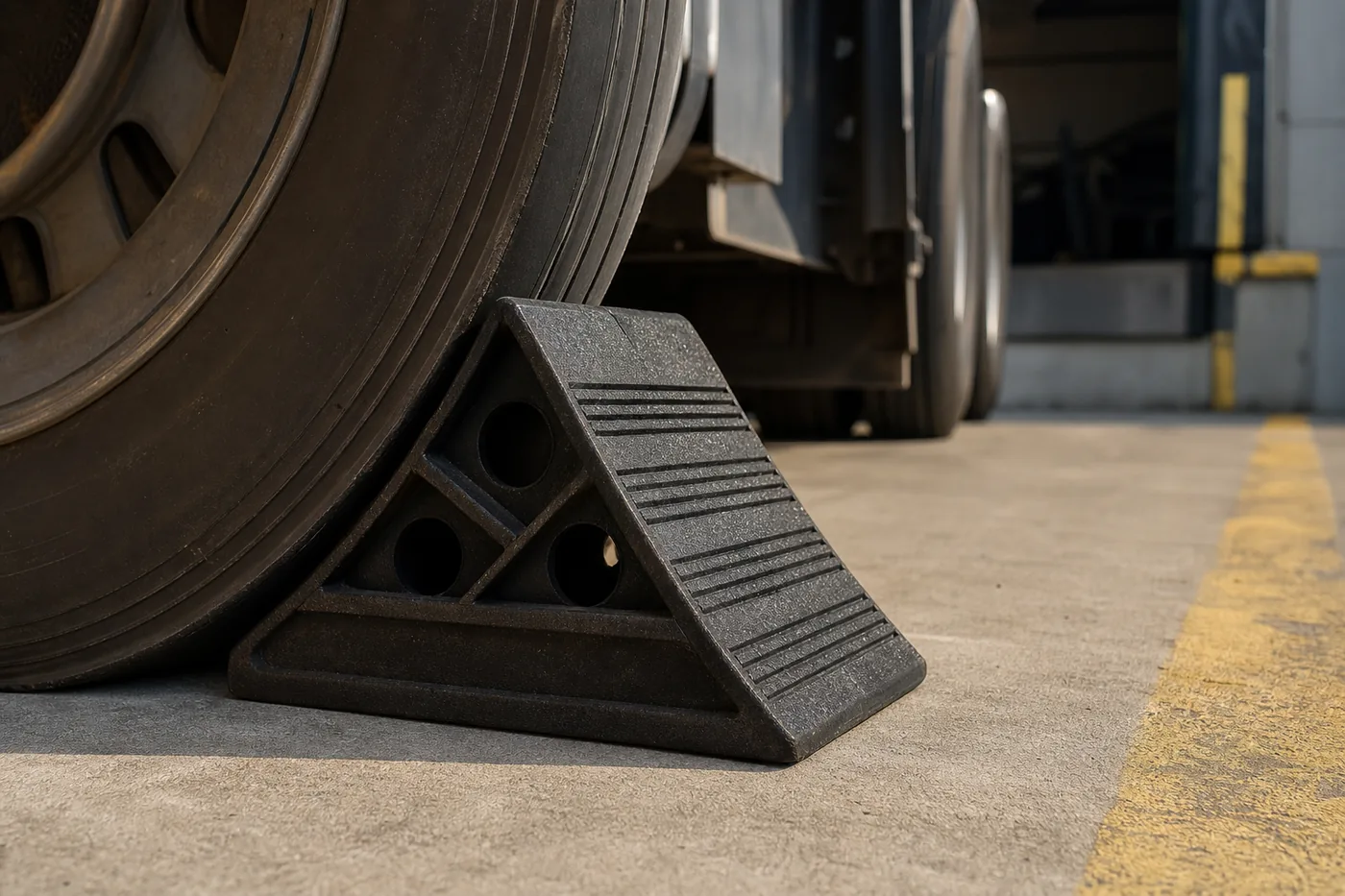
Chocked wheels and set brakes are an OSHA requirement, not a suggestion.

OSHA Requirements at the Loading Dock
Two OSHA general industry standards do most of the work at the dock. Here is how the requirements map to equipment:
| Requirement | Standard | Equipment that satisfies it |
|---|---|---|
| Dockboards support their working load and are secured against movement | 29 CFR 1910.26 | Rated, anchored dock plates and dockboards |
| Portable dockboards have handholds or other safe-handling means | 29 CFR 1910.26(e) | Dock plates with handholds; leverlift options; storage racks |
| Run-off protection where transfer vehicles could run off the edge | 29 CFR 1910.26(b) | Curbed dockboards for powered equipment |
| Brakes set and wheel blocks in place before boarding trucks or trailers | 29 CFR 1910.178(k)(1) / (m)(7) | Wheel chocks, chock holders, and strap kits (or equivalent dock restraints) |
| Support for uncoupled semitrailers to prevent upending | 29 CFR 1910.178(k)(3) | Trailer stabilizing jacks under the trailer nose |
Summary for planning purposes — review the full standards and your own site conditions with your safety team.
The Safe Dock Cycle
Equipment only protects you when it is used in sequence. Train every dock position to run the same cycle on every trailer:
Restrain the trailer
Brakes set, wheel chocks placed against the tires (or dock restraint engaged) before anyone opens the door.
Support the nose
If the tractor is gone, set stabilizing jacks under both sides of the trailer nose before powered equipment enters.
Set the bridge
Position and secure the leveler, dockboard, or plate — confirmed seated, anchored, and rated for the total moving load.
Work the load
Keep speeds down, loads low, and watch trailer creep as weight shifts during the load or unload.
Release in reverse
Store the bridge, pull the jacks, then remove chocks only when the driver is in the cab and ready to pull out.
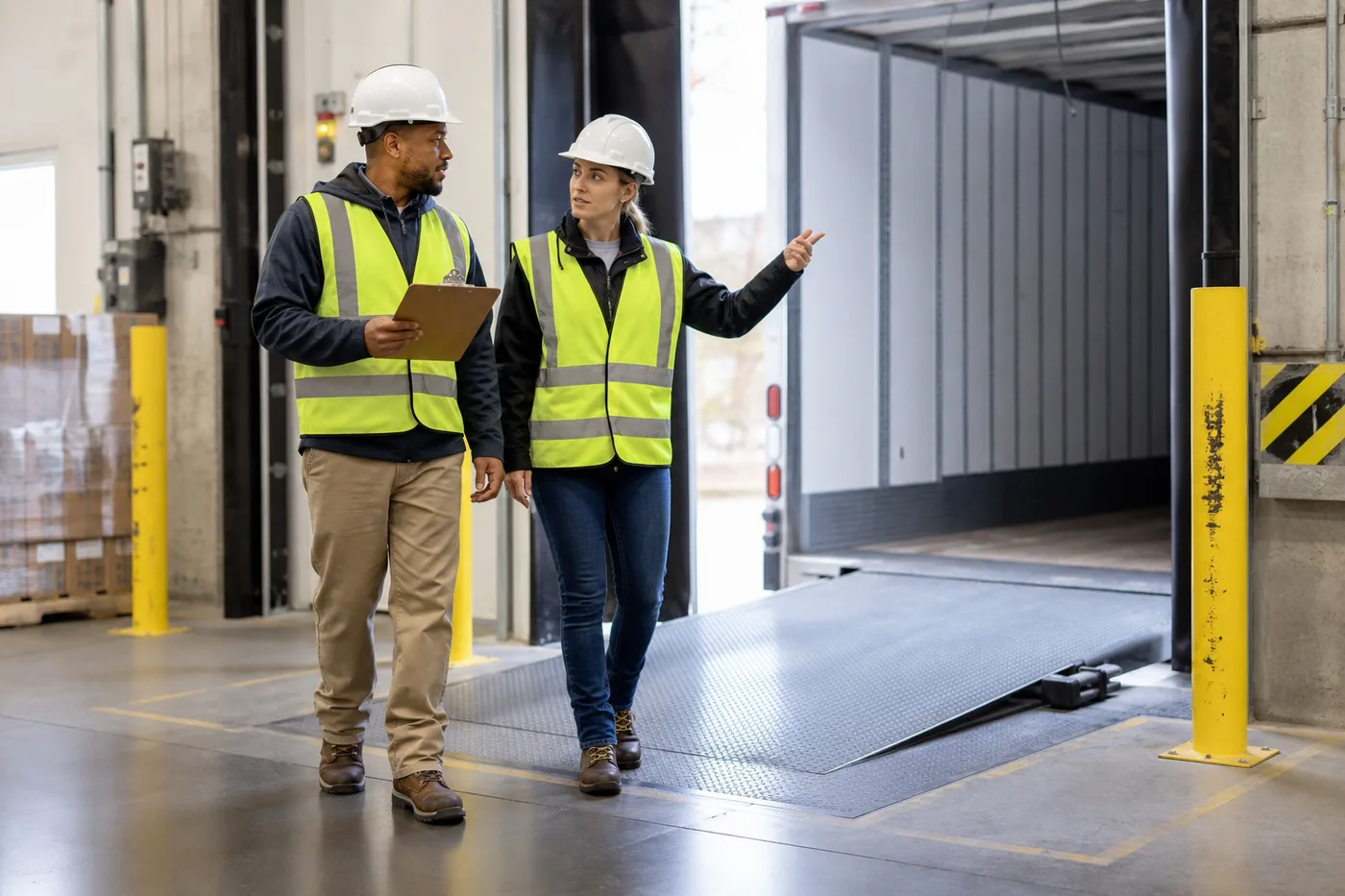
A five-minute dock walk catches most deficiencies: worn bumpers, missing chocks, unsecured plates.
Which Dock Equipment Do You Need?
Start from your situation, not the catalog:
| Your situation | The usual answer |
|---|---|
| Raised dock, trailers near dock height, routine pallet traffic | Edge-of-dock leveler |
| Raised dock, manual equipment only, occasional trailers | Aluminum dock plate |
| Raised dock, forklift traffic across the gap | Curbed steel or aluminum dockboard |
| No dock — forklifts need to enter trailers or containers | Steel or aluminum yard ramp |
| No dock — heavy freight, mixed vehicle types, or no room for a ramp | Truck scissor dock lift |
| Drop-and-hook: forklifts enter uncoupled trailers | Trailer stabilizing jacks (pair) |
| Trailers creep or roll at the dock | Wheel chocks with holders and straps |
| Dock face and wall taking trailer impact damage | Laminated dock bumpers |
| Low trailer beds sitting below dock height | Wheel risers |
- ✓Measure dock height and the bed heights of the trailers you actually serve
- ✓Total moving load: equipment weight + maximum cargo + operator
- ✓Count daily dock cycles — frequency changes the right answer
- ✓Note powered vs. manual equipment crossing the gap
- ✓Check apron slope, drainage, and where a ramp or lift would sit
- ✓Review chocking, restraint, and trailer jack practice against OSHA 1910.178(k)
About Vestil Manufacturing

Vestil manufactures in Angola, Indiana — family-owned since 1958.
Vestil Manufacturing traces to 1958, when it was founded as T&S Equipment in Albion, Michigan. The company moved to Angola, Indiana in 1982 to support its growth, and today operates more than a million square feet of manufacturing and warehouse space in Steuben County. Still family-owned, Vestil has grown into one of the broadest lines in material handling — over 1,000 product lines, many stocked for immediate shipment.
That breadth is exactly what you want at a loading dock, where one project can touch a leveler, a jack, chocks, bumpers, and a storage rack at once. See our Vestil overview for the full range we carry, or browse Vestil brochures for detailed product literature.
Why Buy Vestil Dock Equipment from MH-USA
Stocked Online Store
Hundreds of Vestil loading dock SKUs with live pricing — levelers, ramps, jacks, chocks, bumpers, and options.
Specification Help
We size levelers, ramps, and lifts against your dock heights, loads, and traffic — and tell you when a cheaper option is the right one.
30+ Years of Experience
We have equipped docks, warehouses, and storage systems across the Mountain West and beyond since the early 1990s.
Freight Handled Right
Yard ramps and dock lifts are heavy freight. We coordinate shipping, delivery, and offloading so it arrives ready to use.
One Source for the Dock
Pair dock equipment with pallet rack, conveyor, shelving, and safety netting from a single supplier.
Real Support After the Sale
Parts, options, and answers from people who know the product line — not a marketplace listing.
Vestil Loading Dock Equipment FAQs
What loading dock equipment does Vestil make?
What is an edge-of-dock leveler and when is it the right choice?
What is the difference between a mechanical and a hydraulic yard ramp?
Steel or aluminum yard ramp — which should I buy?
How steep is a yard ramp?
What is a truck scissor dock lift?
Are trailer stabilizing jacks required by OSHA?
What are the OSHA rules for dock plates and dockboards?
What is the difference between a dock plate and a dockboard?
Do I need wheel chocks if my dock has vehicle restraints?
How do dock bumpers protect my building?
How do I get a quote for Vestil loading dock equipment?



Upgrade Your Loading Dock
Tell us your dock height, trailers, and loads — we’ll spec the right Vestil equipment and quote it fast. Or shop hundreds of Vestil dock SKUs online right now.