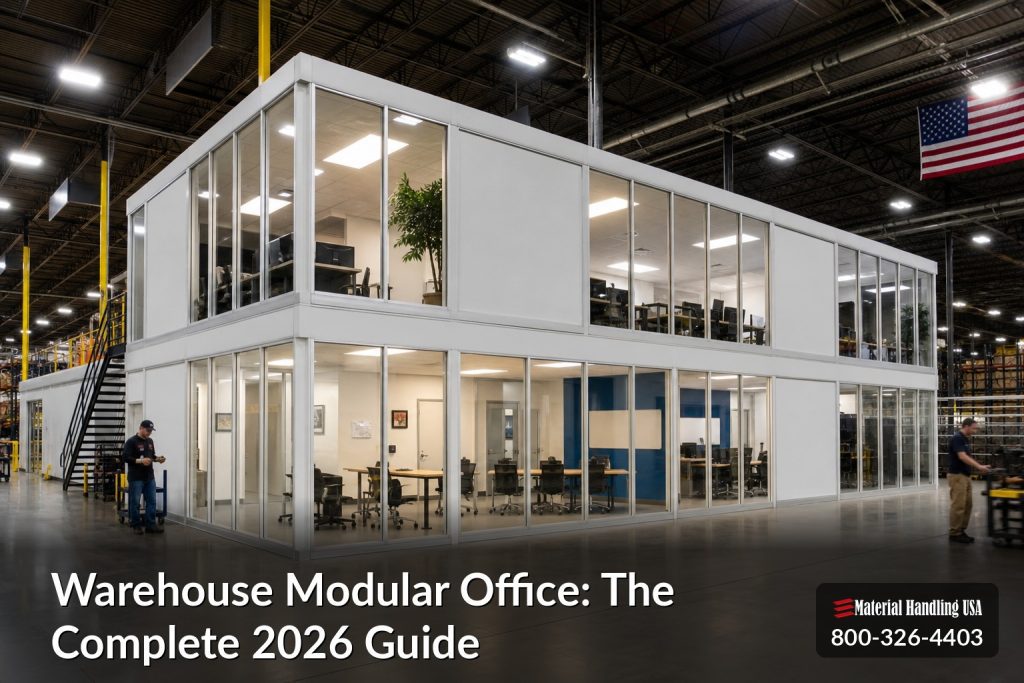
Warehouse Modular Office: The Complete 2026 Guide
URL slug: warehouse-modular-office
Meta title: Warehouse Modular Office Guide for Buyers
Meta description: Explore the warehouse modular office buying guide. Compare options, avoid install pitfalls, and request a free quote today.
Administrative staff are trying to answer calls over forklift traffic. Supervisors need a clear line of sight to the floor but also need a quiet place to review orders, train new hires, and deal with paperwork. The warehouse already feels tight, and nobody wants a drawn-out build that blocks aisles and disrupts shipping.
That’s usually the moment a warehouse modular office stops being a nice idea and becomes an operations decision.
A good in-plant office solves several problems at once. It puts decision-makers closer to receiving, picking, packing, and shipping. It creates separation between foot traffic and active equipment. It gives your team a climate-controlled place to focus without forcing a major renovation inside a working facility.
The broader market tells the same story. The modular construction sector reached $4.7 billion in North America in 2024, and the office and data center segment is projected to grow from $1.4 billion in 2024 to $2.0 billion by 2029 according to the Modular Building Institute industry analysis. That matters because it shows buyers are not treating modular space as temporary compromise. They’re treating it as a practical way to add administrative capacity inside active industrial buildings.
Introduction Why Your Next Office Should Be Inside Your Warehouse
A warehouse office works best when it supports the operation that pays for the building. If your supervisors spend half the day walking back and forth to a distant office, you lose time in small increments that add up fast. If customer service, inventory control, or quality staff are tucked away from the floor, communication slows down and mistakes get harder to catch early.
A warehouse modular office fixes that by placing the office where the work happens. That sounds simple, but its primary benefit is operational. Managers can respond faster. Teams can hold short floor-level meetings without commandeering break areas. Visitors and auditors have a controlled place to stand without entering active travel lanes.
Why buyers are moving this direction
Modular offices also fit the way warehouses change. Layouts shift, storage programs evolve, and one department often outgrows the space originally planned for it. A conventional office build assumes the first layout will stay right for years. That’s rarely how warehouses behave.
Operational reality: The best office location on opening day often isn’t the best location two peak seasons later.
That’s why many buyers now evaluate office space as part of overall facility design, not as a separate construction project. The office has to support throughput, safety, supervision, and future layout changes. If it can’t move, expand, or integrate cleanly with the building systems already in place, it can become the next bottleneck.
What Is a Warehouse Modular Office
A warehouse modular office is a prefabricated office system designed for use inside an industrial building. It’s assembled from engineered wall panels and structural components rather than built piece by piece like a conventional interior renovation. Some systems are panelized and assembled in place. Others are factory-assembled on a welded base and delivered ready for fast installation.
The important distinction is this. Modular doesn’t mean flimsy, and it doesn’t mean makeshift. It means the office is designed as a manufactured building system rather than a one-off carpentry job.
What it is and what it isn’t
A modular office is usually the better fit when you need:
- Faster deployment: Less disruption inside an active warehouse
- Cleaner installation: Fewer trade conflicts and less debris than stick-built work
- Future flexibility: The option to relocate, expand, or reconfigure later
- Controlled specifications: Predefined wall, door, glazing, and utility options
It is not the best answer for every scenario. If you’re doing a full permanent building renovation with no expected layout changes and deep structural modifications already planned, conventional construction may still make sense. But that’s not how most warehouse office projects start. Most start because operations need functional space quickly and can’t afford a messy build in the middle of production.
Modular office vs traditional stick-built construction
| Factor | Warehouse Modular Office | Traditional Stick-Built Office |
|---|---|---|
| Installation approach | Prefabricated components or factory-assembled sections | Built on site from raw materials |
| Disruption to operations | Typically lower, with cleaner and faster assembly | Usually higher due to longer on-site trade work |
| Flexibility | Can often be relocated or reconfigured | Usually fixed in place |
| Layout changes later | Simpler when using panel systems | More invasive and demolition-heavy |
| Utility planning | Best handled upfront during design | Often adjusted during field construction |
| Best fit | Active facilities that need speed and adaptability | Permanent renovation projects with low need for future change |
Forkliftable systems change the conversation
Many modular offices are factory-assembled on a welded steel base, which makes them forkliftable. According to Carolina Handling’s modular warehouse office overview, that design enables relocation in hours, not weeks, which helps facilities that may shift layouts 2 to 4 times per year, and it can cut relocation labor costs by 60% to 80% compared with demolishing and rebuilding a traditional office.
That single feature changes how buyers should think about office space. Instead of treating the office as a fixed improvement, you can treat it as an operational asset that moves with the workflow.
A warehouse rarely stays static. Your office system shouldn’t force the rest of the building to work around yesterday’s layout.
What works well in practice
The best modular office projects usually share a few traits:
- The purpose is specific. Shipping office, supervisor station, QA room, conference room, or multi-office suite.
- The location is chosen by workflow, not empty floor space alone.
- Utilities are planned before fabrication.
- The buyer treats acoustics, HVAC, and fire protection as core design items, not add-ons.
What doesn’t work is buying on footprint alone. A 10×12 office can still fail if the door swings into a travel lane, the HVAC is undersized, or the glazing puts glare on every screen inside.
The Strategic Benefits for Modern Warehouses
A modular office earns its keep when it improves the operation faster than a traditional build would. Speed matters because downtime and disruption inside a warehouse cost more than most estimates capture. Supervisors reroute traffic. Shipping loses space. Maintenance gets dragged into temporary fixes.

The schedule advantage is well documented. 66% of building professionals report accelerated project schedules, and 35% achieve reductions of four weeks or more, according to this review of modular construction advantage statistics. For a warehouse, that earlier turnover means management can start using the space sooner and recover the investment faster.
Where the ROI usually shows up first
The first returns tend to be operational, not cosmetic.
- Faster supervision: Managers are closer to inbound, outbound, or production activity.
- Better working conditions: Staff get a quieter, enclosed environment for paperwork, calls, and meetings.
- Safer circulation: Office work moves out of open floor areas and away from equipment routes.
- Less disruption during install: Warehouses keep running while the office goes in.
If you’re responsible for warehousing operations management, this is the part that matters most. Office placement affects communication, response time, and control on the floor more than many facilities teams expect.
The tax and lifecycle angle
In some cases, modular offices may be classified as equipment rather than real estate, which can support faster depreciation than conventional construction. That’s one reason finance teams often respond well to modular proposals when the project is framed correctly. The value isn’t just a room. It’s a deployable operational asset with a long service life and lower disruption profile.
Buyer’s lens: The strongest modular office justification combines schedule, operational efficiency, and lifecycle flexibility. If you pitch only aesthetics, the numbers usually won’t hold.
Designing Your Perfect In-Plant Office
Design starts with purpose. A shipping office needs visibility, transaction counters, and room for printers and paperwork. A supervisor office usually needs sightlines and sound control. A QA room may need more enclosure and cleaner finishes. A conference room has different occupancy and HVAC needs than a one-person office.
That’s why the first design mistake is choosing a footprint before defining the work that happens inside it.
Start with the job, not the dimensions
Use these questions early:
- Who will use the office every day
- What tasks happen inside
- How much visual connection to the floor is needed
- Whether the space needs one room or several
- What equipment, screens, printers, or counters must fit
- How visitors, managers, and operators enter the space
The second decision is material specification. Standard warehouse modular offices commonly use a 4-inch insulated wall system with a vinyl-clad 1/2-inch gypsum face, and those systems can provide STC ratings up to 47, according to United Partition Systems’ warehouse office specifications. In plain terms, that means much better sound control than a makeshift office built with light materials and wishful thinking.

Design choices that matter more than buyers expect
Some specifications look minor on paper but make a big difference once the office is occupied.
| Design item | Why it matters in a warehouse |
|---|---|
| Window placement | Improves supervision but can create glare or privacy issues |
| Door type and swing | Affects traffic flow and safety near equipment lanes |
| Wall construction | Drives acoustics, durability, and finish life |
| Electrical/data raceways | Reduces field modifications and messy retrofits |
| HVAC approach | Determines comfort, air balance, and usable seasons |
| Interior layout | Controls whether the office feels efficient or cramped |
For a closer planning reference, review in-plant office design guidance before you finalize a quote request. It helps buyers think through layout, use case, and facility fit before they commit to a specific configuration.
A practical design checklist
- Locate for workflow: Put the office where decisions are made, not where leftover floor space happens to be.
- Specify acoustics early: Noise control is far easier to design in than to retrofit later.
- Plan utility walls: Decide where power, data, and HVAC should enter before fabrication.
- Choose glazing with intent: More glass improves visibility, but too much can reduce privacy and wall space.
- Leave room for growth: If the team is likely to expand, design panel layouts that can be extended later.
Navigating Codes Utilities and Structural Needs
Most modular office delays don’t come from the office itself. They come from tying that office into the building around it. The office may be simple. The warehouse systems usually aren’t.

A major issue is systems integration. A 2025 IFMA report noted that 62% of warehouse retrofits face delays from MEP mismatches, which is why planning for utilities and code compliance matters so much in modular office projects, especially around connections to facility services and sprinkler requirements such as NFPA 13, as discussed in this overview of modular office space challenges in warehouse environments.
HVAC, electrical, and fire protection
HVAC is where many projects get underspecified. Buyers assume the warehouse’s ambient air will be good enough, or they assume a small unit can solve comfort across all seasons. It usually can’t. Office occupancy, glazing, roof exposure, and surrounding warehouse conditions all change the load.
Electrical work needs the same level of discipline. Circuit availability, panel capacity, data routing, lighting, and outlet placement should be reviewed before fabrication. A useful general reference on workplace risk is this guide on eliminating electrical hazards in the workplace, especially for teams coordinating office installation in active industrial areas.
Fire protection is paramount. If the office affects sprinkler coverage, ceiling conditions, or egress, the building department and fire authority may want drawings and revisions before approval. Buyers who skip this discussion early are the ones who get surprised late.
Questions that should be answered before fabrication
- Will the office tie into existing HVAC or use dedicated equipment
- Where will electrical feeds and data enter
- Does sprinkler coverage need to be modified
- Are there permit or occupancy triggers for this installation
- Will the floor slab support the final placement
- Are there clearance issues with lights, ducts, or rack flues
The cleanest modular office installs start with ugly coordination meetings. That’s where the real problems get solved.
For specification planning, modular building specifications are worth reviewing before final engineering. They help buyers align product assumptions with code, utility, and structural realities.
Structural fit matters too
Even ground-level offices need structural thinking. The slab condition matters. Overhead clearance matters. Forklift routes matter. If the office sits below other structures or near active storage systems, you also need to think about impacts, guarding, and maintenance access.
What doesn’t work is treating the office like furniture. It’s a building element inside another building. It has to fit the host facility physically and legally.
Integrating Offices with Mezzanines and Racking Systems
A modular office gets more valuable when it’s designed as part of the warehouse layout, not dropped in as an afterthought. The strongest examples are usually tied to vertical space strategy.

An office under a mezzanine can turn otherwise awkward space into productive square footage. An office on top of a structural platform can create floor supervision below and administrative space above. In some layouts, the office becomes part of a broader storage and access plan rather than a stand-alone room.
Common integration approaches
| Configuration | Best use | Main design concern |
|---|---|---|
| Office below mezzanine | Uses lower-level footprint efficiently | Headroom, lighting, sprinkler coordination |
| Office on top of mezzanine | Adds administrative space without consuming floor area | Structural loading and egress |
| Adjacent to racking zones | Keeps supervisors close to inventory activity | Traffic safety and sightlines |
| Multi-level in-plant office | Separates functions by floor | Access, code review, utility routing |
The key is sequencing. If the mezzanine, office, stairs, guarding, and utilities are designed together, the result feels intentional. If they’re purchased separately, field conflicts usually follow.
Where buyers get into trouble
The biggest integration mistake is ignoring workflow. A mezzanine-supported office may look efficient on a drawing but fail in practice if stair travel is inconvenient, visibility is poor, or the office blocks picking movement below.
Another mistake is treating racking and office systems as unrelated. They’re not. Forklift travel, product replenishment, and emergency access all affect where the office should go.
If your project involves raised or combined systems, review mezzanine options and planning details as part of the same design effort. The office should support storage density and supervision, not compete with them.
Good warehouse design stacks functions. Bad warehouse design stacks conflicts.
Your Buyer Checklist and Calculating ROI
Most quote requests fail because they’re too vague. “We need an office in the warehouse” isn’t enough to get a useful proposal. Better input produces a better layout, cleaner pricing, and fewer surprises during install.
Buyer checklist for an accurate quote
- Define the use case: Shipping, supervisor office, QA, conference room, break area, or mixed use
- Mark the location: Include nearby rack, columns, dock doors, conveyors, and travel lanes
- List occupancy needs: Daily users, visitors, and how private or open the space should feel
- Note utility requirements: Power, data, lighting, HVAC, and any fire protection impacts
- Clarify access: Door location, stair needs, forklift exposure, and ADA or egress considerations
- Flag future changes: Possible expansion, relocation, or integration with a mezzanine later
A simple ROI framework
You don’t need a complicated spreadsheet to justify a warehouse modular office. Start with the practical business case:
- Time to use: How much earlier can the office be occupied compared with conventional construction?
- Operational disruption: What internal cost is avoided by reducing blocked areas, dust, noise, and trade traffic?
- Productivity value: What improves when supervisors and support staff work closer to the floor?
- Lifecycle flexibility: What future cost is avoided if the office can be reconfigured or moved instead of demolished?
- Tax treatment: Whether your accounting team sees additional value in equipment-style treatment and faster depreciation.
Use qualitative inputs if you don’t have exact internal cost data. That’s still enough to make a strong comparison. A good modular office proposal should also include a layout that shows how the space will work operationally, not just what it will cost.
Procurement shortcut: If a vendor asks better questions before quoting, the project usually goes better after the order too.
When you’re ready to move from concept to pricing, Request a Quote, Contact Us, or Call (800) 326-4403 for a free layout and no-obligation design review.
Frequently Asked Questions About Modular Offices
How durable is a warehouse modular office
Modular offices built for industrial use are not temporary pop-ups. Verified industry guidance indicates they commonly last 25 to 35 years in industrial settings when properly maintained. Durability comes from steel framing, insulated panels, and finishes intended for active facilities.
Can a modular office really handle warehouse noise
Yes, if you specify the right wall system and door package. Standard systems can use 4-inch insulated walls with STC ratings up to 47, which is enough to make a noticeable difference in spaces with forklift and machinery noise. The result depends on the whole assembly, not just the wall panel.
How long does installation usually take
Installation depends on size and complexity, but standard modular office systems can be installed much faster than traditional construction. Some standard units are installed in 1 to 5 days based on the product configuration and site readiness. The catch is that site coordination still matters. Utility and permitting issues can delay any project if they aren’t handled early.
Can the office be moved later
Often, yes. Many systems are designed for relocation, and some are forkliftable. That’s one of the strongest long-term advantages for warehouses that regularly change layout.
Can I buy online or should I request a quote
If you already know the configuration, Buy Online or Shop Now through the appropriate product pages can be efficient. If your project involves utilities, code review, mezzanines, or custom layout questions, it’s smarter to Request a Quote first.
Conclusion Start Your Warehouse Transformation Today
A warehouse modular office is usually the right choice when you need speed, cleaner installation, better supervision, and room to adapt later. It gives warehouse teams a practical way to add professional workspace without the disruption and rigidity that come with many conventional interior builds.
Planning is the key separator. Buyers who define the use case clearly, coordinate HVAC and electrical early, and treat fire protection and structural fit as part of the initial scope tend to get the best results. Buyers who leave those decisions for later usually discover that the office itself was the easy part.
Demand for flexible industrial space isn’t slowing down, and planning earlier gives you more options on layout, permitting, and installation timing. A well-timed project can improve workflow sooner and help you avoid the delays that come when office space becomes a reactive fix instead of a planned upgrade.
Material Handling USA helps buyers plan, specify, and source the right warehouse modular office with competitive pricing, quality materials, fast delivery, free layouts, and free quotes. If you’re comparing options or need a custom design, Contact Material Handling USA, Request a Quote, email Sales@MH-USA.com, or Call (800) 326-4403.
Who This Is For
Our warehouse modular office solutions are designed for:
- Warehouse managers and operations directors
- Facility planners and engineers
- Property managers
- Government facility coordinators
- Manufacturing plant managers
- Distribution center operators
Common Applications
Warehouse & Distribution
Optimize storage capacity and material flow with warehouse modular office.
Manufacturing
Improve organization and efficiency with industrial-grade warehouse modular office.
Government & Military
Meet security and compliance requirements with certified warehouse modular office solutions.