Meta title: What Is a Dolly and How to Choose the Right One
Meta description: Learn what is a dolly, how to choose the right type, and improve safety and efficiency. Request a Quote or call 800-326-4403.
URL slug: what-is-a-dolly
A warehouse manager usually notices the problem before anyone writes it into a report. Two employees stop to wrestle a load that should have moved in one trip. A lab bench sits in the aisle because nobody wants to risk dragging it. A replacement appliance arrives, but getting it from receiving to install becomes a half-hour disruption.
That is where most conversations about dollies start. Too often, they also end with a generic definition.
A dolly is not just a platform with wheels. In daily operations, it is a low-cost decision that affects labor use, injury exposure, aisle flow, and how often your team improvises around bad equipment. The issue is not whether a facility needs dollies. The issue is whether it has the right ones in the right places.
Search results rarely help with that decision. As noted in this overview of the content gap around dolly ROI and facility metrics, existing search content provides no framework for quantifying how dollies improve warehouse operations, and it does not connect dolly selection to operational KPIs, compliance requirements, or facility efficiency standards.
That gap matters. Managers do not buy dollies to learn vocabulary. They buy them to reduce avoidable handling, keep work moving, and avoid spending more on the wrong tool later.

If you are reviewing your handling process, aisle layout, or transport points between work zones, it helps to look at dollies as part of a broader material handling strategy, not as a miscellaneous accessory.
Key takeaway: The right dolly removes friction from routine moves. The wrong dolly creates workarounds, delays, and preventable risk.
Moving Beyond Muscle Your Introduction to Strategic Material Handling
Manual handling problems usually show up in ordinary tasks. Cases are too heavy to carry comfortably. A piece of equipment is not heavy enough to justify powered transport, but it is awkward enough to slow the shift. Someone ends up “just getting it done” by lifting, dragging, or balancing a load that should have rolled.
Where the cost becomes clear
The cost is not limited to strain. It hits scheduling, labor allocation, and floor flow.
If two people spend time on a move that one person could complete with a dolly, that labor goes somewhere else. If a load blocks an aisle while workers figure out how to move it, that interruption spreads. If teams avoid moving items until help arrives, small delays become baked into the operation.
A good dolly changes that equation because it lowers the effort required for short-distance transport. It also reduces the amount of decision-making on the floor. Workers stop improvising and start using a repeatable method.
Why buyers should think beyond the basic definition
“What is a dolly” sounds like a beginner question, but for buyers it is really a purchasing question. What deck size fits the item mix? What caster material matches the floor? Does a low-profile platform help, or does the load need more retention and control?
Those are practical questions with real consequences. A dolly that fits the environment gets used. One that feels unstable, marks floors, or binds in tight turns gets abandoned.
That is why selection matters more than the label. Facilities that treat dollies as a strategic handling tool usually get cleaner workflows than facilities that buy a few generic units and hope they fit everything.
The Fundamental Role of a Dolly in Material Handling
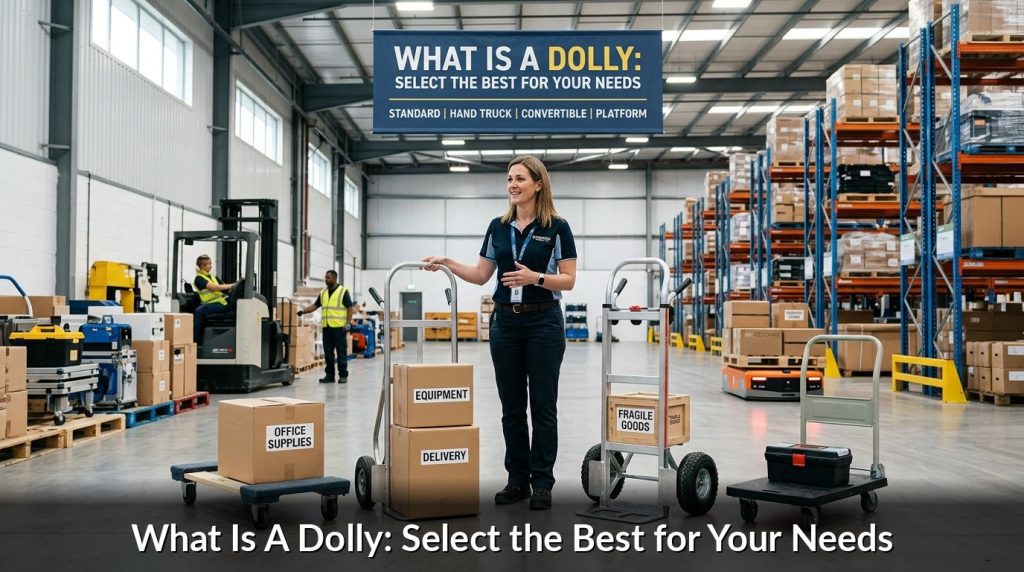
A dolly in industrial use is a low-profile wheeled platform built to move heavy or awkward loads over short distances with less lifting. The classic version has a flat deck and four casters, usually without handles. That simplicity is the point.
What makes a dolly different from a cart
A cart usually asks the operator to load items up onto a frame or basket and steer from a handle. A dolly works closer to floor level, so the team can slide or set the load onto the deck with less vertical lift.
That lower profile helps with bulky items that are hard to grab cleanly. It also helps in tighter aisles because there is no handle projecting into the travel path.
The two parts that matter most
The deck supports the load. The casters determine how the dolly behaves.
If the deck is too small, the load overhangs and becomes harder to stabilize. If the casters are wrong for the floor, even a properly sized dolly becomes frustrating to use.
A practical dolly purchase starts with those basics:
- Deck design: Flat platforms are useful when you need versatility. Carpeted or padded decks help when surface protection matters.
- Caster setup: Swivel casters improve directional control in confined spaces. Locking casters matter where unintended movement is a concern.
- Deck height: A lower deck makes loading easier, especially for equipment, cabinets, and dense cartons.
- Frame material: Wood, steel, and molded materials each fit different environments and cleaning expectations.
Why the simple design pays off
The ergonomic value is not theoretical. According to SafetyLiftinGear’s summary of OSHA ergonomic guidance and wheeled aid use, wheeled aids like dollies can cut peak handling forces from over 100 lbs to under 50 lbs, lower musculoskeletal injury rates by up to 40%, and in tight warehouse aisles their handle-less design can enable 20-30% faster navigation compared to traditional trolleys.
For a manager, that translates into a clear operational point. A dolly does not replace every handling method, but it often solves the middle ground where hand-carrying is risky and powered transport is unnecessary.
Practical rule: If the move happens often, crosses a short distance, and does not require powered lifting, a dolly is usually the first tool worth evaluating.
A Guide to Common Industrial Dolly Types
Most buying mistakes happen because teams use one word, “dolly,” to describe several different tools. They are not interchangeable.

Industrial Dolly Comparison
| Dolly Type | Primary Use | Key Features | Typical Capacity |
|---|---|---|---|
| Platform Dolly | Boxes, totes, flat goods | Low deck, four casters, open platform | Varies by model |
| Furniture Dolly | Furniture, benches, equipment | Carpeted or padded deck, swivel casters | 600-1200 lbs |
| Hand Truck | Tall stacked loads | Upright frame, toe plate, handle control | Varies by model |
| Appliance Dolly | Refrigerators, washers, large equipment | Heavy-duty frame, straps, controlled tilt | Varies by model |
| Converter Dolly | Mixed transport tasks | Configurable design for different load styles | Varies by model |
For buyers comparing broader transport options, this category sits within a larger range of lifting and material transport equipment.
Platform dollies
Platform dollies are the everyday workhorse for cartons, bins, supplies, and flat items. They fit receiving areas, stockrooms, and packing zones where loads vary throughout the day.
They work best on smooth surfaces and predictable travel paths. They work poorly when teams need upright control of tall or unstable loads.
Furniture dollies
Furniture dollies are one of the most useful tools for maintenance teams, lab staff, installers, and facilities groups moving dense, awkward items. They are low, stable, and easy to position under heavy pieces.
According to Lonestar Dollies’ description of standard furniture dolly specs, a standard 18×30 inch furniture dolly with 5-inch non-marking urethane casters typically supports 600-1200 lbs. Its 360-degree swivel casters reduce turning radius to 24 inches, enabling 35% faster repositioning of heavy items in confined spaces.
That combination matters in real facilities. A furniture dolly is often the better choice when you are repositioning lab benches, moving cabinets inside a room, or shifting equipment around support columns.
Hand trucks
Many buyers still call these dollies, and in practice that is common. A hand truck is better when the load is tall and can be leaned back safely onto an upright frame.
It is a poor choice for wide equipment with a low center of gravity. In those cases, a flat dolly usually gives better stability.
Appliance dollies
Appliance dollies are built for concentrated weight and controlled movement. Straps are a major advantage because they keep the load connected to the frame during tilt and travel.
These are useful for facilities teams handling refrigerators, laundry equipment, vending equipment, or large office machines. They are less versatile than flat dollies, but much safer for those specific loads.
Converter dollies and specialized variants
Converter designs make sense when one department handles changing load profiles and wants fewer separate tools. Some operations prefer dedicated equipment instead, especially when training consistency matters.
Other specialized dollies exist for drums, pianos, and application-specific transport. The more specialized the load, the less useful a generic platform becomes.
What works and what does not
A common mistake is using a furniture dolly for loads that need upright restraint. Another is trying to move broad, heavy equipment on a hand truck just because it is available.
Use the tool that matches the load behavior, not just the weight.
- Works well: Matching low-profile dollies to dense, awkward, bottom-heavy items.
- Works poorly: Using general-purpose dollies where the load can shift, tip, or require strap control.
- Works well: Keeping dedicated dollies near the point of use.
- Works poorly: Storing all transport tools in one remote area where crews stop using them out of convenience.
Buyer tip: The best dolly is the one your team will choose on a busy shift because it fits the load without extra setup.
Decoding Dolly Specifications for Peak Performance
A dolly can look fine on paper and still disappoint on the floor. Performance comes down to a few specifications that buyers often rush past.

Load capacity is not just a catalog number
Capacity has to cover the actual item, not the estimated item. If a team regularly moves dense equipment, parts bins, or boxed machinery, guessing is where trouble starts.
A dolly that operates near its limit all the time wears harder and leaves less room for handling error. Buyers should also consider how the load sits on the deck. Off-center weight changes how stable the dolly feels, even when the load is technically within rating.
Caster choice changes everything
Casters are where a dolly succeeds or fails.
Swivel casters improve maneuvering in tight rooms and aisle intersections. Fixed casters can help on longer straight runs, but they are less forgiving in cramped layouts. Brake-equipped casters make sense where a dolly may be parked during loading or used on floors with slight slope.
Caster material matters too:
- Polyurethane: A strong fit for smooth interior floors where floor protection matters.
- Rubber: Useful when you want more grip and a softer ride over minor irregularities.
- Steel: Better suited for very demanding conditions where load severity outweighs noise and floor sensitivity.
Deck material should match the environment
A wood deck can be perfectly suitable for general use. It is practical and common.
Steel makes more sense where impact resistance and long service life matter most. Other materials are useful where cleaning protocols, moisture exposure, or chemical resistance are part of daily operations.
Dimensions affect control more than buyers expect
A dolly should be large enough to support the load properly but not so large that it becomes awkward in travel lanes, doorways, or work cells.
That trade-off becomes obvious in mixed-use facilities. A larger deck may seem more versatile, but if it catches on corners or sits unused because it is cumbersome, that flexibility is not helping the operation.
Quick spec checklist for buyers
- Know the heaviest routine load:
- Check the floor surface and any transitions:
- Measure doorways, aisle widths, and turning points:
- Decide whether the load needs restraint or just support:
- Review whether the dolly will live in one department or move across the facility:
A dolly spec sheet only becomes useful when it is tied to the route, the floor, and the actual item being moved.
How to Choose the Right Dolly for Your Facility
The right answer depends on the environment. That is where most generic content falls short.

As noted in this discussion of the gap in matching dollies to specific industrial environments, facilities managers in pharmaceutical cold storage have very different needs than those in a standard warehouse, yet most guides treat dollies as interchangeable tools.
That is the wrong approach. Dolly selection should be application-specific.
High-volume warehouse
Warehouse travel is repetitive. Teams move cartons, replenishment stock, returns, and equipment through aisles where every interruption compounds.
In that setting, buyers usually benefit from durable platform or furniture dollies that turn cleanly, protect the floor, and can survive constant use. If loads are mixed, a small fleet with more than one deck style often works better than asking one model to do everything.
A related issue is whether the task really belongs on a dolly or whether it would be better handled with powered equipment. This comparison is worth reviewing when moves are frequent or distances are longer, especially if you are considering powered carts and when they outperform manual transport.
Precision manufacturing plant
Plants introduce different problems. Floors may have debris, transitions, or tighter machine clearances. Some loads are dense and compact. Others are awkward, top-heavy, or sensitive to vibration.
In that environment, generic light-duty dollies often disappoint. Buyers should focus on frame durability, wheel material that matches actual floor conditions, and deck sizing that keeps the load planted.
What works well is assigning specific dollies to specific cells or maintenance functions. What does not work is assuming the receiving-area dolly should also handle toolroom equipment or machine-side transport.
Sensitive laboratory or controlled environment
Labs and healthcare settings usually care about maneuverability, surface protection, and control. A dolly that sheds debris, marks floors, or feels clumsy in narrow rooms creates immediate resistance from staff.
For these spaces, low-profile units with smooth rolling casters, stable decks, and materials suited to the cleaning routine are the better fit. In secure or regulated settings, brake-equipped casters may also make sense so the dolly stays put during transfer.
Selection rule: Buy for the environment first, then the load, then the budget. Reversing that order usually produces replacement purchases later.
A short facility checklist
Use this before choosing a model:
- Load profile: What are you moving most often, and does it need support or restraint?
- Travel path: Are floors smooth, uneven, sensitive, or shared with pedestrians?
- Space limits: How tight are doorways, aisles, corners, and workstations?
- Frequency: Is this an occasional tool or a daily-use asset?
- Department fit: Will one team own it, or will several teams compete for it?
ROI comes from fit, not from buying the cheapest unit
A cheap dolly that gets avoided has no real value. A better-fit dolly that shortens routine moves, reduces handling friction, and holds up under use usually earns its keep faster.
Managers also need to think about deployment timing. Facilities that standardize the right dollies earlier usually get smoother training, cleaner storage planning, and fewer last-minute workarounds when demand picks up.
Safety Protocols and Maintenance for Your Dolly Fleet
A good dolly still needs disciplined use. Most preventable problems come from poor loading, rushed movement, or neglect.
Basic operating rules
Push when possible instead of pulling blind through a congested route. Keep the load centered. If the item can shift, secure it before travel.
Do not assume a stable-looking load is a stable load. Tall or uneven items can feel manageable at the start and become unstable on turns, thresholds, or stops.
Simple maintenance that protects uptime
A fleet check does not need to be complicated, but it does need to be consistent.
- Inspect casters: Remove debris, check for flat spots, and watch for binding.
- Check the deck: Look for cracks, splintering, bent sections, or worn padding.
- Verify hardware: Tighten loose fasteners and inspect mounting points.
- Pull damaged units out of service: A questionable dolly should not stay on the floor because it is “good enough for one more move.”
Why maintenance matters
Teams judge equipment quickly. If a dolly drifts, rattles, or fights the operator, people stop trusting it and go back to manual handling.
For broader handling guidance, OSHA resources on material handling and ergonomics are a useful reference: https://www.osha.gov/materials-handling
Floor-level rule: If a dolly is hard to steer empty, it has no business carrying a load.
Conclusion Unlocking Efficiency with the Right Material Handling Tools
A dolly is simple equipment, but the purchase decision is not simple if you care about efficiency, safety, and labor use. The right model reduces avoidable lifting, moves cleanly through the actual space, and fits the loads your team handles every day.
That is where buyers get the full return. Not from owning a dolly, but from choosing one that matches the facility, the route, and the job.
The companies that sort this out sooner usually get the benefit sooner too. Better planning leads to smoother installs, more predictable workflows, and fewer delays caused by handling gaps that should have been solved earlier.
Frequently Asked Questions About Industrial Dollies
What is a dolly used for in a warehouse?
A dolly is used to move heavy or awkward items over short distances with less lifting. Common uses include boxes, benches, appliances, small equipment, and maintenance materials.
Is a dolly the same as a hand truck?
Not exactly. Many people use the terms loosely, but a classic dolly is a low platform on casters, while a hand truck is upright and designed to tilt loads back for transport.
What type of dolly is best for tight aisles?
A low-profile dolly with swivel casters is often the better choice in confined areas because it turns more easily and does not have a projecting handle.
When should I use a specialized dolly instead of a general platform dolly?
Use a specialized dolly when the load needs restraint, unusual support, or application-specific handling. Appliances, drums, and sensitive equipment are common examples.
How often should dollies be inspected?
Inspect them before use in active environments and perform routine fleet checks on a regular schedule. Casters, decks, and hardware are the first areas to review.
Material Handling decisions are easier when you can compare products, get layout input, and move quickly once you know the fit. Material Handling USA offers competitive pricing, quality products, free quotes, and free layouts and designs with no obligation. If you are ready to Shop Now or Buy Online, browse the store. If your facility needs help choosing the right dolly or planning a broader workflow, Request a Quote, Contact Us, call (800) 326-4403, or email Sales@MH-USA.com. Faster planning usually means smoother delivery timelines and fewer avoidable installation delays.