A lot of buyers start in the same place. They know they need to enclose an area, they know wire mesh is probably the right material, and they’re looking at systems that seem similar at first glance. Then a key question arises. Are you trying to protect people from equipment, or protect equipment, tools, or inventory from people?
That difference matters more than the panel looks. A machine guard is part of a safety strategy around active equipment. A security cage is part of an access control and asset protection strategy. Mix them up, and you can create avoidable problems with layout, hardware, compliance review, maintenance access, and daily workflow.
I’ve seen this confusion most often when a facility is expanding quickly. A robotics cell gets added next to storage. An evidence room sits near workstations. A lab needs separation, airflow, and restricted access at the same time. Those are practical design questions, not catalog questions. Even outside industrial settings, the same thinking applies. If you’ve ever looked at fencing solutions for DFW homeowners, the basic lesson is familiar. A barrier only works when it matches the risk you’re trying to control.
For facilities comparing options, it helps to start with the right category. If your project involves machinery, start with machine enclosures and build outward from the hazard, the access points, and the operating process.
Choosing the Right Barrier: People Safety or Asset Security?
When managers search for wire mesh machine guarding vs security cages, they’re usually under pressure to make a fast decision. A new line is coming in. A theft issue needs attention. A safety walk identified an open hazard. The enclosure has to do a job on day one, not just look good on a quote.
The cleanest way to decide is this:
- Choose machine guarding when moving equipment, robotic motion, pinch points, or flying debris create a personnel hazard.
- Choose a security cage when the main goal is restricting access to inventory, tools, evidence, electronics, or controlled materials.
- Choose both when your facility has separate risk zones that need different controls.
Practical rule: A machine guard controls exposure to hazards. A security cage controls access to assets.
That sounds simple, but real facilities blur the lines. A server cage needs airflow and strong access control. An evidence room may need visibility, lock control, and separation from adjacent work areas. A production area may need a guarded robot cell near a caged parts crib. The best layouts treat these as different use cases, even when the panels look related.
What doesn’t work is forcing one system to cover both jobs without reviewing the trade-offs. That usually shows up later as awkward door placement, weak access control, maintenance headaches, or a safety review that sends the design back for changes.
Machine Guarding vs Security Cages At a Glance
At the highest level, machine guarding vs security cage comes down to intended function.
Wire mesh machine guarding is a safety barrier. It separates employees from dangerous motion and helps contain hazards around robots, conveyors, weld cells, and other automated equipment.
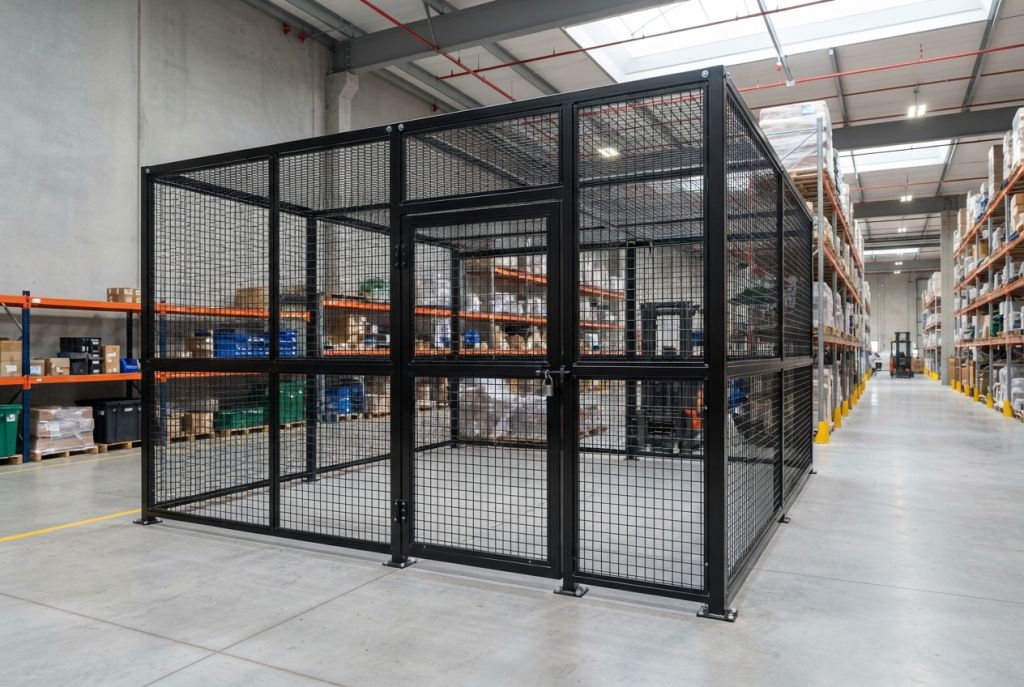
Wire mesh security cages are restricted-access enclosures. They protect tools, inventory, devices, documents, or evidence from unauthorized access while keeping the contents visible and ventilated.
Side by side comparison
| Feature | Wire Mesh Machine Guarding | Wire Mesh Security Cage |
|---|---|---|
| Primary purpose | Protect people from machine hazards | Protect assets from unauthorized access |
| Typical use case | Robot cells, conveyors, automated lines, machinery zones | Tool cribs, stockrooms, evidence rooms, server areas, parts storage |
| Access design | Controlled gates for operation and maintenance access | Lockable doors for controlled entry and inventory handling |
| Visibility | Important for monitoring equipment status | Important for inventory checks and supervision |
| Airflow | Supports cooling and open sightlines around equipment | Supports ventilation and sprinkler compatibility in many layouts |
| Safety role | Primary function | Secondary, depending on application |
| Security role | Limited, unless specifically configured | Primary function |
| Scalability | Modular around machine footprints and process changes | Modular for expansion, relocation, or reconfiguration |
| Installation speed | Depends on compliance needs and access devices | Often straightforward with modular panel layouts |
| Ideal buyer | Safety manager, engineer, plant manager, maintenance lead | Operations manager, facilities buyer, warehouse manager, IT or evidence custodian |
| Budget range | Usually higher when safety-certified customization is required | Standard cages cost $30 to $60 per linear foot of wall, with doors at $500 to $2,000 each, according to [MH-USA’s security cage guide](https://mh-usa.com/warehouse-storage/security-cages-wire-mesh-partitions-guide-2/) |
If your first question is "What am I trying to keep in or keep out," you’ll usually land in the right product family faster.
Comparing Key Specifications and Standards
The technical details matter because the panel pattern, wire type, hardware, and frame design are tied to the job the system has to do.

What machine guarding is built to do
For machine guarding, the mesh opening isn’t just a style choice. It affects reach-through prevention, visibility, and how the barrier performs around active hazards. One established configuration is 1-1/4″ x 2-1/2″, 10-gauge rectangular mesh, which complies with the ANSI/RIA R15.6-1999 standard for robotic machine guards, as described in Cisco-Eagle’s overview of security cages and partitions.
That differs from common security cage construction, where 2″ x 2″, 10-gauge square welded wire mesh is often used for general security applications. The materials may look close in a product photo, but they’re answering different design questions.
When reviewing options, check these details first:
- Mesh opening size for the hazard or storage application
- Wire gauge and welded construction
- Door and gate style based on traffic and maintenance needs
- Anchoring and framing for the floor condition and expected use
- Application-specific requirements from your internal safety or engineering team
What security cages are built to do
Security cages focus on controlled access, visibility, and practical enclosure design. In many warehouse and facility projects, buyers compare lock options, door swing, ceiling panels, and whether the mesh should be more open or tighter based on what’s being stored.
For small, high-risk items, denser mesh can make more sense than a general-purpose partition. For larger inventory, a standard welded wire panel may be enough. In labs, evidence rooms, and hybrid spaces, corrosion resistance and visibility can matter as much as lock strength.
A useful starting point for panel details is reviewing actual security cage specifications before finalizing a layout.
The mistake I see most often is choosing by appearance alone. On paper, both systems are wire mesh. In operation, they solve different problems.
This is also where compliance language needs care. Machine guarding may involve safety requirements and application-specific standards. Security cages are usually part of access controlandstorage protection. Your final design should be reviewed by qualified internal safety personnel, engineers, and any applicable authority having jurisdiction. This article isn’t legal or regulatory advice.
Practical Use Cases for Your Facility
The easiest way to sort out security cage vs machine guard is to match the barrier to the environment.

Where machine guarding makes sense
A robotic welding cell is the clearest example. Workers need separation from moving equipment, but operators and maintenance staff still need visibility and controlled access. That points to wire mesh safety guarding, not a basic storage cage.
The same goes for automated packaging lines, palletizing cells, and conveyors with hazard zones. In those areas, a machine safety barrier vs storage cage isn’t a close call. The safety function comes first.
Where security cages make sense
A warehouse tool crib, a high-value parts room, or a restricted stock area needs controlled entry and clear boundaries. That’s where a wire mesh partition enclosure or modular cage is the better fit.
A few common examples:
- Evidence room: You need restricted access, visual accountability, and a layout that supports chain-of-custody procedures.
- Server cage: Airflow matters. So do lock options and service access.
- Lab support storage: Ventilation and visibility can help, but the material finish and the opening pattern should match what the room stores and how it’s cleaned.
- E-commerce serialized parts cage: Inventory needs to stay secure without building a solid room.
When a facility needs both
This happens more often than people expect. A plant may need industrial machine guarding systems around a robot cell and a separate wire mesh industrial enclosure for spare parts nearby. A police facility may need an evidence cage in one area and a guarded machine enclosure in a maintenance bay. A lab may need caged storage on one side and protected equipment on the other.
That’s usually the right answer. Not one compromise system. Two systems designed for two jobs. A composite factory is a good illustration of both systems in one building — see our composite manufacturing security cage case study.
Planning Your Layout Design and Installation
A good layout saves money before the order is placed. Most problems show up in the planning stage, not after the panels arrive.

What to measure before you order
Start with the actual footprint. Then add the realities buyers often miss:
- Traffic flow: Forklifts, carts, and maintenance paths
- Door clearance: Swing, slide, or double-door access based on what moves through
- Overhead conditions: Lights, ductwork, conduit, sprinklers
- Future changes: Expansion, equipment replacement, or different inventory profiles
For budgeting, standard wire mesh security cages cost $30 to $60 per linear foot of wall, and doors cost $500 to $2,000 each, according to MH-USA’s guide to security cages and wire mesh partitions. That same source notes machine guarding can run 20 to 40% more for certified panels, and cites average OSHA fines of $14,502 per violation in 2023. Those numbers are why rough planning can get expensive fast.
Access, hardware, and layout decisions
Locking strategy should match daily use. A low-traffic evidence room may need a different door setup than a parts cage with constant pick activity. A machine guard may need gate hardware coordinated with the operating process and maintenance procedure.
For modular storage and partition projects, wire mesh modular cages are one practical starting point because they help buyers think in panel runs, openings, and access points instead of one fixed box.
A good access-control example outside this market is Admiral’s Yard’s work on secure gate access at Leeds. The lesson applies here too. Door hardware isn’t an accessory. It defines how people use the enclosure.
Ordering checklist for buyers
Use this before requesting a quote:
- Define the goal: Worker protection, asset security, or separate needs in different zones
- List what must pass through: People, pallets, carts, servers, evidence bins, maintenance tools
- Confirm review team: Safety, facilities, operations, IT, lab management, or law enforcement stakeholders
- Note the floor and ceiling conditions: Slab, obstructions, sprinkler limits, uneven areas
- Decide what can’t be delayed: Install timing, relocation plans, access control, future expansion
If your project is on a planning calendar now, moving sooner usually means better layout options and fewer compromises on lead time, access points, and installation sequencing.
Frequently Asked Questions
Can a machine guard also be used as a security cage
Sometimes physically, yes. Functionally, that’s usually the wrong approach. A machine enclosure vs security cage decision should be based on the primary risk. Guarding is for hazards. Cages are for access controlandstorage protection.
Is welded or woven wire better
For many industrial applications, welded wire is the stronger choice. According to Security Caging’s comparison of Explore MH-USA security cage solutions, welded wire offers up to 50% higher shear resistance at joints, which makes it a strong option for high-impact guarding and high-security cages.
Are open-top cages acceptable with sprinklers
They often are used because open-top designs can support sprinkler coverage, but the final answer depends on the facility, local code interpretation, and the authority having jurisdiction.
What about labs and healthcare support spaces
These spaces usually need more careful review of finish, airflow, cleaning requirements, and access control. Stainless or corrosion-resistant materials may be appropriate depending on the environment.
Do server cages need different planning than warehouse cages
Yes. Airflow, cable routing, service access, and door hardware usually matter more in server areas than in standard stock storage.
What is the biggest buying mistake
Buying by panel appearance instead of use case. A wire mesh safety fence around machinery and a lockable storage cage may look similar online, but the right choice depends on the hazard, the asset, and how the space operates every day.
Should one supplier handle both systems
It can help, especially when a facility needs both a guarded machine zone and a separate secure storage area. The key is getting application-specific guidance, not forcing one standard panel package across the entire building.
If you’re comparing wire mesh machine guarding vs security cages, the right answer comes down to purpose, access, and the way your facility actually works. Material Handling USA can help with wire mesh security cages, modular enclosed storage areas, partitioned secure spaces, custom layouts, and quote support for industrial enclosure projects. To discuss your layout, availability, and sizing options, Contact Us, Request a Quote, or call Call (800) 326-4403. You can also email Sales@MH-USA.com for planning support, free quotes, and no-obligation layout help.
Related Resources
- Security Cages & Wire Partitions — Full range of security cage sizes and configurations
- Mezzanines — Add overhead storage with industrial mezzanine platforms
Additional Considerations
What About Dea Security Cage Requirements?
Understanding dea security cage requirements is essential for making the right purchasing decision. Contact our team for detailed specifications and expert guidance on dea security cage requirements options that match your facility’s requirements.
What About Access Control Options?
Understanding access control options is essential for making the right purchasing decision. Contact our team for detailed specifications and expert guidance on access control options options that match your facility’s requirements.
What About Security Cage Sizing Guide?
Understanding security cage sizing guide is essential for making the right purchasing decision. Contact our team for detailed specifications and expert guidance on security cage sizing guide options that match your facility’s requirements.
What About Tool Crib Cage Setups?
Understanding tool crib cage setups is essential for making the right purchasing decision. Contact our team for detailed specifications and expert guidance on tool crib cage setups options that match your facility’s requirements.
Get Expert Help
Need help choosing the right solution? Our specialists can assess your space, recommend the best configuration, and provide a custom quote. Contact us today for a free consultation.
Additional Considerations
What About Dea Security Cage Requirements?
Understanding dea security cage requirements is essential for making the right purchasing decision. Contact our team for detailed specifications and expert guidance on dea security cage requirements options that match your facility’s requirements.
What About Access Control Options?
Understanding access control options is essential for making the right purchasing decision. Contact our team for detailed specifications and expert guidance on access control options options that match your facility’s requirements.
What About Security Cage Sizing Guide?
Understanding security cage sizing guide is essential for making the right purchasing decision. Contact our team for detailed specifications and expert guidance on security cage sizing guide options that match your facility’s requirements.
What About Tool Crib Cage Setups?
Understanding tool crib cage setups is essential for making the right purchasing decision. Contact our team for detailed specifications and expert guidance on tool crib cage setups options that match your facility’s requirements.
Get Expert Help
Need help choosing the right solution? Our specialists can assess your space, recommend the best configuration, and provide a custom quote. Contact us today for a free consultation.
Online Store
Shop at MaterialHandling-USA.com
Need barriers, access control, or secure storage? Shop online:
Lockers
Warehouse Equipment & Supplies
Browse security & access control products →