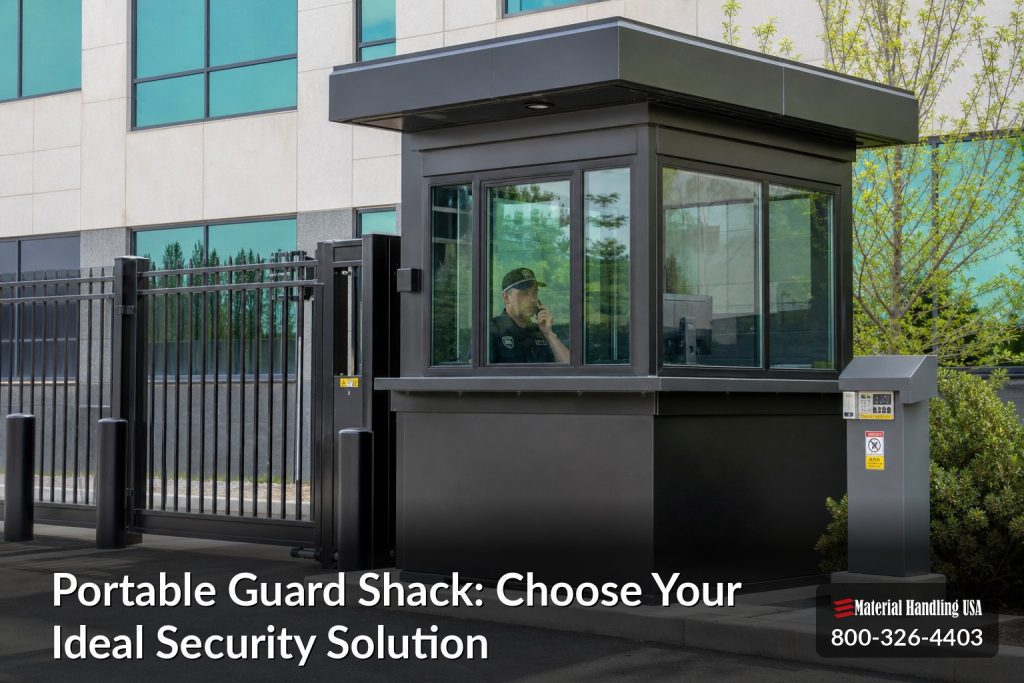
If you're comparing a portable guard shack to a permanent guard booth, the question isn't which one is better in general. It's which one fits your site today, and still makes sense once traffic patterns, utilities, and security needs settle in. For most buyers, the decision comes down to timeline, mobility, and how fixed the checkpoint really is.
A lot of sites need access control before they're ready for full construction. That's common at warehouse expansions, temporary truck gates, parking lots, and construction entrances. In those cases, moving too slowly can create avoidable check-in problems, weak visitor control, and more pressure on office staff who end up handling gate tasks they weren't set up to manage.
If you want to compare available configurations, window layouts, and enclosure options, start with guard booths and security enclosures.
Suggested video topic: Portable Guard Shack vs Permanent Guard Booth for Warehouses, Construction Sites, and Secure Facilities
- Key takeaway 1: Portable units fit changing sites and faster deployment needs.
- Key takeaway 2: Permanent booths make more sense when utilities, traffic flow, and security systems are already fixed.
- Key takeaway 3: Permitting and site prep often decide the project timeline more than the booth itself.
- 0:00 Why buyers compare portable and permanent options
- 0:45 Where a mobile guard shack works best
- 1:30 When a permanent guard booth is worth the commitment
- 2:20 Utility, site prep, and permitting issues to catch early
- 3:15 Rental vs buy questions for mid-term projects
See more videos on our channel
{“@context”:”https://schema.org”,”@type”:”VideoObject”,”name”:”Portable Guard Shack vs Permanent Guard Booth for Warehouses, Construction Sites, and Secure Facilities”,”description”:”Suggested future video topic for buyers comparing portable guard shacks and permanent guard booths.”,”publisher”:{“@type”:”Organization”,”name”:”Material Handling USA”}}Understanding Core Differences in Guard Booths
A buyer usually sees the true difference before the booth is even ordered. One project needs a checkpoint in place next week, with the option to move it once traffic patterns settle. Another has a fixed entrance, buried utilities, and a long-term security plan already approved. Both need access control, but they are solving different operational problems.
That is the core split. A portable unit is built around deployment flexibility. A permanent booth is built around site integration and staying power. The choice affects delivery method, foundation work, utility connections, maintenance access, and how easily the checkpoint can change later.
For buyers focused on protecting business assets, the booth should be evaluated as part of the security program. It is a working post for personnel, communications, visibility, and controlled entry.
Portable vs permanent at a glance
| Feature | Portable Guard Shack | Permanent Guard Booth |
|---|---|---|
| Mobility | Can be relocated or redeployed as site needs change | Fixed in place |
| Installation speed | Usually better for faster deployment and phased projects | Usually involves more site integration and planning |
| Upfront investment | Often a practical fit when you need security before major construction | Often makes more sense when the site layout is already final |
| Utility integration | Can work with simpler utility plans or temporary service | Better suited for fully integrated power, data, and site systems |
| Best fit | Temporary gates, construction sites, expanding yards, parking control | Main entrances, long-term campuses, fixed industrial checkpoints |
| Security posture | Strong for operational flexibility | Strong for long-term control and site presence |
What a portable unit really means
A portable guard shack is usually a prefabricated structure delivered ready for placement, then set with a crane, forklift, trailer, or similar equipment depending on the design. In the field, that may mean a skid-mounted, container-based, or trailer-mounted unit. Buyers comparing relocation-friendly options often start with a mobile guard booth because the category is built around changing site conditions.
The trade-off is straightforward. Portable units reduce commitment to one exact location, but they also force buyers to think carefully about access for delivery, leveling, tie-down needs, and temporary versus permanent utility service. I have seen projects delay a "fast" portable install because no one confirmed truck access or pad readiness before delivery.
Practical rule: If the gate location, traffic pattern, or site plan may change during the life of the project, keep flexibility as long as possible.
What permanence changes
A permanent booth changes the project in a different way. It usually ties into a finished traffic pattern, established foundations, permanent power and data, and a more formal entry sequence for employees, visitors, or trucks. That extra commitment can pay off when the checkpoint location is settled and the site wants a stronger long-term presence.
It also changes the approval path. Permanent structures often trigger more coordination with civil work, electrical contractors, and local permitting authorities. Portable units can still require permits, but the level of review is often different because the deployment method is different.
Federal purchasing standards reflect how specialized these structures have become. The GSA mobile guard booth document outlines procurement requirements for portable guard booths and includes higher-security configurations for buyers with stricter protection needs.
Best Use Cases for a Portable Guard Shack
Some sites need control first and permanence later. That's where a portable unit earns its place.

A construction site is the clearest example. The gate needs a check-in point now, but the final road layout, utility routing, and long-term building plan may still be moving. In that situation, a temporary guard shack lets the team establish a visible checkpoint without waiting for a site-built structure.
The same logic applies to warehouse expansions. A yard may need truck control while a larger plan is still under review. Instead of sending drivers to an office door or using a folding table at the gate, the site gets a dedicated station that can later be moved or reassigned.
Where portable units tend to work best
- Construction entrances: Useful when the project needs controlled access before permanent buildings are complete.
- Overflow parking or event lots: Good for visitor direction, credentials, and simple monitoring.
- Warehouse yards in transition: Practical when truck patterns may shift during expansion.
- Seasonal or changing gates: A strong fit when one checkpoint may not stay in the same place.
Why the layout matters
Not every portable booth feels the same in use. Portable guard shacks are commonly deployed as trailer-mounted or container-based units in sizes like 10 ft and 14 ft, and one 14-ft model offers 112 sq ft with three windows for 270-degree visibility, according to this portable guard shack rental overview. That kind of layout matters when one person is checking visitors, monitoring traffic, and handling paperwork at the same time.
A portable booth works best when the site is still changing, but security can't wait for the final phase.
When a Permanent Guard Booth Is the Right Choice
A fixed gate changes the decision. The traffic pattern is established, the checkpoint location is not expected to move, and the security team needs a station that fits the site for the long run. In that situation, a permanent guard booth usually delivers a better operational result than a portable unit.

The biggest advantage is not appearance alone. It is how the booth fits into the full deployment lifecycle. A permanent installation can be planned with the gate arms, foundations, underground power, network runs, exterior lighting, drainage, and pedestrian routing from the start. That reduces the number of workarounds operators deal with later.
Manufacturing plants are a common fit. So are corporate campus entrances, data-focused facilities, and industrial sites with a stable perimeter. In these cases, a permanent guard booth often supports a more polished arrival experience, better camera and access-control integration, and a layout that holds up under daily use.
Permanent booths also make sense when the post has grown beyond basic credential checks. If the officer needs space for visitor processing, package handling, monitors, radios, printers, and file storage, a fixed booth functions more like a small security office. That affects daily comfort, shift efficiency, and equipment reliability.
What buyers usually gain from going permanent
- Better infrastructure integration: Electrical, data, HVAC, and security devices can be built into a fixed plan instead of added as temporary connections.
- Fewer layout compromises: The booth, curb lines, barriers, and lane geometry can be designed to work together.
- Stronger day-to-day durability: Permanent installations generally handle constant traffic, repeated shifts, and long service life with fewer improvised fixes.
- A clearer security presence: Visitors read the checkpoint as part of the site, not a temporary control point.
There is a trade-off. Permanent booths ask for more coordination up front, and that starts before the building is delivered. Foundation requirements, utility trenching, local approvals, and site-specific planning rules can affect schedule and budget. Buyers comparing a fixed installation with a guard shack mounted on a trailer should weigh that extra front-end effort against how long the checkpoint is expected to stay in service.
Permitting can also change by jurisdiction, especially if the structure is treated as a permanent building or placed on a site with container-based elements. For UK projects, this essential guide on UK container planning is a useful starting reference before finalizing the booth type.
Site Prep, Utilities, and Permitting Requirements
Booth selection is only half the job. Most delays happen on site.

A portable unit may look simple on paper, but the delivery path, placement area, and utility plan still need to work. If the truck can't reach the set point, or the ground isn't ready, the project slows down fast. The same goes for permanent installations, only with more coordination up front.
A commonly overlooked issue is compliance. Permitting, ADA accessibility, and fire safety requirements can change depending on whether the booth is treated as temporary or permanent, and missing that step can lead to major delays, as discussed in this overview of portable guard shack code considerations.
Deployment items to confirm before delivery
- Ground condition: The placement area should be level and stable.
- Access path: Delivery equipment needs enough room to enter, turn, and set the booth.
- Utility availability: Power, lighting, communications, and sometimes climate control need a real plan.
- Placement method: Some sites need forklift access. Others need crane coordination.
For buyers reviewing a trailer solution, a guard shack mounted on a trailer can simplify redeployment, but it doesn't remove the need for access and placement planning.
Permitting isn't one-size-fits-all
Local rules vary. Even though it's a UK-focused resource, this essential guide on UK container planning is useful because it shows the broader principle buyers often miss. Whether a structure is movable doesn't automatically mean it avoids planning review.
Check classification early. A booth used for a short-term gate may be reviewed differently than one serving as a long-term staffed checkpoint.
If you want to avoid delays, ask the permitting questions before finalizing the booth type, not after delivery is scheduled.
Analyzing Costs, Customization, and Renting vs Buying
Most buyers start with purchase price. That isn't enough.

A useful comparison looks at the whole operating picture over a 3 to 5 year horizon, including staffing flow, energy use, downtime risk, and whether the booth will still fit the site once conditions change. That broader ROI framing is highlighted in this discussion of trailered booth cost considerations.
Rental vs buying
Renting often fits projects with uncertain duration, temporary gates, or sites that may move the checkpoint later. It's also useful when the business needs a working booth before a larger capital decision is made.
Buying usually makes more sense when the booth will stay in service for the foreseeable future, or when the layout needs enough customization that a standard rental unit becomes less practical.
Customization changes the budget and the outcome
Some booths only need a basic check-in counter and visibility. Others need to support camera screens, driver paperwork, staff access control, and year-round occupancy. That's when details like window placement, counters, HVAC, insulation, doors, and electrical service matter more than the shell itself.
For buyers who need a more customized layout, a custom security booth is one option to review alongside standard portable and permanent formats.
Your Guard Booth Decision Checklist
Use these five questions to pressure-test your decision.
Five steps that usually clarify the right choice
Will the checkpoint location stay fixed?
If the answer is no, a portable or mobile guard shack usually fits better.How quickly do you need access control in place?
Faster deployment often favors portable formats.What will staff do inside the booth?
Simple credential checks need less interior support than a booth handling paperwork, camera feeds, and communications.What utilities are available at the site?
Don't assume power, data, or service routing will be easy.Is this part of a larger facility plan?
If your site is still evolving, flexibility has real value. For a broader look at modular building planning, Van Dyke Outdoors' cabin guide is a useful reminder that portable structures work best when the site plan and use case are matched early.
Frequently Asked Questions About Guard Booths
Is a portable guard shack only for temporary use
No. Many buyers use portable units for temporary needs, but they can also serve longer-term roles when mobility and simpler deployment still matter.
What is a mobile guard shack
It usually refers to a portable unit designed for relocation or redeployment, often with a trailer-mounted or similar movable format.
How do I choose between guard shack rental vs buy
Start with project duration, site stability, and how customized the booth needs to be. Shorter or uncertain projects often lean toward rental. Longer-term use often supports buying.
Can a portable guard booth support year-round staffing
Yes, if the booth is configured with the right HVAC, insulation, visibility, and electrical setup for the site.
Are permanent guard booths always more secure
Not always. The right choice depends on the level of integration, site conditions, and whether the checkpoint itself is fixed or still changing.
What should I prepare before requesting a quote
Have the use case, site location, staffing plan, utility information, and delivery access details ready. That speeds up layout decisions and reduces revision cycles.
Can one booth handle more than gate control
Yes. Some layouts are used for visitor check-in, truck paperwork, employee access, and camera monitoring in one space.
Where can I compare modular building options related to guard stations
If your project connects to a larger facility buildout, review prefabricated modular building options and modular office solutions to see how the checkpoint may fit into the broader plan.
{“@context”:”https://schema.org”,”@type”:”FAQPage”,”mainEntity”:[{“@type”:”Question”,”name”:”Is a portable guard shack only for temporary use”,”acceptedAnswer”:{“@type”:”Answer”,”text”:”No. Many buyers use portable units for temporary needs, but they can also serve longer-term roles when mobility and simpler deployment still matter.”}},{“@type”:”Question”,”name”:”What is a mobile guard shack”,”acceptedAnswer”:{“@type”:”Answer”,”text”:”It usually refers to a portable unit designed for relocation or redeployment, often with a trailer-mounted or similar movable format.”}},{“@type”:”Question”,”name”:”How do I choose between guard shack rental vs buy”,”acceptedAnswer”:{“@type”:”Answer”,”text”:”Start with project duration, site stability, and how customized the booth needs to be. Shorter or uncertain projects often lean toward rental. Longer-term use often supports buying.”}},{“@type”:”Question”,”name”:”Can a portable guard booth support year-round staffing”,”acceptedAnswer”:{“@type”:”Answer”,”text”:”Yes, if the booth is configured with the right HVAC, insulation, visibility, and electrical setup for the site.”}},{“@type”:”Question”,”name”:”Are permanent guard booths always more secure”,”acceptedAnswer”:{“@type”:”Answer”,”text”:”Not always. The right choice depends on the level of integration, site conditions, and whether the checkpoint itself is fixed or still changing.”}},{“@type”:”Question”,”name”:”What should I prepare before requesting a quote”,”acceptedAnswer”:{“@type”:”Answer”,”text”:”Have the use case, site location, staffing plan, utility information, and delivery access details ready. That speeds up layout decisions and reduces revision cycles.”}},{“@type”:”Question”,”name”:”Can one booth handle more than gate control”,”acceptedAnswer”:{“@type”:”Answer”,”text”:”Yes. Some layouts are used for visitor check-in, truck paperwork, employee access, and camera monitoring in one space.”}},{“@type”:”Question”,”name”:”Where can I compare modular building options related to guard stations”,”acceptedAnswer”:{“@type”:”Answer”,”text”:”If your project connects to a larger facility buildout, review prefabricated modular building options and modular office solutions to see how the checkpoint may fit into the broader plan.”}}]}A portable guard shack is usually the right fit when the site is evolving, the timeline is tight, or the checkpoint may move. A permanent guard booth makes more sense when the perimeter, utilities, and security process are already established. If you'd like help comparing layouts, traffic flow, and site requirements, contact Material Handling USA to request a free guard booth quote, call 800-326-4403, or email Sales@MH-USA.com. Free quotes and layout support can help you plan sooner, avoid permitting surprises, and keep your project on schedule.