
Mobile & Portable Guard Booths
Deploy a staffed security checkpoint in hours, not months. Forklift-movable, trailer-mounted and quick-ship guard booths arrive pre-assembled, need no foundation, and relocate as your perimeter changes — with ballistic, hurricane-rated and climate-controlled options available.
Same-day
Most stock booths are operational the day they arrive on site
40–60% less
Typical cost versus equivalent site-built construction of the same size
No slab required
Sets on asphalt, existing concrete or compacted gravel
4×6 – 8×12
Standard footprints in feet; larger and custom sizes available
Why a mobile guard booth
A permanent guard house is the right answer when a checkpoint sits in the same spot for the next twenty years. Most security needs are not that stable — perimeters move as construction phases advance, as a distribution yard adds trailer parking, as a campus opens a second entrance, or as a special event takes over a lot for a weekend. A mobile guard booth gives officers a real weatherproof workstation without committing concrete, permits and a construction schedule to a location that may change next quarter.
Because a portable booth arrives fully built — walls, glass, wiring, HVAC provisions, counter and door already installed — site work is limited to a level pad and a power drop. That is where the schedule and cost savings come from, and it is why portable booths are the default choice for temporary and semi-permanent checkpoints.
- Relocatable — move by forklift, crane or trailer as the perimeter changes, with no demolition and no salvage loss.
- No foundation — sets on asphalt, existing concrete or compacted gravel; the skid or trailer base spreads the load.
- Fast deployment — delivered pre-assembled, with most stock booths staffed the same day they arrive.
- Lower cost — typically 40–60% less than equivalent site-built construction of the same size.
- Often equipment, not real estate — frequently classified as equipment for depreciation rather than a permanent building improvement; confirm the treatment with your accountant.
- Reusable asset — when the project ends, the booth moves to the next site instead of being scrapped.
Case study: Charleston Southern University
Charleston Southern University’s custom guard booth project shows how a mobile booth solves a real campus problem. Working with campus security, Material Handling USA designed a fully mobile guardhouse that met the university’s need for a movable security solution rather than a fixed structure. Director of Security John E. Wilson reported that the booth had a positive impact on campus security after installation.
What this case study is, and is not
Facility layouts, room dimensions and project values are not published here. The account above reflects what the client and Material Handling USA have shared publicly about the project.
Booth models
Portability means different things depending on how often the booth moves and how far. These are the configurations we specify most often, and the conditions each one fits.
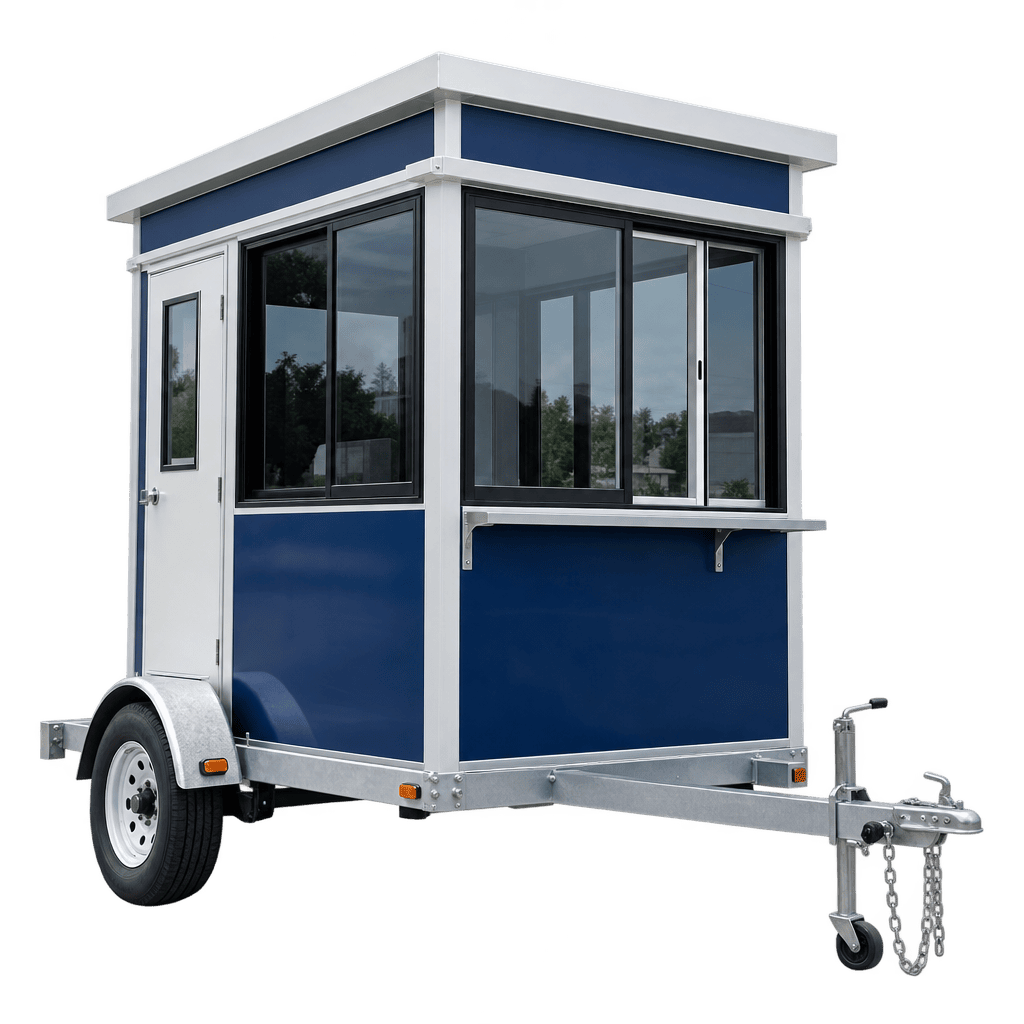
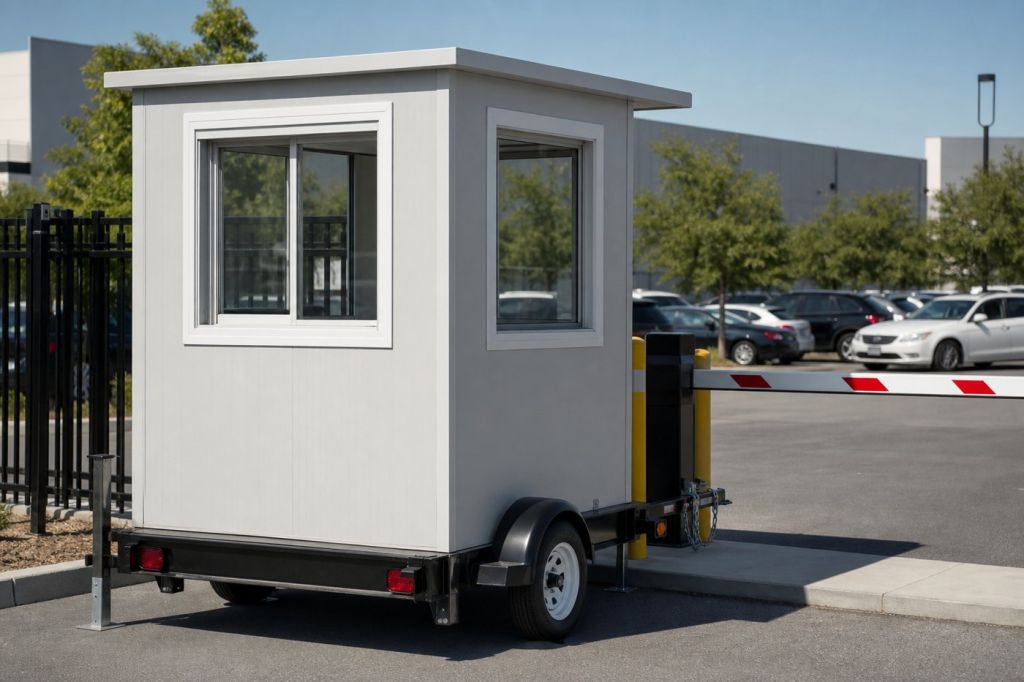
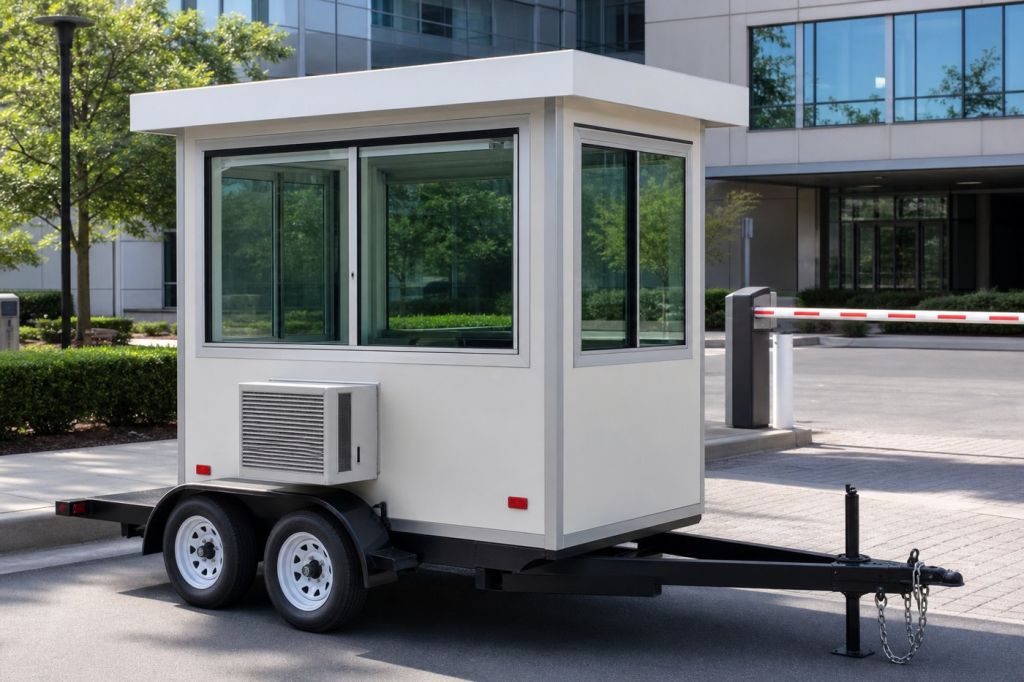
 Trailer-MountedHighway-towable on a DOT-rated chassis. Tow behind a ¾-ton pickup, level with stabilizer jacks, and relocate between sites in an afternoon.
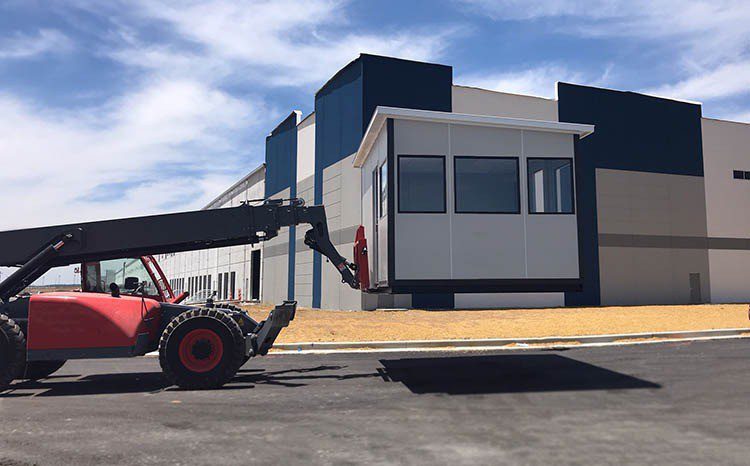 Forklift-Movable4×6 ft to 6×8 ft steel-frame booths with forklift pockets in the skid base. Typical weights of 1,200–2,500 lbs let a standard 5,000 lb forklift reposition them within a yard.
 Quick-Ship StockStandard footprints held in stock in standard colors with sliding windows, an interior counter, LED lighting and a 30A shore power inlet — the fastest path when schedule is the constraint.
Custom booths remain the right call for a specific footprint, ballistic glazing, a restroom, or an unusual window arrangement — expect a longer lead time in exchange for the exact configuration. We quote both paths side by side so you can see what the schedule actually costs.

Standard features and upgrades
Every portable booth we supply is built as an occupied workspace rather than a shed with a window. The baseline specification below is what ships on a standard unit; nearly all of it can be upgraded.
- All-welded steel frame with insulated wall and roof panels
- Sliding or swinging transaction and communication window
- 180° or 360° tempered glass visibility packages
- Interior work counter with under-counter storage
- Exterior-rated LED lighting and interior ceiling fixture
- Shore power hookup (30A or 50A) with portable HVAC provisions
- Lockable personnel door with deadbolt and closer
- Powder-coat or stainless steel exterior finish in standard or custom colors
- Skid or trailer base engineered for repeated lifting
Stainless steel exteriors give a clean, easy-to-clean appearance suited to pharmaceutical and other finish-sensitive facilities. Where wind and impact resistance matter, our ballistic-rated modular buildings page covers UL 752 and NIJ-rated glazing and armor in detail, and units can also be specified to resist hurricane-force wind loads for coastal and Gulf Coast sites.
Sizing and specifications
Size the booth around the number of officers per shift and the equipment they need at the window. Use the table as a starting point, then confirm against your actual post orders.
| Footprint | Occupancy | Approx. Weight | Typical Move Method | Best Fit |
|---|---|---|---|---|
| 4×6 ft | 1 officer | 1,200–1,600 lbs | Forklift | Single-lane pedestrian or vehicle gate |
| 5×7 ft | 1 officer + gear | 1,600–2,000 lbs | Forklift or crane | Yard checkpoint with monitors and radio |
| 6×8 ft | 1–2 officers | 2,000–2,800 lbs | Forklift or crane | Two-lane entry, badge issuance |
| 7×10 ft | 2 officers | 3,000–4,200 lbs | Crane or trailer | Main entrance, visitor screening |
| 8×12 ft | 2–3 officers | 4,500–6,000 lbs | Trailer or crane | Primary campus gate, restroom package |
Check the lift capacity first
Forklift pockets are only useful if your lift truck can handle the load at the required fork spread and mast height. Confirm rated capacity at load center before ordering a forklift-movable booth — we will verify it with you during quoting.
Common applications
Mobile and portable booths show up wherever access control is needed before, or instead of, permanent construction.
Ticket booths and related booth types
The same panelized construction that builds a guard booth builds a family of related transaction and attendant structures. These are the configurations we specify most often beyond the standard security checkpoint:
- Ticket booth — transaction window, speak-hole and exterior counter options for venues and attractions.
- Cashier / parking attendant booth — compact booth for lots and garages with a transaction window and attendant desk.
- Gas station attendant booth — weather-tight booth for fuel islands and drive-through service lanes.
- Equipment enclosure — protects pumps, controls and sensitive equipment from weather and tampering.
- Elevated observation or guard tower — raised structure for sight lines over a fence line or a large lot; see our guard towers and observation towers page.
Where the need is a full occupied structure rather than a checkpoint — a gatehouse with a break room, or an office built into a larger security post — our modular in-plant offices and prefabricated guard booths and security shacks pages cover the larger end of this product line.
Power, climate and comfort
The single biggest cause of complaints about portable booths is temperature, and it is almost always a specification problem rather than an equipment failure. A booth is a small volume with a large percentage of glass: in direct sun it behaves like a greenhouse, and on a cold night it loses heat through the same glazing. Size the HVAC for the glass area and the local design temperatures, not for the square footage alone.
- Insulated wall, roof and floor panels — not single-skin steel.
- Low-E tempered glazing to cut solar gain without losing sight lines.
- Through-wall heat pump sized to glass area and design temperature.
- A 30A or 50A shore connection to run lighting, monitors, a gate operator and the heat pump together.
- Where trenching is impractical, a solar and battery package will carry lighting and communications reliably; sustained heating and cooling still need shore power or a generator.
- Units can be specified for hurricane-force wind loads on coastal and Gulf Coast sites.
- GFCI receptacles and a small load center inside the booth.
How deployment works
From the first call to a staffed checkpoint, the path is short and predictable when the site details are settled early.
Define the Post
We review shift count, equipment at the window, threat level, and how long the booth stays before it moves.
Select & Quote
Stock quick-ship unit or custom build, with freight, offloading and any electrical work priced separately and clearly.
Prepare the Pad
You confirm a level, firm pad, the power drop location, and the delivery route; we provide the pad and clearance requirements in writing.
Deliver & Set
The booth arrives pre-assembled and is set by forklift or crane. Shore power is connected and the booth is turned over ready to staff.
Site preparation still matters. The pad has to be level within roughly a quarter inch per foot so doors and sliding windows operate correctly, and it has to be firm enough that the skid or trailer jacks do not sink — asphalt, existing concrete and well-compacted road base all work; soft soil, fresh fill and landscaped areas do not. Plan the delivery route as carefully as the pad: a delivery truck needs clear overhead height and a turning radius, and a crane needs a set-down location within reach. We walk the route with you before the booth ships.
Permits and code
Requirements vary by jurisdiction and by how the booth is used. Many authorities treat a skid-mounted, unanchored booth on an existing surface as equipment rather than a structure, which avoids a building permit. Others require a permit once the booth is connected to permanent power, occupied continuously, or in place beyond a defined temporary period. Trailer-mounted units bring vehicle registration into the picture.
We will tell you which questions your local building department is likely to ask and provide the drawings, weights and engineering documentation you need to answer them. What we will not do is tell you a permit is unnecessary — that call belongs to your jurisdiction, and getting it wrong is expensive.
Mobile vs. permanent, side by side
| Factor | Mobile Guard Booth | Site-Built Guard House |
|---|---|---|
| Time to occupancy | Days to a few weeks | Several months |
| Foundation | Level pad, usually no slab | Engineered footings and slab |
| Relocatable | Yes — forklift, crane or tow | No |
| Typical cost | 40–60% less | Baseline |
| Accounting treatment | Often equipment | Building improvement |
| Best for | Temporary, changing or fast-need posts | Permanent flagship entrances |
Related guard booth resources
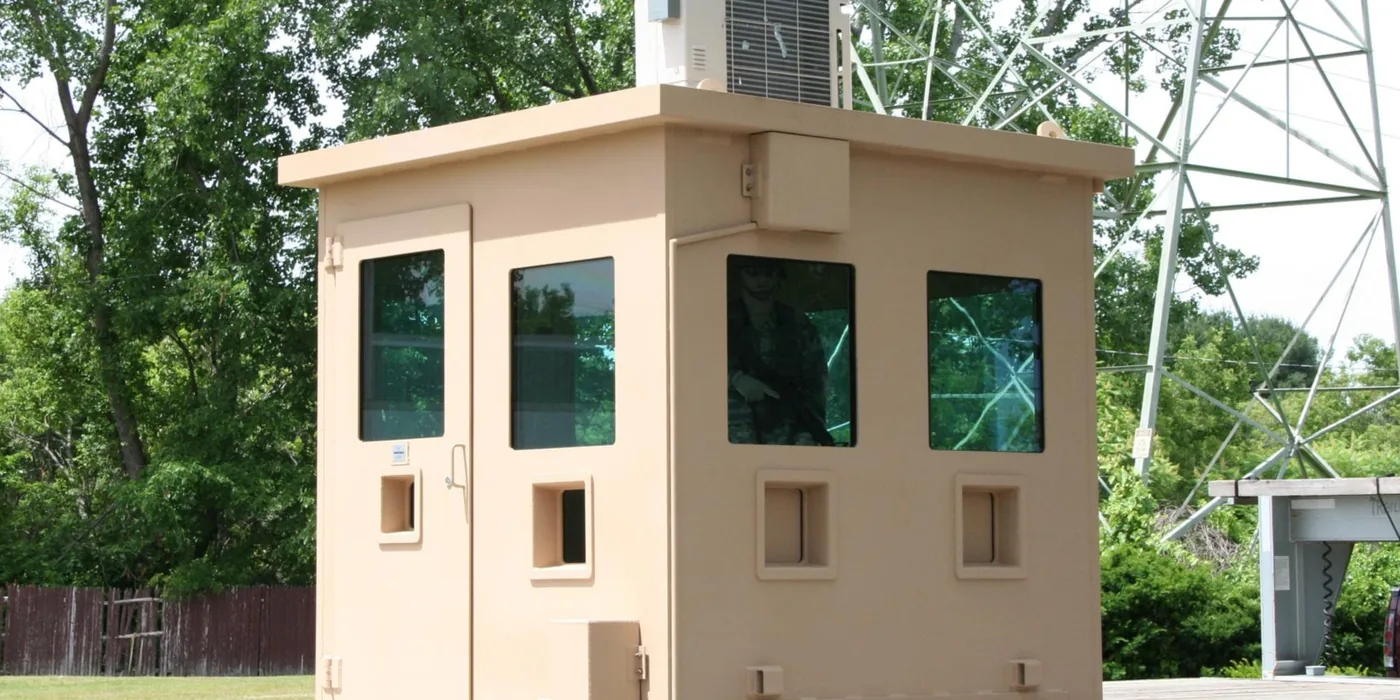 Ballistic-Rated Modular BuildingsUL 752 and NIJ-rated glazing and armor for high-threat checkpoints and cash handling.
 Guard Towers & Observation TowersRaised structures for sight lines over a fence line, yard or large lot.
 Guard Shacks for Government AgenciesBooths specified to federal and municipal procurement and post-order requirements.
For a fixed, permanent post, our guard booths and guard shacks buyer’s guide compares stationary and trailer-mounted options, and booths that tow between sites are covered on our trailer-mounted guard booths page. Utah customers can also see our Utah guard booths page for local lead times and delivery, and government buyers purchasing through a cooperative vehicle should see our guard shack on GSA contract page.
Frequently asked questions
How fast can a mobile guard booth be deployed?
Do I need a concrete foundation?
Can one booth be moved between multiple sites?
What materials are the booths made of?
Will a mobile booth stay comfortable in extreme weather?
Is a building permit required?
Can a mobile guard booth be ballistic rated?
What power does the booth need?
Do you deliver and install nationwide?
Need a staffed checkpoint this month?
Tell us the location, the shift plan and your date. We will size the booth, price the freight, and confirm what your pad needs — no obligation.
Should you rent or buy? Run the break-even first
Guard shack rentals run roughly $200–$500 a month and new booths $5,500–$28,500, which puts the crossover between 20 and 40 months for most posts. Our guard shack rental vs. buying cost guide walks the math with published 2026 market pricing, plus the freight, pad, power, permit and return-condition costs neither quote includes.