Cantilever Rack Systems: Storing Lumber, Pipe & Long Materials
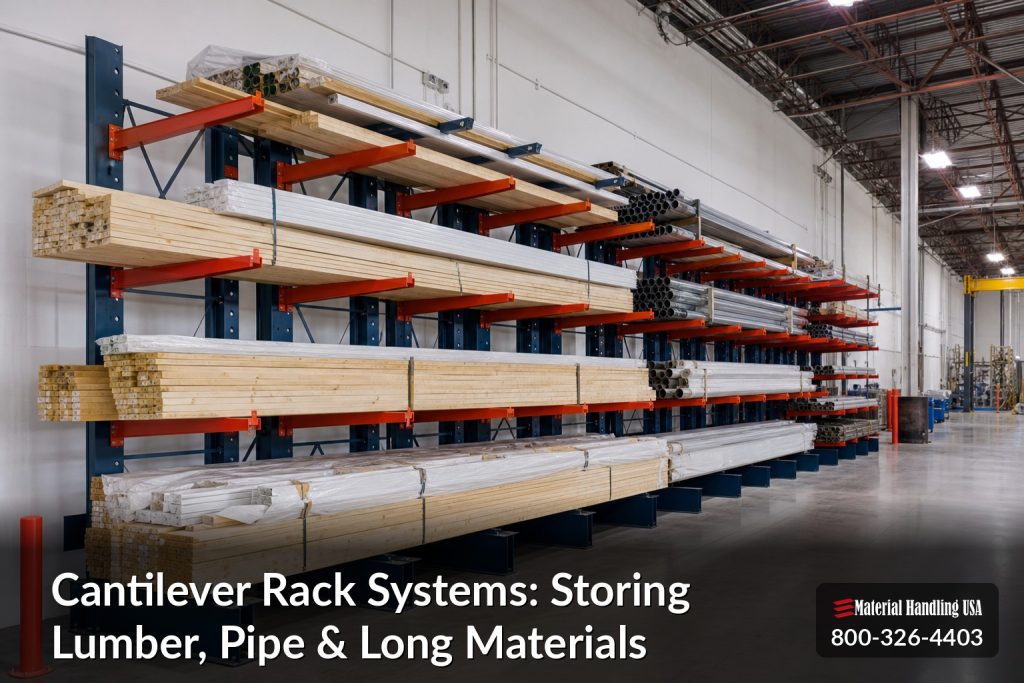
Cantilever rack is purpose-built for storing items that are too long, bulky, or awkwardly shaped for standard pallet rack. Lumber, pipe, tubing, sheet goods, furniture, and bar stock all store efficiently on cantilever arms, with full front-loading access and no vertical obstructions.
We’re authorized dealers for Cogan cantilever rack systems, one of the leading North American manufacturers. Here’s how to choose and configure the right system for your operation.
How Cantilever Rack Works
Unlike pallet rack, which uses horizontal beams between two uprights, cantilever rack uses arms that extend outward from a single column. This creates an open front with no uprights to block loading. Materials are loaded from the front using a forklift, crane, or by hand.
Cantilever Rack Configurations
Single-Sided
Arms extend from one side only. Typically placed against a wall. Best for facilities with limited space that need to maximize one wall for long material storage.
Double-Sided
Arms extend from both sides of each column. Placed in freestanding rows with aisle access from both sides. More efficient use of floor space and the most common configuration.
Structural vs. Roll-Form
- Structural (I-beam): Heavy-duty, handles the heaviest loads and toughest environments. Columns and arms are made from hot-rolled structural steel.
- Roll-form: Lighter duty, uses cold-formed steel. Lower cost for lighter loads. Good for furniture, sheet goods, and light-gauge materials.
What Can You Store on Cantilever Rack?
- Lumber and dimensional wood
- Steel pipe, tubing, and bar stock
- Sheet goods (plywood, drywall, sheet metal)
- PVC pipe and conduit
- Furniture (couches, mattresses, tables)
- Carpet rolls and fabric bolts
- Canoes, kayaks, and boats
Selecting the Right Arm Capacity
| Application | Arm Length | Arm Capacity | Column Spacing |
|---|---|---|---|
| Lumber / dimensional wood | 36″–48″ | 2,000–3,000 lbs | 4’–6′ |
| Steel pipe / bar stock | 24″–48″ | 3,000–6,000 lbs | 4’–8′ |
| Sheet goods | 48″–60″ | 1,500–3,000 lbs | 4’–6′ |
| Furniture / light items | 36″–48″ | 500–1,500 lbs | 4’–6′ |
Frequently Asked Questions
How much does cantilever rack cost?
Structural cantilever typically costs $200–$600 per arm, plus $300–$800 per column. A standard 20-foot run of double-sided structural cantilever costs $5,000–$12,000. Roll-form costs 30–40% less.
Does cantilever rack need to be anchored?
Yes. All cantilever rack columns must be anchored to the concrete floor with properly sized wedge anchors or epoxy anchors. Anchoring is critical for stability, especially in seismic zones.
How tall can cantilever rack go?
Standard cantilever systems go up to 20–25 feet. Heights above 16 feet typically require structural-grade columns and may need additional bracing.
Get a Free Cantilever Rack Layout
Send us your dimensions and what you’re storing, and we’ll design a cantilever rack layout with a complete cost estimate.
Request your free cantilever layout → or call (801) 328-8788.
Who This Is For
Our cantilever rack systems lumber pipe storage solutions are designed for:
- Warehouse managers and operations directors
- Facility planners and engineers
- Property managers
- Government facility coordinators
- Manufacturing plant managers
- Distribution center operators
Common Applications
Warehouse & Distribution
Optimize storage capacity and material flow with cantilever rack systems lumber pipe storage.
Manufacturing
Improve organization and efficiency with industrial-grade cantilever rack systems lumber pipe storage.
Government & Military
Meet security and compliance requirements with certified cantilever rack systems lumber pipe storage solutions.
Related Products & Resources
Common Applications
- Organizing dimensional lumber inventory in large home improvement retail centers
- Storing PVC and metal piping in plumbing supply wholesale warehouses
- Managing raw steel bar stock in heavy manufacturing fabrication shops
- Storing finished furniture components in woodworking and cabinetry production facilities
- Organizing construction site materials in outdoor lumber yard storage areas
- Storing aluminum extrusions in aerospace and automotive parts manufacturing plants
- Managing large rolls of carpet and flooring in wholesale distribution centers
- Storing structural steel beams in industrial metal service centers
- Organizing landscaping timber and fencing supplies in garden supply depots
Why Choose Material Handling USA?
Expert Guidance
Our team helps you choose the right products for your application, facility, and budget. We work with you from planning through installation.
Trusted Brands
We partner with leading manufacturers to offer high-quality, durable products backed by real warranties and factory support.
Nationwide Service
Based in Utah with service across the U.S. We handle quoting, project coordination, delivery, and installation support.
Free Quotes
Request a no-obligation quote for any project. We provide layout assistance, product recommendations, and competitive pricing.
Ready to Get Started?
Material Handling USA can help you find the right products for your facility. Get a free quote and layout assistance.
Or call 1-800-326-4403
Selecting the Right Cantilever Configuration for Your Facility
When planning a storage layout, facility managers must evaluate the specific weight and dimensions of their longest inventory items. Cantilever rack systems are uniquely engineered to handle these loads by utilizing a central upright and horizontal arms that extend outward. This design eliminates the need for front vertical posts, which typically obstruct the loading of long materials like timber or metal extrusions. By removing these barriers, operators can use forklifts to place items across multiple arms without worrying about clearance issues or damaging the rack structure.
The versatility of these systems allows for significant customization based on the specific type of material being stored. For example, arms can be configured with varying lengths and capacities to accommodate everything from lightweight plastic tubing to heavy structural steel beams. Many systems also offer specialized accessories such as pipe stops or inclined arms, which are designed to prevent cylindrical items from rolling off the rack. These options help maintain a safe working environment while ensuring that inventory remains organized and easily accessible for order fulfillment.
Installation considerations are critical for ensuring the long-term stability and safety of a cantilever system. Because these racks are often top-heavy when loaded, they typically require secure anchoring to a reinforced concrete floor. Facility managers should also consider whether a single-sided or double-sided configuration best suits their available floor space. Single-sided racks are ideal for placement against walls, while double-sided units provide maximum storage density by allowing access from both aisles. Proper spacing between uprights is also essential to prevent the sagging of flexible materials.
Beyond immediate storage needs, cantilever systems offer a scalable solution that can adapt to changing business requirements. As inventory levels grow or product lines change, the height of the arms can typically be adjusted in small increments to create new storage levels. This flexibility ensures that the warehouse footprint is used efficiently, reducing the need for costly facility expansions. Furthermore, the modular nature of these racks means that additional bays can be added to an existing run, providing a cost-effective way to increase capacity over time.
- Open front design allows for the unobstructed loading of extra-long materials.
- Adjustable arm levels can be reconfigured to accommodate changing inventory heights.
- Available in both single-sided and double-sided configurations to optimize floor space.
- Specialized arm attachments like end stops help secure round materials such as pipes.
- Heavy-duty construction options are suitable for both indoor and outdoor storage environments.
- Modular components allow for easy system expansion as your storage requirements grow.