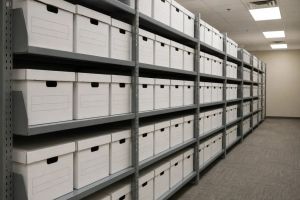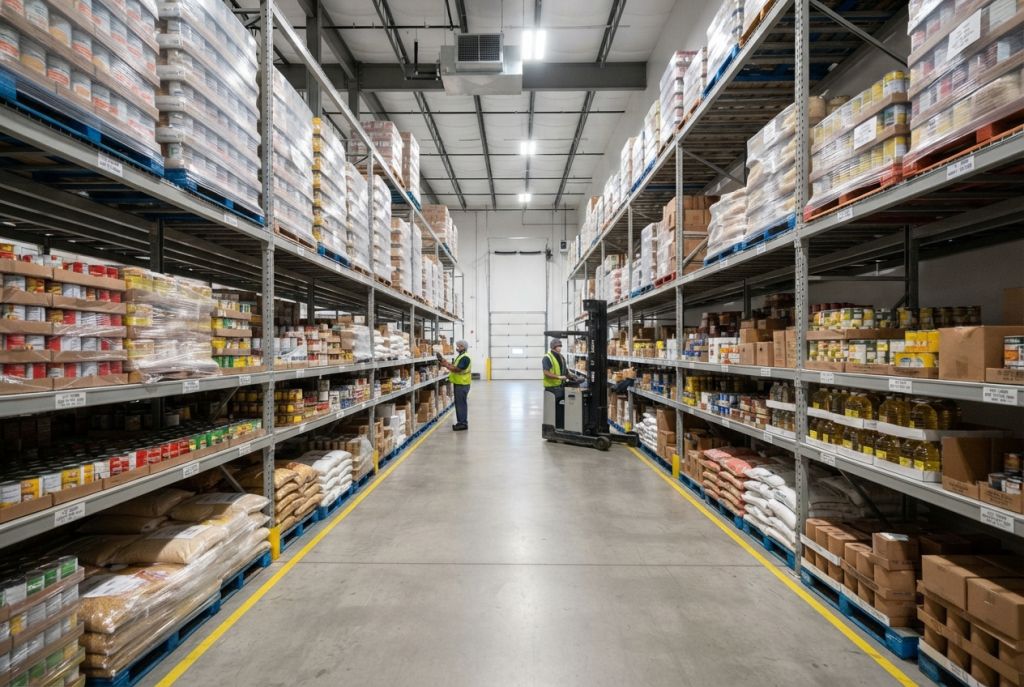
When a food warehouse starts missing temperature checks, struggling with lot rotation, or cleaning around hard-to-reach rack lines, the problem usually isn't just labor. It's storage design. The right food warehouse storage solutions support product safety, easier sanitation, cleaner traffic flow, and faster daily decisions from receiving through shipping.
Introduction
Food storage gets expensive when the layout fights the process. A warehouse manager might have enough square footage on paper, but still deal with blocked airflow in cold rooms, mixed lots in pick faces, or racks that make inspections harder than they should be.
That's why food warehouse storage solutions need to be planned around safety, compliance, and operational flow first. Rack style, shelving material, aisle width, and zone separation all affect how well a facility handles sanitation, FIFO rotation, traceability, and daily throughput.
A practical plan usually starts with a few basic questions. What products are being stored. How fast do they move. Which items need frozen, refrigerated, or ambient zones. And which storage system helps the team rotate stock and clean the facility without adding unnecessary handling?
If you're comparing options before purchase, this guide will help you narrow down what works, where it works, and what tends to create problems later.
Why Food Warehouse Storage Requires Special Planning
Food storage is different from general merchandise storage because the consequences are different. A poor rack layout in a general warehouse may slow down picking. In a food facility, the same mistake can also make cleaning harder, increase spoilage risk, complicate recall response, or create audit issues.
The broader warehousing market is large and active. In the U.S., the general warehousing and storage industry had 42,427 businesses in 2026 and a market size of $43.9 billion, according to IBISWorld industry data. Food operations sit inside that bigger environment, but with extra obligations. Those obligations include FDA registration, FSMA food safety planning, documented temperature logs, traceability records, pest controls, and FIFO inventory practices.
Storage choices affect more than capacity
A buyer looking only at pallet count can miss the bigger picture. Dense storage may improve cube use, but it can also reduce visibility, inspection access, or rotation flexibility. Wide-open selective rack may improve access, but it can waste refrigerated space if SKU counts are low and pallet depth is predictable.
The right answer depends on trade-offs such as:
- Rotation method: FIFO and FEFO usually need better lane discipline than basic bulk storage.
- Cleaning access: Some layouts leave too many dead spots near walls, corners, and lower rack levels.
- Lot control: Fast recall response depends on clear slotting and labeling, not just software.
- Traffic separation: Forklift routes, pedestrian paths, and temperature-zone crossings all matter.
Practical rule: In food facilities, storage is part of the food safety system. It isn't just a place to put product.
Cost mistakes usually show up later
The cheapest rack quote often ignores the expensive part. What matters is whether the system supports inspection, rotation, cleaning, and stable handling over time. If it doesn't, the operation pays for that mismatch every day.
That's why food warehouse racking and shelving should be selected with input from operations, maintenance, sanitation, and the food safety team, not just procurement.
Core Food Warehouse Storage Systems
Most food facilities use a mix of systems, not a single format. Frozen pallet reserve storage, dry goods picking, ingredient shelving, and kitchen support areas often need different equipment in the same building.

Pallet rack for food distribution centers
Pallet rack is the backbone of many food distribution center storage layouts. It works well for palletized goods, reserve inventory, replenishment stock, and staging near shipping.
Selective rack is the most flexible choice when you need direct access to many SKUs. It's often the safest starting point for mixed inventory because every pallet position stays visible and reachable. That matters for lot separation, inspection, and fast slot changes.
Higher-density options can work too, but only when the operating pattern supports them:
- Drive-in or drive-through styles: Better for large volumes of similar product with predictable handling patterns
- Pushback systems: Useful when density matters but access speed still matters too
- Deep-lane approaches: Best when you can group inventory cleanly by lot or product family
For operations comparing configurations, food and beverage pallet rack systems can help frame what fits refrigerated storage versus dry distribution needs.
Wire shelving for food storage
Wire shelving is common in prep areas, coolers, ingredient rooms, and hand-pick storage because it supports visibility and airflow. It's especially useful where teams need to inspect items often, clean under and around shelves, or store smaller cartons and supplies.
In food environments, wire shelving often works best when you need:
- Air circulation: Helpful in cooled areas and around packaged product
- Easy visual checks: Staff can spot debris, leaks, or misplaced stock faster
- Flexible shelf adjustment: Better for changing package sizes and mixed-case storage
For smaller-item applications, the related guide on wire shelving for commercial kitchens covers many of the same sanitation and accessibility concerns.
Gravity flow racks for FIFO inventory
Gravity flow rack is one of the most useful tools for date-sensitive inventory. Product loads from one side and presents to the pick face on the other, which supports first in, first out rotation with less operator judgment required.
That doesn't mean it fits every food operation. It works best when carton size, lane consistency, and replenishment patterns are stable. It becomes less helpful when SKU churn is high or package dimensions vary too much.
Good uses include:
- Short-dated packaged goods
- Repetitive case picking
- Staging lanes where FIFO discipline matters
- Fast-moving items with steady replenishment
If your operation is evaluating carton flow, gravity flow rack applications are worth reviewing before you lock in lane counts and pick-face depth.
A storage system should reduce daily decision-making, not add to it. FIFO works best when the rack design makes the right move the easy move.
Specialized Considerations for Food Environments
Food-safe storage isn't defined by one material or one rack type. It's defined by whether the system fits the environment, supports cleaning, and holds up under the actual conditions in the facility.

Cold storage racking considerations
Cold rooms create a different set of stresses than ambient storage. Moisture, condensation, frost, and repeated exposure to low temperatures all affect finish durability, floor conditions, and handling safety.
The U.S. cold storage market comprises roughly 3.0 billion usable cubic feet, and more than half of that space is concentrated in eight states, according to AEW logistics research. That concentration shows how critical cold storage pallet rack and refrigerated infrastructure are to food supply chains.
For cold storage racking, buyers usually need to look beyond basic load ratings and ask:
- Will the finish resist corrosion in damp or washdown-prone areas
- Does the rack layout support airflow around pallet loads
- Can operators handle pallets safely on cold floors with the current aisle plan
- Will decking, shelf surfaces, and labels hold up in the actual temperature zone
Food grade warehouse shelving considerations
Food grade warehouse shelving should be easy to clean, resistant to moisture where needed, and simple to inspect. In many operations, that points toward wire shelving, stainless options, or coated shelving designed for food contact-adjacent environments.
The issue isn't whether a shelf looks clean on day one. It's whether the shelf keeps working after repeated cleaning cycles, daily contact, and product changes.
Look for practical features such as:
| Shelving consideration | Why it matters |
|---|---|
| Open design | Improves visibility and access during cleaning |
| Smooth surfaces | Helps reduce debris traps |
| Adjustable levels | Supports changing package sizes |
| Corrosion resistance | Important in refrigerated or damp spaces |
| Clear labeling areas | Supports lot control and picking accuracy |
Food safe shelving should also match the process. A sanitation-heavy prep area may need a different finish and shelf style than a dry backstock room.
Layout Design for Sanitation and Temperature Control
A good food warehouse layout separates temperature zones clearly and keeps product movement simple. The more often staff or forklifts cross between frozen, chilled, and ambient areas without a clear reason, the more likely the facility is to lose time and create handling errors.

Temperature zones should follow product and traffic patterns
Frozen, refrigerated, and dry goods zones should be organized around handling needs, not just available floor area. Put high-turn items where they can move with fewer touches. Keep replenishment routes short. Avoid layouts that require product to wait in the wrong zone during staging.
A practical multi-temperature layout usually includes:
- Clear physical separation: Frozen, chilled, and ambient areas should be easy to identify and manage
- Dedicated staging logic: Don't let outbound congestion push product into the wrong zone
- Simple travel paths: Reduce cross-traffic and handoff confusion
Cleaning access and pest control need physical space
Sanitation plans fail when teams can't physically reach the areas they need to inspect. Rack rows set too tight to walls, blocked corners, and cluttered under-shelf space create avoidable risk.
That's also why air movement and building condition matter. In facilities dealing with moisture or air balance concerns, outside resources such as indoor air quality services can help operations teams think through environmental conditions that affect comfort, condensation, and room performance.
For storage design, the practical rules are simple:
- Leave inspection visibility: Staff should be able to see behind, beneath, and between storage zones where needed
- Preserve cleaning lanes: Floor scrubbers, sanitation tools, and pest inspections need real access
- Separate by handling risk: Raw inputs, packaged goods, allergen-sensitive products, and finished goods may need different locations and traffic rules
For refrigerated projects, cold storage warehouse solutions are usually easier to evaluate when the layout is reviewed as a workflow plan, not just a rack count.
Navigating FDA and FSMA Compliance in Your Warehouse
FDA warehouse compliance and FSMA planning can sound abstract until you connect them to the floor. In practice, many requirements show up as basic operational questions. Can you trace a lot quickly. Can you show temperature records. Can the team rotate stock properly. Can inspectors access storage areas without fighting the layout.
This article isn't legal or regulatory advice. Requirements vary by facility, product type, storage temperature, local rules, FDA guidance, FSMA obligations, customer audits, and each site's food safety plan. Final decisions should be reviewed with your compliance team, food safety manager, or authority having jurisdiction.
What compliance means in storage terms
A compliant storage plan usually supports:
- Traceability: Clear lane labels, slot IDs, and lot separation
- Temperature documentation: Product placement that aligns with required monitoring practices
- FIFO or FEFO execution: The rack should support the policy, not contradict it
- Inspection access: Teams need to reach product and storage areas without workarounds
Pest prevention also overlaps with storage design. If your team is reviewing warehouse sanitation risk points, practical resources like warehouse pest control in Crown Point can help frame common vulnerabilities around stored goods and building conditions.
Where open, cleanable shelving is required, NSF-certified shelving solutions may be part of the discussion, especially for areas where visibility, washdown, and food-safe shelving requirements are stricter.
Storage doesn't create compliance by itself, but a poor storage layout can undermine a good food safety plan very quickly.
Decision Scenarios and System Comparison
The best storage choice depends on product mix, rotation rules, and how much flexibility the operation needs. A frozen pallet reserve area has different priorities than a grocery pick module or a commercial kitchen backroom.
Food warehouse storage solutions comparison
| Storage Solution | Best Use Case | Key Benefits | Compliance Considerations |
|---|---|---|---|
| Selective pallet rack | Mixed SKU pallet storage | Direct access to each pallet, flexible slotting, easier inspection | Supports lot separation and visual access |
| Pushback rack | Higher-density pallet storage with repeated SKUs | Better cube use with front-face loading | Watch how density affects rotation logic |
| Drive-in or deep-lane rack | Large quantities of similar product | High density in limited space | Best only when lot control and rotation are simple |
| Wire shelving | Small-item food storage, coolers, kitchens | Airflow, visibility, easy access | Useful where cleaning and inspection matter |
| Gravity flow rack | Date-sensitive case picking | Supports FIFO presentation and efficient picking | Works best with stable carton sizes and lane discipline |
| Food safe shelving | Prep, ingredient, or regulated storage areas | Cleanable surfaces and organized access | Material choice should match sanitation needs |
Common decision scenarios
Cold storage facility
Cold storage pallet rack usually needs to balance density with airflow and safe handling. If SKU variety is low, a denser format may work. If lot visibility and quick access matter more, selective rack may be the smarter choice.
Dry goods distributor
Dry goods facilities often benefit from selective pallet rack combined with flow lanes for faster movers. That setup keeps reserve and picking functions separate without making replenishment harder than it needs to be.
Beverage warehouse
Beverage storage can stress both rack capacity and traffic flow. Heavy pallet loads, repetitive SKU movement, and seasonal volume swings often push the design toward durable pallet rack with clearly defined staging and replenishment lanes.
Grocery distribution operation
Grocery distribution usually needs a blend of systems. Reserve pallet storage, case picking, and fast-turn replenishment often work better in zones than under one universal rack strategy.
Commercial kitchen or support storage
In kitchens and support rooms, food grade warehouse shelving and wire shelving are often better fits than pallet systems. The priority shifts toward access, cleaning, visibility, and small-lot organization.
5 Step Checklist for Choosing Food Warehouse Storage
A solid buying process usually starts with operations data, not product brochures.

Step 1
Analyze inventory. Review SKU count, pallet sizes, carton dimensions, lot control needs, and whether products follow FIFO or FEFO.
Step 2
Map the facility. Check clear height, column spacing, floor condition, dock access, and where frozen, chilled, and ambient zones should sit.
Step 3
Match storage to sanitation needs. Ask how often each area is cleaned, how inspections happen, and whether shelving or racking creates hard-to-reach zones.
Step 4
Review throughput realistically. A system that looks space-efficient may still slow receiving, replenishment, or picking if it doesn't fit the actual workflow.
Step 5
Leave room for change. Food operations don't stay still. SKU mix changes, customer requirements change, and labor availability changes. A layout with some flexibility usually ages better than one built around a perfect but narrow assumption.
Questions to Ask Before Requesting a Quote
A good quote depends on good input. If a buyer can answer the right questions early, the design process moves faster and the recommendation is more useful.
Bring these details to the conversation:
- What products are stored: Frozen foods, chilled items, dry goods, ingredients, beverages, or mixed inventory
- How inventory rotates: FIFO, FEFO, batch hold, quarantine, or customer-specific segregation
- What the packaging looks like: Full pallets, cases, totes, trays, bags, kegs, or hand-loaded items
- What equipment is used: Counterbalance forklifts, reach trucks, pallet jacks, carts, or hand picking
- What the environment requires: Refrigerated, damp, washdown-prone, or dry ambient conditions
- What audits expect: FDA warehouse compliance concerns, customer standards, labeling rules, sanitation access, and traceability needs
Also gather building details such as clear height, obstructions, door locations, and traffic flow problems. That information helps prevent a layout that looks efficient in a drawing but creates friction on the floor.
If you're ready to compare options, a practical next step is to get a food warehouse storage quote based on real operating conditions, not a generic rack template.
Conclusion Your Partner in Compliant Food Storage
The best food warehouse storage solutions aren't chosen by rack style alone. They're chosen by how well they support sanitation, temperature control, lot traceability, inventory rotation, and daily throughput.
That's why cold storage racking, food grade warehouse shelving, wire shelving, and gravity flow systems should be evaluated as part of one operating system. The goal is to build a layout that works under real conditions, not just one that fits the most product on paper.
Planning earlier usually gives buyers better layout options, fewer installation conflicts, and a smoother path to compliance review. It also helps avoid delays that come from redesigning after equipment is ordered.
Frequently Asked Questions About Food Storage Solutions
What is the best material for food grade shelving
It depends on the area and the cleaning process. In many food environments, buyers look for shelving that is easy to clean, resistant to corrosion where needed, and suitable for the temperature zone. Wire shelving, coated shelving, and stainless options are all used depending on the application.
What is the difference between FIFO and FEFO
FIFO means first in, first out. FEFO means first expired, first out. FIFO rotates by arrival order. FEFO rotates by the nearest expiration or use-by date. In food operations with short shelf life, FEFO may be more useful than simple FIFO.
Can you mix different types of racking in one food facility
Yes. Many facilities use selective pallet rack for reserve storage, gravity flow for case picking, and wire shelving for smaller-item storage or support areas. Mixed systems often work better than trying to force one rack type into every zone.
How does racking choice affect cleaning
Rack style affects how easily teams can inspect under bays, around uprights, and behind rows. Dense systems can save space, but they may reduce cleaning access if the layout isn't planned carefully. Open shelving and visible lower levels usually make routine checks easier.
How do you calculate aisle width in a food warehouse
Aisle width should be based on the material handling equipment, pallet dimensions, turning needs, and safety clearances. In food environments, don't stop at forklift specs. Also consider cleaning equipment access, pedestrian safety, and whether the aisle supports inspection and sanitation tasks.
What works best for cold storage pallet rack
Cold storage pallet rack should support safe handling, airflow, and durability in low-temperature conditions. The finish, decking, and layout all matter. A system that performs well in ambient storage may not hold up the same way in cold, damp, or frost-prone areas.
Are there special rack rules for organic or allergen-sensitive storage
The storage system itself may not be unique, but the layout often is. Facilities may need clearer separation, tighter labeling discipline, and better control of product movement to support internal procedures, customer audits, or contamination prevention practices.
When does high-density storage become a bad fit
It becomes a bad fit when space savings start hurting access, rotation, cleaning, or service levels. If operators spend too much time relocating pallets, struggling with lot separation, or working around inflexible lane assignments, the density benefit may not be worth it.
If you're planning a new food distribution center storage layout or upgrading an existing facility, Material Handling USA can help you compare pallet rack, wire shelving, cold storage solutions, and food-safe shelving options based on your workflow. For a free quote or no-obligation layout review, Contact Us, Request a Quote, email Sales@MH-USA.com, or Call (800) 326-4403.
Online Store
Shop at MaterialHandling-USA.com
Stock up on food-safe shelving, janitorial supplies, and storage:
Janitorial Supplies
Shipping Labels & Tags
Drums, Pails & Containers
Shop food service supplies →