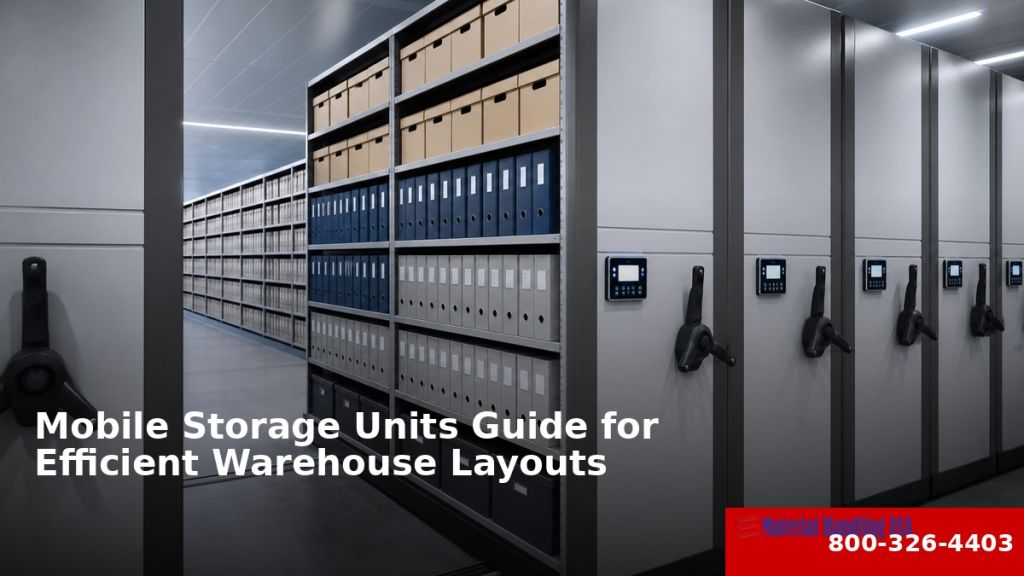
Floor space disappears faster than most facility managers expect. One quarter becomes overflow staging. Another turns into a temporary holding area. Before long, forklifts are working around fixed aisles that no longer match the way your team picks, stores, or secures inventory.
That's where mobile storage units start to make sense. Instead of treating storage as a fixed layout problem, they let you adapt capacity, access, and security to the work happening in the building right now. For some operations, that means adding short term container storage outside. For others, it means installing mobile shelving or rolling storage systems inside to reduce wasted aisle space and improve retrieval.
Interest in this category keeps growing. The global market for mobile storage units was valued at $3.24 billion in 2023 and is projected to grow at a 7.4% CAGR from 2024 through 2030, according to market data cited here. That growth reflects a simple reality. Warehouses, labs, government facilities, and commercial sites need flexible storage that can change with demand.
For buyers, the challenge isn't just finding a unit. It's choosing the right format, planning for delivery and code issues, and avoiding layout mistakes that create bottlenecks later. The details matter, especially when the goal is better use of expensive space, safer access, and fewer surprises during installation.
Introduction to Mobile Storage Units
A common scenario looks like this. A distribution center has decent square footage on paper, but the operation still feels crowded. Fast moving SKUs keep getting pushed into secondary areas. Seasonal inventory lands in corners. Team members lose time walking around fixed shelving and temporary stacks because the layout can't flex with the workload.
Mobile storage units solve that problem in two broad ways. Some are portable container based units delivered to a site for temporary or ongoing storage. Others are mobile interior systems that move shelving or racking so the facility only opens an aisle where access is needed. Both approaches help managers use space more deliberately.
What matters most is the fit between the system and the task.
If you're dealing with overflow stock, project materials, records, evidence, tools, healthcare supplies, or palletized product, a mobile approach can give you more control than static storage. It can also make planning easier when your workload changes by season, project phase, or department.
Practical rule: If your aisles stay fixed while your inventory mix keeps changing, the layout is probably costing you usable capacity.
Buyers also need to think beyond storage alone. Security requirements, forklift access, climate sensitivity, permit rules, and floor conditions all affect whether a system will help or frustrate daily operations. That's why the strongest projects start with a layout review instead of a product shortcut.
Understanding Core Concepts of Mobile Storage Units
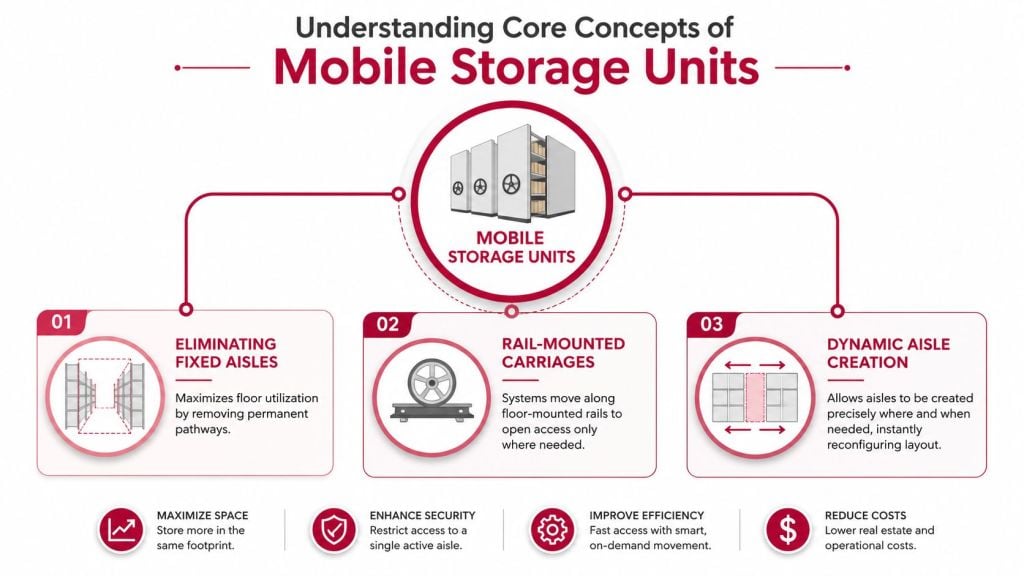
At the most basic level, mobile storage units help you store more in the same footprint by reducing or relocating unused aisle space. Instead of giving every row a permanent access lane, the system creates access only where it's needed.
Two common ways they work
Interior mobile systems usually place shelving or racking on moving bases. Staff turn a handle, push an assisted carriage, or use powered controls to open one active aisle. This works well when square footage is limited and access patterns are predictable.
Portable exterior units work differently. A container is delivered to the site and placed where the operation needs extra capacity. These units are useful for overflow inventory, renovations, short term projects, or remote site storage.
The phrase “mobile storage units” covers both categories, but the buying logic changes depending on whether you need dense interior organization or containerized on site storage.
Why dimensions change your operation
Size affects much more than capacity. It also shapes loading speed, handling equipment, and access method.
For example, industry standard 20 foot container class mobile storage units deliver about 1,460 cubic feet of interior volume and can store up to 14 standard pallets when stacked two high, according to this portable storage container guide. That sounds straightforward until you think about how people move product inside a narrow container. A unit can hold a lot, but loading and retrieval may be slower if staff need single file movement or careful sequencing.
The simple test
Ask three questions:
-
Who needs access
One person at a time, a pick team, or forklift operators? -
What is being stored
Files, parts, tools, cartons, or palletized inventory? -
Where will the unit live
Inside a controlled building or outside on a pad or yard area?
Those answers usually point you toward the right system type faster than product brochures do.
Key Categories of Mobile Storage Units
Different operations need different forms of mobility. A hospital archive doesn't store like a manufacturing plant, and a temporary jobsite container doesn't operate like a secure evidence room.

Side by side category comparison
| Category | Best fit | Access style | Typical strength |
|---|---|---|---|
| Mobile shelving | Files, small parts, boxed items, supplies | Hand access | Dense storage in limited space |
| Mobile pallet racking | Palletized goods and heavier bulk stock | Forklift access | Better cube use in industrial settings |
| High density mobile systems | Areas with serious space pressure | Controlled aisle opening | Maximum storage within existing footprint |
| Security or evidence units | Sensitive, regulated, or restricted items | Controlled user access | Protection, accountability, and compartmentalization |
How to think about each option
Mobile shelving works best when people retrieve items by hand and need organization more than brute capacity. Offices, labs, healthcare stockrooms, and archive rooms often use it because it keeps materials close without filling the room with permanent aisles.
Mobile pallet racking fits facilities handling heavier inventory. It's a practical choice when expanding the building isn't realistic but storage pressure keeps increasing.
High density systems are often chosen when floor area is expensive, restricted, or already built out. They can support long term planning because they focus on layout efficiency first.
Security oriented systems add another layer. Instead of just storing items, they help control access, preserve chain of custody, or separate users and materials by permission level.
For a deeper look at interior system planning, this complete mobile shelving system guide is useful when comparing applications and layout goals.
A good category match should reduce wasted movement, not just increase storage count.
Evaluating Features and Specifications
Buyers often save money or lose it during this phase. While the visible product may look fine, the critical decision depends on load, workflow, floor conditions, access equipment, and permit rules.

Specs that deserve close attention
Start with these:
- Load capacity: Match shelf, bay, or container use to the actual items being stored.
- Aisle and access needs: Measure for people, carts, pallet jacks, or forklifts.
- Floor and slab condition: Mobile systems depend on stable, suitable support.
- Power method: Decide between manual movement, assisted movement, or powered operation.
- Expandability: Check whether the system can grow with changing inventory.
- Security needs: Look at lock type, enclosure design, and user control.
A buyer comparing only dimensions and price may miss the daily operating impact. A system that stores more but slows picking can become a poor fit. A unit that arrives quickly but triggers local permit problems can stall the whole project.
Hidden costs many buyers miss
One of the biggest blind spots is permitting. Sixty eight percent of urban areas require specific zoning permits for portable container placement, with permit fees averaging $150 to $450 per unit, according to this portable container permitting guide. That matters if you plan to place units outside a building, near traffic flow, or in visible site areas.
Those costs aren't always large by themselves. The bigger issue is delay. If a container is scheduled before site approval is complete, the project timeline can slip and receiving plans can get messy.
A practical evaluation checklist
- Measure the real site, not the old drawing: Confirm doors, turning space, and clearance conflicts.
- Map the workflow first: Note who accesses the unit, how often, and with what equipment.
- Review local placement rules: Outdoor storage may trigger zoning, notice, or encroachment requirements.
- Ask about service and reconfiguration: Storage needs rarely stay fixed.
- Compare total cost, not just product price: If you're also weighing alternatives, outside references on how much self storage costs can help frame broader budget discussions.
Benefits and Industry Use Cases for Mobile Storage Units
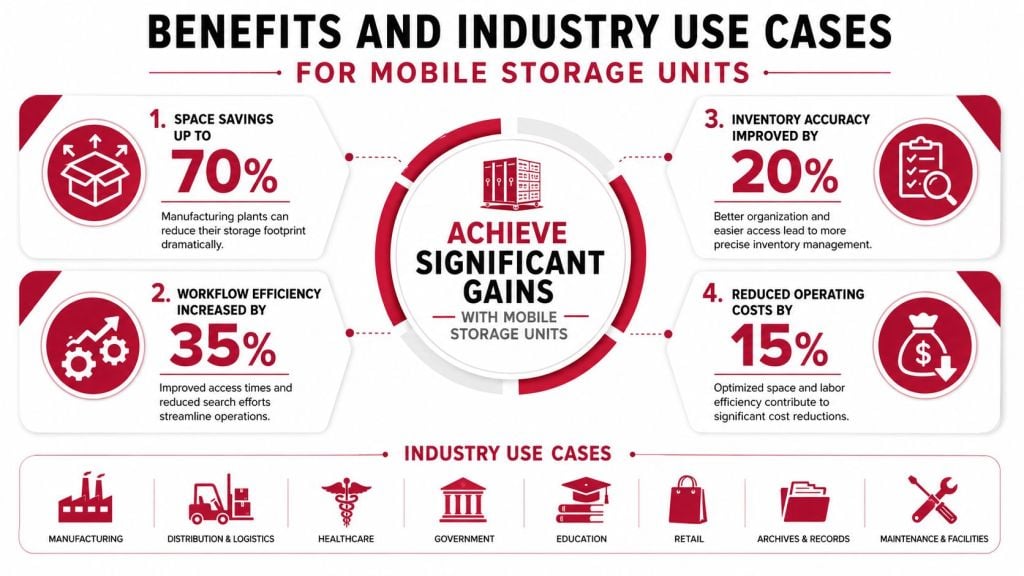
The strongest argument for mobile storage units isn't theory. It's that they solve different space problems in different environments without forcing every facility into the same layout logic.
Where they fit best
In manufacturing, teams often use mobile systems to keep parts, tooling, and support inventory closer to production while reducing wasted aisle area. The value comes from cleaner organization and better use of floor space that would otherwise disappear into static access lanes.
In healthcare and laboratory settings, mobile storage helps consolidate supplies, records, and controlled materials in a footprint that stays manageable. That matters when rooms must hold more without hindering movement.
In government, police, and secure facilities, mobile cabinets and enclosed systems help separate access by user and protect sensitive contents. For evidence or restricted records, storage has to support accountability as much as capacity.
In warehousing and distribution, portable container units can support overflow inventory, renovation staging, or temporary seasonal spikes. This category is especially relevant because 80% of mobile storage rentals last under six months, based on 2025 mobile storage market trends. That shows how often organizations use mobile storage for short term flexibility rather than permanent expansion.
Why buyers move forward with these systems
The gains usually show up in four areas:
| Operational need | How mobile storage helps |
|---|---|
| Space pressure | Reduces fixed aisle waste or adds temporary capacity |
| Access control | Supports lockable or restricted storage formats |
| Project flexibility | Handles temporary peaks, moves, and phased renovations |
| Layout planning | Lets teams align storage more closely with actual workflow |
For more examples of where these systems make sense, see these compelling reasons for mobile storage systems.
When a facility keeps postponing storage changes, the cost usually shows up as labor friction, overflow workarounds, and delayed planning.
Selecting the Right Mobile Storage System
Choosing the right system starts with the workflow, not the catalog. Buyers who rush to size and finish often miss the larger question. What problem is the unit supposed to solve every day?
A step by step selection path
First, define the storage job clearly. Is the goal denser file storage, secure records retention, pallet overflow, renovation support, or better use of a cramped stockroom?
Next, look at who touches the system. A hand loaded room for archived records has different needs than a container loaded by forklift or a parts room accessed all day by multiple users.
Then compare total cost of ownership. Include equipment, installation, maintenance, and the effect on labor and retrieval. Material Handling USA helps clients review that full picture during planning and offers complimentary layout design services with scaled drawings and 3D renderings that show product placement, aisle widths, clearance needs, and workflow fit.
Where ROI thinking helps
The return doesn't come from storage alone. It comes from what the storage changes. Better space use can postpone expansion. Better organization can reduce search time. Better access planning can improve inventory handling and reduce daily friction.
Most customers evaluating a shift from static to mobile storage look for measurable returns within 12 to 18 months, based on the planning context provided by the content owner. The exact result depends on labor patterns, layout efficiency, and how well the chosen system matches the site.
If you want another outside perspective on planning questions and buying considerations, this ultimate 2026 guide to mobile storage offers a broad overview of the topic.
Implementation and Safety Best Practices
A strong storage decision can still fail during rollout if the site isn't prepared. Installation planning matters because mobile storage units interact with floors, access paths, traffic patterns, and local requirements.
Before installation starts
Check the basics first:
- Site readiness: Confirm slab condition, grade, and placement area.
- Traffic flow: Make sure the unit won't block docks, exits, or regular travel paths.
- Access equipment: Verify that carts, lifts, or forklifts can work safely in the space.
- Code review: Confirm local placement, clearance, and safety requirements early.
For interior systems, rail alignment and floor tolerance deserve close attention. For exterior units, delivery approach, ground condition, and placement restrictions matter just as much.
Safety habits that protect the investment
Once the system is in place, operators should know simple rules. Don't overload shelves. Don't force movement if something binds. Keep aisles and tracks clear. Inspect locks, handles, rails, and moving parts on a routine basis.
A layout review also helps prevent avoidable conflicts. This is especially important when a project includes multiple storage types, changed traffic routes, or future expansion plans. Facilities planning support such as warehouse design and layout solutions can help teams align storage with broader building use.
Keep the operating area as disciplined as the storage system itself. Mobile storage performs best when the surrounding workflow is just as organized.
Long term planning
Storage needs rarely stay still. Departments grow. Item mix changes. Security expectations tighten. A smart implementation leaves room for adaptation, whether that means reconfiguring shelf locations, adding controlled access, or repositioning temporary exterior storage during later project phases.
That's one reason many buyers start planning before the space issue becomes urgent. Earlier decisions usually mean cleaner layouts, fewer permitting surprises, and smoother installation windows.
Conclusion and Next Steps
Mobile storage units make sense when space is tight, access needs are changing, or security matters as much as capacity. The right system can help a facility reduce wasted aisle space, support cleaner workflows, protect sensitive materials, and handle temporary demand without forcing a larger footprint.
The key is choosing based on function. Start with what's being stored, who needs access, how often it moves, and where the unit will be installed. Then review floor conditions, equipment compatibility, permit requirements, and long term flexibility before ordering.
That upfront work usually leads to better results than chasing the lowest initial price. It also helps teams avoid the hidden delays that come from missed site details, outdoor placement rules, or poor traffic planning. With demand for flexible storage continuing to rise, earlier planning can also mean better timing for layout reviews, product availability, and installation scheduling.
If your facility needs a standard solution, you can Buy Online through MH USA store options. If the project needs custom planning, secure storage, or a denser layout, a design review is the better starting point. Free quotes, free layouts and designs with no obligation, competitive pricing, and fast shipping can make the decision process much easier.
If you're comparing mobile storage units for a warehouse, lab, secure room, or project site, Material Handling USA can help you plan the right fit. Request a Quote, Contact Us, or Call (800) 326-4403. For online purchasing paths, use Shop Now or Buy Online on applicable store pages. You can also email Sales@MH-USA.com to start a free layout and design conversation before delays and space constraints become harder to solve.