If you have a compliance review coming up, a new storage area in design, or a purchase request waiting on final approval, spill containment usually moves from “we should address that” to “we need a clear answer now.” That shift happens fast. One leaking drum, one rain-filled sump, or one missed inspection log can turn a routine storage setup into a safety problem and a regulatory problem at the same time.
Secondary spill containment sits at the center of that risk. It protects people, floors, drains, and nearby soil or water if a primary container fails. It also affects how you plan storage layouts, choose equipment, and document inspections. For managers and buyers, the challenge isn't just finding a pallet or berm. It's making sure the system fits the liquid, the space, the code path, and the way the area is used in practice every day.
Introduction Why Spill Containment Is Non-Negotiable
Spill containment is one of those facility issues that seems simple until you have to sign off on it. A few drums of oil, a tote of chemical product, or a hazardous waste accumulation area can trigger requirements that involve the EPA, OSHA, fire code, and site-specific procedures. The equipment matters, but so does the way you size it, place it, drain it, and inspect it.
The biggest mistake I see is treating containment as a one-time purchase. A buyer orders a spill pallet with enough sump volume on paper, and the team assumes the job is done. It usually isn't. Outdoor units collect rainwater. Indoor rooms may need to account for fire protection water under local code. Hazardous waste areas often follow one standard, while petroleum storage follows another.
That's why secondary spill containment requirements should be handled as an operations decision, not just a product decision.
A solid plan usually comes down to five questions:
- What are you storing: Oil, petroleum products, hazardous waste, or another regulated liquid.
- How much is on site: Container size and total stored volume both matter.
- Where is it stored: Indoor and outdoor areas often follow different design expectations.
- How is the area maintained: Passive systems still need active oversight.
- What proof do you have: Inspectors care about equipment, but they also care about records.
Practical rule: If your containment plan depends on people doing the right thing, document the steps and make them easy to follow.
What Is Secondary Spill Containment
Secondary containment is the backup system that catches a leak or spill from the main container. The easiest way to think about it is a saucer under a coffee cup. The cup holds the liquid during normal use. The saucer only matters when the cup drips, cracks, or tips.
In a facility, the primary container might be a drum, IBC tote, tank, or pail. The secondary containment might be a spill pallet, deck, berm, sump, or a contained room floor. Its job is to stop the liquid from spreading into aisles, drains, work areas, and the environment.
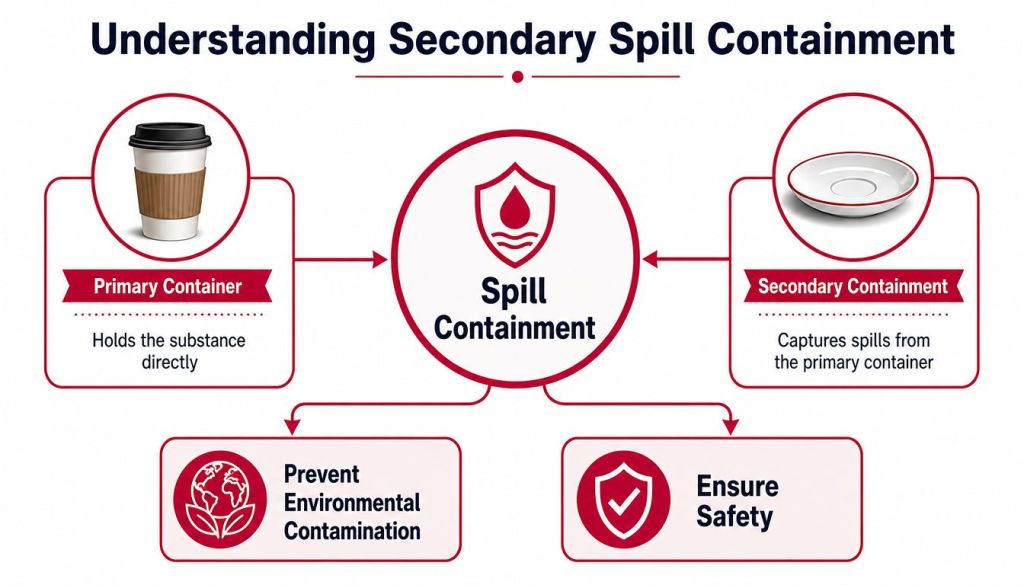
Three practical goals drive most containment decisions:
- Worker safety: Wet floors and chemical contact create immediate hazards.
- Facility protection: Leaks can damage concrete, coatings, equipment, and stored goods.
- Environmental control: The whole point is to keep regulated liquids out of drains, soil, and water pathways.
That simple backup role is why containment rules are so specific. The system must be there before a failure happens, not after.
Decoding the Spill Containment Regulatory Landscape
A plant can buy the right spill pallet, place it under the right drum, and still fail an inspection. I see that happen when teams focus on storage volume and miss the operating rule attached to that area. The regulator is often looking past the sump and asking a harder question. Will this system contain a release under real site conditions, and can the facility prove it stays ready to work?
No single regulation covers every liquid and every use case. Petroleum storage, hazardous waste accumulation, indoor chemical rooms, and outdoor transfer areas can fall under different rule sets at the same site. The expensive mistakes usually show up in the gaps between those rules, especially where inspection, housekeeping, and maintenance expectations differ for active containment systems such as pumped sumps or trench drains versus passive systems such as spill pallets, berms, and curbed pads.
EPA and SPCC for petroleum storage
For oil and petroleum products, the first rule many facilities need to review is EPA SPCC under 40 CFR §112.7. The familiar benchmark is containment sized to hold the largest container plus enough freeboard for precipitation or displacement, depending on the setup.
That is the part people remember. The part they miss is that SPCC also expects containment to work as installed and as maintained. Cracked coatings, blocked drain valves, open manual drains, and stained containment areas with no documented cleanup history draw attention fast. For outdoor systems, rain management matters as much as raw capacity. For indoor systems, traffic damage and poor access for inspection are common failure points.
Layout decisions affect compliance more than many buyers expect. A containment area that technically has enough volume can still create problems if forklift routes cross berm walls, if transfer points sit outside the protected area, or if operators cannot inspect low spots and drain controls without moving product. That is why containment should be reviewed with the broader OSHA-compliant warehouse design process before equipment is ordered.
OSHA and fire code requirements
OSHA rules and fire code requirements often shape how containment must function day to day, even when EPA or RCRA sets the baseline storage standard. The International Fire Code and local authority having jurisdiction may look at spill control, drainage control, fire water runoff, chemical compatibility, and room construction as one package rather than separate purchasing decisions.
That difference matters in practice.
A passive spill pallet may satisfy a storage need for small containers, but an indoor liquid room may still require curbing, protected drains, fire-rated construction, or additional control of sprinkler discharge. An active containment system may solve one problem and create another if nobody assigns responsibility for testing pumps, alarms, or shutoff devices. I have seen facilities pass a product review and fail the final site review because the room design assumed clean water drainage while the fire official assumed contaminated runoff containment.
The lowest-risk approach is simple. Match the containment product, the room design, and the inspection routine to the actual liquid hazard and the way the area operates.
RCRA for hazardous waste areas
Hazardous waste storage follows RCRA 40 CFR 264.175, which uses a different benchmark from petroleum storage. The requirement is 100% of the largest container or 10% of the total aggregate volume of all containers, whichever is greater.
The bigger compliance gap is usually not the math. It is condition and documentation. Hazardous waste containment areas are expected to stay free of accumulated releases, incompatible waste mixing risks, and deterioration that could affect containment performance. If the area has coatings, liners, grating, sump components, or drain plugs, those parts need routine inspection and prompt repair. A neglected passive berm and an untested active sump can both trigger the same result. The facility cannot show that containment was reliable when it mattered.
For managers who need a broader plain-language overview of waste rules, this guide can help simplify hazardous waste rules. It is useful when you need to separate standard liquid storage from regulated hazardous waste accumulation areas.
Here is a practical way to sort the rule path before you buy or reconfigure anything:
| Storage situation | Main rule path to review | Common compliance miss |
|---|---|---|
| Petroleum and oil storage | EPA SPCC | Adequate volume, but poor drainage control or no maintenance record |
| Hazardous waste accumulation | RCRA | Container area meets capacity rule, but condition checks and cleanup records are weak |
| Indoor hazardous liquid areas | IFC and local fire code | Product selected without considering fire water, room construction, or drain control |
| Outdoor storage | EPA, IFC, local code | Rainfall allowance ignored, or containment left full of stormwater and debris |
How to Calculate Your Required Containment Capacity
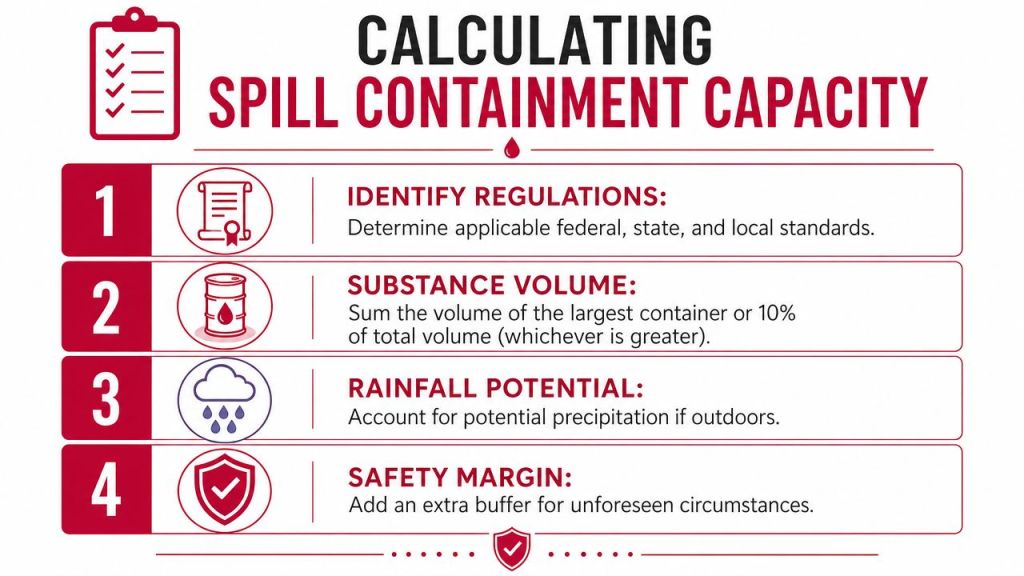
A containment system can look adequate on the purchase order and still fail a compliance review once someone checks the actual storage layout, weather exposure, and operating conditions. Capacity calculations need to match the rule path for the material and the way the area is used. That means checking the largest container, the total stored volume, and whether the system sits indoors or outside.
Single container example
For petroleum storage under SPCC, a common starting point is 110 percent of the largest container. If a facility stores one 5,000-gallon tank or tanker, the containment target is 5,500 gallons. That works out to about 735.29 cubic feet.
The mistake I see is treating that extra capacity like a margin you can give back by adding pumps, grating, or other components inside the berm. You cannot count on nominal sump volume alone. Internal obstructions, uneven floors, and poor drainage details can reduce usable containment volume fast.
Multiple container example
Hazardous waste container areas usually follow the greater-of-two-values test. The containment system must hold either the full volume of the largest container or 10 percent of the total volume stored there, whichever is greater.
A simple example shows how this works:
- Twenty 55-gallon drums equal 1,100 gallons total
- Ten percent of 1,100 gallons is 110 gallons
- The largest single container is 55 gallons
- The minimum required capacity is 110 gallons
Buyers often get tripped up. They price drum pallets one at a time because each unit looks compliant by itself, then later group containers in a way that changes the required capacity. Shared containment can be a smart choice, but only if the final arrangement, not the catalog photo, meets the volume requirement.
Outdoor freeboard matters
Outdoor systems need more than product-release capacity. Under 40 CFR §112.8(c)(2), SPCC-regulated oil storage also has to account for precipitation. That is why an outdoor berm or concrete basin that pencils out indoors can come up short once stormwater enters the calculation, as summarized in this EPA secondary containment summary.
A second gap shows up after installation. Passive outdoor containment has to preserve its rated volume between cleanouts, and active systems such as sumps or pumped basins need proof that valves, pumps, and controls are working as intended. If rainwater is left standing, drain valves are left open, or a sump pump is not tested, the system may miss the capacity it was designed to provide.
Use this checklist before approving a layout or placing an order:
- Confirm the material class. Oil, petroleum, hazardous waste, or another regulated liquid can trigger different standards.
- List the actual container sizes and counts. Estimates create bad calculations.
- Verify the storage configuration. Dispensing, staging, and long-term storage do not always use the same containment approach.
- Account for outdoor exposure. Rainfall, snowmelt, and debris reduce available volume.
- Subtract displaced volume. Grating, supports, pumps, and containers inside the area can reduce real capacity.
- Check inspection access. If staff cannot see drain plugs, sump corners, or low spots, maintenance problems get missed.
Good containment math is part volume calculation and part field reality. The facilities that avoid fines are usually the ones that confirm both before equipment shows up.
Common Types of Secondary Containment Systems
A system can meet the volume requirement on paper and still create problems in daily use. The right choice depends on how containers are loaded, where transfers happen, how often staff inspect the area, and whether the setup is passive or relies on drains, pumps, or other components that need routine checks.

Spill pallets and decks
Spill pallets and decks fit well in drum storage and dispensing areas, especially where the footprint is tight and containers stay in a defined location. Pallets usually offer more contained volume in a single unit. Decks are easier to build into longer indoor runs and often reduce trip hazards because of their lower profile.
The trade-off is access versus capacity. Low-profile decks make drum handling easier, but they usually leave less sump depth and can fill faster if a leak goes unnoticed. Higher pallets hold more, but they can slow loading and increase the chance of rough handling if forklift clearance is tight.
Drum movement should be part of the selection, not an afterthought. If operators use drum trucks, rotators, or handlers in the same area, review compatible drum handling equipment for pallet and deck layouts before finalizing the containment height and spacing.
IBC units and contained dispensing areas
IBC containment systems are built for larger liquid volumes and heavier traffic. In many facilities, the weak point is not the sump rating. It is valve access, visibility under the tote, and whether staff can inspect for small releases before residue builds up.
Dedicated IBC units usually outperform improvised setups made from multiple smaller pieces. They are easier to load correctly, easier to inspect, and less likely to leave uncovered gaps around the base. That matters in dispensing areas, where minor drips are common and poor housekeeping can hide a larger leak.
Berms, sheds, and larger containment zones
Flexible berms are often used for temporary work, mobile equipment, maintenance projects, or areas where fixed steel or poly units do not fit the layout. They solve footprint problems, but they also demand more attention during setup. If the sidewall is crushed, the surface is uneven, or vehicle traffic damages the edge, the rated containment volume may no longer reflect field conditions.
Covered units and containment sheds are a better fit for outdoor drum storage where weather exposure affects inspection, housekeeping, and available capacity. They cost more upfront, but they often reduce the maintenance burden that leads to fines, especially when rainwater management and locked access are ongoing concerns.
When sourcing these systems, suppliers like Material Handling USA can help when a project includes both IBC spill containment and broader warehouse equipment planning.
| Containment type | Best fit | Trade-off |
|---|---|---|
| Spill pallet | Drum storage and dispensing | Limited flexibility for odd layouts |
| Spill deck | Modular indoor drum areas | Lower profile may mean less sump depth |
| IBC containment sump | Tote storage | Larger footprint |
| Covered pallet or shed | Outdoor drum storage | Higher upfront cost |
| Berm | Temporary or custom area | Requires careful setup and monitoring |
Choosing the Right Design and Materials
Containment capacity gets most of the attention, but material compatibility is just as important. A sump that holds enough volume but degrades in contact with the stored liquid isn't a compliant long-term solution.
Poly versus steel
High-density polyethylene is common because it resists many oils, acids, and caustics. It also works well in many warehouse and plant environments where corrosion resistance matters more than fire resistance.
Steel units are often chosen for tougher duty cycles, certain flammable liquid applications, or areas where structural rigidity matters more than chemical breadth. They can also make sense where rough handling is expected and the stored liquids are compatible with the finish and construction.
Design details that matter in daily use
The best containment designs usually solve inspection and cleanup problems before they happen.
- Removable grates: These make routine cleaning much easier.
- Drain access: Useful for controlled liquid removal when procedures allow it.
- UV resistance for outdoor units: Plastic units exposed to sunlight need material suited to that environment.
- Forklift access: Important if totes or drums are loaded in place.
- Low step-up height: Better for frequent drum handling.
Buy for the liquid and the workflow. Either one by itself can lead you to the wrong product.
A good product review should answer four questions clearly: what liquid it can handle, what volume it can contain, how staff will access it, and how the team will maintain it after installation.
Critical Inspection and Maintenance That Prevents Fines
This is the gap that catches a lot of facilities. They buy compliant equipment, place it correctly, and still fail because the ongoing maintenance process is weak.
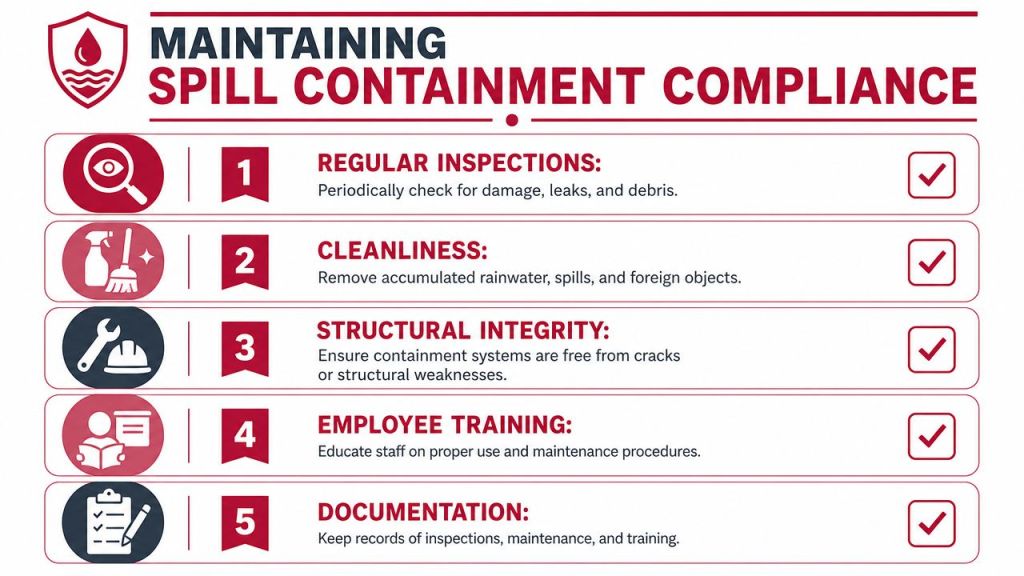
Passive containment systems need active management. A berm, pallet, or outdoor sump doesn't protect you if it is already full of rainwater or if nobody can show that accumulated liquid was removed on time.
The passive system liability gap
A verified EPA data point makes this issue hard to ignore. A 2024 EPA audit of 127 facilities found 43% failed due to unverified slope integrity or unlogged precipitation removal in passive containment systems, according to this EPA secondary containment enforcement page.
That finding matters because many teams assume “installed” means “covered.” It doesn't. Inspectors may look for evidence that precipitation was removed, that liquid flowed where it was supposed to flow, and that the system still had usable capacity at the time of inspection.
What a practical inspection routine looks like
A workable routine is simple, visible, and documented.
- Check sump condition: Look for cracks, warping, blocked drainage paths, or damaged grates.
- Verify usable capacity: Rainwater, debris, or old spill residue can reduce available containment volume.
- Confirm container placement: Drums and totes should sit fully within the protected area.
- Review slope and low-point function: If the system relies on drainage to a sump, confirm it still works as intended.
- Log each check: A missing log can be as damaging as a missed inspection.
For teams building a broader audit routine, this lab safety checklist is a useful model for documenting repeat inspections and assigning responsibility.
The best inspection log is the one a supervisor can find in under a minute.
Frequently Asked Questions About Spill Containment
Below are common questions that come up after the first layout review or product shortlist.
Common Spill Containment Questions
| Question | Answer |
|---|---|
| Do I need separate containment under every drum? | Not always. A common collection area may be acceptable if it meets the required total capacity and supports safe use. |
| Can I use the same containment for different liquids? | Only if the material of the containment is compatible with each liquid and your operating procedures prevent unsafe mixing. Mixed-chemical storage needs careful review. |
| Is indoor containment easier than outdoor containment? | Usually, yes. Outdoor systems add weather exposure, precipitation management, and more maintenance pressure. |
| What's the most common buying mistake? | Choosing based on footprint alone. Capacity, material compatibility, access, and maintenance all matter. |
| Can rainwater stay in an outdoor sump until the next scheduled inspection? | That's risky. The issue is whether the system still has usable capacity and whether removal is documented. |
| Should I choose a pallet, deck, or berm? | Use a pallet or deck for routine drum storage, an IBC unit for totes, and a berm for larger or temporary containment zones. |
| Do local rules ever exceed federal minimums? | Yes. State and local authorities may apply stricter requirements, especially through fire code or hazardous waste rules. |
| What should I have ready for an inspection? | Product specifications, layout details, inspection logs, maintenance records, and your facility procedures for precipitation removal or spill response. |
Two questions deserve extra emphasis. First, buyers often ask whether a product spec sheet alone proves compliance. It doesn't. The product is one part of the answer. Placement, use, and documentation matter just as much.
Second, teams often delay containment decisions until late in a project. That usually creates layout conflicts with aisles, wall clearances, and material flow. Earlier planning gives you more product options and a better chance of avoiding install delays.
Achieve Compliance and Peace of Mind
A facility can buy the right sump, the right pallet, and the right berm and still fail an inspection. The gap is usually not capacity on paper. It is the day-to-day control of the system after installation.
Active and passive containment do not create the same maintenance burden. Covered units, pumped sumps, and systems that rely on valves or drain procedures need tighter oversight because there are more failure points and more opportunities for undocumented action. Passive systems are simpler, but they still fail if grates crack, sump capacity is reduced by debris or rainwater, or inspections stop after startup.
That is where managers get exposed to avoidable fines. Inspectors often ask basic questions with expensive consequences. Who checked the unit. What condition was it in. Was liquid removed properly. Is there a record. If the answer depends on memory, the facility is already in a weak position.
Early planning still pays off. Teams that resolve containment details before final layout typically avoid rushed substitutions, blocked access, and systems that meet volume requirements but create inspection and cleaning problems later.
Material Handling USA can help review layouts, compare containment options, and match the right product to your storage needs. For planning support, Contact Us, Request a Quote, call 800-326-4403, or email Sales@MH-USA.com. If you are ready to purchase containment products online, you can also Shop Now or Buy Online through the MH-USA store.