If you're comparing automated vertical storage, you're probably dealing with the same pressure most facilities face. Floor space is tight. Walking time is eating labor. Pick errors are harder to tolerate. And every storage decision now has to support both today's workflow and tomorrow's SKU mix.
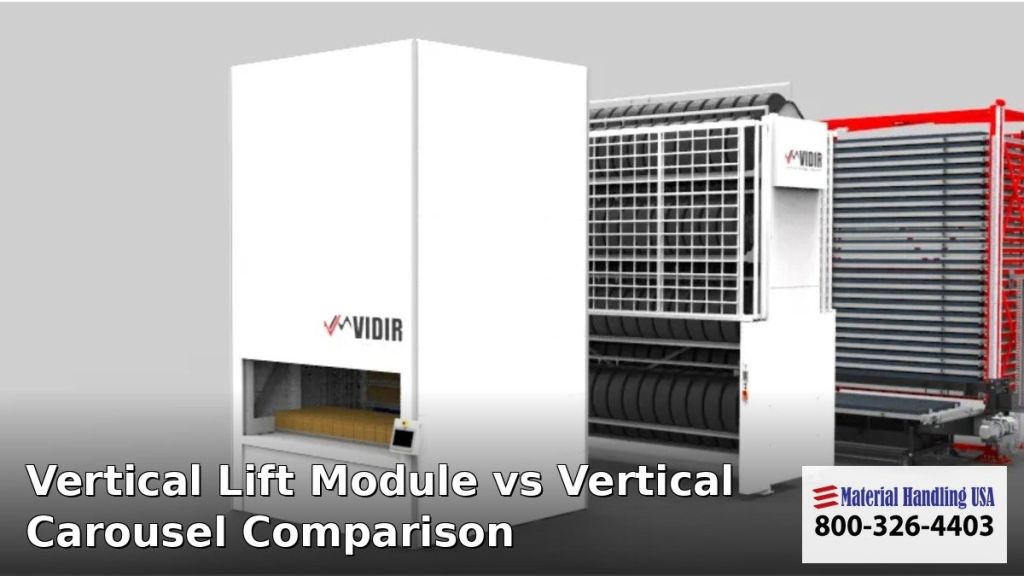
That is why the Vertical Lift Module vs Vertical Carousel comparison matters so much. On paper, both systems reclaim vertical space and bring goods to the operator. In practice, they solve different problems. One is usually better for heavier, more varied, and changing inventory. The other can still make sense for more uniform storage and simpler workflows.
The hard part is that buyers often get pulled toward a feature list instead of a decision framework. That usually leads to the wrong system for the operation. A good fit depends on ceiling height, item mix, weight profile, turnover volatility, access pattern, and how much automation you may need later.
This guide breaks down the key trade-offs that matter when you're planning a purchase, layout, or retrofit.
Choosing Your Automated Storage Solution
A common starting point looks like this. A warehouse or stockroom has outgrown static shelving, but the building isn't getting bigger. Operators spend too much time walking, searching, and reaching. Supervisors know there is wasted cube overhead, yet every expansion conversation turns into a budget fight.
That is where vertical automation usually enters the discussion. A Vertical Lift Module, often shortened to VLM, and a Vertical Carousel, often shortened to VC, both reduce floor-space pressure by storing inventory upward instead of outward. Both can improve control over parts, supplies, and work-in-process. Both support goods-to-person retrieval, which cuts unnecessary movement on the floor.
But these systems don't behave the same way once they are installed.
A VLM works best when the inventory profile is mixed, changes often, or includes heavier parts. A VC can still be a practical option when items are more uniform and the operation values a straightforward rotating storage method. For many buyers, the mistake isn't choosing a bad technology. It's choosing a good technology for the wrong environment.
Practical rule: Start with your inventory behavior, not the machine brochure. Storage systems usually succeed or fail based on SKU variation, weight distribution, and pick pattern.
| Specification | Vertical Lift Module (VLM) | Vertical Carousel |
|---|---|---|
| Core motion | Central extractor retrieves one tray at a time | All carriers rotate in a continuous loop |
| Typical strength | High-density storage for varied and heavier inventory | Compact storage for more uniform item profiles |
| Height potential | Taller systems are available for high-clearance spaces | Better fit where ceiling height is more limited |
| Storage flexibility | Strong fit for changing SKU mix | Better fit for fixed, repeatable storage patterns |
| Operator experience | Controlled tray presentation with strong ergonomic options | Simple rotating access at an ergonomic window |
| Best fit | MRO, manufacturing, healthcare, secure storage, mixed parts | Uniform small to medium parts, repeat picks, lower ceilings |
| Price range | Varies by size, payload, controls, and integration needs | Varies by size, carrier design, and control package |
Understanding the Core Technologies
How a Vertical Lift Module works
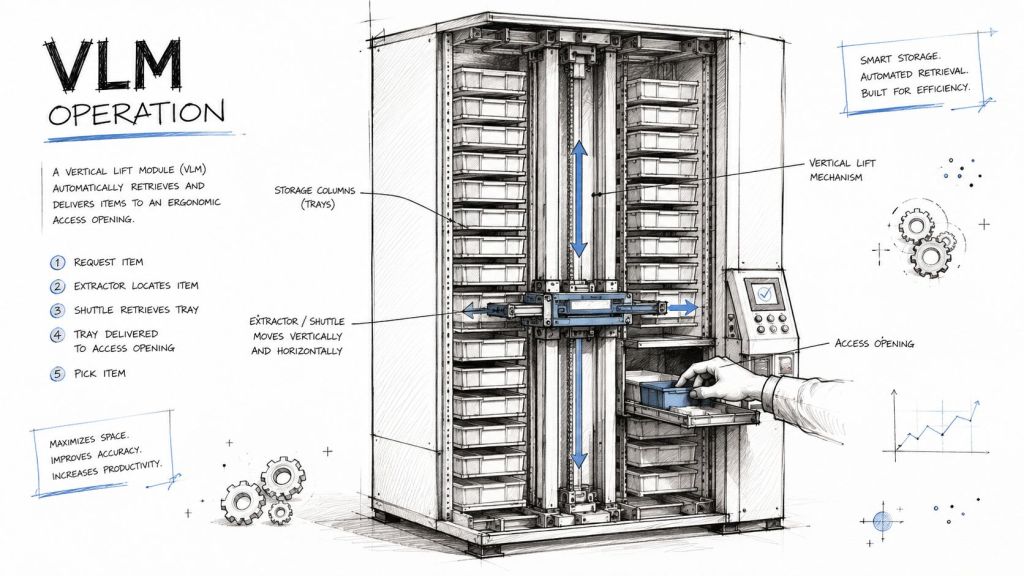
A VLM stores trays in two vertical columns with a central inserter and extractor that moves up and down to retrieve the requested tray. The easiest way to picture it is an elevator for inventory. Instead of moving every stored location, the system brings back only the tray the operator needs.
That mechanical design is the reason VLMs tend to perform well in mixed inventory environments. The machine can store trays tightly, retrieve them individually, and support more dynamic slotting. In facilities with high ceilings, that flexibility becomes even more valuable. Vertical lift modules can reach heights of up to 50 feet or more, whereas vertical carousels are typically limited to heights of about 25 feet due to balance issues inherent in their rotating chain design, which gives VLMs a clear advantage when you want to maximize vertical cube in taller buildings, as noted by Modula's comparison of vertical carousels and vertical lift modules.
Teams evaluating system types can review more application detail on vertical lift modules.
How a Vertical Carousel works
A vertical carousel operates more like a Ferris wheel. Carriers are linked together in a rotating chain, and the entire set of carriers moves until the correct shelf reaches the access opening. That design is simple to understand and can work well for repetitive access to similar items.
The trade-off is built into the motion itself. Since all carriers rotate together, the system has to move the full loop to deliver one location. That can make weight balance, carrier consistency, and overall system height more restrictive. It can still be a solid choice, but it rewards uniformity more than variation.
The biggest mechanical difference is also the biggest buying clue. One system moves one tray. The other moves the whole chain.
Comparison of Footprint Storage Density and Capacity
Why storage density usually favors VLMs
When buyers compare footprint alone, both systems can look efficient. The better question is how much usable inventory volume each system stores inside that footprint.
A VLM usually wins that test in mixed inventory applications because it stores trays in a tighter stack and can use more building height. It also handles larger item dimensions more gracefully. VLMs offer a broader height range of 13 to nearly 100 feet and greater depth, with units up to 13 feet wide and trays that are 7 to 10 feet deep, while vertical carousels are generally in the 6 to 32 feet height range and 4 to 5 feet deep. VLMs can also handle maximum product heights of about 28 inches compared with about 18.5 inches for a VC, according to Modula's overview of vertical carousel storage systems.
That matters in practical terms because inventory is rarely perfect. A parts room may hold cartons, kits, tools, maintenance items, and odd-shaped components side by side. Fixed carrier heights make that harder to compress efficiently.
For facilities that are planning around cubic utilization, high-density storage design guidance is often where layout discussions should start.
Capacity and load profile
Load profile is where the gap gets harder to ignore. Each tray in a standard VLM can support up to 2,200 pounds, with a total system payload reaching 200,000 pounds, while vertical carousel carriers max out at just over 1,400 pounds per unit due to the need to balance weight across the rotating mechanism, based on Apex Warehouse Systems' comparison.
That doesn't mean every application needs a VLM. It does mean that if your inventory includes heavier parts, uneven weight distribution, or frequent changes in tray contents, the VLM gives you more operating margin.
Quick fit checklist
- Choose VLM first if your inventory includes heavy components, varied carton heights, or changing part families.
- Consider VC first if most items are similar in size and weight and your storage pattern stays fairly stable.
- Audit ceiling height early because lost vertical opportunity can lock you into a lower-density outcome.
- Review concentrated floor loading before layout approval, especially for high-capacity systems.
Analyzing Throughput Ergonomics and Accuracy
Throughput comes from the motion path
Throughput isn't just about motor speed. It is about how much machine movement is required to complete each pick.
Vertical Lift Modules deliver significantly higher picking accuracy and throughput efficiency compared to Vertical Carousels because VLMs retrieve a single, tightly stacked tray using a central inserter and extractor, whereas VCs rotate all carriers past the access point like a Ferris wheel, causing wait times, as explained in Cisco-Eagle's VLM vs vertical carousel analysis.
That difference becomes more visible when pick demand is irregular. In a VLM, the system only needs to move the requested tray. In a VC, even a simple retrieval may require rotation of the carrier loop. If your team is picking from a broad SKU list with inconsistent demand, those extra seconds stack up over a shift.
Ergonomics and operator control
Both systems improve ergonomics compared with static shelving because they present inventory at an access opening instead of forcing workers to climb, bend, or travel aisle to aisle. The difference is in flexibility.
VLMs can support both front and rear access openings at the same time, while VCs are generally limited to single-sided access. In operations that want replenishment on one side and picking on the other, that matters. It can improve flow, reduce congestion, and help separate tasks more cleanly.
Accuracy also tends to be easier to control when the system presents a single tray rather than a larger exposed carrier. Operators see a smaller decision field. That reduces visual clutter and helps support disciplined picking.
Operator view matters: The more inventory a worker sees at once, the more chances there are to pick from the wrong location.
Matching the System to Your Operation
When a vertical carousel fits best
A vertical carousel still deserves a place in the conversation. It can be a good fit for operations storing lighter, more uniform inventory with a predictable access pattern. Think stockrooms where items are already standardized in bins, service counters with repeat picks, or facilities with lower clear heights where a very tall machine isn't practical.
It can also appeal to buyers who want a simpler mechanical concept and whose inventory profile doesn't change much through the year. If your operation is stable, your item dimensions are similar, and your workflow is repetitive, a VC may cover the need without requiring the flexibility of a VLM.
When a VLM becomes the smarter long-term choice
The decision often shifts once inventory becomes more dynamic. Recent warehouse automation trends show operations with more than 30 percent seasonal SKU variability achieve 18 to 22 percent higher ROI with VLMs due to dynamic tray-height adjustment, while a VC's fixed-height limitation can waste 15 to 25 percent of storage volume when tall and small items coexist, according to industry analysis of vertical lift modules versus vertical carousels.
That is one of the most important buying points in this whole comparison. A lot of buyers focus on upfront equipment cost and miss the cost of poor fit over the next year or two. If product mix changes often, fixed-height storage starts wasting space fast.

A simple decision framework
Use this filter when narrowing your choice:
- Inventory changes often. Lean toward a VLM.
- Item size and weight stay consistent. A VC may be enough.
- Ceiling height is valuable cube. VLMs usually make better use of it.
- You may add automation later. VLMs usually offer a clearer path.
- You need simple, repetitive access. A VC may still be a practical answer.
Buy for the inventory you expect to manage after implementation, not only the inventory you have today.
Evaluating Costs Maintenance and Total ROI
Upfront cost is only part of the story
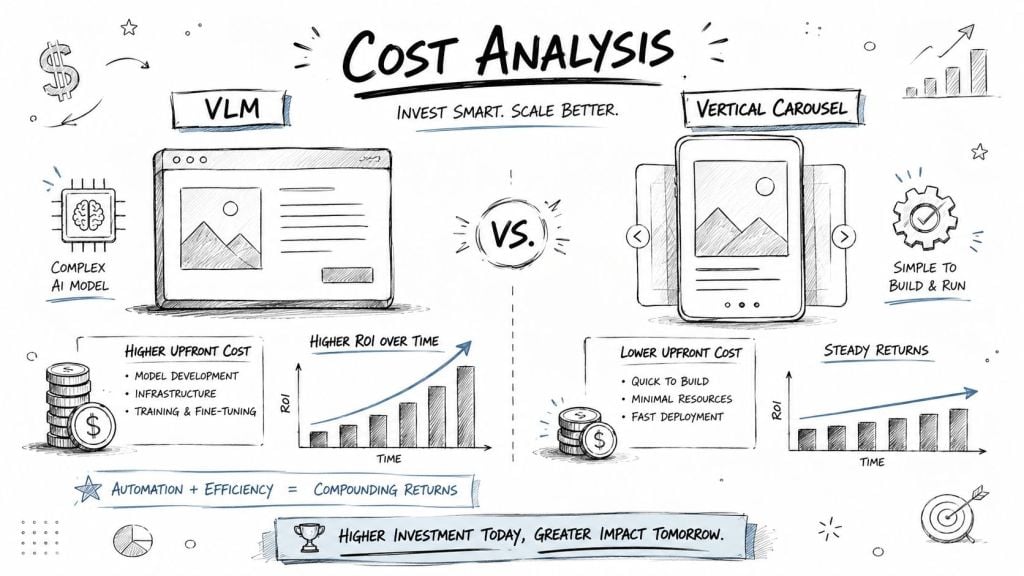
A vertical carousel can look attractive if the initial purchase price is lower. That is not the same as lower total cost. The better comparison looks at labor impact, density, growth flexibility, and what future integration may cost.
One overlooked issue is robotics. Few sources quantify the added $15,000 to $35,000 cost for robotic arms and software integration with VLMs. However, a VLM's modular design can reduce initial labor costs by 40 percent compared to a VC's solid-unit installation, offsetting some robotic integration expenses, based on the source summary provided in this industry video reference.
That doesn't mean every VLM should have robotics. It means buyers who expect future automation should price that pathway now instead of treating it as a separate problem later.
Build your ROI model around operational fit
A reliable ROI model should test more than equipment cost. It should include floor space pressure, labor movement, SKU volatility, pick pattern, and future integration plans. If you are working through that process, this guide to forecasting automation financial impact is a useful framework for structuring the analysis.
For buyers comparing budget paths, a vertical storage cost and pricing guide can help frame the questions before you request pricing.
Cost items buyers often miss
- Space loss inside the machine because fixed carrier heights don't match inventory variation
- Installation labor differences tied to system design and site conditions
- Software and automation expansion if robotics or broader system integration may come later
- Operational drag from choosing a system that doesn't match turnover or product mix
Your Path to Implementation Layout Permitting and Installation
A good automated storage project usually starts long before equipment arrives. The most successful ones begin with a hard look at item dimensions, access frequency, floor loading, ceiling constraints, and how operators will use the access openings during a shift.
That early planning matters because both VLMs and VCs are building-dependent systems. Layout, clearance, fire protection coordination, and local permitting can all influence what works. A machine that looks perfect in a brochure can become a poor choice if the access side blocks traffic, the ceiling interferes with usable height, or the concentrated load doesn't match the slab or mezzanine conditions.
What a clean implementation process looks like
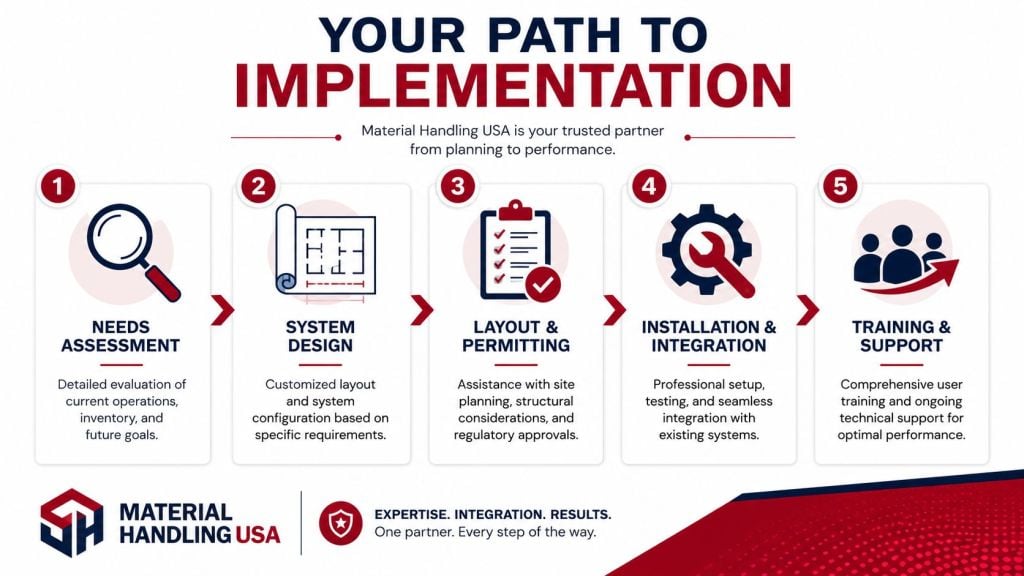
A strong project path usually includes these stages:
- Needs assessment. Review SKU range, item weights, pick frequency, and future growth.
- System design. Match the machine type to the actual inventory profile, not assumptions.
- Layout and permitting review. Confirm clearances, code issues, and structural considerations.
- Installation and integration. Coordinate controls, software, and operator access flow.
- Training and support. Make sure the team understands the process and the machine logic.
Buyer checklist before you request final pricing
Use this list before moving to a quote package:
- Measure the inventory accurately. Include awkward items, not just standard bins.
- Check ceiling and obstructions. Lights, sprinklers, ductwork, and doors all matter.
- Map traffic flow. The access opening should support work, not create a bottleneck.
- Flag future automation plans. Even if robotics aren't immediate, the choice today can affect tomorrow's upgrade path.
- Ask for layout options. Alternate placements often expose a better fit.
Field note: Delays usually come from site conditions and planning gaps, not from the storage machine itself.
The practical advantage of planning early is simple. You get cleaner design choices, better installation scheduling, and fewer surprises during approval and commissioning.
Frequently Asked Questions
Is a VLM always better than a vertical carousel
No. A VLM is usually stronger for mixed, heavy, or changing inventory. A vertical carousel can still be the better fit for lighter, more uniform items and simpler access patterns.
Which system uses tall buildings better
A VLM is generally the better match for high ceilings because it can go much taller than a VC. If your building has valuable overhead cube, that can shape the entire ROI picture.
Which system is easier for operators to use
Both can be operator-friendly because they bring inventory to an ergonomic access point. Ease of use depends more on item presentation, software setup, and workflow design than on the machine name alone.
What if our SKU mix changes throughout the year
That usually points toward a VLM. Seasonal or shifting SKU profiles tend to punish fixed-height storage because unused vertical space builds up inside the machine.
Are vertical carousels outdated
No. They still fit many operations well. They are just more specialized in the kinds of inventory and workflows they support best.
Should we plan for robotics now even if we are not ready
Yes. You don't need to buy robotics immediately, but you should understand whether your storage choice supports that path cleanly. Retrofitting strategy after the fact is usually harder than planning ahead.
What matters more, footprint or storage density
Storage density. A compact machine isn't automatically efficient if it leaves a lot of unusable air inside. Buyers should compare usable stored volume, not just the floor dimensions.
When should we start layout planning
Earlier than generally assumed. Early planning helps avoid permit delays, layout conflicts, and missed installation windows, especially when project demand is high.
Conclusion Making the Right Investment for Your Facility
The best answer in a Vertical Lift Module vs Vertical Carousel comparison depends on how your operation runs. If your inventory is uniform, your ceiling height is limited, and your pick pattern is steady, a vertical carousel may be the right fit. If your items vary in size and weight, your SKU mix changes often, or you want stronger long-term density and automation flexibility, a VLM is usually the smarter investment.
The key is to make the decision around workflow, not assumptions. A system that matches your inventory profile will perform better, support cleaner ROI, and stay useful longer. Early planning also helps you secure better design options and avoid the kind of project delays that come from rushed layouts or late site review.
If you're weighing these options, the next step should be a layout and ROI discussion based on your real space, item mix, and growth plans. Request a Quote for a no-obligation design review, or Call (800) 326-4403 to talk through the best fit for your facility.
Material Handling USA helps facilities plan smarter storage projects with competitive pricing, fast shipping and delivery, quality products, free quotes, and free layouts and designs with no obligation. If you're ready to compare options, Contact Us for a custom recommendation, email Sales@MH-USA.com, or Call 800-326-4403 to speak with a solutions expert.