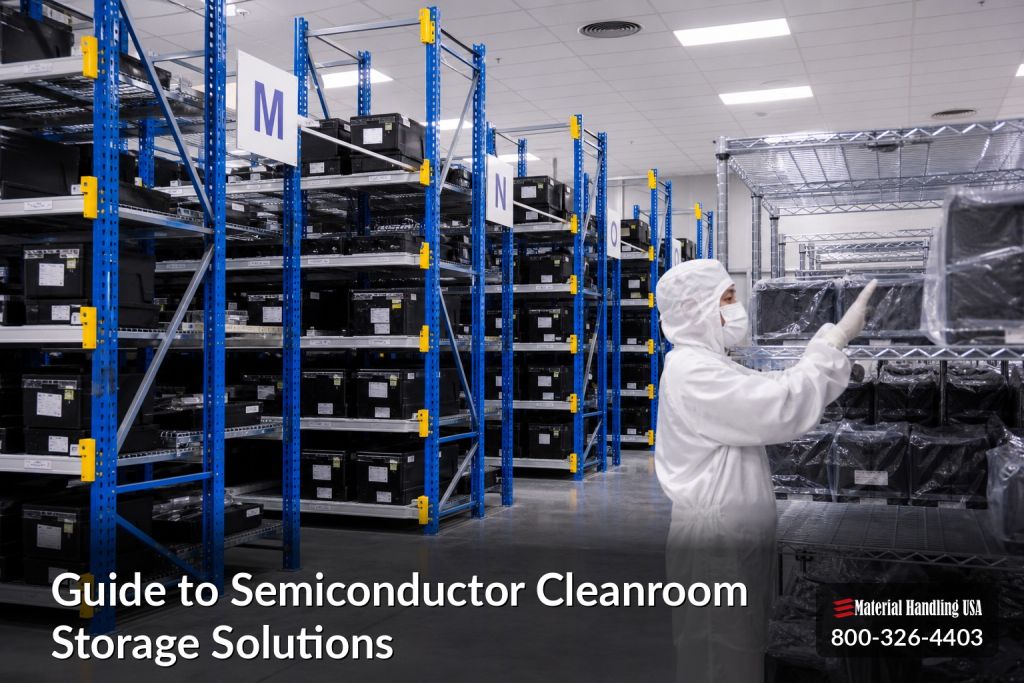
If you're planning a new fab area, upgrading a support room, or replacing aging racks inside an existing cleanroom, storage usually looks simple on paper. In practice, it's tied to yield, handling discipline, cleaning routines, and how people move through the room every shift. A poor storage choice can interfere with airflow, create avoidable touch points, or introduce static risk where none should exist.
That is why semiconductor cleanroom storage solutions need to be treated as part of the process environment, not as general facility furniture. Buyers who focus only on purchase price often miss the larger cost picture. The better question is whether the storage system protects wafers, supports compliance, and keeps daily work predictable for years.
The High Stakes of Storage in Semiconductor Fabs
A semiconductor cleanroom does not tolerate casual decisions. In photolithography, deposition, wafer staging, and support zones, storage affects what reaches the tool, how often operators handle sensitive items, and whether contamination control measures work as intended.
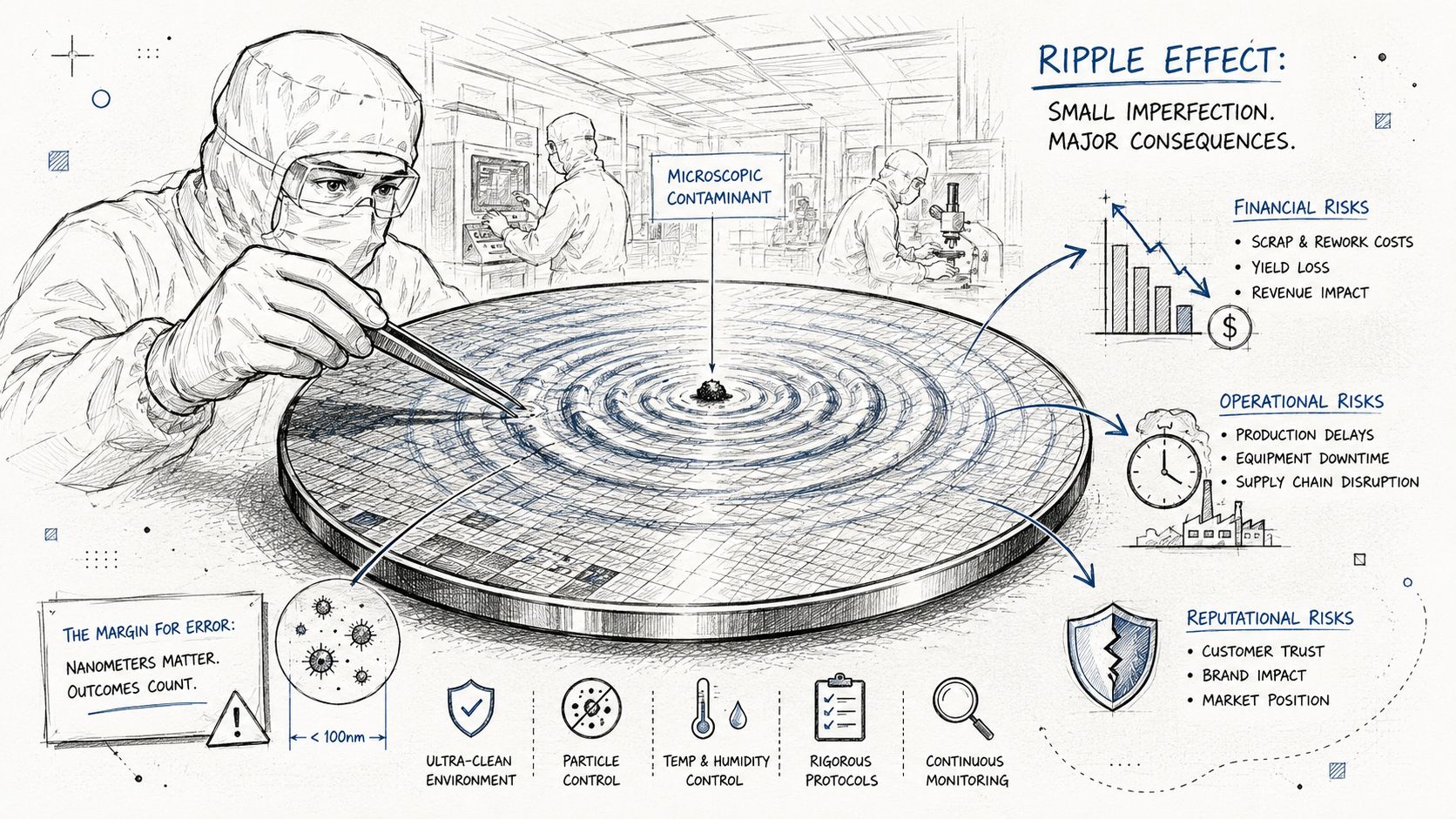
The investment trend alone tells you this is not a side issue. The global cleanroom storage cabinet market was valued at USD 794 million in 2024 and is projected to reach USD 1.15 billion by 2030, expanding at a CAGR of 6.4%, according to Strategic Market Research's cleanroom storage cabinet market report. Buyers are putting real capital into storage because modern chip manufacturing depends on tightly controlled environments.
Why storage is part of yield protection
Storage units sit in the same ecosystem as HEPA or ULPA filtration, gowning discipline, wipe-down procedures, and ESD controls. If racks shed particles, obstruct airflow, or force repeated manual handling, they work against the rest of the room.
In semiconductor operations, the cost of a bad storage decision usually appears in indirect ways:
- More handling steps that increase the chance of wafer or component contact
- Hard-to-clean surfaces that collect residue or particles
- Poor location choices that create travel loops through critical zones
- Ungrounded metal or wrong plastic grades that increase ESD exposure
- Mismatched storage formats that don't fit actual containers, pods, bins, or WIP routines
Practical rule: If a rack, cabinet, or cart makes operators improvise, it is already too expensive.
The total cost of ownership view
A lower upfront price can still produce a higher total cost of ownership. If the unit degrades under cleaning chemistry, needs early replacement, blocks airflow, or doesn't support your workflow, you keep paying for that decision. Better storage tends to reduce friction in daily operations. It also gives project teams cleaner layout planning, fewer exceptions, and more stable maintenance routines.
That matters even more when cleanroom projects are already competing for budget, install windows, and qualified labor. Facilities that choose the right storage earlier usually get smoother planning and fewer late-stage revisions.
Understanding Cleanroom Classifications and Requirements
Storage only works when it matches the room it goes into. That sounds obvious, but many specification problems start when buyers select a product category first and think about ISO classification later.

Semiconductor fabrication cleanrooms require strict environmental control. Temperature is maintained between 20 to 22°C, or 68 to 72°F, and humidity is controlled within 30 to 50%. In addition, storage solutions in photolithography and deposition areas often demand ISO Class 3 or Class 4 purity to prevent particle contamination that can directly cause yield loss, as outlined in this overview of semiconductor manufacturing and cleanroom requirements. For buyers comparing room types and build strategies, it's useful to review broader clean room solutions alongside storage decisions.
What the classification means for storage
The tighter the cleanliness requirement, the less tolerance you have for particle generation, dead spots in airflow, and difficult-to-sanitize surfaces. Storage has to support the room classification, not just survive inside it.
A simple way to think about it:
| Cleanroom concern | What it means for storage |
|---|---|
| Particle control | Surfaces must resist shedding and be easy to clean |
| Airflow integrity | Shelving style and cabinet placement can't disrupt the air pattern |
| Temperature and humidity stability | Materials must perform consistently in controlled conditions |
| Process sensitivity | Storage near critical tools must match the cleanliness level of that area |
Storage requirements change by zone
Not every semiconductor area needs the same storage strategy. A staging area, gowning support area, wafer handling area, and maintenance support room may all sit within one facility, but they should not share the same assumptions.
Critical process support areas usually need cleaner geometry, fewer exposed collection points, and tighter control over how inventory is presented to the operator. Less critical spaces may allow more flexibility, but they still need compatible materials and cleanability.
The right question isn't "Will this shelf fit?" It's "Will this shelf behave correctly in this zone, under this airflow pattern, with this cleaning method?"
Environmental controls don't stop at HVAC
Temperature and humidity specs matter because storage doesn't exist apart from the process. If a room is held inside a narrow temperature and humidity range to prevent condensation, static issues, and process instability, the storage system must support that environment through material choice, finish quality, and layout discipline.
That is why cleanroom storage selection should be reviewed by facilities, process owners, EHS, and procurement together. A rack that looks acceptable in a catalog can still be wrong for the actual zone where it will be used.
Essential Materials and Finishes for Contamination Control
Material choice is where many cleanroom storage projects succeed or fail. In semiconductor environments, the wrong finish or polymer can become a cleaning problem, a static problem, or an airflow problem long before it becomes a load capacity problem.
ESD safety and airflow are not optional
For semiconductor cleanrooms, open-wire or perforated shelving is specifically recommended for horizontal airflow configurations because it allows air to pass through rather than deflecting, which helps maintain particle removal efficiency required for ISO Class 5 or higher environments. The same guidance states that all metal racks must be properly grounded to prevent electrostatic discharge, as explained in Angstrom Technology's cleanroom storage design guide.
That one point changes how you evaluate shelving. A solid shelf may look cleaner to the eye, but in the wrong airflow setup it can work against contamination control. Likewise, a metal rack is not automatically suitable just because it's durable. If it isn't properly grounded, it creates unnecessary ESD risk.
Common material options and trade-offs
Buyers usually compare stainless steel, polymer-based systems, and wire shelving formats. The best fit depends on ISO target, cleaning chemistry, airflow, and the items being stored.
| Material or finish | Best fit | Main advantage | Main trade-off |
|---|---|---|---|
| Stainless steel | High-purity and high-cleanability areas | Durable, cleanable, stable surface | Higher upfront cost |
| ESD-dissipative polypropylene | Electronics and semiconductor support storage | Helps address static risk and chemical compatibility | Must be matched carefully to application |
| Open-wire or perforated shelving | Horizontal airflow layouts | Supports airflow through the rack | Not ideal for every stored item without accessories |
| Grounded metal racks | Areas needing structural strength and ESD control | Strong and suitable when properly grounded | Grounding must be verified and maintained |
Finish quality matters in daily cleaning
The shape of a rack often matters as much as the base material. Seams, crevices, chipped coatings, and rough edges can all make wipe-downs harder. That increases labor and creates more room for inconsistency between shifts.
When teams compare cleanroom and lab storage materials, countertop and work surface guidance can help frame the same issues around chemical resistance and cleanability. This overview of materials to consider for your lab countertops is useful because the same practical questions apply to shelving and cabinets. How does the surface respond to repeated cleaning, and how easy is it to keep contamination from collecting on it?
What works and what usually doesn't
Good cleanroom storage tends to share a few traits:
- Smooth, cleanable geometry that doesn't trap residue
- Material compatibility with your actual cleaning agents
- Grounding strategy for metal storage in ESD-sensitive spaces
- Shelf design that supports the room's airflow pattern
- Right-sized bins and accessories that reduce direct handling
What often fails is a retrofit mindset. Standard industrial shelving with a clean appearance is still standard industrial shelving. If the product wasn't chosen for ESD behavior, cleaning compatibility, and airflow performance, it usually becomes a compromise the operations team has to work around.
Types of Semiconductor Cleanroom Storage Solutions
Not every storage category solves the same problem. The best layout usually combines several types instead of trying to force one product family to do everything.
Cabinets for enclosed protection
Cleanroom cabinets are useful when you need controlled, organized storage for sensitive items or supplies that shouldn't sit exposed on open shelving. They also help reduce visual clutter and support disciplined segregation between materials.
Enclosed formats are often chosen for:
- Wafer carriers and boxes that need protected staging
- Process support items that should stay covered between uses
- Documentation or controlled accessories used inside support spaces
Wire shelving and open racks for airflow-friendly storage
Wire shelving and perforated racks remain practical when airflow compatibility is the priority. In the right environment, they make cleaning access easier and allow better air passage than blocked shelf surfaces.
This is also the category where buyers often improve space use without overcomplicating the room. If the application needs denser storage, planners may compare static shelving with compact systems such as mobile high density shelving for lab instruments.
Carts and mobile units for point-of-use movement
Some of the most important cleanroom storage isn't fixed. Mobile carts and temporary staging units help limit repeated trips across the room and keep materials near the task without creating permanent obstructions.
That said, mobile storage can also become a weak point if it's oversized, difficult to sanitize, or used as a catch-all parking area. It works best when the route, parking location, and use case are clearly defined.
A mobile unit should shorten controlled movement. It should not become permanent overflow storage.
High-density systems for expensive floor space
Cleanroom square footage is expensive. In support zones where denser storage is acceptable, high-density systems can improve floor use and reduce the need to expand footprint. The trade-off is access planning. If retrieval frequency is high or multiple operators need the same aisle at once, dense storage can create bottlenecks.
For procurement teams also thinking about environmental stability in adjacent storage planning, this external guide to climate controlled storage units offers a useful background view on how controlled environments affect stored materials outside traditional warehouse assumptions.
Cleanroom storage solutions comparison
| Storage Type | Primary Use Case | Typical ISO Class | Common Materials |
|---|---|---|---|
| Enclosed cleanroom cabinets | Protected storage for sensitive items and controlled supplies | Critical and support cleanroom areas | Stainless steel, cleanroom-grade polymers |
| Open-wire shelving | Airflow-friendly general storage in suitable zones | Cleanrooms where open format supports airflow strategy | Grounded metal wire, perforated metal |
| Perforated shelving racks | Particle-conscious storage with pass-through airflow | Higher-control environments needing airflow support | Stainless steel, grounded metal |
| Mobile cleanroom carts | Point-of-use transport and temporary staging | Support and transfer applications | Stainless steel, ESD-safe polymers |
| High-density mobile shelving | Space optimization for organized inventory | Support zones with planned access control | Steel systems with application-specific finishes |
| ESD-safe bins and containers | Small parts, components, and handled items | Semiconductor and electronics environments | ESD-dissipative polypropylene |
Layout Design and Workflow Integration
The best storage system can still underperform if it's placed in the wrong spot. Layout decides how often people cross paths, where WIP pauses, how long retrieval takes, and whether material flow stays clean and predictable.
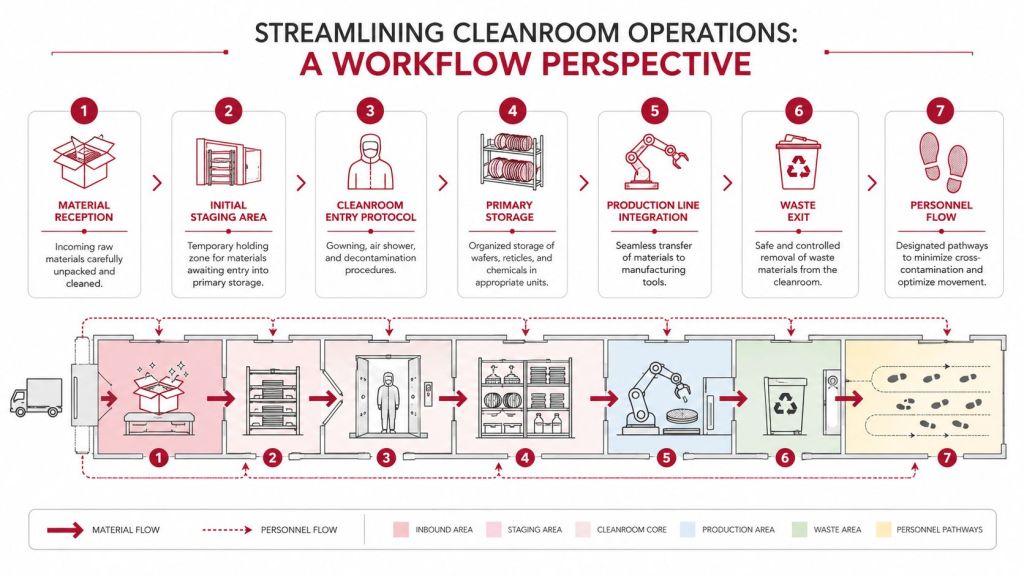
The broader operating context matters here. The semiconductor cleanroom logistics services market is valued at $4.2 billion in 2025 and projected to reach $8.0 billion by 2034, according to Market Intelo's semiconductor cleanroom logistics services market report. That growth highlights something facility managers already know. Storage and material handling directly affect throughput and yield.
Layout choices that reduce risk
Good workflow design usually follows a few clear rules:
- Separate incoming, staged, and in-process materials so operators don't mix statuses
- Keep high-use storage close to the point of use to reduce unnecessary travel
- Protect main pathways so carts, people, and materials don't compete for the same space
- Place tall units carefully so they don't interfere with air returns or access routes
Why free layout planning matters
Storage buyers often think of layout support as a nice extra. It isn't. A proper layout review can prevent expensive revisions, awkward aisle spacing, and poor equipment placement that only becomes obvious after installation.
Storage should follow the process path. If the process path has to bend around storage, the layout is backward.
A good layout package should include product specs, fit checks, and drawings that help facilities, contractors, and procurement stay aligned before material arrives on site. That reduces the chance of field changes, delayed installs, or compromised traffic flow once the room is active.
Procurement and Maintenance Protocols
Buying the right system starts with a tighter set of questions. Keeping it compliant depends on disciplined maintenance after installation.

What to ask before you buy
Use a practical checklist during supplier review:
- Material fit: Is the product built from materials appropriate for your cleanroom class and cleaning method?
- ESD protection: Are bins dissipative where needed, and can metal systems be properly grounded?
- Load and use case: Does the stated capacity match real wafer, box, bin, or accessory loads?
- Documentation: Are detailed spec sheets and CAD drawings available for review?
- Cleaning access: Can staff wipe all surfaces without disassembly or awkward reach points?
- Installation planning: Can the supplier coordinate layout, delivery, and install timing with site conditions?
Maintenance is part of the ownership cost
Storage that is difficult to clean will cost more over time, even if it was cheaper to buy. The same is true of systems that need frequent adjustment, grounding checks, or replacement parts that are hard to source.
A workable maintenance program should include routine cleaning verification, visual inspection for wear, and clear ownership between facilities and operations. If your team can't explain who checks grounding, who inspects damage, and who removes non-compliant add-ons, the system will drift out of spec.
Frequently Asked Questions
What makes semiconductor cleanroom storage different from standard industrial shelving
It has to support contamination control, airflow behavior, and ESD protection. Standard shelving may hold the same load, but it usually isn't selected for particle control or cleanroom cleaning routines.
When should I choose open-wire shelving instead of enclosed cabinets
Choose open-wire or perforated shelving when airflow compatibility is a major concern and the stored items are appropriate for an open format. Use enclosed cabinets when items need more protection from exposure or visual clutter.
Do all semiconductor cleanroom racks need grounding
Metal racks in ESD-sensitive semiconductor environments should be properly grounded. That is an essential part of preventing electrostatic discharge risk.
Are polymer bins acceptable in semiconductor spaces
They can be, if the material is appropriate for the application. ESD-dissipative polypropylene is commonly used where static control is required and the material is compatible with the environment.
How do I know if a storage system fits my cleanroom classification
Start with the room or zone classification, then review material, finish, cleanability, airflow impact, and ESD requirements. The storage has to match the area it supports, not just the items it holds.
Is mobile storage a good choice for wafer staging
It can be, especially in support workflows or temporary staging applications. The key is to control the route, parking location, and sanitation routine so the cart doesn't become an unmanaged touch point.
What should procurement teams request from a supplier
Ask for spec sheets, CAD drawings, material details, load information, and layout support. Those documents help facilities, contractors, and operations review the same assumptions before installation.
Conclusion: Partnering for Yield Protection and Future Growth
Semiconductor cleanroom storage solutions are not just another line item in a facility budget. They influence contamination control, manual handling, cleaning labor, space use, and long-term compliance. The best systems earn their cost by protecting process stability and making daily work easier to control.
Teams that plan earlier usually get better layouts, fewer install changes, and a cleaner path to future expansion. In a market where cleanroom infrastructure demand continues to rise, waiting too long can narrow product availability and push projects into less convenient timelines. Moving sooner gives buyers more room to compare materials, confirm fit, and keep construction or retrofit schedules on track.
If you need standard products for a fast-moving project, browse available options and Buy Online. If you're planning a room, retrofitting an existing area, or comparing storage formats, Request a Quote for a more customized review.
For help selecting the right semiconductor cleanroom storage solutions, connect with Material Handling USA. You can Contact Us for free layouts and designs with no obligation, request free quotes, or Call (800) 326-4403 to discuss product specs, competitive pricing, fast shipping and delivery, and the best fit for your facility. You can also email Sales@MH-USA.com.