Expert Guide to Pharmacy Drug Security Cage Selection
URL slug: /pharmacy-drug-security-cage
Meta title: Pharmacy Drug Security Cage Guide for Buyers
Meta description: Learn how to choose a pharmacy drug security cage with practical buying tips. Request a quote or call for a free layout consultation.
A pharmacy manager usually starts looking for a pharmacy drug security cage when the storage problem is already clear. Controlled substances need tighter access. High value inventory needs better protection. The current room, cabinet, or back shelf setup no longer feels strong enough.
That pressure is real. You need to protect product, keep workflows moving, and make sure the storage setup supports your security program instead of slowing it down. Buyers also have to think about buildout time, access control, inventory visibility, and whether the system can adapt as storage needs change.
A good cage solves more than one problem at once. It creates a controlled physical barrier, supports restricted access, and gives your team a clearer way to secure drugs inside an active pharmacy, hospital, lab, or warehouse environment.
Why Secure Pharmaceutical Storage is Non-Negotiable
If you oversee pharmacy operations, you already know the chain of custody can break in ordinary moments. A door gets left open. A cabinet is too small, so overflow stock goes elsewhere. Temporary storage becomes permanent. Those are the gaps that create risk.
The stakes are not theoretical. In 2023, the DEA recorded nearly 900 burglaries targeting pharmacies, resulting in approximately $26 million in losses, according to this pharmacy security report. That kind of exposure affects inventory, insurance, compliance, and patient safety at the same time.
A wire mesh enclosure is not the whole answer, but it is often the most practical physical layer when a facility needs stronger storage controls without building a full hardened room. Teams that manage regulated materials often use the same planning mindset seen in secure evidence storage guidance. The goal is simple. Limit access, improve accountability, and remove easy opportunities for diversion or theft.
A quick product walkthrough can help when you're comparing layouts and cage styles. A strong match from the MH-USA YouTube channel wasn't clearly available here, so a useful future video topic would be: How to plan a pharmacy drug security cage layout inside an active pharmacy or warehouse.
Suggested video takeaways
- Layout first: Plan aisle space, door swing, and staff traffic before choosing cage dimensions
- Security layers: Pair the enclosure with access control and camera coverage
- Growth planning: Leave room for shelving changes and future inventory expansion
Suggested timestamp outline
- 0:00 Common storage pain points in pharmacy environments
- 0:45 Wire mesh cage basics
- 1:30 Door, lock, and access control options
- 2:30 Installation planning tips
- 3:30 Common buying mistakes
See more videos on our channel
{“@context”:”https://schema.org”,”@type”:”VideoObject”,”name”:”How to plan a pharmacy drug security cage layout inside an active pharmacy or warehouse”,”description”:”A suggested MH-USA video topic covering layout planning, access control, and installation tips for pharmacy drug security cages.”,”thumbnailUrl”:”https://mh-usa.com//wp-content/uploads/placeholder-video-thumbnail.jpg”,”uploadDate”:”2026-04-23″,”duration”:”PT4M”,”embedUrl”:”https://www.youtube.com/@MaterialHandlingUSA/videos”,”publisher”:{“@type”:”Organization”,”name”:”Material Handling USA”}}
What is a Pharmacy Drug Security Cage?
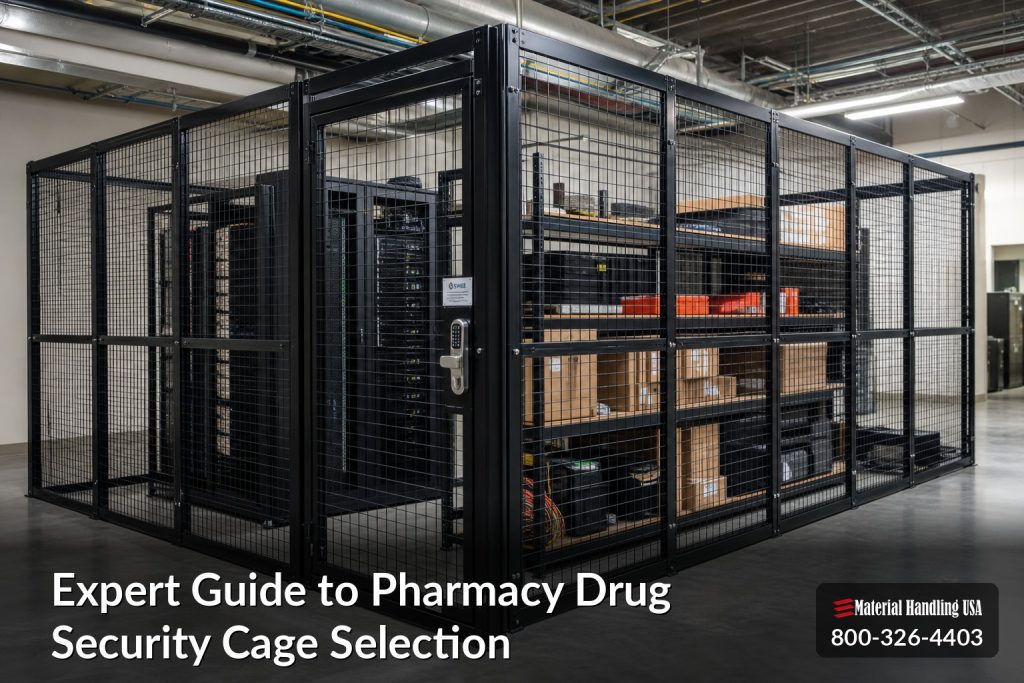
A pharmacy drug security cage is a lockable enclosure built to restrict access to pharmaceuticals, controlled substances, or other high value medical inventory. Most are modular systems made from heavy wire mesh panels, framed posts, and lockable doors. The enclosure creates a defined secure zone inside an existing building.

Where these cages are used
You will see a drug security cage in several settings:
- Hospital pharmacies: To control access to regulated inventory
- Pharmaceutical warehouses: To separate high value products from general stock
- Labs and medical facilities: To create a secure storage area without major construction
- Distribution centers: To protect inventory that needs tighter handling controls
A cage is different from general storage because the purpose is not just organization. It is controlled access. The enclosure helps teams decide who can enter, when they can enter, and how inventory is protected during normal operations.
Why buyers choose them
A pharmacy security cage often makes sense when a facility needs stronger storage but doesn't want the cost, downtime, or permanence of building a full room. That is why modular wire mesh systems are common in active facilities.
A well planned cage should support the way staff work every day. If it adds friction at every pick, count, or restock, the design needs work.
Common reasons to install a pharmaceutical storage cage include:
- Theft deterrence: Creates a visible physical barrier
- Access control: Limits entry to approved staff
- Inventory separation: Keeps sensitive drugs apart from general supplies
- Adaptability: Can often be expanded or reconfigured later
For many buyers, a secure drug storage cage sits in the middle ground between a small cabinet and a full room buildout. That middle ground is often the most practical choice.
Key Features and Compliance Considerations
If you're comparing products, this is where details matter. A cage may look solid in photos, but the actual panel construction, post spacing, door hardware, and anchoring method are what separate a serious enclosure from a light-duty partition.
Construction details that matter
DEA-focused specifications for some cage applications call for walls built from No. 10 gauge steel wire mesh with openings no larger than 2.5 inches across the square, with steel posts spaced no more than 10 feet apart, as outlined in these DEA cage requirements. If you are buying a wire mesh drug cage, those are the kinds of details worth checking line by line.
That does not mean every pharmacy storage problem needs the same enclosure. It means buyers should verify whether the cage design matches the security level required for the inventory being stored.
Doors and access control
The door is where many projects succeed or fail. A strong panel system does not help much if the entry point is weak or routinely left unsecured. In many regulated applications, buyers should pay close attention to self-closing and self-locking functionality, lock type, and how access is controlled during shift changes.
For teams evaluating electronic entry, it can also help to review broader keyless entry solutions to understand how keypad, card, and controlled access setups are used in secure environments.
If your needs are limited to smaller enclosed storage, a cabinet may be enough. For that option, lockable medication cabinets are worth comparing before you commit to a larger cage footprint.
Comparison of secure pharmaceutical storage options
| Feature | Wire Mesh Security Cage | Lockable Drug Cabinet | Secured Storage Room | Modular Partitioned Enclosure |
|---|---|---|---|---|
| Visibility | High | Low to moderate | Low unless windows are added | Moderate to high |
| Airflow | High | Low | Depends on room HVAC | Depends on panel type |
| Scalability | Good for expansion | Limited | Often harder to change | Good for phased growth |
| Access control | Good with proper locks or readers | Basic to moderate | Strong when fully built out | Good with added hardware |
| Installation speed | Usually faster than room construction | Fast | Usually slowest option | Usually fast |
| Ideal use case | Secure inventory zone inside an existing facility | Small volume, limited footprint | Permanent dedicated secure room | Custom areas with changing workflows |
| Budget range | Mid range | Lower range | Higher range | Mid to higher range |
Practical rule: Buy for the way staff access product, not just for the amount of product you store today.
Sizing, Layout, and Customization Options
The right controlled substance storage cage is sized around workflow, not just square footage. Start with what you need to secure now, then look at how product moves in and out during a normal week. Picking, receiving, returns, cycle counts, and supervised access all affect the layout.

How to think about size
A pharmacy cage for drugs should leave enough space for shelves, carts, and safe movement. If the cage is too tight, staff will store overflow outside of it. That defeats the point.
Look at these planning questions:
- Current footprint: How many shelves, cabinets, or pallet positions need to fit inside
- Access pattern: Do staff enter often, or does one authorized person retrieve product
- Growth path: Will the same area still work if your volume increases
- Interior layout: Will shelving, bins, or lockboxes be added inside the enclosure
Door style and lock options
Door placement has a major effect on daily use. Swing doors work well when space is open and traffic is light. Sliding doors can help when aisles are tight or carts move past the opening.
DEA guidance for some regulated cage applications requires doors to be self-closing and self-locking, based on 21 CFR Sections 1301.72 through 1301.76, according to this drug storage cage overview. That matters because the most common operational failures happen at the door, not the wall panel.
Locking options may include:
- Keyed locks: Simple, familiar, but harder to manage across shifts
- Keypad access: Good for controlled groups and code changes
- Card readers: Useful when you want access logs tied to staff credentials
- Electronic locks: Helpful when the cage must fit into a larger access control system
A lockable pharmacy storage cage also benefits from the right accessories. Ceiling panels, service windows, shelf cutouts, partitioned sections, and controlled pass-through points can make a big difference.
One practical advantage of working with security cage specialists is getting free layouts and design help before the quote is finalized. That matters because the expensive mistake is usually not the cage itself. It is ordering the wrong footprint.
Installation and Facility Integration
A modular drug storage security enclosure should fit the building you already have. That means checking floor conditions, clear heights, sprinklers, lighting, existing walls, and how installers will stage materials without blocking operations.

Site conditions to review early
For Schedule I and II substances, DEA compliant cages or safes must weigh at least 750 lbs or be securely bolted to the floor, according to this pharmacy security guide. Even when your application differs, anchoring and floor attachment still need careful review.
Installation planning usually goes smoother when buyers confirm:
- Floor type: Concrete anchoring is common, but slab condition matters
- Clearance: Doors, ceiling panels, and lighting need room
- Traffic control: Installers should not block core pharmacy or warehouse paths
- Integration: Cameras, readers, and alarms may require separate coordination
A modular cage usually installs faster than stick-built construction, which helps active facilities reduce disruption. It also gives buyers more flexibility if the secure area needs to expand later. That is one reason many teams begin planning early through pharmaceutical and healthcare warehouse design support. Early planning often means better scheduling options and fewer compromises on layout.
How to Choose the Right Cage and Supplier
A buyer choosing a pharmacy warehouse security cage should evaluate the supplier as closely as the enclosure. Product quality matters, but so do lead times, layout support, installation coordination, and the ability to answer detailed questions before the order is placed.

Five step checklist
-
Define the risk clearly
Identify what inventory is being secured, who needs access, and whether the project is for controlled substances, high value pharmaceuticals, or general restricted stock. -
Match the cage to the workflow
The right pharmacy inventory security cage should work with your picking, receiving, and audit process. -
Check the hardware details
Review mesh, posts, anchoring, lock types, and whether the enclosure supports your facility's access control plan. -
Ask about design help
A supplier should be able to help with dimensions, layout options, accessories, and installation planning. -
Think beyond the cage alone
A 2025 study found that facilities combining cages with AI monitoring and digital access controls reduced diversion incidents by 60%, according to this hybrid security article. That makes it worth asking whether the supplier understands physical and digital security together.
Decision examples buyers face
- Hospital pharmacy: A cage works well when several staff need supervised access and visibility matters.
- Distribution center: A larger enclosure can protect high value pharmaceutical stock without building a separate room.
- Small secure area: A cabinet may work if volume is low and access is limited to a very small group.
- Growing operation: A modular system is often easier to expand than a fixed room buildout.
For buyers comparing modular options, wire mesh modular cages are one route to review when flexibility is important.
Your Next Steps FAQs and Getting a Free Design
The right DEA compliant drug storage cage is the one that fits your inventory risk, your workflow, and your facility. Some buyers need a compact enclosure inside an existing room. Others need a larger secure area in a warehouse. The best choice usually comes from layout planning first, then product selection.
Common questions
Can a pharmacy drug security cage replace a cabinet
Sometimes. If your inventory volume is growing or multiple people need managed access, a cage often gives you more usable space and better visibility.
Is a wire mesh enclosure always enough for controlled substances
Not always. Buyers should verify current requirements with their internal compliance team and the applicable regulators. This article is practical guidance, not legal advice.
What if I only need a small secure footprint
A cabinet may be the better fit. The right choice depends on volume, access pattern, and where the inventory is stored now.
Can access control be added later
Often yes. Many modular cages can be ordered with basic locks first and upgraded later, but it is better to plan wiring and hardware early.
Are these cages only for pharmacies
No. Labs, hospitals, distribution centers, and other regulated storage environments also use them.
Can the layout be customized
Yes. Door location, panel size, partitions, ceiling panels, and lock options can usually be adapted to the site.
What should I bring to a quote discussion
Bring approximate dimensions, photos of the area, ceiling height, floor type, and a simple list of what needs to be stored and who needs access.
How do I avoid ordering the wrong size
Ask for a layout review before buying. A free design conversation can prevent expensive rework.
If you're comparing a pharmacy drug security cage, a cabinet, or a larger modular enclosure, Material Handling USA can help you sort through sizing, layout, and access options with a free quote and no-obligation design support. To keep your project moving while lead times and install schedules are still workable, Contact Us for a free layout consultation, explore security cage specifications for planning details, or review WireCrafters security solutions if you are ready to compare build options. You can also Request a Quote, Buy Online when a store option fits, email Sales@MH-USA.com, or Call (800) 326-4403 to speak with a specialist.
Who This Is For
Our pharmacy drug security cage solutions are designed for:
- Warehouse managers and operations directors
- Facility planners and engineers
- Property managers
- Government facility coordinators
- Manufacturing plant managers
- Distribution center operators
Common Applications
Warehouse & Distribution
Optimize storage capacity and material flow with pharmacy drug security cage.
Manufacturing
Improve organization and efficiency with industrial-grade pharmacy drug security cage.
Government & Military
Meet security and compliance requirements with certified pharmacy drug security cage solutions.
Frequently Asked Questions
Does Material Handling USA offer free quotes?
Yes. Material Handling USA provides free, no-obligation quotes for all warehouse storage and material handling projects. Contact us online or call 801-328-8788.
Do you handle delivery and installation?
Yes. Material Handling USA provides professional delivery and installation for pallet rack, shelving, mezzanines, security cages, and all warehouse equipment. Our team manages the project from layout to final walkthrough.
Related Solutions
Need Help Choosing the Right Solution?
Material Handling USA provides free warehouse design consultations, competitive pricing, and expert project management from layout to installation.
Get a Free Quote or call 801-328-8788