
Lighting, Ergonomics & Safety in Automotive Parts Rooms
A guide to creating a productive, safe, and efficient environment that protects your employees and your bottom line.
Talk with a specialist. Call (800) 326-4403 or Email Sales@MH-USA.com
The Foundation of a High-Performing Parts Department
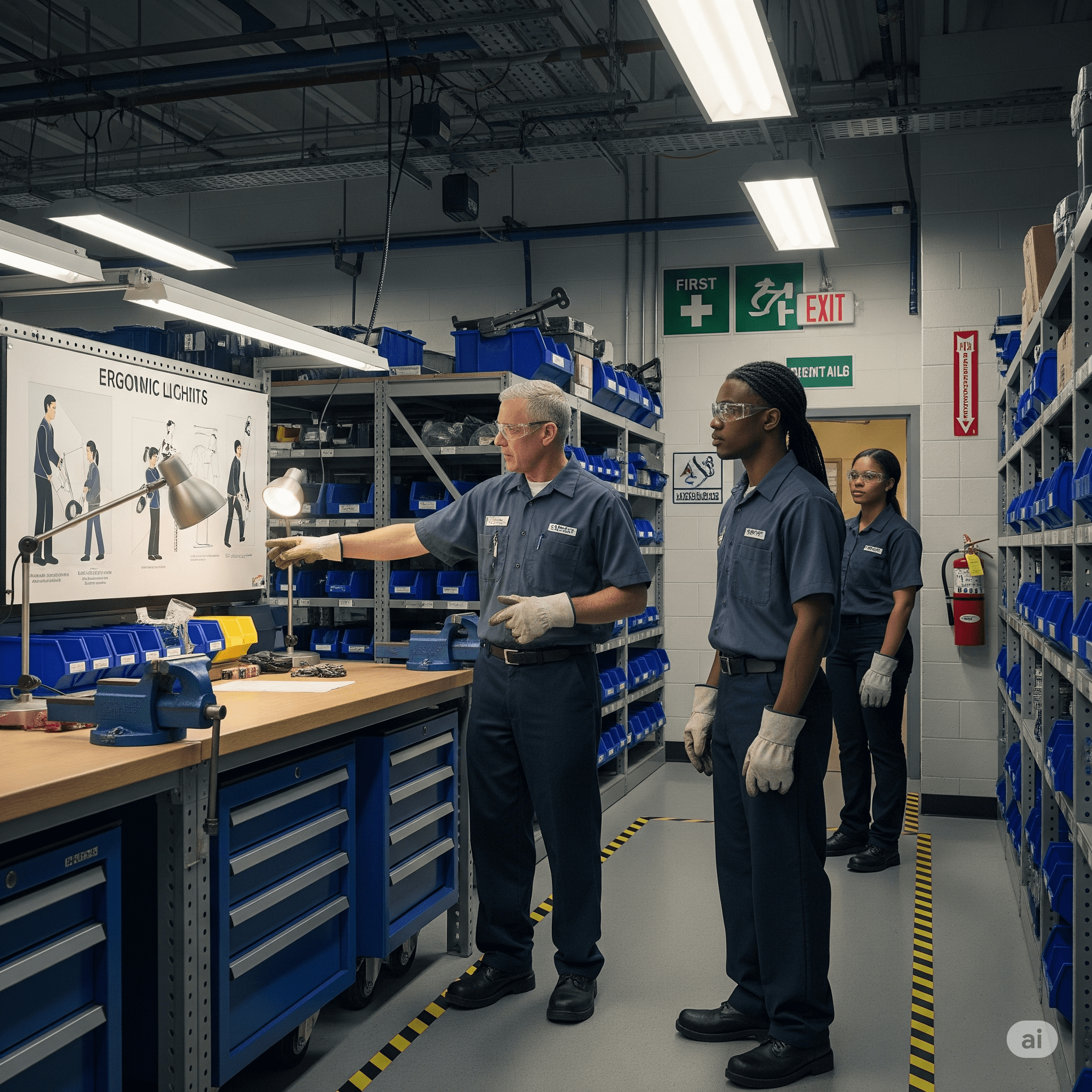
An efficient parts room is built on more than just shelving and inventory. The environment itself—how well it is lit, how it supports the physical needs of your staff, and how safe it is—plays a direct role in its performance. Poor lighting leads to mispicked parts. Bad ergonomics lead to fatigue, repetitive strain injuries, and costly workers’ compensation claims. Inadequate safety protocols can result in serious accidents. These are not secondary concerns; they are foundational pillars of a successfulautomotive parts room design. By focusing on lighting, ergonomics, and safety, you create a workspace that fosters accuracy, productivity, and employee well-being, which are all essential for long-term profitability.
Explore Custom Solutions Today!
Upgrade Your Tool Storage– Invest in an automotive rolling tool cart and transform your workshop into an organized, efficient workspace.
Core Principles for a Safer, More Productive Workspace
Integrating best practices for lighting, ergonomics, and safety into your design.
1. Optimal Lighting Design
Proper lighting is critical for accuracy and safety. A dimly lit parts room makes it difficult to read labels and part numbers, leading directly to picking errors. It also creates shadows that can hide tripping hazards. The goal is to create bright, even, and glare-free illumination throughout the entire space. Modern LED lighting is the superior choice over outdated flu or escent tubes. LEDs provide brighter light, use significantly less energy, have a much longer lifespan, and do not flicker.
Your lighting strategy should be multi-layered. Start with high-output overhead fixtures to provide ambient light. Then, focus on aisle lighting. Fixtures should be positioned to shine light vertically down the faces of your automotive shelving, illuminating labels on every level. Finally, add dedicated task lighting at workstations, the parts counter, and inspection areas. Good lighting is one of the highest-return investments you can make in your parts department’s efficiency and is a key topic in ourcomprehensive guide to storing auto parts.
2. Ergonomics in Workflow and Equipment
Ergonomics is the science of designing the workspace to fit the worker, not the other way around. Good ergonomics reduces physical strain, minimizes the risk of injury, and fights fatigue. In a parts room, this starts with smart inventory slotting. The heaviest and most frequently picked parts should be stored in the “golden zone,” between a worker’s waistandshoulder height. This minimizes bending, reaching, and lifting. Lighter and less frequent items can be placed on lower or higher shelves.
The right equipment is also crucial. Adjustable-height workbenches and anti-fatigue mats at standing workstations reduce strain. For moving parts, automotive rolling tool cartsare essential to avoid carrying heavy or awkward items by hand. For small parts, high-densityautomotive modular drawersbring items to the user at an optimal height, eliminating the need to stoop and search through low bins. For tires, anautomated tire storage system like a Vidir tire carouselpresents heavy tires at a comfortable working height, eliminating dangerous manual handling.
3. Safety Protocols and Environment
A safe parts room is an efficient parts room. The most fundamental rule is maintaining clear, unobstructed aisles. Aisles should be wide enough for staff and carts to pass easily, and they must be kept free of clutter, boxes, and stray parts at all times. All storage systems must be properly installed and anch or ed to prevent tipping. This is especially important for tall shelving units and heavy-duty racking.
Proper storage techniques are vital. Heavy items must be stored on lower shelves. Bulky items like tires should be secured in dedicatedtire storage systems, not leaned against a wall. Provide readily accessible, appropriate safety equipment, such as rolling safety ladders for accessing high shelves and gloves for handling sharp or oily parts. Regular safety walkthroughs to identify and correct potential hazards should be part of your standard operating procedure. A safe environment is a non-negotiable aspect of a professional operation.
Design a Safer and More Profitable Parts Room
Explore our solutions and see how a focus on your work environment can transform your business.
The Business Benefits of a Superior Workspace
How focusing on your environment protects your people and your profits.
Fewer Picking Errors
Good lighting and clear organization directly lead to higher accuracy, reducing the costs associated with incorrect parts.
Reduced Workplace Injuries
Proper ergonomics and safety protocols lower the risk of accidents and strain, leading to fewer injuries and lower insurance premiums.
Increased Employee Productivity
A comfortable, safe, and well-lit environment reduces fatigue and allows employees to work more efficiently throughout their entire shift.
Improved Staff M or ale
Investing in a quality work environment shows employees that you value their well-being, which can improve retention and performance.
FAQs
The most common and dangerous risks are trips, slips, and falls caused by cluttered aisles, and back injuries caused by improper lifting. Keeping aisles completely clear at all times and training employees on proper lifting techniques (and providing tools like carts to minimize lifting) are the two most effective ways to reduce the major ity of accidents.
A simple test is to walk to the darkest, most remote aisle in your parts room and try to read the label on the lowest shelf without straining or using a flashlight. If you can do so easily, your lighting is likely adequate. If you struggle, you have a problem. There should be no significant shadows, and the light should feel consistent from the main counter to the back corner.
Yes, significantly. Automated storage and retrieval systems (AS/RS) follow the principle of “goods-to-person.” Instead of a person walking and climbing to get a part, the machine delivers the part to the operator at an optimal, ergonomic height. This eliminates nearly all risks associated with climbing ladders, reaching, bending, and lifting heavy items, making them an inherently safer solution.
Shop Bin Storage Systems Online
Buy select items directly from our online store, or request a quote for volume, custom sizes and freight-rated orders.
Related Products & Resources
Ready to Get Started?
Contact our team for a free design consultation and quote.