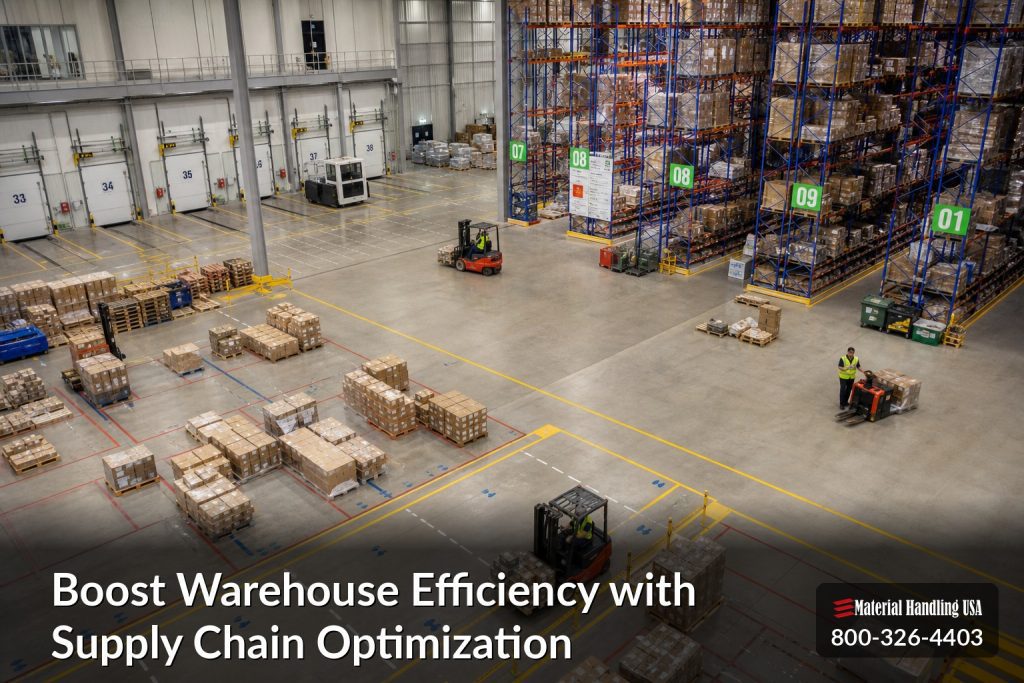
You see the symptoms before you call them strategy problems. Pickers double back for items that should be close together. Overflow inventory lands in staging because the rack plan stopped matching demand months ago. Fast movers hide behind slow movers. Aisles narrow, travel time grows, and every stockout feels like a purchasing issue when part of the problem is sitting on the warehouse floor.
That's where supply chain optimization becomes practical. It isn't just network modeling, procurement policy, or software dashboards. It's the daily work of making storage, movement, visibility, and replenishment line up with how your operation runs.
Why Supply Chain Optimization Starts in Your Warehouse
Most managers don't need another abstract definition of supply chain optimization. They need a way to stop wasted motion, reduce space pressure, and make inventory easier to see and easier to move. The warehouse is where high-level decisions become physical constraints.

In the United States, business logistics costs recently reached $2.58 trillion, equal to 8.8% of GDP, which is why every part of a warehouse, from storage density to picking speed, is under pressure to perform better, as noted in these supply chain statistics. When costs are that large across the economy, small layout mistakes inside one facility stop being small.
What optimization looks like on the floor
A practical supply chain optimization plan usually starts with questions like these:
- Where does travel time pile up: Long pick paths, poor slotting, and dead-end aisles slow every order.
- Where is space being lost: Empty vertical cube, oversized aisles, and bad rack selection waste usable capacity.
- Where does visibility break down: If inventory can't be found quickly, planners compensate with excess stock.
- Where does flow get interrupted: Congestion at receiving, packing, or replenishment turns routine work into firefighting.
Practical rule: If your team is solving the same warehouse problem every week, it's probably a design issue, not a people issue.
Managers looking beyond a single building can also learn from Coreties' international fulfillment strategies, especially when warehouse decisions have to support broader distribution complexity. For facilities focused on layout, storage, and flow inside the four walls, warehouse optimization planning is often the first place real operational gains show up.
The Core Levers of Warehouse Optimization
Most warehouse problems trace back to a short list of levers. If you improve these, supply chain optimization stops being a theory exercise and starts producing cleaner execution.

Oracle notes that many businesses try to optimize network decisions without first fixing storage geometry. It also points out that warehouse operations can be optimized with shelving and racking systems, inventory planning, and layout design, making facility design a core input that determines throughput, space utilization, and order-flow efficiency in Oracle's overview of supply chain optimization.
Layout and travel path
Bad layout hides in plain sight. You can feel it in cross-traffic, blocked replenishment lanes, and pack stations that are too far from reserve storage.
A strong layout does three things well:
- Separates flows: Receiving, putaway, picking, packing, and shipping shouldn't compete for the same narrow paths.
- Places fast movers intentionally: High-velocity SKUs belong where they cut travel, not where empty space happened to exist.
- Supports replenishment without disruption: Reserve and forward pick areas need a relationship that reduces interruptions.
Racking and storage geometry
The rack system is not just a storage purchase. It defines accessibility, density, replenishment effort, and how forgiving the building is under demand swings.
Here's a simple comparison:
| Storage approach | Best fit | Main advantage | Main trade-off |
|---|---|---|---|
| Selective pallet racking | Wide SKU variety | Fast access to individual pallets | Lower density |
| Drive-in or high-density pallet storage | Deep inventory of similar items | Better cube utilization | Slower selectivity |
| Carton flow or pick modules | Case picking and fast movers | Cleaner FIFO flow and faster picks | More planning required |
| Mezzanines | Buildings with unused height | Adds usable space without expanding footprint | Requires careful access and workflow planning |
| Secure cages and partitioned storage | Controlled access inventory | Better accountability and visibility | Can create bottlenecks if poorly located |
Inventory policy and slotting
Inventory policy sounds strategic, but on the floor it becomes a slotting and replenishment issue. If planners want safety stock, the building has to hold it without burying active inventory. If operations want FIFO discipline, the storage system has to support it.
What usually works:
- Match slotting to velocity: Re-slotting by movement matters more than sticking with old product families.
- Separate reserve from active pick faces: This keeps daily picking cleaner and replenishment easier to manage.
- Use storage type intentionally: Bulky, long, secure, or small-parts inventory should not share one default solution.
Good slotting reduces labor friction before it shows up in labor reports.
Data and technology integration
Technology helps when it improves decisions, not when it adds another layer of screens. The useful shift is from descriptive reporting to predictive and prescriptive action. That means using data from transactions, inventory indexes, documents, and operating systems to expose bottlenecks, production lags, and inventory lapses, as described in this overview of data analytics for supply chain optimization.
For warehouse teams, that translates into better demand-supply synchronization, fewer avoidable stockouts, and less pressure to hold excess inventory in racks, mezzanines, or secure storage.
From Theory to Action A 4-Step Implementation Plan
Most operations don't need a grand transformation plan. They need a workable sequence. The best projects start with the floor, connect to data, and move in manageable steps.

Sensitech notes that best practice requires centralized, accurate, and up-to-date data, and that real-time monitoring via sensors and analytics software for inventory levels, transportation, and equipment performance increases decision speed and reduces errors in its discussion of optimizing supply chain performance.
Step 1 Audit what really happens
Walk the floor during receiving, peak picking, replenishment, and shipping. Don't rely on process maps alone. Watch where operators wait, where forklifts queue, and where product gets staged because the assigned storage no longer fits reality.
Capture observations such as:
- Travel hotspots: repeated long runs for common picks
- Space leaks: empty upper cube, oversized locations, floor-stacked overflow
- Control gaps: unclear labeling, duplicate touches, hard-to-find inventory
Step 2 Identify the constraint that hurts most
Not every problem deserves first priority. Start with the issue that causes the most downstream disruption. In one building, that may be poor forward pick design. In another, it may be secure storage access, bad receiving flow, or reserve inventory buried behind active stock.
Field note: Fixing one physical bottleneck often cleans up several reporting problems at the same time.
For teams that also need equipment reliability folded into the plan, RCM for logistics distribution is a useful reference for thinking about asset uptime inside distribution operations.
Step 3 Design around flow, not around leftover space
Many projects either improve quickly or stall out at this point. A better layout should support demand, handling method, replenishment frequency, and access rules. It shouldn't just fill available square footage with as much equipment as possible.
If your layout work needs to connect operating data with physical design decisions, WMS integrated warehouse design is a useful model for aligning slotting, flow, and storage choices.
Step 4 Measure and adjust
Once changes are in place, keep watching the operation. Good teams track search time, congestion points, replenishment interruptions, and storage utilization trends. The point isn't to create more reports. It's to catch drift early and tune the system before bad habits become the new standard.
Optimizing Your Facility Layout and Storage Density
A warehouse can post decent inventory accuracy and still lose money every hour on bad layout. Forklifts wait for blocked aisles. Pickers walk past reserve stock to reach active locations. Receiving fills the nearest open floor space because staging has no defined home. Those are facility design problems, and they sit underneath a large share of supply chain performance.

Choose storage for the way inventory actually moves
Facilities often inherit one storage type and keep forcing new demand patterns into it. That usually works until SKU count rises, order profiles change, or replenishment frequency increases. Then the building starts creating labor.
Selective pallet rack works well when access speed matters more than maximum density. Denser systems make sense when product variety is lower and lane depth is stable. Small-parts operations often need shelving, bins, or carton flow that improves visibility and shortens pick travel.
The trade-off is straightforward:
- High accessibility: Faster picks and easier replenishment, with lower cube utilization
- High density: More storage capacity, with slower access and more handling discipline required
Good layout decisions start with that trade-off. A manager should know which SKUs need speed, which need density, and which should never share the same storage logic.
Use building height before paying for more building
Many warehouses run out of floor space long before they run out of cubic space. I see this often in operations that added shelving in phases and slowly gave away travel lanes, staging area, and packout room.
Mezzanines, raised work platforms, and multi-level pick modules can convert unused vertical space into productive space. That can delay expansion, reduce off-site storage, and free the ground level for movement. The return depends on throughput, replenishment method, fire code limits, and how often people need direct access to the product.
A simple guide helps frame the decision:
| If your problem is… | Consider… | Why it helps |
|---|---|---|
| Fast growth in SKU count | Pick modules or shelving zones | Improves organization and pick visibility |
| Floor congestion | Mezzanines or vertical storage | Frees floor space for movement |
| Secure inventory control | Cages, partitions, controlled access zones | Improves accountability and separation |
| Long material storage | Cantilever rack | Stores awkward items safely and efficiently |
Build flexibility into the layout
A layout that only works for this quarter will cost more than it saves. Demand shifts. Product mix changes. New customers bring different order profiles. The facility needs room to absorb those changes without turning every peak season into a patchwork of temporary fixes.
Adjustable beam elevations, modular shelving, movable partitions, and expansion zones give operators options. So does a layout that separates forward pick, reserve storage, staging, and secure inventory instead of mixing them wherever space happens to exist. For teams trying to reduce congestion and improve travel paths, this guide on eliminating bottlenecks with a lean warehouse layout design is a useful reference.
If replenishment, picking, and cycle counting interfere with each other, the layout is still costing the operation money.
One option some buyers use for this kind of project is Material Handling USA, which supplies storage equipment and supports facility layout work for warehouses, labs, and secure storage environments.
Real-World Examples of Supply Chain Optimization
The best way to judge supply chain optimization is to look at how physical decisions change daily work.
E-commerce stockroom with constant re-slotting pressure
An e-commerce operation had plenty of SKU variety but poor pick flow. Popular items were scattered across shelving added in phases. The fix wasn't exotic. The team reorganized fast movers into easier-to-reach pick faces, separated reserve stock from active picks, and tightened the packout path. Orders became easier to build because the layout matched movement, not old category logic.
Manufacturing site with raw material congestion
A manufacturing facility stored long material and mixed pallet inventory in ways that stole floor space from staging and fork travel. The solution was to separate storage by handling requirement. Long stock moved into cantilever rack, palletized material shifted into a more intentional rack plan, and staging lanes became visible again. The immediate gain was cleaner movement and fewer handling conflicts.
Improving supply chain visibility is a top priority for 55% of manufacturing-related businesses, and that goal connects directly to facility choices such as pallet racking, mezzanines, and secure cages, according to Fictiv's supply chain statistics roundup.
Secure storage room with accountability issues
A controlled-access environment needed better organization, separation, and retrieval discipline. The team created designated zones, added higher-density storage where appropriate, and improved visibility of where items belonged. In secure settings, optimization is not only about speed. It's also about control, chain of custody, and reducing the chance of misplacement.
Frequently Asked Questions
What's the difference between supply chain management and supply chain optimization
Supply chain management is the broad job of running sourcing, inventory, warehousing, transportation, and fulfillment. Supply chain optimization is the improvement work inside that system. It focuses on making the system more efficient, more visible, and more resilient.
Do I need expensive software before I can improve my warehouse
No. Software helps, especially when you need cleaner data and better monitoring, but many operations can improve significantly by fixing layout, storage selection, slotting, and replenishment flow first. If the building is creating waste, software alone won't remove it.
What can I do if my budget is limited
Start with the changes that remove friction without forcing a full rebuild. Re-slot fast movers. Separate reserve from pick faces. Improve labeling. Rework aisle flow. Reconfigure shelving or rack elevations where possible. Smaller physical changes often make later capital requests easier to justify because the operation becomes easier to measure.
How do I build a business case for facility improvements
Tie the request to daily pain points your team already feels. Show where congestion slows picking, where overflow inventory consumes staging space, where poor storage fit causes extra touches, and where visibility issues force defensive inventory habits. Buyers and managers usually get faster internal support when the proposal solves specific workflow problems instead of making a generic efficiency claim.
Your Next Step Toward a More Efficient Operation
A warehouse manager usually feels the problem before the dashboard catches up. Pick paths get longer. Staging areas fill with overflow. Forklift traffic starts fighting the layout instead of supporting it. At that point, supply chain optimization stops being a strategy discussion and becomes a facility decision.
The next step is to look at the building the way the floor team does. Where are the extra touches happening. Which SKUs are sitting in the wrong storage type. How much usable cube is stranded above the pick zone. Those answers shape labor cost, throughput, and service levels more than another planning meeting will.
Early planning gives operators room to make better trade-offs. They can compare racking options against actual product mix, test layout changes before peak pressure hits, and schedule installation with less disruption to shipping. Waiting usually narrows the choices and raises the cost of every fix.
If you are evaluating storage upgrades, layout changes, or a full facility redesign, Material Handling USA can help you compare options and plan the right next step. For online product purchases, Shop Now or Buy Online through the store. For layout help, Request a Quote, Contact Us, or Call (800) 326-4403. You can also email Sales@MH-USA.com for free quotes, no-obligation layouts, and design guidance that helps you move faster without guessing.
Related Products & Resources
- security cages — Wire partition security cages for warehouse, server rooms, and evidence storage
- industrial mezzanines — Industrial mezzanine platforms to add usable floor space
- mobile storage systems — Pipp mobile shelving for healthcare, military, and high-density storage