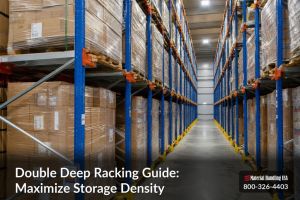
You're trying to fit more pallets into the same building, and the calendar keeps reminding you that expansion isn't always the easy answer. For many facilities, the core question isn't whether to store more, it's how to do it without creating a maze of aisles, extra travel time, and a bigger operating budget. Double deep racking is one of the most practical answers when density matters more than having every pallet face fully open at all times.
This rack style stores pallets two deep on a single aisle side, so it can raise storage density while keeping the basic pallet-rack format familiar to most warehouse teams. Industry materials describe it as a way to reduce aisle demand and make better use of floor space, with utilization often landing well above single-deep layouts in the right application. That trade-off is why it shows up in distribution centers, manufacturing, cold storage, and other operations that need more positions without a total redesign of the building. Go vertical with high-density storage design
The Warehouse Space Challenge
A warehouse gets tight in a very ordinary way. Inventory grows, slotting changes, seasonal stock lands all at once, and the floor starts feeling smaller even though the building itself hasn't changed. That's usually when managers begin looking at racking not as a storage accessory, but as a space strategy.
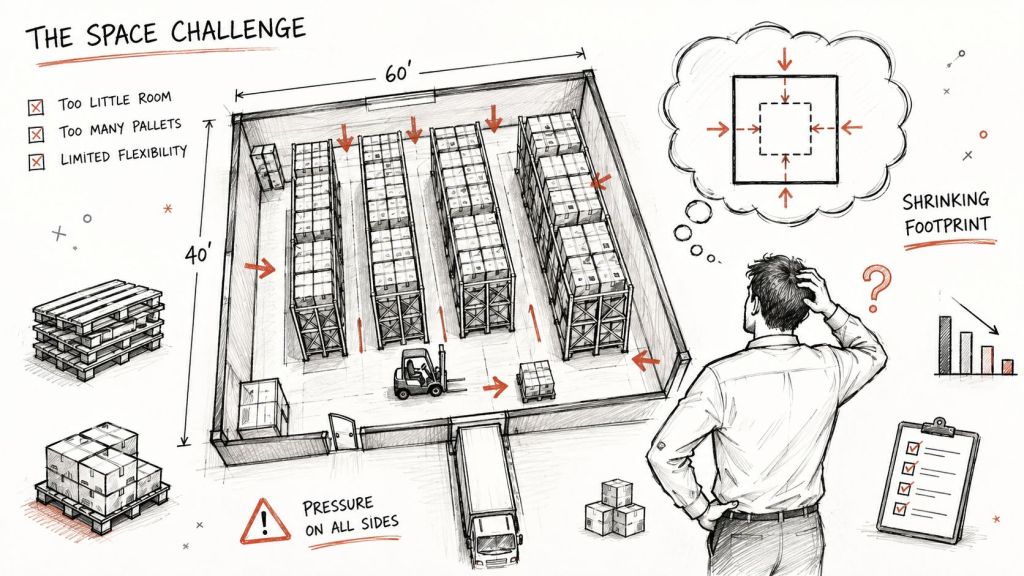
Double deep racking fits that problem well because it keeps pallets in a familiar rack structure while reducing the number of aisles needed compared with standard selective layouts. That means a facility can often add positions without changing the whole operating model. In practical terms, it's a density play first, not a flashy new process.
Why facilities start looking at density
The most common trigger is simple. A building can still be safe and organized, but the team keeps running out of open locations. Once that happens, every extra aisle becomes a decision, not just a walkway.
A dense layout helps when the business has more pallets than floor space wants to admit. It's especially useful when the inventory profile is stable enough that not every pallet needs instant, direct access. That's why this system often enters the conversation before a lease renewal, a relocation, or a costly expansion project.
Practical rule: If your team can accept some access trade-off to gain more pallet positions, double deep racking deserves a look.
For buyers, the issue is not just storage capacity. It's also how much layout freedom you keep, how much equipment change the building can handle, and whether the rack plan matches daily workflow instead of fighting it.
How Double Deep Racking Works
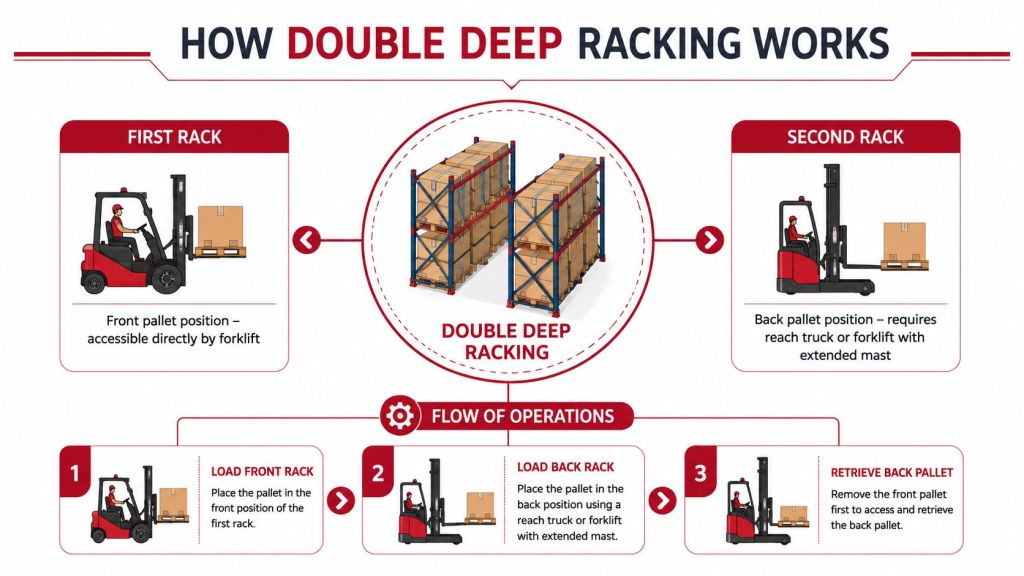
A warehouse manager looking at a crowded aisle can usually spot the appeal right away. Two pallet positions sit one behind the other on each side of the aisle, so the rack holds more inventory in the same footprint. Double deep racking uses that deeper arrangement while keeping the structure familiar to teams already used to standard pallet racking.
The basic parts
The system still relies on standard upright frames and beams. The difference is in how the pallet positions are arranged, because the rear pallet sits behind the front pallet in the same bay. That deeper lane means the operator needs equipment with enough reach to place and retrieve the back load safely.
In practice, that usually means a reach truck or another forklift setup built for extended access. The rack layout itself is simple, but the handling equipment has to match it. If the truck cannot reach the rear position cleanly, the system creates delays instead of efficiency.
Inventory movement usually follows LIFO, last in, first out, since the front pallet has to move before the pallet behind it can come out. That flow works well for products with predictable turnover. It becomes harder to manage when the order pattern shifts often or the warehouse needs frequent direct access to every pallet.
The access trade-off
The main trade-off is access. Only the front pallet in each pair can be reached right away, so the other pallet depends on the first one being moved. That is why planning guidance often treats the layout as offering roughly half immediate accessibility, and why the system is best viewed as a density decision rather than a pure storage upgrade.
A dense rack plan only works when the inventory profile supports it. The rack is one part of the equation, but the SKU mix and retrieval pattern decide whether the layout performs well in daily use.
For that reason, double deep racking usually fits high-volume products with fewer SKU variations. It rewards consistency and steady replenishment. It does not suit inventory that changes direction constantly or requires frequent random picking.
Comparing Storage Systems
The easiest way to judge double deep racking is to place it beside the other options your team is already considering. Selective racking gives the most direct access. Push-back racking goes denser, but with a different operating flow and more moving cart mechanics. Double deep usually sits in the middle, offering more density than selective while staying simpler than deeper systems.
| System Type | Storage Density | Accessibility | Initial Cost | Best For |
|---|---|---|---|---|
| Selective Racking | Lower density | Highest access to every pallet | Usually the simplest rack format | High-SKU operations that need direct access |
| Double Deep Racking | Higher density than selective | Reduced access, rear pallet needs front pallet moved first | Often a middle-ground option | High-volume SKUs with limited variation |
| Push-Back Racking | High density | Lower direct access than selective, different flow behavior | Typically more complex than double deep | Dense storage where lane-based storage works well |
That comparison matters because managers often compare systems on price alone. Price is important, but it doesn't tell you whether the building will run the way you need it to run. A lower-cost rack that slows retrieval can cost more in labor and disruption later.
What the comparison really tells you
Selective racking is easier to live with when every pallet matters and access speed comes first. Double deep racking asks for a little more planning, but it can fit a tighter footprint without jumping to a more specialized configuration. Push-back can be a stronger density choice, but it usually brings a different level of system complexity.
For project teams, the useful question is not which rack is “better.” It's which rack matches the inventory flow, forklift capability, and available space in your facility. That is where the decision gets real.
Benefits and Drawbacks
The best case for double deep racking starts with space. Verified industry materials describe layouts reaching about 45% to 60% space utilization, compared with about 30% to 35% for single-deep racking, and one brochure notes an average of 0.60 square meters of floor area per pallet position with about 88% average location use (double deep racking brochure). Those are the kinds of numbers that matter when floor space is expensive or hard to add.
Benefits worth weighing
A dense rack line can cut aisle demand roughly in half versus standard selective racking, according to industry materials in the same brochure. That opens room for more pallet positions without changing the building shell. It also makes the layout feel more compact, which is helpful in cold storage, bulk storage, and other facilities where every aisle has a cost.
Another practical benefit is that the system stays within the familiar pallet-rack family. For many operations, that lowers the learning curve compared with deeper or more automated storage styles. In the right environment, it can be a straightforward way to capture storage density without rebuilding the whole warehouse logic.
Drawbacks that don't show up on the first quote
The downside is access. The rear pallet is not directly reachable, so the operation must accept LIFO behavior or carefully control what goes into each lane. The other issue is equipment. Recent guidance notes that specialized reach trucks with telescopic forks or pantograph mechanisms are often needed, which adds another layer of planning for cost, training, and maintenance.
Safety and code review also matter. Deeper lanes can make rack contact harder to see, complicate inspection, and affect sprinkler coverage or emergency egress depending on the building. That means the savings on rack steel don't tell the full story.
If you're comparing financing or project budgets, it helps to think beyond the rack line itself. A useful resource for that broader planning is the best SBA lenders list, especially when your project includes building improvements, equipment, or phased expansion.
Bottom line: Double deep racking is rarely the lowest-complexity choice. It's the storage choice that makes sense when density is valuable enough to justify the operational trade-offs.
Key Selection Criteria
The right answer starts with the inventory profile. If your facility handles a small number of high-volume SKUs, double deep racking becomes much easier to justify. If your team touches a wide mix of product every day, the reduced selectivity can become a real obstacle.
Use this pallet rack selection guide when you're comparing layouts, because the rack style should follow the inventory pattern, not the other way around. That sounds obvious, but a lot of projects get into trouble when density is chosen before workflow.
What to check before you commit
- SKU behavior: Look at how often product turns and how often the same pallet needs to be accessed again.
- Throughput needs: Confirm whether the warehouse can absorb slower rear-pallet retrieval without bottlenecks.
- Forklift fit: Make sure the truck style matches the rack depth and operator visibility requirements.
- Facility limits: Review floor conditions, ceiling height, dock flow, and aisle geometry.
- Code and safety needs: Check fire protection, pedestrian paths, and rack inspection expectations before finalizing the plan.
The other thing buyers should evaluate is total operating friction. Some layouts look inexpensive at first and then become costly once you add equipment changes, operator training, or product damage from tighter lanes. That is where a site-specific design matters more than a catalog price.
Material Handling USA can support that planning with pallet rack selection, layout guidance, and project coordination as part of a broader storage package. The value is not in the rack alone. It's in matching the system to the exact use case before anything gets ordered.
A simple decision test
If your answer to most of these questions is yes, the system is worth serious consideration. Do you have limited SKU variety, a stable storage pattern, and a need for more pallet positions in the same footprint? Do you also have the right equipment and a floor plan that can support the deeper lane?
If the answer is mostly no, selective or another layout may be easier to run long term.
Planning and Installation
A double-deep project succeeds or fails before the first upright is set. The layout has to work for the building, the inventory, and the equipment, not just for a quote sheet. Good planning keeps the system from becoming a maintenance headache later.
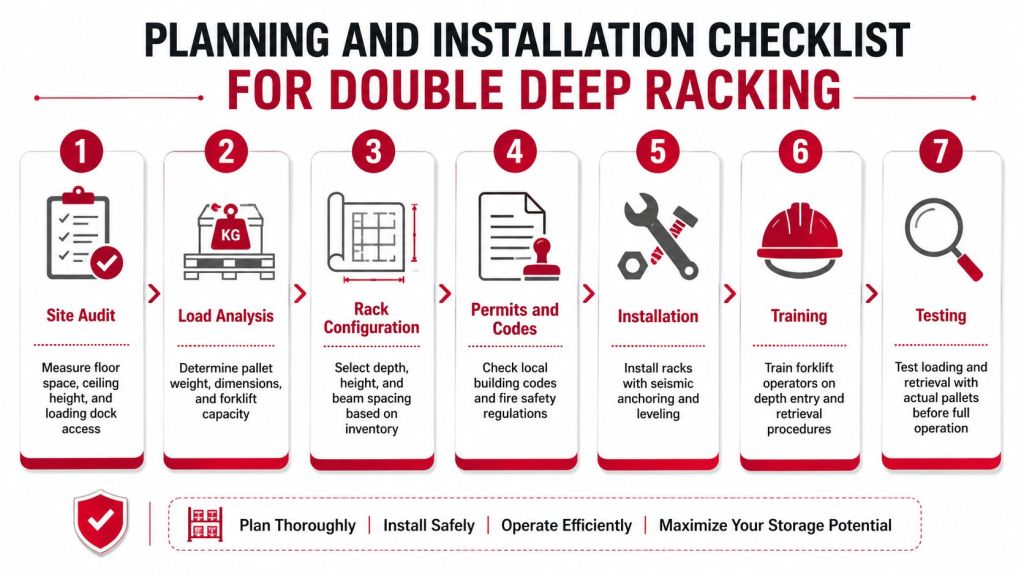
The checklist that keeps projects on track
- Site audit. Measure floor space, ceiling height, and dock access before drawings are finalized.
- Load analysis. Confirm pallet weight, pallet size, and truck capacity together.
- Rack configuration. Set depth, height, and beam spacing around the inventory.
- Permits and codes. Review building, fire, and safety requirements early.
- Installation. Use leveling, anchoring, and proper alignment during setup.
- Training. Teach operators how rear access works and how to avoid rack contact.
- Testing. Run actual pallets through the system before normal operations begin.
Review professional rack installation options when you want the rack system set up to match the plan instead of forcing adjustments later.
Why the install details matter
The biggest avoidable problems usually come from the basics. The floor isn't level, the operator training is rushed, or the reach equipment doesn't match the lane depth. Once those issues show up in live operations, the savings from the rack design get harder to realize.
Professional installation is not just about speed. It's about keeping the rack square, the load paths correct, and the building compliant from day one.
That is also why planning should include maintenance from the start. If the system is going to run for years, it needs a clear inspection routine and a team that knows what normal wear looks like.
Next Steps for Your Warehouse
A warehouse team usually reaches the double-deep conversation when it wants more room without taking on a bigger footprint. That makes sense, but the rack should only move forward when the inventory flow, equipment, and building constraints all line up. When they do, the system can give you more positions and a cleaner use of space without pushing the operation into a more complex storage class.
The smartest next move is a layout review based on your actual SKUs, pallet sizes, and truck fleet. If you want a practical starting point, Material Handling USA can help with a free quote, layout planning, and product guidance for pallet rack projects that need to balance density with day-to-day usability.
If you're evaluating double deep racking for a facility upgrade or a new build, contact Material Handling USA for a free layout consultation and quote. Visit Material Handling USA, or call 800-326-4403 to talk through your rack options, delivery timing, and installation needs with a team that works on warehouse storage every day.