Floor space gets tight long before a building is full. A conveyor gets added. New equipment lands in the middle of a production line. Maintenance staff start reaching valves, motors, or controls with ladders because there's no permanent access route. That's usually the point where industrial catwalk and platform systems move from a nice idea to a serious project.
Done right, these systems do more than add steel above the floor. They create safer access, cleaner traffic flow, and better use of vertical space without the cost and disruption of a major building expansion. Done wrong, they create pinch points, dead ends, and structural layouts that cost more than they should.
Buyers often focus first on deck size or rail style. The bigger decision is purpose. Is the structure for equipment access, or is it a travel path for regular personnel movement? That one distinction affects width, layout, loading, compliance, and price.
Your Guide to Industrial Catwalk and Platform Systems
Industrial catwalk and platform systems are raised structures built to help people move around equipment, work safely at height, and reach areas that are hard to access from the floor. In many facilities, they solve a practical problem fast. They turn wasted air space into usable access space.
A project manager usually sees the need before the drawing exists. Workers are crossing around conveyors. Technicians are leaning over machinery to reach service points. Supervisors need better sightlines over a process area. The floor plan still works, but access no longer does.
That's where a well-planned system earns its value.
Practical rule: Start with the task, not the structure. If you know who needs access, what they carry, and how often they use the path, the right design gets much easier.
The strongest projects stay focused on three outcomes:
- Safer access: Replace improvised ladders and awkward work positions with fixed, guarded routes.
- Better space use: Build up instead of pushing equipment farther apart on the floor.
- Cleaner workflow: Separate pedestrian movement from production bottlenecks.
For buyers, the goal isn't just to purchase steel. It's to choose a system that fits the operation, meets code, and avoids expensive redesign later.
What Are Industrial Catwalks and Platforms
An industrial catwalk is a raised walkway. Its job is access. It helps staff reach machinery, utility runs, tanks, conveyors, or maintenance points that sit above or beyond normal floor traffic.
An industrial platform is a raised work area. Its job is stability. It gives personnel a fixed place to inspect, service, monitor, or operate equipment.
The two are often paired. A catwalk gets a technician to the location. A platform gives that technician enough room to work safely once they get there.
Catwalks vs platforms vs mezzanines
These terms get mixed together, but they aren't interchangeable.
- Catwalks are usually narrower and built for access routes.
- Platforms create a standing or working area at elevation.
- Mezzanines act more like partial floor systems for broader use, such as storage, workstations, or support space.
If you're comparing options for a larger raised system, it helps to understand where catwalks stop and mezzanines begin. The structure may look similar, but the intended use changes the design logic.
Why facilities install them
Most projects come back to a few recurring needs:
- Equipment service access: Reach motors, valves, drives, piping, and controls without temporary access gear.
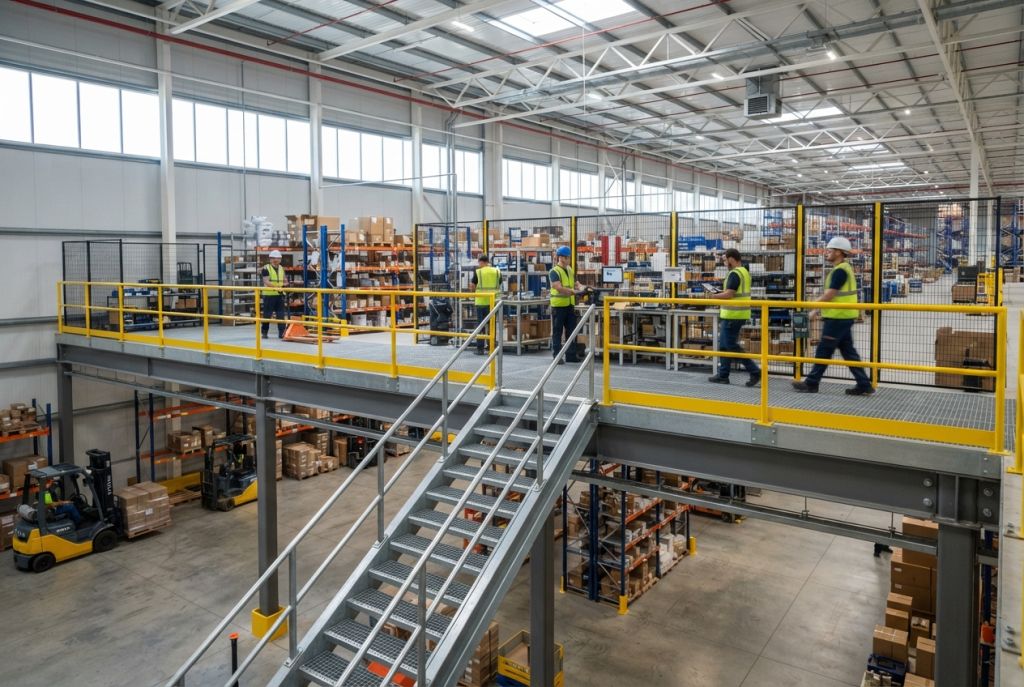
- Conveyor crossing: Let people move over production or sortation lines without interrupting flow.
- Operator support: Create stable points for observation, inspection, or process checks.
- Safety improvement: Reduce risky climbing, stretching, and off-route walking.
A catwalk should make the safe path the easy path. If workers still bypass it, the layout probably missed the real workflow.
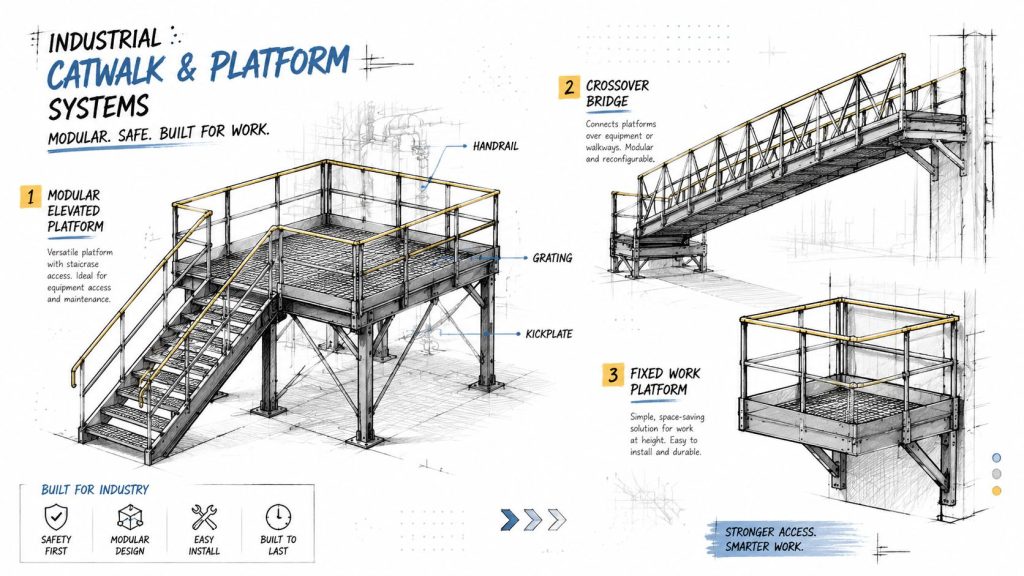
Common Types of Catwalk and Platform Systems
No single layout fits every facility. The right system depends on what people need to reach, how often they use it, and what sits below it.
For facilities evaluating broader access options for higher levels, mezzanine systems can also be part of the discussion when the project expands beyond narrow access routes.
Equipment access catwalks
These are built to reach machinery, piping, tanks, and rooftop or overhead service points. They're common in manufacturing plants, utility areas, and process environments where technicians need repeatable access.
A good equipment access catwalk stays direct. It avoids unnecessary turns and gives the worker enough room at the destination to perform the task without crowding railings or equipment.
Crossover platforms and bridges
Conveyors, process lines, and fixed machinery can split a floor plan in half. Crossover systems solve that by carrying foot traffic above the obstruction.
These are especially useful when pedestrian paths and product flow keep conflicting. Rather than forcing staff to walk the long way around, a crossover restores direct movement while keeping the floor below open.
Work platforms
A work platform is less about getting somewhere and more about staying there safely. These systems support ongoing tasks such as inspection, monitoring, packing support, or equipment operation.
They're often installed beside large machines or integrated into a line where floor-level access doesn't provide the right angle, reach, or visibility.
Observation and supervisory platforms
Some facilities need elevation for visibility rather than maintenance. Observation platforms help supervisors, quality personnel, or operations teams monitor traffic, line status, or activity across a wide area.
In those cases, the platform's value comes from line of sight and layout control, not just physical access.
Key Materials and Decking Options
A platform that works well in a dry assembly plant can become a maintenance problem in a washdown room or chemical area. Material and decking choices set the service life, the cleaning burden, and how safely people move on the structure every day.
This is also where teams often miss the difference between an access catwalk and a travel walkway. An access catwalk that only serves a valve bank or rooftop unit can often use a lighter, more targeted decking approach. A walkway that carries regular foot traffic across a process area usually needs more attention to wear, deflection, traction, and dropped-object control.
For structural steel, ASTM grades such as A36, A572, and A992 are common reference points in industrial platform work, as covered by the American Institute of Steel Construction steel construction standards. In practice, the right grade depends on span, connection design, fabrication method, and how much weight the system needs to carry without feeling springy underfoot.
Material Comparison for Industrial Platforms
| Material | Key Advantage | Best For | Consideration |
|---|---|---|---|
| Steel | High strength and broad fabrication options | Interior plants, equipment platforms, and heavier-duty systems | Usually needs galvanizing, paint, or another protective finish in wet or corrosive areas |
| Aluminum | Lower dead load and good corrosion resistance | Rooftop access, outdoor service platforms, and retrofit projects with weight limits | Deflection, connection detailing, and impact resistance need close review in harder-use applications |
| Fiberglass FRP | Strong corrosion resistance and low maintenance in the right setting | Chemical areas, wastewater, and frequent washdown zones | Structural behavior, fire performance, and surface wear should be checked against the actual use case |
Decking choices that affect daily use
Decking changes how the platform performs in service. It affects slip resistance, drainage, visibility to the floor below, and whether bolts, tools, or product can fall through.
- Bar grating: A practical choice where water, dust, and debris need to pass through instead of collecting on the walking surface. It also reduces standing water, which matters on outdoor access routes and in wet process areas.
- Solid plate or diamond plate surfaces: Better suited to tasks where dropped parts are a real concern, or where workers need carts, small-footed equipment, or a more closed walking surface.
- FRP or specialty anti-slip surfaces: Useful in corrosive or constantly wet environments where steel maintenance becomes expensive and traction has to stay consistent.
In facilities with fire and drainage concerns, open grating can support the overall design intent. This overview of a grated mezzanine floor for fire safety is a useful reference when the deck decision affects more than just footing.
Finish and environment
Finish selection should match the exposure. Painted carbon steel may be fine inside a dry plant with controlled housekeeping. The same finish can wear out quickly near caustic washdown, salt air, or chemical vapors.
I usually advise clients to decide on the environment before they decide on the coating. In facilities where abrasion, moisture, or chemical exposure are concerns, review options for durable, high-tech industrial coatings before finalizing the specification.
The wrong combination rarely fails all at once. It shows up first as slippery surfaces, coating breakdown at connections, rust at cut edges, and a platform that costs more to maintain than it should.
Critical Load and Safety Standards You Must Know
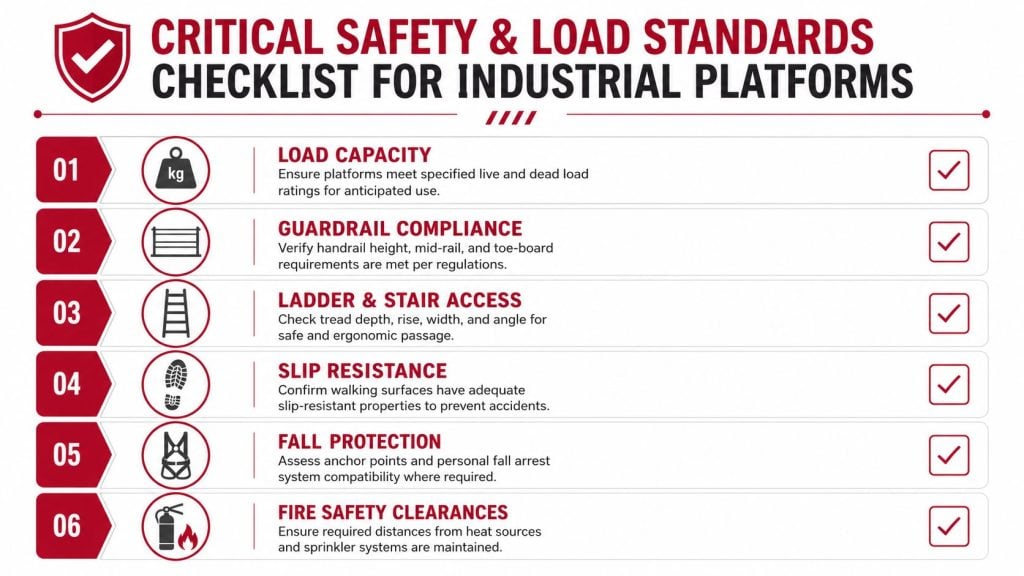
A platform gets expensive fast when the load assumptions are wrong. I see this most often when a buyer asks for a catwalk "just for access," then operations starts using it as a regular travel route or a place to stage parts. That one decision changes live load, width, guard requirements, and sometimes the slab work below it.
Width and guardrail requirements
Start with purpose, then size the path. An access catwalk serving equipment is one thing. A walkway people use to move between work areas is another. That distinction drives width, egress treatment, and how the authority having jurisdiction will view the system during review.
OSHA and building code requirements often overlap, but they do not always point to the same minimums. This OSHA catwalk requirements reference gives a practical summary of common width and guardrail requirements, including the need for top rails around 42 inches high and guard systems designed to resist a 200 pound load.
Those numbers affect more than the railing detail. They influence column spacing, connection design, stair geometry, and whether a retrofit will fit the available footprint.
Toeboards and opening protection
Dropped-object protection deserves more attention than it usually gets. In active plants, the injury risk is often below the platform, not on it.
OSHA requires toeboards where employees can be exposed to falling objects from raised walking-working surfaces. OSHA's walking-working surfaces guidance is a better reference than a general catwalk article when you are checking edge protection and opening details. Opening covers and gates also need to be selected for the actual hazard. A personnel opening at a ladder or stair landing is different from a pallet loading edge, and the wrong detail can create a pinch point, a fall exposure, or both.
Good specifications call out where tools, cartons, and loose parts are likely to be handled. That is how you decide whether a standard toeboard is enough or whether the area needs mesh infill, self-closing gates, or a different loading arrangement.
Load paths and foundation planning
Load capacity starts at the deck, but it does not stop there. The deck feeds the beams. The beams feed the columns. The columns feed the slab or footing.
For preliminary planning, many designers use around 100 PSF for access platforms and around 125 PSF when the platform may carry light storage or equipment service loads. The Ross Technology guide to industrial steel work platforms is a useful reference for those baseline assumptions. The trade-off is straightforward. A true access catwalk can often stay lighter and less expensive. A travel walkway or mixed-use platform usually needs more steel, stiffer framing, and closer attention to vibration and deflection.
That load path has to reach competent support. If the system needs columns or isolated footings in a slab-sensitive area, early coordination with the structural engineer avoids expensive revisions later. For buyers coordinating that review, this primer on understanding soil strength for foundations is a useful starting point. Fire protection can affect the framing choice too, especially where open deck construction supports sprinkler and drainage goals. In those cases, grated mezzanine floor systems for fire safety often enter the discussion.
A simple compliance checklist
- Define the platform as access, travel, or mixed use before requesting quotes.
- Verify width, guardrails, and openings against the code path your project will be reviewed under.
- Specify dropped-object protection based on the work performed on the platform, not as an afterthought.
- Confirm the design live load in writing so future use does not exceed the original intent.
- Check the slab, footing, and subgrade early, because support below the platform is part of the system.
Smart Design and Layout Considerations
A layout can look efficient on a drawing and still create daily problems on the floor. I see this most often when a maintenance access catwalk gets treated like a general travel route, or when a travel path is undersized because the team assumed only technicians would use it.
Access path vs travel path
The first design decision is purpose. An access catwalk serves equipment inspection, adjustment, or maintenance at a defined point of use. A travel walkway supports regular movement from one area to another and may affect circulation or egress. The Explore our related solutions is a useful reference for how those access requirements differ from broader walkway expectations.
That difference drives width, framing, and cost.
If the route only needs to get a technician safely to a valve bank, motor, or service point, the structure can often stay narrower and lighter. If people will pass through it routinely, carry tools across it, or rely on it as part of the building's movement path, the design usually needs more width, better traffic flow, and closer coordination with the code review path. Getting that call wrong cuts both ways. One option wastes steelandsupport cost. The other creates a pinch point that shows up on day one.
Mixed-use conditions deserve extra caution. A platform that starts as maintenance access often becomes a regular route after equipment moves, staffing changes, or process upgrades. If that future use is even moderately likely, it is usually cheaper to address it during design than to widen or reinforce the system after installation.
Clearance and interference
Good layouts start with the operations below the platform, not the platform itself.
Column locations should stay out of forklift aisles, pallet staging zones, and machine approach paths. Service access has to protect swing clearances for doors, panels, and pull-out components. Overhead framing needs to be checked against lights, sprinklers, cable tray, ductwork, and crane envelopes before fabrication drawings are released.
Future changes matter too. Plants rarely hold still. Equipment gets replaced, conveyors shift, and maintenance teams ask for safer access to a point that was not part of the original scope. A layout with no room for expansion usually becomes expensive in the field, where every relocation affects steel, anchors, and production time.
The expensive mistake is rarely the platform itself. It is the interference you discover after the steel arrives.
Early layout review helps buyers compare a simple access structure against a wider travel system based on actual use, not assumptions. That is how you control cost without creating a safety problem later.
Selecting the Right System for Your Industry
The same product category solves different problems depending on the facility.
Manufacturing
Manufacturing plants often need stable access around large equipment, tanks, presses, and production lines. In those settings, the best layout usually supports maintenance without forcing shutdowns or awkward reach positions.
Distribution and e-commerce
Distribution centers tend to use crossover systems above conveyors and sortation lines. The goal is simple. Keep pedestrians moving without cutting through product flow.
Food, beverage, and washdown areas
Wet environments need more attention on surface choice, cleanability, and corrosion resistance. Buyers in these facilities usually care as much about maintenance and sanitation as they do about structure.
Healthcare, education, and government spaces
These projects often involve service access, observation points, or support structures inside occupied buildings. Coordination matters because access, safety, and minimal disruption all carry more weight during installation.
One practical option in this category is a custom catwalk system when standard layouts don't match the equipment footprint or circulation pattern.
Installation and Maintenance Best Practices
A solid design can still underperform if installation is rushed or poorly sequenced. The field side of the project matters.
Material Handling USA coordinates professional installation with experienced crews who understand commercial and industrial environments. Projects typically begin with a site survey, layout review, delivery planning, and installation scheduling to reduce disruption to ongoing operations.
Installation habits that help
- Survey first: Confirm actual field dimensions before fabrication is finalized.
- Stage delivery carefully: Large components need a realistic unloading and staging plan.
- Coordinate shutdown windows: If work happens near production, timing matters.
- Document final conditions: Sign-off should reflect the installed layout, not just the original concept.
Maintenance habits that protect the investment
A catwalk system doesn't need complicated care, but it does need consistent attention.
- Inspect connections: Check bolts, fasteners, and attachment points for loosening or movement.
- Review rails and edges: Guardrails, gates, and toeboards should stay secure and undamaged.
- Watch the deck surface: Look for wear, corrosion, buildup, or traction issues.
- Track impact damage: Forklifts, carts, and moved equipment can affect supports or columns over time.
The best maintenance plan is simple enough that the facility team will actually follow it.
Frequently Asked Questions About Catwalks and Platforms
What's the difference between a catwalk and a platform
A catwalk is mainly a raised access route. A platform is a fixed raised work area. Many systems include both.
Do all elevated walkways need the same width
No. Width depends on use and code requirements. The key issue is whether the structure is an access route or a broader travel path.
Can a system be designed around existing conveyors or machinery
Yes. Many projects are built specifically to cross over conveyors, wrap around equipment, or reach raised service points. Field dimensions and layout coordination are critical.
What should buyers decide before requesting a quote
Start with the basics:
- Use case: Maintenance access, crossover traffic, observation, or work platform
- Environment: Dry, wet, corrosive, washdown, or outdoor
- Traffic pattern: Occasional use or routine daily movement
- Integration needs: Existing mezzanines, conveyors, racking, or process equipment
Are permits or stamped drawings required
That depends on the site, local code, and scope of work. Many projects require engineering review and coordination with local authorities or the building owner.
How long does installation usually take
Schedule depends on layout complexity, site conditions, and access. The process typically includes survey, design, logistics, delivery, and assembly, with installation coordinated to fit the operating environment.
What drives long-term cost the most
Not just purchase price. Maintenance exposure, corrosion risk, poor layout choices, and later modifications often have a bigger impact over time than the initial steel package.
Design Your Ideal Catwalk System Today
Industrial catwalk and platform systems work best when the design matches the actual job. That means understanding who uses the structure, what they carry, how often they travel it, and whether the route is for access or regular movement. That's where smart planning protects both budget and safety.
The buyers who move earlier usually get a cleaner process. They have more time to review layout options, coordinate installation, and avoid project delays caused by late-stage code or clearance changes. In busy production and warehouse environments, that planning window matters.
If your team is weighing options now, focus on function first. Choose the right width, the right load assumption, the right deck surface, and the right path through the building. That approach leads to fewer field changes and a system that stays useful as operations evolve.
For planning support, product guidance, and free quotes, contact the team through the Material Handling USA website, email Sales@MH-USA.com, or call 800-326-4403.
If you're comparing industrial catwalk and platform systems for a current facility project, Contact Us for a free layout consultation or Request a Quote to review options, pricing, and lead times. If you're ready to discuss your application with a specialist, call (800) 326-4403.
Related Resources
- Security Cages — Explore our complete product line and request a free quote
- Mobile Shelving Systems — Explore our complete product line and request a free quote
- Industrial Mezzanines — Explore our complete product line and request a free quote