You can usually tell a warehouse is under pressure before anyone says it out loud. Aisles feel tighter than they used to, fast-moving pallets keep showing up in the wrong place, and the team starts talking about “high-density options” because the current layout is no longer keeping up. That is where pallet flow racking systems enter the conversation.
At a basic level, pallet flow is gravity-fed, first-in, first-out storage built on a slight incline. Pallets are loaded from one side, travel through the lane on rollers or wheels, and come out at the picking face in the same order they went in. For buyers, that makes the system useful when space is tight, turnover matters, and inventory rotation has to stay simple without adding software or powered equipment.
Pallet flow is also a mature category, not a niche experiment. Independent market research values the market at $1.8 billion in 2025 and projects it to reach $2.8 billion by 2034, with a 5.8% CAGR over that period (marketintelo.com). That kind of scale matters because it tells facility teams they're comparing a proven storage method, not a one-off custom idea.
Why Pallet Flow Racking Systems Are Worth a Serious Look
A warehouse team usually starts asking about pallet flow when floor space gets tight and the aisle count starts working against them. The appeal is straightforward. Pallet flow racking systems turn deep storage into active picking lanes, so the back of the rack is not just sitting there like a parked row of shelves. It gives dense storage and FIFO control in the same layout, which is a useful combination when product needs to move in order and the building cannot keep giving up more aisle space.
Selective rack works more like an open parking lot, every pallet is reachable, but that convenience costs space. Pallet flow uses a gravity-fed lane, so the front pallet comes out first and the next one advances into position behind it. That keeps the pick face orderly and reduces the amount of aisle traffic your team has to manage.
Practical rule: if the facility needs FIFO rotation and wants to cut down on aisle congestion, pallet flow deserves a quote even when other rack types are still being considered.
The point is fit. Pallet flow is not a universal drop-in answer, it is a measured storage system that has to match the pallet, the load, and the replenishment pattern. Fraunhofer IML's whitepaper on pallet flow and pallet shuttle rack systems says pallet flow systems deliver 9% to 15% higher throughput capacity than pallet shuttle systems in its calculation model, and that pallet flow is in most cases the preferred technical and process choice (Fraunhofer IML whitepaper). The same paper also links pallet flow to lower operating costs than comparable alternatives. That matters because the buyer is not only choosing storage density, they are choosing how much work it takes to keep the lanes full and the pick faces supplied.
A good comparison is a grocery shelf stocked from the back. If the restock lane is set up correctly, the next item slides into place without confusing the picking order. If the lane geometry is wrong, the system becomes harder to feed and the front end slows down.
| Specification | Typical Range | Why It Matters |
|---|---|---|
| Storage method | Gravity-fed FIFO lanes | Keeps older pallets moving out first |
| Lane incline | About 3% to 4% | Helps pallets move without surging |
| Lane depth | Commonly 6 to 12 pallet positions | Affects density and live load |
| Load per position | Up to 1,500 kg | Sets structural and component limits |
| Storage density | Often much higher than selective rack | Frees floor space in dense operations |
The hidden tradeoff is replenishment time. A pallet flow lane can save space and keep product rotating correctly, but it also asks the receiving side to do more disciplined loading so the lanes stay balanced and the flow face stays ready. For that reason, buyers should look at pallet compatibility, the amount of slope the pallet really needs, and whether Material Handling USA conveyor solutions or another transfer method are part of the handoff into the rack. When those pieces line up, pallet flow stops looking like a generic storage choice and starts looking like a system built for a specific operation.
How Pallet Flow Racking Actually Works
A pallet enters at the load side, then rolls down a slightly inclined lane until it reaches the discharge end in the same order it was loaded. That simple path hides the intricate design work. The lane has to match the pallet type, the load weight, and the way the product will be replenished.
The parts that make the lane work
A typical lane includes inclined rails, rollers or skatewheels, entry-side load rails, and exit-side pick lanes. Some designs also use speed controllers or brakes near the discharge end so the pallet does not hit the stop too hard. The slope drives pallet movement.
That slope usually sits around 3.0% to 4.5%, and one industry source says a 4% slope helps support smooth, safe pallet movement (Explore MH-USA pallet rack solutions). Another notes most systems are installed near 7/16 inch per foot of slope, which falls in the same design range. If the pitch is too low, pallets can stall before they reach the pick face. If it is too high, they can gain speed too quickly and put extra stress on the brake rollers or stop.
The geometry is where first-time buyers often get caught. A lane that looks fine on paper may still fail if the pallet base is uneven, the deck boards sit low, or the load shifts the center of gravity too far forward. In practice, pallet flow is an engineered fit problem, so compatibility testing matters before the rack layout is finalized.
Replenishment time also matters. A pallet flow lane can save space and keep product rotating correctly, but it asks the receiving side to load with more discipline so the lane stays balanced and the flow face stays ready. For that reason, buyers should look at pallet compatibility, the amount of slope the pallet really needs, and whether warehouse conveyor solutions or another transfer method are part of the handoff into the rack.
A pallet flow lane should feel controlled, not fast. If a pallet is drifting, surging, or hanging up, the lane is telling you the slope or rolling surface is wrong for the load.
Types of Pallet Flow and How They Compare to Other Rack Systems
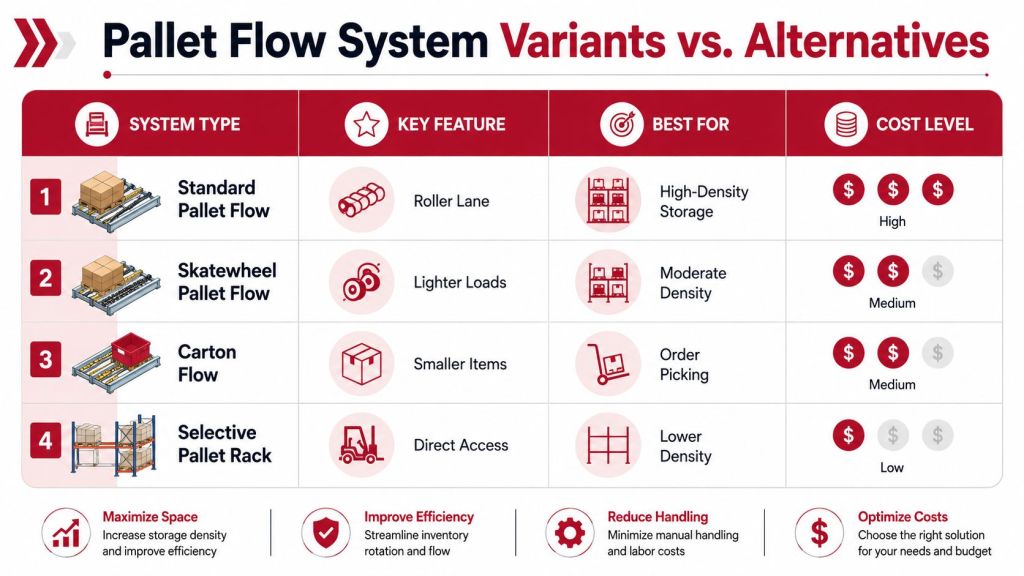
A first-time buyer usually begins with a simple question, single-deep, double-deep, or something custom. Single-deep pallet flow is the most common starting point because it is easier to engineer, easier to test with real pallets, and easier to keep stable over a long lane. Double-deep and deeper layouts can work too, but they only work well when the pallet base, lane slope, and rolling surface all match the load profile.
Pallet flow also solves a different storage problem than drive-in rack, shuttle rack, or selective rack. Each one serves a different mix of access, density, and inventory rotation. Pallet flow is a strong fit when FIFO matters and floor space is tight, shuttle systems are better suited to other automation goals, and selective rack stays the simplest choice when direct access to every pallet is the priority.
| System | Density | FIFO/LIFO | Best Use Case |
|---|---|---|---|
| Pallet Flow | High | FIFO | Fast-moving goods, rotation-sensitive inventory |
| Selective Rack | Lower | FIFO or manual rotation | Direct access to every pallet |
| Drive-In Rack | High | LIFO | Deep storage with fewer SKU changes |
| Pallet Shuttle | High | Usually FIFO or LIFO by design | Semi-automated dense storage |
Density is one of the main reasons buyers study pallet flow first. Market research at marketintelo.com reports that single-deep pallet flow is a major share of the category and typically offers more storage density than selective racking. That matters in warehouses where every bay has to carry more product without expanding the building footprint.
The tradeoff is in replenishment. A pallet flow lane gives you compact storage and orderly rotation, but it expects the back end to feed pallets in a controlled way so the front face stays ready. That is why pallet compatibility testing and slope matching matter so much. A lane that runs well with one pallet style may behave differently with another, which is why pallet rack specifications should be checked against the actual pallet pool before the layout is finalized.
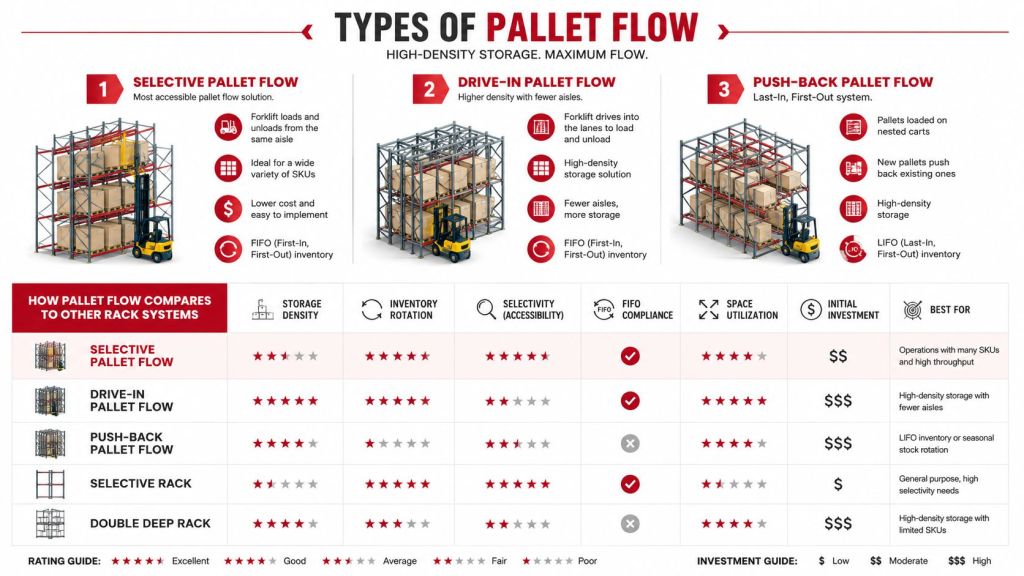
As noted earlier, pallet flow also has to be judged as an engineered fit, not a generic rack option. A system that looks attractive on paper can still underperform if the pallet bottoms are uneven, the deck boards sit too low, or the load shifts the center of gravity too far forward. The comparison point buyers should watch is that the right rack type matches the load, the replenishment rhythm, and the amount of control needed at the pick face.
Key Design Factors and Specifications to Evaluate
The biggest mistake first-time buyers make is treating pallet flow like a catalog item. It is closer to an engineered fit than a standard rack purchase. The same basic system can work beautifully in one building and fail in another if the pallet pool, slope, and brake setup are wrong.
What to gather before you request quotes
- Lane depth: Common benchmark ranges are 6 to 12 pallet positions per lane, with some systems extending to 15 pallets deep or more.
- Load per position: Heavy-duty systems may support up to 1,500 kg per pallet position (Dexion).
- Wheel or roller style: The rolling surface has to match pallet condition, bottom-deck design, and wear patterns.
- Incline setting: The right pitch depends on weight, wheel type, and how quickly the pallet should travel.
- Brake control: The discharge end needs enough control to keep pallets square and safe at the pick face.
That last point is where compatibility becomes real. Independent guidance stresses that slope and roller choice depend on the pallet's weight and bottom construction, and that suppliers should test with the customer's own pallets rather than guess (Hammerhead LLC). If your pallet pool is mixed, cracked, or inconsistent, the rack may not perform the way the brochure suggests.
Buyer note: a pallet flow proposal is only useful if it is based on your actual pallet, not a generic one in a spec sheet.
For buyers comparing proposals, a detailed reference such as pallet rack specifications can help keep dimensions, loads, and lane counts aligned across vendors.
Industry Applications and Real-World Use Cases
A food and beverage warehouse with fast-moving inventory often sees the clearest value from pallet flow. Cases with date codes need to leave in the right order, and pallet flow supports that by keeping the next pallet ready at the pick face without asking forklift drivers to manage rotation lane by lane. That fit matters because the system is designed around product turnover, not just around space.
Cold storage is another place where pallet flow makes practical sense. Operators in refrigerated buildings want fewer touches, fewer search moves, and a front face that stays easy to read in a tight work area. Gravity-fed lanes help because each empty slot becomes the next pick position automatically, which keeps the process straightforward when gloves, condensation, and limited visibility already make the job harder.
Manufacturing and consumer goods sites usually apply pallet flow in a more selective way. A plant may reserve deeper lanes for slow-moving stock and use shorter lanes for fast-moving parts or finished goods. That mix lets planners match lane depth to SKU behavior instead of forcing every item into the same storage pattern, which is often where a layout feels awkward in real use.
Compatibility still decides whether the design works. A lane that looks good on paper can still perform poorly if the pallet style, bottom deck, wheel or roller surface, and slope setting do not work together. A practical warehouse might use deeper lanes for reserve inventory and lighter incline settings for quick pick faces, but the test is whether the actual pallet travels cleanly, stays square at discharge, and replenishes without creating extra handling at the back end.
Cost, ROI, and the Throughput Tradeoff Buyers Should Understand
A pallet flow project often looks expensive at first glance because the rack is doing more than holding product. Frame height, lane depth, brake count, finish, and seismic requirements all shape the final price. A taller lane, a deeper lane, or a lane with tighter speed control will cost more than a simple shallow run, because each of those choices adds steel, hardware, or engineering work.
The return is usually tied to how the system changes space use and picking behavior. Buyers gain value from higher density, fewer aisles, faster turnover, and less product damage when pallets move in a controlled first-in, first-out lane. The bigger point is that pallet flow is not just a storage buy, it is a warehouse fit decision. If the pallet style, load profile, and slope are matched well, the rack helps the operation do less repositioning and keeps the front face easier to work from.
There is also a replenishment-time tradeoff that many overview guides leave out. A published empirical economic analysis found that high-density flow-rack storage can reduce throughput time by up to 4.60%, but it can also increase replenishment processing time by up to 38.65% (Polimi PDF). That is the part buyers need to model carefully. Picking can become more orderly while back-end restocking takes more labor, so the key question is whether the labor shift fits the way your team works.
| Factor | Impact on Cost | Impact on ROI |
|---|---|---|
| Lane depth | More steel and control hardware | More storage per square foot |
| Incline and brake design | Higher engineering and setup effort | Better flow control and fewer jams |
| Load rating | Stronger components raise cost | Safer handling and longer service life |
| Pallet compatibility testing | Adds planning time | Reduces install risk and downtime |
| Finish and site conditions | Can raise project cost | Helps long-term durability |
Specifying, Installing, and Maintaining Pallet Flow Systems
A good pallet flow project starts before anyone orders steel. The first step is a site survey with pallet samples, load data, and the actual dimensions of the SKU profile. If the supplier cannot test your real pallets, the proposal is missing one of the most important inputs.
A working checklist for buyers
- Map the pallet pool. Confirm pallet quality, bottom deck design, load weight, and any mixed pallet styles.
- Define the lane behavior. Decide whether the lane is for fast-moving pick stock, reserve storage, or a mixed role.
- Request drawings and engineering. Ask for CAD layouts and stamped engineering where required.
- Plan the install window. Professional crews should align aisles, set anchors, and calibrate brakes without disrupting operations more than necessary.
- Set maintenance routines. Inspect rollers, test brakes, check pallet condition, and re-torque anchors on a regular schedule.
Pallet quality deserves special attention. If pallets are bent, damaged, or inconsistent, the lane may not move smoothly. The same compatibility issue that shapes design also affects long-term performance, so warehouse teams need a simple inspection habit at receiving and replenishment.
For buyers still in the planning stage, design services for pallet rack can help translate site data into a layout, quote, and installation plan that fits the building instead of forcing the building to fit the rack.
Maintenance rule: if pallets change over time, the lane should be reviewed again. A system that worked well with one pallet mix can behave differently after inbound sourcing changes.
Get a Custom Pallet Flow Layout for Your Facility
A pallet flow lane only performs well when the rack matches the job in front of it. A warehouse that wants FIFO storage, tighter cube use, and predictable pallet movement can get real value from pallet flow racking systems, but the layout has to fit the pallet pool, the slope, and the way replenishment happens on the floor.
A lane is a lot like a gravity-fed chute with a few important adjustments. If the pallet base does not match the rollers, or the lane pitch is too steep or too flat, the system may move poorly or require more attention than the buyer expected. Lane depth, roller choice, pallet condition, and the rate of replenishment all need to work together, because a good drawing on paper does not guarantee good movement in practice.
That is why a custom layout matters. Material Handling USA can help with a free design review, a quote, and practical guidance for dense FIFO storage. Start with pallet rack design services, or call (800) 326-4403 to talk through your project with a specialist. You can also visit Material Handling USA to request a layout and see how pallet flow can fit your facility plan.
For a first-time buyer, the key question is simple. Will this lane keep moving the way your operation needs it to, with the pallets you receive and the refill pace your team can sustain? A custom layout answers that before the steel goes in the floor.
Material Handling USA helps facilities plan pallet flow projects with practical layouts, competitive pricing, and product options built for real warehouse conditions. If you're evaluating pallet flow racking systems, reach out for a free quote and a no-obligation layout review so your team can compare options with confidence.