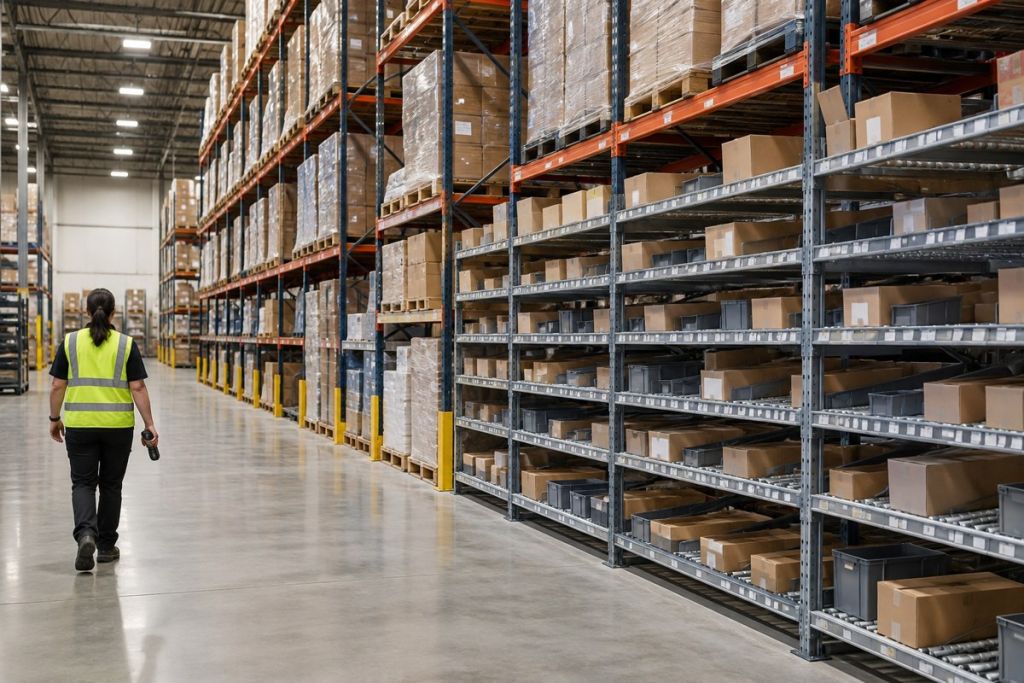
The usual advice is to shove every slow item to the back and leave the pick face for fast goods. That rule is not always the lowest total cost. In a tight Utah building, deep storage can cut rent per unit and still add travel, extra touches, and a missed line.
Slow moving SKU storage for Utah 3PL warehouses is a service choice. You class the SKU, match a home, and check whether retrieval still meets the client promise.
Slow Moving SKU Storage for Utah 3PL Warehouses
Ninety days without a pick does not make an SKU disposable. It makes the storage decision more important. A slow item still has a client promise, a cube cost, and a retrieval path. If that path sits behind three better-moving accounts, the warehouse has shifted cost from space to service.
A practical slow SKU is one with few picks over the last 90 to 180 days. Use order history, not a walk through the aisle. An academic warehouse-slotting study defines slow-moving Class S items as products with a demand ratio between 1 and 3, and reports that this group usually represents approximately 30% to 35% of the total item population. That share can crowd prime locations if you slot by SKU count instead of movement. Treat the range as a starting review, then check each client's order history. Slotting by item criteria can cut travel, equipment moves, labor, pick errors, and operating cost. It is an ongoing allocation, not a one-time map.
| Configuration | Best fit | Access | Density | Main trade-off |
|---|---|---|---|---|
| Selective pallet rack | Many SKUs with few pallets each | Every pallet | Medium | Uses more aisle than dense reserve |
| Upper reserve beams | Slow full pallets with rare picks | Forklift, less convenient | High vertical | Height can trigger permit and seismic design |
| Carton shelving | Case and each quantities | Walk-up | Medium | Poor fit for full pallets |
| Drive-in or push-back | Many pallets of one SKU | Limited, often last in first out | High | Mixed client SKUs become hard to reach |
| Vertical lift or carousel | Small, secure, or high-value parts | Goods to person | Very high | Higher cost and not for bulk pallets |
| Satellite site or client return | Aged stock blocking active cube | Outside the primary pick path | Frees prime space | Transfer time can miss the promised lead time |
How each option fails or fits
Selective pallet rack fits many SKUs with few pallets each. Every pallet stays reachable, which matters when a slow line still needs a controlled pick. The cost is aisle space. For Utah 3PLs with high SKU counts and lower quantities per SKU, that access is often worth the extra floor area.
Upper reserve beams fit slow full pallets when height, permit limits, and seismic design allow them. Vertical cube is useful when floor space is tight. The forklift trip is the price. If the item is ordered once a quarter, a longer retrieval may be acceptable. If it is ordered every week, the saved rent can turn into labor and missed cutoffs.
Carton shelving fits cases and eaches at a walk-up face. It keeps small quantities visible and scannable. It is a poor home for a full pallet, and it becomes a picking problem when cartons from several clients share one open shelf without clear controls.
Drive-in or push-back fits many pallets of one SKU. Those systems work on a last-in, first-out path, with the truck driving into the structure for a true drive-in bay. They fail when mixed client SKUs bury each other. Deep lanes need clean ownership, controlled lot IDs, and a reason to accept limited access.
A vertical lift or carousel fits small, secure, or high-value parts as goods come to the person. Vidir automated vertical carousels and lifts are built for parts, files, and similar goods, not for a full pallet lane. The trade-off is higher equipment cost and a poor fit for bulk storage.
A satellite site or a return to the client fits aged stock that blocks a growing account. It also puts the item outside the primary pick path. That can free prime space, but the transfer can miss the lead time you already promised. Use it when the client accepts the service limit in writing.
A slow SKU that is often ordered with a fast SKU should stay near that pick face. Split travel costs more than the cube you think you saved. The same caution applies to special handling. If a client also stores cylinders, Gateway Propane coverage details can sit beside a broader service-area note, while cylinder storage should be separated from anonymous pallet bays under the client's handling rules.
Material Handling USA supplies pallet rack, shelving, and storage systems for warehouses and facilities. Selective, drive-in, structural, cold storage, double-deep, narrow-aisle, push-back, pallet flow, mobile, and cantilever options each solve a different cube and access problem. The right home depends on unit load, pick frequency, client separation, and how often the location must change.
What Shared Warehouses Hold for Slow Accounts
Slow accounts fill the gaps in a shared building. Seasonal leftovers sit near spare parts, overrun e-commerce goods, lot-controlled batches, and cartons that no longer earn a forward face. That mix is normal in a 3PL. The cost problem starts when every slow SKU gets treated the same.
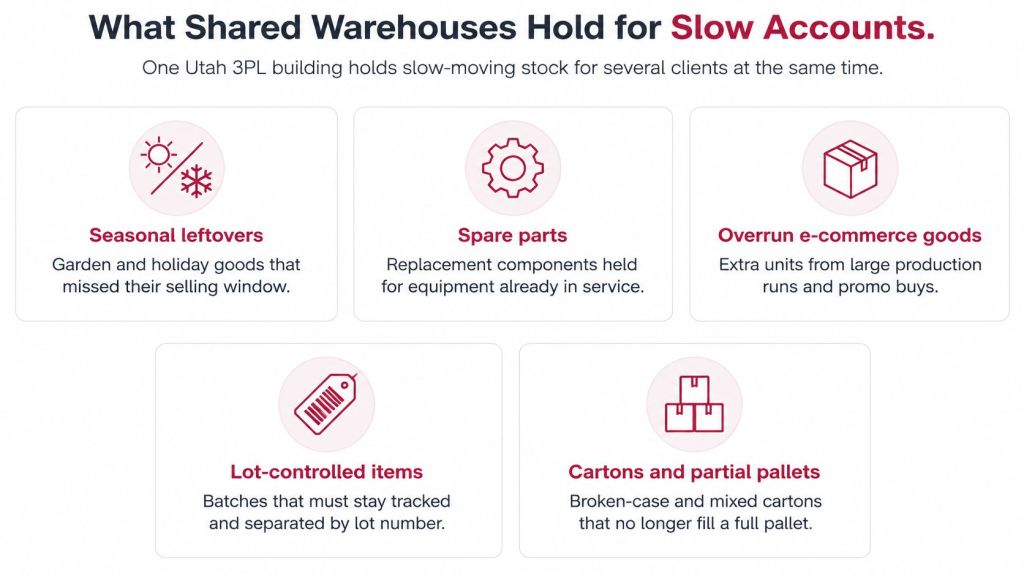
Full pallets, cases, and eaches need different homes. A pallet wants a beam. A case wants a shelf. An each wants a bin or a pocket you can scan. Mixing those forms in one deep lane is how pickers open the wrong client's freight.
The 2002 U.S. Economic Census recorded 64 warehousing and storage establishments in Utah, including 38 classified as general warehousing and storage, and those businesses employed 2,057 people. That is old, statewide context, not a count of today's 3PL sites. It still shows that general-purpose space has long held goods that do not earn a premium face. Carrying costs can be a meaningful share of inventory value, and the share changes by product and operating model. Slow stock still uses labor, insurance, security, and a location when orders are rare.
What should not sit in a deep lane
Dated goods need a face you can reach before the date passes.
Regulated or high-value goods need a controlled spot, not an unlabeled tunnel of mixed pallets.
Odd shapes jam a standard beam. A client who stores exchange cylinders should review propane cylinder storage racks so those units are not forced into a general bay.
Material Handling USA works with 3PLs, aerospace, automotive, data centers, healthcare, laboratories, manufacturing, government, military, and warehouses. The intake should describe the operation, not a catalog item. A WMS-integrated warehouse design starts from order data, so the layout follows how the building picks. That matters for slow accounts because the cheapest cube can still create the most touches.
What to collect per client
- SKU count and units on hand: How many items, and how much of each.
- Pallet and carton size, plus weight: The actual load, not a catalog guess.
- Days since last pick: The clock that marks a slow mover.
- Lot or date rules: What must stay separated.
- Contract lead time: The promise a deeper slot still has to meet.
That profile separates low-velocity pallets from stock that only looks slow because the pick data is messy. It also gives the layout team enough detail to assign a beam level, shelf, bin, or controlled room without promising service the building cannot support.
Cube Days Rent and Retrieval Cost
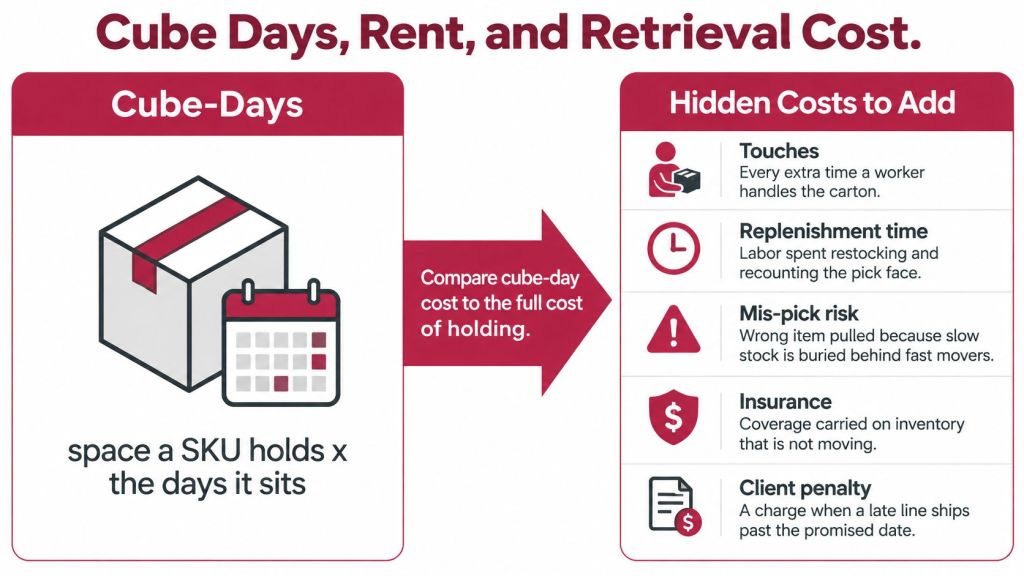
Cube-days equal the space a SKU holds times the days it sits. Add touches, replenishment time, mis-pick risk, insurance, and any client penalty for a late line. Compare that total with the rent you save by leaving a forward face.
Recent Salt Lake City industrial market figures show 10,000 to 100,000 square foot properties at approximately 1.5% vacancy and $1.14 per square foot per month, while buildings above 100,000 square feet show 5.6% vacancy and $0.85 per square foot. In Utah County, industrial asking rent was reported at $1.02 per square foot per month in Q1 2026. These are market context, not a quote for your building. Cheap overflow is not a safe assumption, and a slow SKU does not automatically deserve the cheapest treatment.
When dense storage loses
Dense reserve can lower rent per unit and still raise travel and errors. Keeping a slow mover near dispatch can be the rational call when the item is high value, regulated, seasonal, or prone to a sudden spike.
Deeper storage wins only when retrieval time still meets the client lead time. If it does not, you moved the bill from rent to labor and service failures.
What to log and what to measure
For 30 days, log four things.
- Picks per labor hour: Whether the new home slowed the pickers.
- Cubic use of the reserve zone: Whether the cube you freed is real.
- Replenishment trips: How often someone still walks or drives to that SKU.
- Days since last movement: Whether the SKU stayed slow.
I would review volatile e-commerce accounts every month and stable industrial accounts every quarter. Before you commit the move, measure clear height, beam elevations, the column grid, the aisle width the lift needs, pallet overhang, and the path into the reserve zone. A high-density storage design only pays when that path still hits the promise.
Utah Permits Seismic Design and Safe Loads
Reserve height is a space choice and a compliance choice. Moving slow pallets up can free floor area and still trigger a permit, anchorage, a load rating, aisle clearance, and paperwork. Treat those items as part of the storage decision, because a cheap vertical move can become an expensive service problem if beam levels, access, or load ratings do not match the SKU profile.
| Trigger | What to plan for |
|---|---|
| Rack above 5 feet 9 inches in Salt Lake City | Building permit plus structural plans and calculations stamped by a Utah-licensed engineer |
| Seismic design of the rack | Design to the ASCE 7 edition adopted by the local code, using the actual site category |
| Rack at least 8 feet in Seismic Design Category D, E, or F | Extra compliance documents; steel rack design references ANSI/MH 16.1 |
| Before fabrication | Pallet weights, load position, height, beam levels, forklift impact, slab, and site category |
| After go-live | No ad hoc beam moves; inspect damage; record SKU and weight by location |
Salt Lake City guidance uses a 5 feet 9 inches rack threshold for a building permit, with plans and calculations stamped by a Utah-licensed structural engineer. Seismic design should follow the ASCE 7 edition adopted by the local code, based on the site category, not a statewide guess. The Utah IBC 2021 steel chapter also reflects steel-rack design language tied to ANSI/MH 16.1, and Utah provisions call for added compliance documents when rack is at least 8 feet high in Seismic Design Categories D, E, or F. Confirm the rules with the local building official and the project engineer before the layout is frozen.
Inputs the engineer needs
Supply actual pallet weights, how the load sits on the pallet, rack height, beam elevations, forklift impact exposure, slab condition, and the site seismic category. Slow-moving inventory still needs honest weights. A light outer carton can hide a dense case pack, and one overweight pallet can turn a reserve rack into a liability.
Ridg-U-Rak pallet rack with a seismic base is one path when the base and the stamp have to match the site, not a generic frame. That matters in 3PL space, where one building may hold client goods with very different weights, packaging, and retrieval promises. I would rather pay for a clean rack package up front than rebuild a bay after inspection, damage, or a client weight change.
Rated storage matters for more than pallets. The Florida Lift Gas propane rack guide is a useful reminder that cylinders belong on purpose-built racks, not on a beam someone raised in the field. The same discipline applies to slow reserve: use equipment designed for the load, keep the allowance visible, and do not assume a labeled bay is the same thing as an approved rack.
After the rack is in
Put heavy or unstable loads in lower, labeled positions. Do not change beam levels on the floor. Inspect uprights and anchors after an impact. Keep a location record that ties each SKU and pallet weight to the approved layout.
New clients change weights, and slow accounts can change packaging without warning. Without a new review, the live load drifts away from the stamp. That is when the storage plan starts saving rent on paper while adding risk, rework, and retrieval delays on the floor.
Installation Lead Time and Service After Delivery
Put the work on a calendar before peak receipts. Lead time depends on design, engineering, and the manufacturer, so the quote has to state it. Some common sizes are stocked at select manufacturers, subject to confirmation.
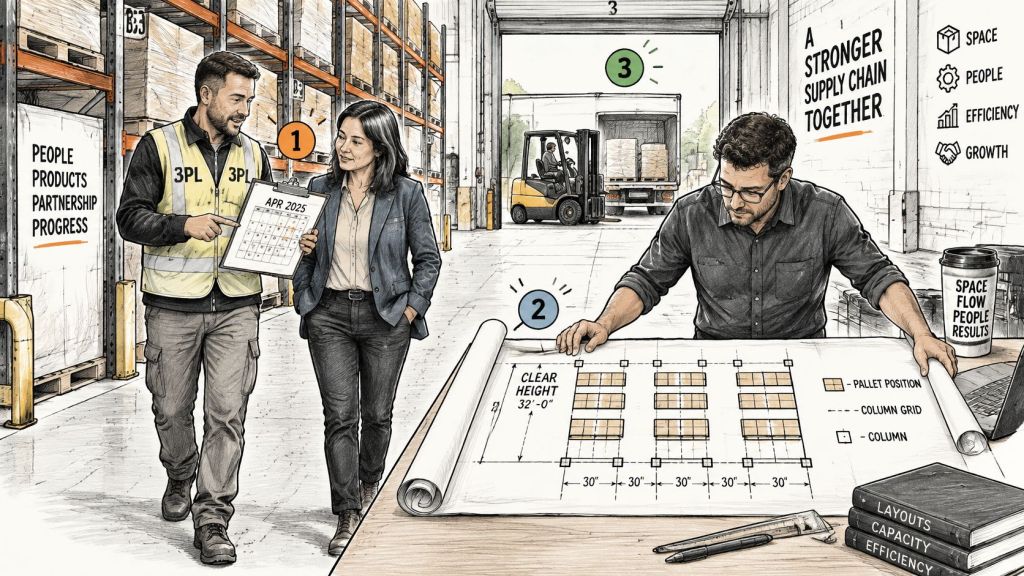
- Share clear height, the column grid, slab notes, SKU and pallet data, and the client lead-time promise. We start from what you store, what you must secure, and any space or timing limit.
- Review a no-obligation layout that keeps fast pick faces apart from slow reserve. We scope full facility work, including warehouse design, pallet rack layout and permitting, mezzanines, in-plant offices, and specialized rooms, and we also handle a single product order.
- Freeze beam elevations and weights so the seismic package matches the rack you will install.
- Confirm freight, delivery, and install. We coordinate freight, delivery, and installation so the order arrives ready to use.
- Label locations and load the slot file before inventory moves. An unlabeled reserve bay is where the wrong client's pallet lands.
Designed rack and lifts belong in a quote, not a blind cart. Contact Us for that layout. Starting the drawing before peak receipts protects planning time, so fast freight does not land in unfinished reserve.
Buyer Scenarios and Slow SKU FAQs
You have three choices for slow stock. Keep it in the primary building, move it to a lower-cost satellite, or return it to the client. The right choice weighs transfer cost, the promised lead time, inventory value, and the chance demand comes back.
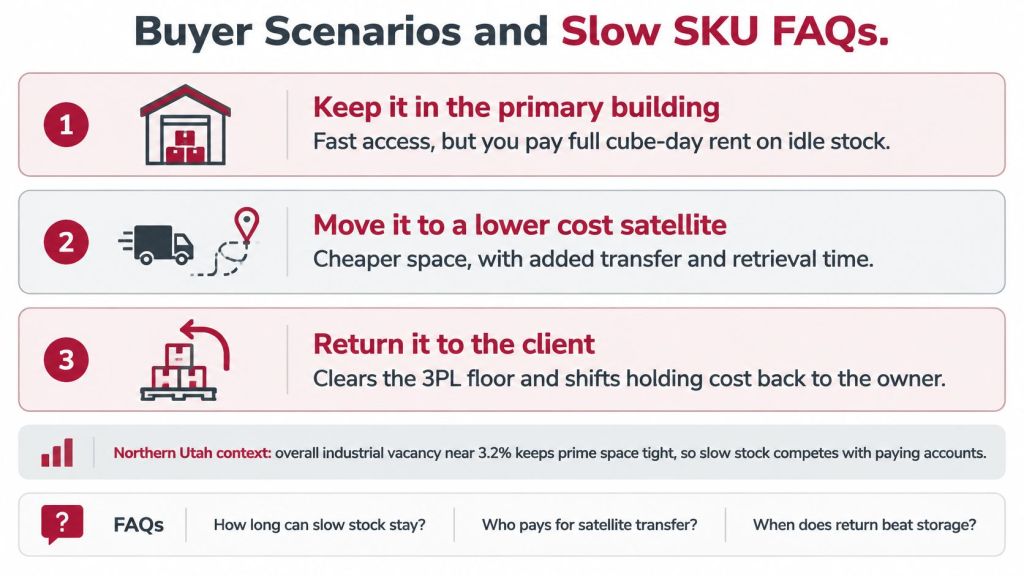
Northern Utah industrial reporting put overall industrial vacancy at 3.2% in Q2 2026, with warehouse and distribution vacancy at 3.5%. The same reporting shows a split between available large-box space and stronger demand for small and mid-size buildings. That is not a promise of cheap overflow. Slow stock still competes with a new account.
Four cases
A Salt Lake County 3PL under 100,000 square feet with many e-commerce SKUs should keep fast faces clear, use shelving or a lift for small slow parts, and review slots every month.
A larger building with a few slow industrial pallets can use upper selective reserve when the weights match the stamp.
One client's idle pallets that block a new account should carry an aging storage price, a review date, and a transfer-cost check against the promised order time.
Dated, regulated, or high-value goods stay accessible and controlled. Density is the wrong win if you cannot reach the lot.
Contract topics to discuss
These are discussion points, not legal advice.
- Minimum monthly storage charge: So idle cube is not free.
- Aging fee: So long-sitting stock pays for the location it holds.
- Return or liquidation date: So obsolete goods have an end.
- Forecast accuracy: So a surprise receipt is not your only plan.
- Notice before a move: So a re-slot or a satellite transfer is not a surprise.
- Who owns the inventory data: So disposition is clear when the SKU dies.
Questions buyers ask
How do you bill a slow SKU? Bill the cube it holds and the days it sits, then add special handling. A flat pallet rate hides a SKU that has not moved in months.
Who pays a transfer? The client whose stock moves, unless your agreement already bought that flexibility. Price the truck, the unload, and the longer pick before you promise the same lead time.
What do you do with obsolete stock? Set a review date, then return, liquidate, or dispose under the client's written choice. Do not let dead goods keep a location by default.
What notice does a client get before re-slotting? State the notice in the agreement. A short written notice is enough for a move inside the building. A satellite move needs more time because the lead time changes.
How do you handle lot-controlled or dated stock? Keep the lot identity on the location, do not mix lots in one deep lane, and keep dated goods where a picker can reach them before the date.
What belongs in a location record? SKU, client, quantity, pallet weight, lot or date, and the approved beam or shelf. That record is what you check after an impact or a new account.
Request a Layout Review Before Peak Receipts
Slow moving SKU storage for Utah 3PL warehouses works when each SKU is classed by movement, matched to a configuration, checked against cube-days and the client lead time, and designed to the site seismic inputs.
An earlier layout leaves time for engineering, permitting, and a cleaner install before receipts pile up. Buildings planned early avoid a season spent working around unlabeled reserve. Some common sizes are stocked at select manufacturers, subject to confirmation.
Request a Quote for a free layout with no obligation, or Contact Us. You can also call (800) 326-4403 or email Sales@MH-USA.com. The first step is to share dimensions, what you are storing, and the goal. Our office is at 222 S. Main St., 5th Floor, Salt Lake City, UT 84101, and we serve customers nationwide from Utah. For local help, see Utah slow-SKU layout help.
Material Handling USA designs warehouse storage around how a Utah 3PL holds slow SKUs, from selective rack and shelving to lifts and a full layout with permitting support. Share your dimensions, your inventory, and your lead-time goal, and we will turn that into a practical quote with no obligation. Visit Material Handling USA or call (800) 326-4403 to start the layout review.